 English
  German
  Spanish
  Portuguese
  French
  Japanese
  Arabic
  Korean
  Vietnamese
  Russian
 # Bolt vs Screw: The Complete Difference Guide for Engineers and DIYers (2026)

A bolt pairs with a nut and is tightened by torquing the nut; a screw drives directly into material and is torqued at its own head — the core difference is how each transfers load.
Walk into any hardware store and you’ll find bolts and screws on shelves only feet apart. The packaging looks similar. The threading looks similar. Even experienced builders sometimes grab the wrong fastener — and in structural or safety-critical applications, that mistake costs time, money, and sometimes structural integrity. Understanding the difference between bolt and screw isn’t just academic: it determines whether your joint holds under vibration, whether you can disassemble and reassemble cleanly, and whether your assembly meets industry specifications.
This guide covers everything you need — engineering definitions, types, material grades, strength comparisons, industry applications, and a plain-English decision framework — so you pick the right fastener the first time.
What Is the Difference Between a Bolt and a Screw?
A bolt is a fastener that relies on a mating nut (or pre-tapped hole) to clamp two or more materials together; torque is applied at the nut end. A screw is a fastener that drives directly into a substrate — whether wood, metal, plastic, or concrete — and is torqued at its own head.
That one-sentence distinction ripples through every aspect of how these fasteners perform: installation method, clamp load distribution, removability, and load transfer.
The Engineering Definition
According to the ASME B18 fastener standards, the technical definition hinges on how the fastener is tightened:
- Bolt: a fastener with a head on one end, threaded shank, and designed to be assembled with a nut. Tightening is done by rotating the nut, not the bolt head.
- Screw: a fastener that is tightened by rotating its own head. It may thread into a tapped hole, a pre-formed hole, or create its own thread in the substrate.
In practice, the line blurs. A hex bolt used in a tapped hole — tightened by rotating its own head — technically behaves like a screw by this definition. Engineers sometimes joke that “a bolt becomes a screw the moment you remove the nut.” That pragmatic view is why the terms get conflated, but for specification, sourcing, and load calculations the formal distinction matters.
How Standards Define Bolts vs Screws
The International Organization for Standardization (ISO) and ASME both codify fastener types with specific dimensional standards. ISO metric bolts follow the M-series (M6, M8, M10, etc.) and screw thread standards follow ISO 68-1. Understanding which standard governs your fastener ensures interoperability — especially critical in manufacturing environments where bolts and screws from different suppliers must assemble consistently.
TABLE 1: Bolt vs Screw — Side-by-Side Comparison
| Feature | Bolt | Screw |
|---|---|---|
| Tightening method | Nut or paired component | Own head rotation |
| Thread coverage | Partial or full | Almost always full |
| Substrate requirement | Through-hole or pre-tapped hole | Substrate material (wood, metal, plastic) |
| Removal/reuse | High — nut can be replaced | Moderate — substrate thread can strip |
| Load transfer | Tension via nut clamp | Tension + some shear via substrate engagement |
| Typical head styles | Hex, flange, carriage | Pan, flat, round, hex, Phillips |
| Standards | ASME B18.2.1, ISO 4014/4017 | ASME B18.6, ISO 1207 |
| Primary applications | Structural, mechanical assemblies | Wood, sheet metal, plastic, light fabrication |
Types of Bolts — A Complete Overview
The difference between bolt and screw becomes clearer when you see how many bolt variants exist, each engineered for a specific load condition or installation environment.
Hex Bolts and Carriage Bolts
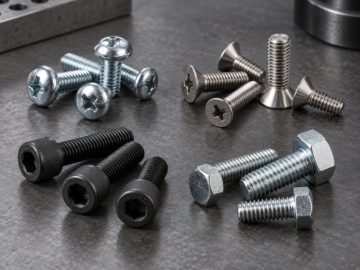
Hex bolts (also called hex cap screws) are the most common bolt type in industrial and construction applications. They have a six-sided head for wrench engagement, a partially threaded shank, and are used with a hex nut or in tapped holes. The partial thread (unthreaded shank below the head) resists shear loads better than a fully threaded fastener — a critical advantage in structural steel connections.
Carriage bolts take a different approach to installation security. Their domed, smooth head sits flush on the outer surface, while a square shoulder just below the head bites into the surrounding material and prevents rotation during nut tightening. This makes carriage bolts ideal for wood-to-wood and wood-to-metal connections where you cannot access the bolt head side once assembled — deck construction, trailer frames, and playground equipment are classic applications.
Anchor Bolts and Flange Bolts
Anchor bolts embed into concrete or masonry, providing a threaded protrusion to which structural elements (columns, sill plates, machinery bases) can be fastened. There are L-shaped anchor bolts (cast into wet concrete), expansion anchor bolts (installed into cured concrete by drilling), and chemical/epoxy anchor bolts for the highest load capacities. In production environments, machinery anchor bolts must be torqued to precise specifications to prevent micro-movement that causes vibration fatigue.
Flange bolts add a built-in, serrated washer face (the flange) to the bolt head. The serrations bite into the mating surface, creating both a locking action and a larger bearing area that distributes clamp load. You see flange bolts heavily used in automotive exhaust systems, plumbing flanges, and anywhere vibration would loosen standard bolt-and-washer assemblies.
Eye Bolts, U-Bolts, and Specialty Bolts
Eye bolts have a looped head for attaching rigging, cables, or lifting hooks. Their rated working load is stamped on the shank or provided in documentation — always verify this rating before any lifting application. U-bolts wrap around pipes, conduit, or round bar to clamp it against a flat surface; they’re specified by pipe diameter and are the standard fastener for pipe supports in HVAC and plumbing.
TABLE 2: Bolt Types and Their Best-Fit Applications
| Bolt Type | Thread | Head Style | Primary Application | Key Spec |
|---|---|---|---|---|
| Hex bolt | Partial | Hex | Structural, machinery | ASME B18.2.1 Grade 5/8 |
| Carriage bolt | Full | Domed + square neck | Wood connections, decking | ASME B18.5 |
| Flange bolt | Partial | Hex + serrated flange | Automotive, vibration environments | ISO 1665 |
| Anchor bolt | Partial | L-bend / hooked | Concrete embedment | ASTM F1554 |
| Eye bolt | Full | Ring/loop | Lifting, rigging | WLL stamped on shank |
| U-bolt | Full | U-shape | Pipe clamping, round section | Specified by pipe OD |
| Shoulder bolt | Partial | Hex | Pivot points, jig components | Precision ground shank |

Types of Screws — Everything You Need to Know
Screws outnumber bolts in terms of variety because they must interface with an enormous range of substrates — from softwood to hardened steel, from ABS plastic to gypsum board.
Machine Screws vs Wood Screws
Machine screws are fully threaded with uniform thread pitch, designed to thread into tapped metal holes or assemble with a nut. They differ from bolts in that they are sized in smaller diameters (typically #0 through #12 in imperial, or M1.6–M8 metric) and are torqued at the head. Machine screws appear everywhere in electronics, appliances, and precision instruments. When you’re tightening the cover plate on an electrical panel or reassembling a laptop, those are machine screws.
Wood screws have a tapered, gimlet point that self-starts in wood without pre-drilling (though pilot holes are recommended to prevent splitting). The thread form is coarser and deeper than machine screws, designed to grip wood fibers rather than mate with a machined thread. Modern production wood screws — including many manufactured for high-volume assembly — use a type 17 notched point for even faster drive and reduced splitting tendency.
Self-Tapping and Sheet Metal Screws
Self-tapping screws form or cut their own thread as they’re driven. There are two sub-types:
- Thread-forming (plastic/soft metal): displace material rather than cut it, creating a thread without swarf. Common in thermoplastics, aluminum, and die-cast zinc.
- Thread-cutting (harder materials): cut a thread with fluted or slotted tips, removing material like a tap. Used in steel, cast iron, and harder substrates.
Sheet metal screws are a specific self-tapping design with a sharp point and fully threaded shank. They’re the go-to for attaching thin metal panels, ductwork, and light-gauge steel framing. One underappreciated rule: sheet metal screws should not be used where the joint will be repeatedly assembled and disassembled — each removal degrades the formed thread.
Production Screws for Manufacturing
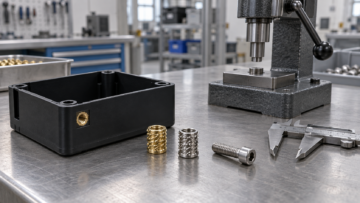
In high-volume manufacturing, production screws are engineered for automated assembly — consistent head geometry for powered drivers, tight dimensional tolerances to prevent jamming in feeders, and surface finishes (zinc plating, Dacromet, black oxide) that meet corrosion specifications. According to data from Fastener Technology International, production environments running automated assembly see a 15–25% cycle time reduction when switching from standard commercial screws to production-grade fasteners with tighter tolerances and consistent drive geometry.
Key production screw specifications to look for:
- Drive recess depth tolerance ± 0.05 mm for reliable automated bit engagement
- Head height variation under 0.1 mm to prevent jams in vibratory bowl feeders
- Coating thickness: ASTM B633 Zinc for 72-hour salt spray, or ASTM B695 for mechanical zinc in high-volume applications
Bolt vs Screw: Strength, Applications, and Selection
Understanding the theoretical difference between bolt and screw is useful; knowing which one to specify for a given load condition is the practical skill.
When to Use a Bolt
Use a bolt when:
- The joint must be disassembled and reassembled repeatedly. Bolts and nuts distribute clamping force across a replaceable nut — threads on the bolt itself are rarely the wear point. Screws that engage substrate material can strip after repeated removal.
- You need to hit a precise clamp load (torque-tension relationship). Bolted joints have well-characterized torque-tension curves. SAE Grade 5 and Grade 8 bolts (and metric 8.8, 10.9, 12.9 equivalents) have published torque tables. This matters in structural engineering, pressure vessel flanges, and automotive applications.
- The application sees significant shear loads. Partially threaded hex bolts have an unthreaded shank portion that acts as a structural shear pin. A Wikipedia article on bolted joints explains that the shear plane location — whether it crosses the threaded or unthreaded portion — significantly affects the bolt’s shear capacity. Proper joint design puts the shear plane in the shank, not the threads.
- You’re connecting structural steel members per AISC specifications.
- Through-hole access is available from both sides.
When to Use a Screw
Use a screw when:
- Access is available from only one side. Self-tapping screws, drywall screws, and wood screws all drive from one side with no nut needed.
- The substrate is wood, plastic, or light-gauge sheet metal. These materials grip screw threads directly — adding a nut would require through-drilling, which weakens thin substrates.
- The assembly is semi-permanent. Screws are faster to install and adequate for joints that won’t be broken repeatedly.
- Weight and space are at a premium. Eliminating the nut saves weight and reduces the clearance zone needed behind the joint — relevant in aerospace and electronics packaging.
- Automated production assembly. Self-tapping production screws are optimized for high-speed robotic or semi-automatic driving with consistent torque shutoff.
Material Grades and Specifications
The material grade of your fastener determines its strength, corrosion resistance, and temperature range. Most confusion around the difference between bolt and screw compounds when people ignore grade — a Grade 2 bolt and a Grade 8 bolt look nearly identical but have vastly different proof loads.

Grade identification (imperial bolts):
- SAE Grade 2 (no marks on head): low-carbon steel, minimum proof strength 55,000 psi. General-purpose, non-structural.
- SAE Grade 5 (3 marks): medium-carbon steel, proof strength 85,000 psi. The most common structural bolt in U.S. construction.
- SAE Grade 8 (6 marks): alloy steel, proof strength 120,000 psi. High-strength applications — drivetrain, suspension, pressure vessels.
Metric bolt property classes:
- Class 8.8: 800 MPa tensile, 640 MPa yield. Rough equivalent to Grade 5. Standard for structural machinery.
- Class 10.9: 1040 MPa tensile, 940 MPa yield. High-strength; requires controlled torquing.
- Class 12.9: 1220 MPa tensile, 1100 MPa yield. The highest standard metric class; often used in precision machinery and motorsport.
TABLE 3: Bolt and Screw Material Grade Comparison
| Grade / Class | Material | Tensile Strength | Typical Application | Identification |
|---|---|---|---|---|
| SAE Grade 2 | Low-carbon steel | 60,000 psi | General use, non-structural | No marks |
| SAE Grade 5 | Medium-carbon | 120,000 psi | Construction, light structural | 3 radial marks |
| SAE Grade 8 | Alloy steel | 150,000 psi | Automotive, heavy machinery | 6 radial marks |
| Metric 8.8 | Carbon steel | 800 MPa | Machinery, equipment | “8.8” stamped |
| Metric 10.9 | Alloy steel | 1040 MPa | High-load assemblies | “10.9” stamped |
| Metric 12.9 | Alloy steel | 1220 MPa | Motorsport, precision machinery | “12.9” stamped |
| Stainless A2 | 304 SS | 700 MPa | Food, marine, outdoor | “A2-70” |
| Stainless A4 | 316 SS | 800 MPa | Marine, chemical | “A4-80” |
As ASTM International’s fastener standards make clear, specifying only “bolt” or “screw” without a grade designation is incomplete engineering — strength, ductility, and corrosion resistance all vary significantly across grades.
Future Trends in Fastener Technology (2026+)
The difference between bolt and screw is becoming more sophisticated as fastener technology evolves. Both categories are being transformed by smart manufacturing, sustainability mandates, and advanced materials.
Smart Fasteners and Torque Monitoring
Instrumented bolts with embedded strain gauges or ultrasonic transducers can transmit real-time clamp load data to monitoring systems. This eliminates the guesswork from torque-tension relationships — instead of inferring clamp load from applied torque (which varies ±25–30% due to friction), you measure clamp load directly. According to a 2024 report from McKinsey & Company on industrial IoT adoption, predictive maintenance using sensor-enabled fasteners has reduced unplanned downtime in heavy machinery by up to 18% in pilot manufacturing environments.
Digital torque traceability is becoming a specification requirement in aerospace and automotive tier-1 suppliers. Every bolt tightening event gets logged with torque value, angle, and timestamp — enabling full traceability from assembly through field service. This is a quality shift that blurs the line between the traditional bolt and the “smart” fastener of Industry 4.0.
Sustainable Materials and Coatings
Environmental pressure is reshaping fastener surface finish specifications. Hexavalent chromium (Cr6+) coatings — long standard for corrosion resistance — are being phased out under EU REACH regulations and are increasingly restricted globally. Replacement coatings include:
- Trivalent chromate (Cr3+): drop-in replacement with similar salt spray performance
- Dacromet / Geomet: zinc-aluminum flake coatings offering 480+ hours of salt spray resistance without hexavalent chrome
- Zinc-nickel: 500–1000 hours salt spray; gaining traction in automotive underbody applications
Titanium and aluminum fasteners — once reserved for aerospace — are working their way into premium bicycle, motorsport, and consumer electronics applications as machining costs fall. Titanium offers a strength-to-weight ratio better than most steel grades with excellent corrosion resistance; its downside is that galling is a real risk without anti-seize compounds.
Frequently Asked Questions
What is the difference between a screw and a bolt?
A bolt relies on a separate nut to clamp components together; a screw threads directly into a substrate and is driven at its own head. In practice: if you’re tightening by turning the nut, it’s a bolt; if you’re turning the head, it’s a screw — even if it looks identical to a bolt.
Is a bolt just a screw?
No. A bolt is designed to work with a paired nut or pre-tapped mating component. Bolts typically have a partially unthreaded shank that improves shear resistance — something screws optimized for substrate penetration don’t need. The terms are colloquially confused, but the engineering difference is significant for load calculations.
Why would you use a bolt over a screw?
Bolts are preferred when: (1) the joint needs to be disassembled and reassembled without degrading the fastener; (2) you need precise torque-tension control; (3) significant shear or structural loads are present; (4) both sides of the joint are accessible. Bolts also allow replacement of the nut alone if threads strip, whereas a screw that strips the substrate thread may require helicoil repair or re-drilling.
What is the difference between Allen screws and bolts?
“Allen” refers to the drive type — a hexagonal internal socket (also called a hex socket or ISTA type) rather than the fastener category. An Allen bolt has a hex socket head and is used with a nut; an Allen screw (socket head cap screw) is tightened by turning its own head. Both use an Allen wrench (hex key) for installation. Socket head cap screws are popular in precision machinery because the recessed drive allows counterboring into tight spaces.
What is bolt vs screw strength in a structural joint?
Grade-for-grade, a bolt is typically stronger in tension (proper preload via nut) and significantly better in shear (unthreaded shank in shear plane). A screw driven into wood or sheet metal derives its pull-out strength from thread engagement depth and substrate material strength. For structural steel connections, only bolts meeting AISC specifications (typically ASTM A325 or A490, metric equivalents 8.8/10.9) are acceptable.
Can I use a screw instead of a bolt?
In non-structural applications — wood framing, sheet metal panels, plastic enclosures — yes, often. In structural, pressure-containing, or safety-critical applications, no. Always check the applicable design standard (AISC for structural steel, ASME Section VIII for pressure vessels, NEC for electrical) before substituting fastener types.
What does “difference between nut and bolt and screw” mean in practice?
A nut is the mating threaded component that pairs with a bolt. A bolt is the externally threaded fastener that passes through a clearance hole and is held by the nut. A screw is the externally threaded fastener that creates or engages threads in the substrate itself. Together, bolt + nut form a complete fastening system; a screw is self-sufficient in its substrate.

Conclusion
The difference between bolt and screw is not merely semantic — it determines load capacity, installation method, reusability, and regulatory compliance. Bolts, paired with nuts, deliver precise, re-torqueable clamp loads suited to structural and mechanical assemblies. Screws, threading directly into their substrate, offer faster installation and one-sided access at the cost of substrate thread longevity.
Use the tables and selection framework in this guide to identify your joint requirements — substrate, load type, assembly frequency, and grade specification — before you order fasteners. In production environments especially, specifying the wrong fastener type doesn’t just slow assembly; it creates quality escapes that surface in the field. For high-volume production screw sourcing, grade-specific technical datasheets, and application engineering support, our team at Production Screws is ready to help you get the specification right the first time.
Related Products
Solutions & Cluster
Related Articles
- Sex Bolt: The Complete Guide to Barrel Nuts, Chicago Screws, and Through-Bolting Fasteners
- Top Silicon Bronze Bolts for Durable and Reliable Fastening Solutions
- How Do You Use a Rivet Gun? Step-by-Step Guide for Clean, Strong Blind Rivets
- What Is a Shear Bolt? Types, Grades, Sizes & Selection Guide
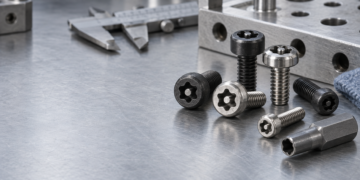
- Security Bits: Complete Guide to Types, Uses, and Choosing the Right Set
- Bolt vs Screw: What’s the Real Difference and When Should You Use Each?
- Plastic Screws: Complete Guide to Types, Materials & Applications
- M2 Screw Dimensions: Complete Size Chart, Head Types & Specs