 English
  German
  Spanish
  Portuguese
  French
  Japanese
  Arabic
  Korean
  Vietnamese
  Russian
 Loose bolts cause more industrial failures than most engineers care to admit. A single loose fastener in an automotive engine can lead to catastrophic failure, costing manufacturers millions in recalls. In construction, a loosened bolt in a steel structure can compromise entire building safety. Lock nuts solve this critical problem by providing reliable resistance against vibration-induced loosening, which standard nuts simply cannot match.
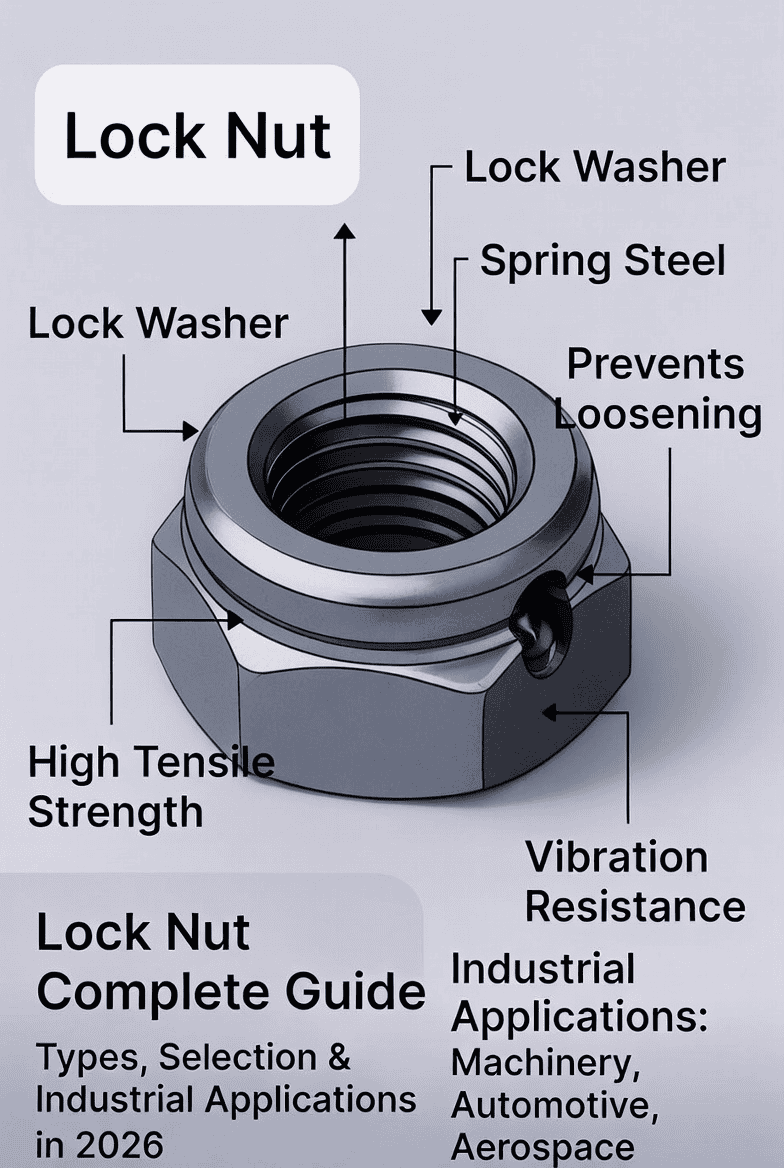
The challenge isn’t just about tightening harder—it’s about maintaining preload force under continuous vibration, thermal cycling, and mechanical stress. We’ve seen countless cases where properly torqued regular nuts still failed within weeks in high-vibration environments. This is where lock nuts become non-negotiable. They employ specialized mechanisms to maintain tension and prevent rotation, making them essential in applications where safety, reliability, and long-term performance matter.
What is a Lock Nut? Understanding the Basics
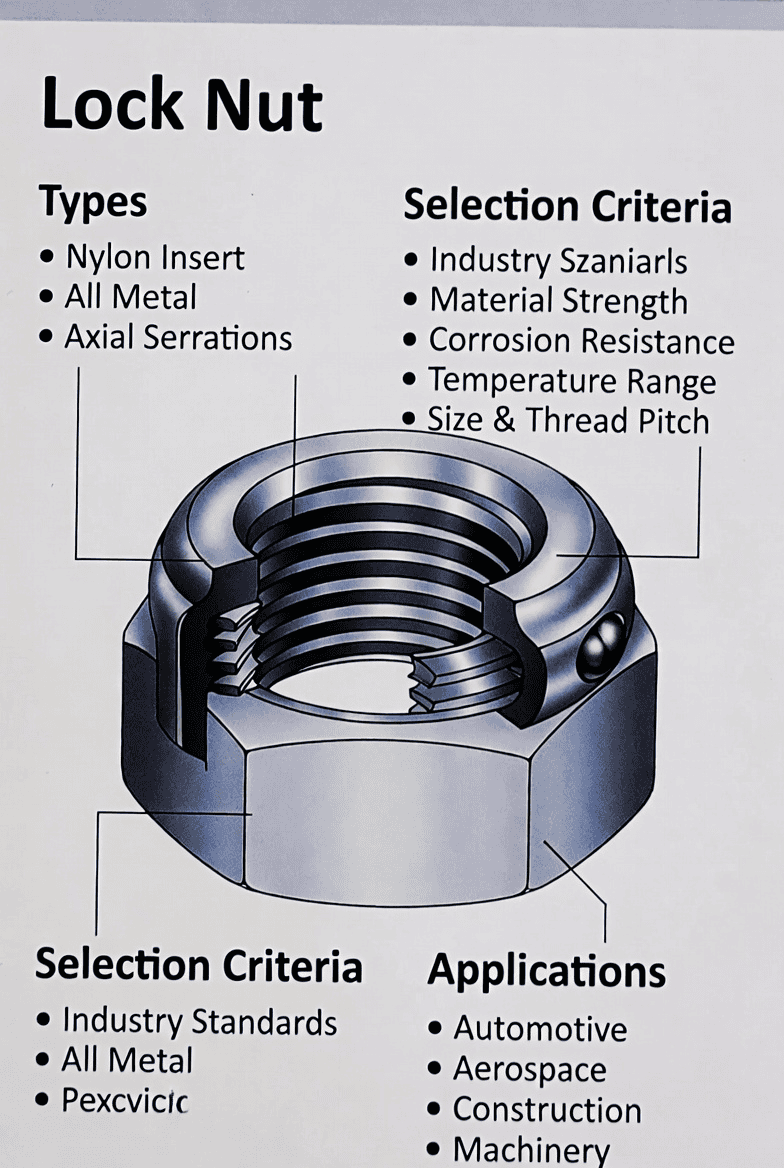
A lock nut (also called a self-locking nut or prevailing torque nut) is a specialized fastener designed to resist loosening under vibration and torque. Unlike regular nuts that rely solely on friction between threads, lock nuts incorporate additional mechanisms that create resistance to rotation even when external forces try to turn them.
The core function of a lock nut is maintaining prevailing torque—the continuous resistance to rotation that keeps the fastener secure. This is achieved through two primary approaches: friction-based locking (using materials like nylon inserts or thread deformation) and mechanical locking (using physical barriers like cotter pins or locking tabs). Standard nuts lose their effectiveness in dynamic environments because vibration gradually overcomes thread friction, but lock nuts counter this with engineered resistance mechanisms.
Three defining characteristics set lock nuts apart:
Self-locking capability: They maintain tension without additional components (in most designs)
Vibration resistance: Specifically engineered to withstand cyclic loading and oscillation
Prevailing torque: Measurable resistance throughout the threading range, typically conforming to standards like ISO 2320
Lock Nut vs Regular Nut: Key Differences
Understanding when to use a lock nut versus a regular nut requires knowing their fundamental differences. The table below clarifies these distinctions across critical performance dimensions.
Table 1: Lock Nut vs Regular Nut Comparison
| Comparison Dimension | Regular Nut | Lock Nut |
|---|---|---|
| Structural Design | Standard thread profile | Modified thread or insert |
| Locking Mechanism | Thread friction only | Friction + mechanical lock |
| Installation Torque | Standard | Higher (prevailing torque) |
| Vibration Resistance | Low to moderate | High |
| Cost | Lower | 20-300% higher |
| Reusability | Unlimited | Limited (varies by type) |
| Suitable Environment | Static loads | Dynamic/vibration loads |
These differences matter significantly in real-world applications. We worked with a manufacturing client who initially used regular nuts on conveyor belt assemblies to save costs. Within three months, they experienced multiple equipment shutdowns due to loosened fasteners. After switching to nylon insert lock nuts, their maintenance calls dropped by 78%, and the slightly higher upfront cost paid for itself within six months.
The key takeaway: lock nuts are not optional in high-vibration environments—they’re a reliability requirement. Use regular nuts for static applications like furniture assembly or light fixtures, but always specify lock nuts for machinery, vehicles, or structural connections subject to movement, vibration, or thermal cycling.
Types of Lock Nuts: Complete Classification
Not all lock nuts are created equal, and selecting the wrong type can be as problematic as using no lock nut at all. The lock nut market offers several distinct categories, each engineered for specific performance requirements and operating conditions. Understanding these variations allows you to match the fastener to your exact application needs rather than settling for a one-size-fits-all approach.
The primary distinction lies in how each type generates its locking action: some rely on deformable materials that create friction, others use metal deformation, and still others employ mechanical interference. However, there’s another critical factor—reusability. Some lock nuts are designed for single-use applications, while others can be removed and reinstalled multiple times without losing effectiveness. We’ve observed that many field failures stem from reusing single-use lock nuts or, conversely, discarding reusable types prematurely, both of which increase costs unnecessarily.
Nylon Insert Lock Nuts (Nylock Nuts)
The most widely recognized lock nut type features a nylon insert (typically a polymer collar) embedded into the upper section of the nut. As the bolt threads through, it cuts into this softer material, creating both compression and friction that resist backing out. This elegant design offers excellent vibration resistance at a relatively low cost, making it the default choice for countless applications.
Working principle: The nylon collar has a smaller diameter than the bolt thread, forcing the bolt to deform the nylon as it passes through. This interference creates continuous radial pressure and friction throughout the threaded engagement.
Key characteristics:
Temperature range: -40°C to 120°C (standard nylon); high-temp variants extend to 200°C
Installation: Requires 30-50% more torque than regular nuts
Reusability: Single-use recommended (nylon deforms permanently)
Advantages:
Low cost and wide availability
Easy installation with standard tools
Excellent vibration resistance for general applications
No risk of over-torquing damage to threads
Disadvantages:
Temperature limitations (nylon degrades above 120°C)
Not suitable for repeated disassembly
Chemical sensitivity (some solvents attack nylon)
UV degradation in outdoor applications
Typical applications: Automotive components (non-engine), consumer electronics enclosures, HVAC equipment, agricultural machinery, general industrial equipment, and home appliances where temperatures stay moderate.
All-Metal Lock Nuts
When temperature, chemicals, or reusability requirements exceed what nylon inserts can handle, all-metal lock nuts provide the solution. These fasteners achieve locking action through thread deformation or distorted thread profiles—the nut itself is manufactured with an intentionally deformed thread section (usually in the top portion) that creates interference with the bolt threads.
The manufacturing process typically involves crimping, elliptical deformation, or conical thread distortion. Unlike nylon inserts, this approach maintains effectiveness across extreme temperature ranges and harsh chemical environments. We’ve deployed all-metal lock nuts in petrochemical facilities where temperatures exceed 300°C and standard nylon inserts would fail within hours.
Performance characteristics:
Temperature range: -200°C to 600°C (depending on material)
Reusability: 5-15 cycles (varies by design and torque specifications)
Cost: 2-3× higher than nylon insert types
These lock nuts excel in aerospace, high-temperature industrial processes, chemical processing equipment, and automotive engine applications. The trade-off is higher cost and slightly more complex installation—over-torquing can damage the deformed thread section, reducing effectiveness.
Serrated Flange Lock Nuts
Combining a built-in washer (flange) with serrated teeth on the bearing surface, this design prevents rotation through multiple mechanisms simultaneously. The serrations bite into the mating surface, creating mechanical interference, while the enlarged flange distributes clamping load over a greater area, reducing surface pressure and preventing embedment.
This dual-action approach makes serrated flange lock nuts particularly effective on softer materials (aluminum, plastic, composite panels) where standard nuts might pull through or indent the surface. The flange eliminates the need for a separate washer, streamlining assembly in high-volume manufacturing.
Best suited for: Automotive body panels, electrical equipment housings, sheet metal assemblies, and applications requiring vibration resistance with surface protection. We recommend these for any application where the mating surface is softer than steel or where washer omission would simplify assembly.
Castellated Nuts (Castle Nuts)
Taking a completely different approach, castellated nuts feature radial slots cut into the top, resembling castle battlements. A cotter pin passes through these slots and a drilled hole in the bolt, creating a positive mechanical lock that prevents rotation entirely. This isn’t friction-based locking—it’s physical prevention of unscrewing.
The advantage is absolute security: the nut cannot loosen unless the cotter pin fails or is removed. The disadvantage is complexity: installation requires aligning the slots with the bolt hole and inserting the pin, making it slower than friction-based lock nuts. However, in safety-critical aerospace applications, aircraft landing gear, automotive ball joints, and heavy equipment steering linkages, this extra installation time is worthwhile for the certainty of locking performance.
Castellated nuts require precise torque control—you must torque to specification, then advance (never back off) to the nearest slot alignment. This requirement means they’re not suitable for applications requiring specific torque values that might not align with slot positions.
Jam Nuts & Two-Way Lock Nuts
The simplest locking approach uses two nuts tightened against each other—the jam nut (thinner nut) is tightened first, followed by the main nut tightened against it. The opposing thread friction created when they’re torqued against each other prevents loosening. This method requires no specialized fastener manufacturing, just two standard nuts.
Applications: Adjustable assemblies, threaded rod connections, equipment leveling feet, and situations requiring field-adjustable positioning with subsequent locking. The main limitation is the additional height required for two nuts, which may not be available in space-constrained assemblies.
How Lock Nuts Work: The Science Behind Locking
Understanding the underlying mechanics helps you select appropriate lock nuts and diagnose failures when they occur. All lock nut designs fall into two fundamental categories based on their locking mechanism.
Friction-Based Locking
This approach increases resistance to rotation by raising the friction coefficient between threads or between the nut and bearing surface. Prevailing torque—the force required to turn the nut even without axial clamping—is the defining characteristic. In a standard nut, once you overcome initial thread friction, rotation is relatively easy. Friction-based lock nuts maintain resistance throughout the entire threading range.
Nylon insert lock nuts achieve this through material compression. The nylon deforms elastically and plastically, maintaining constant radial pressure on bolt threads. All-metal lock nuts use thread distortion—the deformed section requires more force to advance, creating consistent resistance. Serrated flange nuts bite into the mating surface, and any rotation attempt must overcome the mechanical interference of the serrations.
Typical prevailing torque values:
Nylon insert lock nuts: 15-30% of installation torque
All-metal lock nuts: 20-40% of installation torque
Torque retention under vibration: 85-95% after 10,000 vibration cycles
Mechanical Locking
Rather than relying on friction, mechanical locking physically prevents rotation through geometric interference. Castellated nuts with cotter pins exemplify this approach—the pin blocks nut rotation regardless of vibration or thread friction. Similarly, lock plates and tab washers (bent to engage both the nut and a fixed surface) create mechanical stops.
The advantage is absolute reliability: mechanical locks don’t degrade from vibration or temperature cycling the way friction can. The disadvantage is complexity—they require additional components and installation steps. In practice, mechanical locking is reserved for applications where failure consequences are severe: aircraft critical fasteners, heavy equipment steering systems, and high-consequence industrial machinery.
Lock Nut Selection Criteria: Choosing the Right One
Selecting the optimal lock nut requires evaluating multiple factors simultaneously. Making the wrong choice doesn’t just risk fastener failure—it can lead to equipment damage, production downtime, or safety incidents. We’ve developed a systematic framework for lock nut selection based on years of field experience and failure analysis.
Operating Environment Considerations
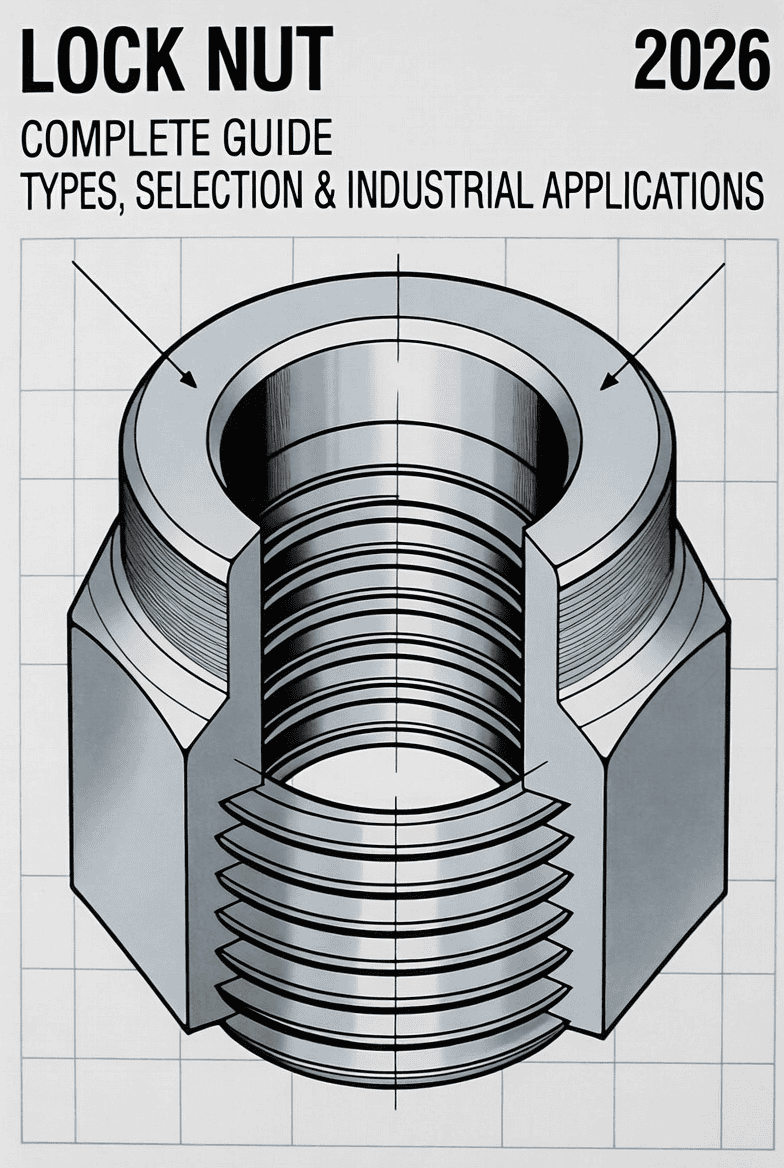
Environmental conditions dictate material compatibility and locking mechanism viability. Three factors dominate this analysis:
Temperature extremes eliminate certain lock nut types immediately:
Below -40°C → Standard nylon inserts become brittle; use all-metal or high-temp polymer inserts
Above 120°C → Standard nylon degrades; transition to all-metal designs
Above 300°C → Requires high-alloy steel or specialty materials (Inconel, stainless steel)
Thermal cycling → All-metal lock nuts handle repeated expansion/contraction better than nylon
Corrosive environments demand material upgrades:
Marine/salt exposure → 316 stainless steel lock nuts with appropriate coating
Chemical processing → Material compatibility analysis required (some chemicals attack even stainless steel)
Outdoor UV exposure → Nylon inserts degrade; use metal-coated designs or all-metal types
Galvanic corrosion risk → Match lock nut material to bolt/substrate to prevent dissimilar metal corrosion
Vibration intensity and frequency determine locking mechanism strength:
High-frequency vibration (engines, compressors) → All-metal or high-quality nylon insert lock nuts
Impact loading (presses, hammers) → All-metal with thread locking compound backup
Continuous mild vibration (conveyor systems) → Standard nylon insert lock nuts sufficient
Intermittent vibration → Evaluate duty cycle; high-duty applications may require all-metal designs
Load Requirements Analysis
Load magnitude and type directly impact lock nut specification. We categorize loads into three bands:
Light loads (< 50 Nm torque): Suitable for nylon insert lock nuts, serrated flange types, or plastic lock nuts. Applications include consumer electronics, light fixtures, and non-structural assemblies. Cost optimization is appropriate here.
Medium loads (50-200 Nm torque): Require standard all-metal or premium nylon insert lock nuts. Typical in automotive non-powertrain applications, HVAC equipment, and general industrial machinery. Material grade becomes important—Grade 5 minimum for steel fasteners.
Heavy loads (> 200 Nm torque): Demand all-metal lock nuts with appropriate grade matching. Structural steel connections, heavy equipment, and high-torque applications fall here. Always specify Grade 8 or higher for steel lock nuts, and consider thread locking compounds as additional security.
Static vs. dynamic loading creates different requirements:
Static loads → Any lock nut type appropriate if environmental conditions permit
Dynamic/cyclic loading → All-metal lock nuts preferred due to superior fatigue resistance
Shock loading → Avoid brittle materials; ductile steel lock nuts with thread locking compound
Material Selection
Lock nut material must match or exceed bolt material grade while considering environmental compatibility:
Carbon steel (zinc-plated): Most economical option for indoor, non-corrosive applications. Grades 5 and 8 available. Temperature range: -40°C to 200°C.
Stainless steel (304/316): Corrosion resistance for outdoor, marine, or chemical exposure. Higher cost but essential for longevity in harsh environments. Note: Lower strength than equivalent-grade carbon steel.
Brass: Non-magnetic, electrically conductive applications. Moderate corrosion resistance. Common in electrical equipment and marine hardware.
Titanium: Aerospace applications requiring maximum strength-to-weight ratio. Excellent corrosion resistance. Cost prohibitive for most applications.
Aluminum: Lightweight applications where load is low. Requires careful galvanic corrosion prevention if mating with dissimilar metals.
Installation & Reusability Requirements
Applications requiring frequent disassembly need reusable lock nut designs:
Maintenance-intensive equipment → All-metal lock nuts rated for multiple reuse cycles (typically 5-15 cycles)
Single-assembly applications → Nylon insert lock nuts acceptable and more economical
Field-adjustable assemblies → Jam nuts or all-metal designs that tolerate repositioning
Automated assembly lines → Serrated flange lock nuts (no separate washer) or designs compatible with power tools and consistent torque application
Application Scenario Matching Table
This quick-reference table maps common applications to recommended lock nut types and key considerations:
Table 2: Lock Nut Selection Quick Reference
| Application Scenario | Recommended Lock Nut Type | Key Considerations |
|---|---|---|
| Automotive Engine | All-metal lock nut | High temp (150-250°C), vibration, oil resistance |
| Structural Steel | All-metal or heavy hex | High torque, outdoor exposure, long-term reliability |
| Aerospace Critical | Castellated + cotter pin | Safety-critical, traceability, certification required |
| Marine Equipment | 316 SS all-metal | Salt corrosion, moisture, temperature variation |
| Electronics Enclosure | Nylon insert lock nut | Low cost, mild vibration, moderate temp |
| Heavy Machinery | All-metal Grade 8 | High torque, shock loads, maintenance cycles |
| High-Temp Process | All-metal (specialty alloy) | 300°C+, chemical exposure, thermal cycling |
| Conveyor Systems | Nylon insert or serrated | Continuous vibration, indoor, cost-effective |
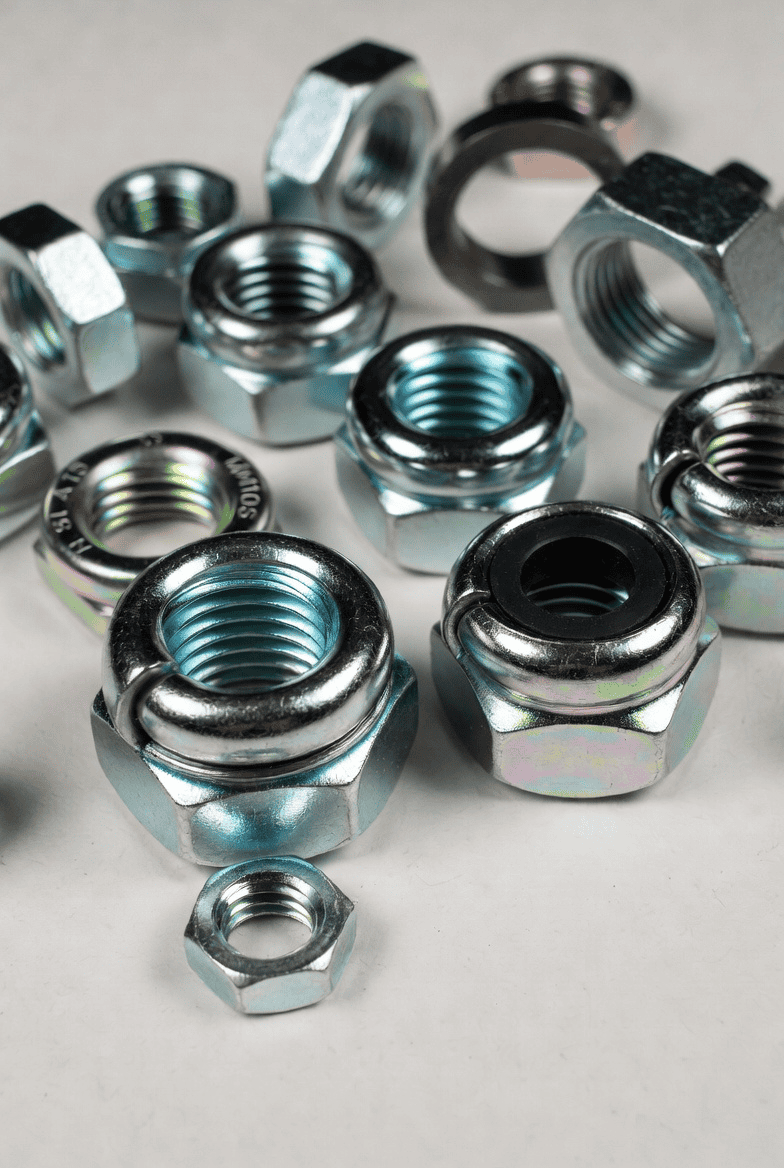
Lock Nut Industrial Applications: Real-World Use Cases
Lock nuts serve critical functions across virtually every industrial sector, but their specific requirements vary dramatically by application. Understanding these real-world use cases helps you anticipate challenges and specify appropriately.
Automotive Industry
Modern vehicles contain hundreds of threaded fasteners, many in high-vibration environments that would cause regular nuts to loosen within hours. Lock nuts are mandatory in powertrain assemblies (engine mounts, transmission cases), suspension systems (control arms, shock absorbers), steering linkages, exhaust systems, and wheel attachments.
The rise of electric vehicles (EVs) introduces new challenges: higher torque outputs from electric motors create more severe vibration profiles, while lightweight construction mandates smaller fasteners that must maintain higher unit stresses. We’ve seen automotive OEMs shift from nylon insert to all-metal lock nuts in EV motor mounts specifically to handle these increased demands. Additionally, aluminum components (common in EVs for weight reduction) require careful lock nut selection to prevent galvanic corrosion and thread galling.
Critical specification: Automotive lock nuts must meet industry standards like ISO 7042 (all-metal prevailing torque nuts) or ISO 10511 (nylon insert prevailing torque nuts), with batch testing to verify prevailing torque consistency. A single defective lock nut in a safety-critical application can trigger million-dollar recalls.
Aerospace & Aviation
No industry scrutinizes fasteners more rigorously than aerospace. A loosened nut in an aircraft structure or control system can cause catastrophic failure, making lock nuts non-negotiable in countless applications. Castellated nuts with cotter pins remain the gold standard for rotating assemblies (landing gear actuators, flight control linkages) because they provide positive mechanical locking with visual inspection capability—you can see if the cotter pin is present and properly installed.
All-metal lock nuts find extensive use in non-rotating structural connections, engine mounts, and interior fittings. However, aerospace specifications go far beyond just the locking mechanism: material traceability, batch certification, and individual part tracking are mandatory. Every lock nut must have documented provenance from certified suppliers, with test certifications showing compliance with specifications like NAS679 (castellated nuts) or MS21042 (all-metal self-locking nuts).
We worked with an aerospace contractor whose initial component approval was delayed by six months solely due to inadequate lock nut documentation—the parts met performance specifications but lacked required material certifications. This illustrates that in aerospace, selection is only half the equation; procurement from qualified sources is equally critical.
Construction & Infrastructure
Steel structures—bridges, high-rise buildings, transmission towers, industrial plants—rely on bolted connections where lock nuts prevent loosening from wind-induced vibration, thermal expansion, and structural loading. The challenge here is longevity: these connections must maintain integrity for 50-100 years with minimal maintenance.
All-metal lock nuts with hot-dip galvanizing are standard for outdoor structural steel, providing both locking function and corrosion protection. Building codes increasingly require lock nuts (or equivalent locking mechanisms like lock washers) for connections subject to vibration or dynamic loads. In seismic zones, building codes mandate positive locking for critical structural connections because earthquake-induced oscillation can loosen standard nuts.
For temporary structures (scaffolding, formwork), reusable all-metal lock nuts reduce costs compared to single-use nylon inserts that must be replaced after each disassembly. However, contractors must track reuse cycles and retire lock nuts once they exceed manufacturer-specified limits—typically visible thread wear or reduced prevailing torque.
Heavy Machinery & Manufacturing
Production equipment, hydraulic presses, CNC machines, material handling systems, and process machinery operate in environments where continuous vibration is the norm. Lock nuts here serve dual purposes: preventing operational failures (which halt production) and ensuring worker safety (loose components can become projectiles or cause pinch points).
We’ve observed that maintenance cost reduction is often the primary driver for lock nut specification in manufacturing. A food processing company we consulted with calculated that each unplanned conveyor shutdown cost $12,000 in lost production. After systematically replacing regular nuts with lock nuts throughout their facility, unplanned downtime decreased by 43%, saving over $200,000 annually—far exceeding the $15,000 investment in upgraded fasteners.
For maintenance-intensive equipment requiring frequent adjustments or component replacement, reusable all-metal lock nuts prove more economical than constantly replacing nylon insert types. Track reuse cycles in maintenance logs to ensure timely replacement before locking effectiveness degrades.
Marine & Offshore Applications
Salt water is extraordinarily corrosive, creating a hostile environment for fasteners. Standard carbon steel lock nuts fail rapidly in marine environments—within months, corrosion can compromise both thread engagement and locking function. 316 stainless steel lock nuts are the minimum specification for marine hardware, with specialty coatings (PTFE, ceramic) sometimes added for extreme service.
The challenge extends beyond just corrosion: marine applications often involve difficult access for maintenance (underwater, offshore platforms, confined spaces), making reliability paramount. We specify mechanical locking (castellated nuts with cotter pins) for critical below-waterline fittings precisely because they provide visual confirmation of locking function during inspections—a critical capability when access is expensive and infrequent.
Offshore oil platforms, ship propulsion systems, marine renewable energy installations, and commercial vessel structures all require specialized lock nut specifications that balance corrosion resistance, strength, and locking performance in dynamic loading conditions (wave action, thermal cycling).
Electronics & Consumer Appliances
High-volume consumer products demand cost-effective fastening solutions, making nylon insert lock nuts the dominant choice. Home appliances, power tools, consumer electronics, and HVAC equipment rarely experience temperature extremes or severe vibration that would necessitate more expensive all-metal designs.
However, the trend toward product miniaturization creates challenges: smaller fasteners mean reduced thread engagement length, which decreases locking effectiveness. We’ve seen manufacturers compensate by specifying higher-quality nylon inserts or adding thread-locking compounds to micro-fasteners (M3 and smaller) where lock nut geometry alone provides insufficient security.
Automated assembly lines favor serrated flange lock nuts because they eliminate separate washer handling, reducing assembly steps and associated labor costs. For products exceeding 100,000 units annually, this assembly time reduction often justifies the 15-20% price premium over standard nylon insert lock nuts.
Installation Best Practices: Maximizing Lock Nut Performance
Even the best-specified lock nut fails if improperly installed. We’ve investigated numerous fastener failures that traced back to installation errors rather than specification problems. Following these practices ensures your lock nuts perform as designed:
Step 1: Surface preparation → Clean mating surfaces of oil, dirt, paint, or corrosion. Contamination reduces friction and clamping force. For critical applications, use solvent cleaning followed by visual inspection.
Step 2: Thread inspection → Examine bolt threads for damage, corrosion, or debris. Run a die over threads if any roughness is detected. Damaged threads prevent proper engagement and reduce lock nut effectiveness.
Step 3: Proper tool selection → Use correct wrench size to prevent nut deformation. Impact wrenches are acceptable for non-critical applications but should be calibrated. Torque wrenches are mandatory for safety-critical or high-load applications.
Step 4: Initial threading → Hand-thread the lock nut at least 3-4 turns before applying tools. If significant resistance is encountered early, stop—this indicates cross-threading or thread damage. Never force a lock nut with power tools from the start.
Step 5: Torque application → Tighten to specified installation torque, not just “tight enough.” Lock nuts require higher torque than regular nuts due to prevailing torque. Consult manufacturer specifications or engineering drawings. Typical installation torque is 20-30% higher than equivalent regular nuts.
Step 6: Verification → After tightening, mark both nut and bolt with paint or marker. This enables visual verification that the fastener hasn’t rotated during service. For critical applications, measure and record final torque or use tension-indicating devices.
⚠️ Critical warnings:
Never reuse single-use lock nuts (nylon insert types)—the nylon deforms permanently during first installation
Never overtorque—excessive torque damages locking features and can strip threads
Never use thread lubricants unless specified—most lock nuts are designed for dry installation; lubricant changes friction coefficients and can lead to overtorquing
Never mix imperial and metric fasteners—even close sizes will cross-thread and fail
We’ve observed that improper torque accounts for approximately 60% of lock nut failures we’ve investigated. Undertorquing leaves inadequate preload (vibration then loosens the fastener), while overtorquing damages the locking mechanism or strips threads entirely. Invest in quality torque wrenches and calibrate them regularly—this single investment prevents the majority of installation-related failures.
Common Lock Nut Problems & Troubleshooting
Even with proper selection and installation, lock nuts sometimes fail. Rapid diagnosis and correction prevent recurring problems and equipment damage.
Table 3: Lock Nut Troubleshooting Guide
| Problem Symptom | Possible Cause | Solution | Prevention |
|---|---|---|---|
| Premature loosening | Insufficient preload, wrong type for vibration level | Verify torque, upgrade to all-metal type | Use torque wrench, match type to application |
| Difficult installation | Cross-threading, contamination, wrong size | Stop, inspect threads, clean/replace | Hand-thread first 3-4 turns, inspect parts |
| Corrosion/seizing | Wrong material for environment | Replace with corrosion-resistant material | Specify stainless steel or coated types |
| Thread damage | Overtorquing, reusing single-use nuts | Replace both nut and bolt | Follow torque specs, don’t reuse nylon insert |
| High-temp failure | Nylon degradation above 120°C | Switch to all-metal design | Check operating temperature before specifying |
| Loss of locking | Exceeding reuse cycles, contamination | Replace nut, inspect bolt | Track reuse cycles, clean threads |
Most frequent issue we encounter: Attempting to reuse nylon insert lock nuts. After initial installation, the nylon collar is permanently deformed to match that specific bolt’s thread profile. Removing and reinstalling deforms it further, creating gaps that eliminate locking function. The nut may feel tight during installation, giving false confidence, but it won’t maintain preload under vibration. Always replace nylon insert lock nuts during disassembly—the cost savings from reuse are illusory and lead to far more expensive failures.
Second most common problem: Using lock nuts without addressing root-cause vibration. Lock nuts mitigate loosening but don’t eliminate vibration. If a fastener repeatedly loosens despite lock nut use, investigate the underlying vibration source—unbalanced rotating equipment, structural resonance, or improper mounting. Adding thread locking compounds or upgrading to mechanical locking may be necessary for extreme vibration environments.
Future Trends in Lock Nut Technology
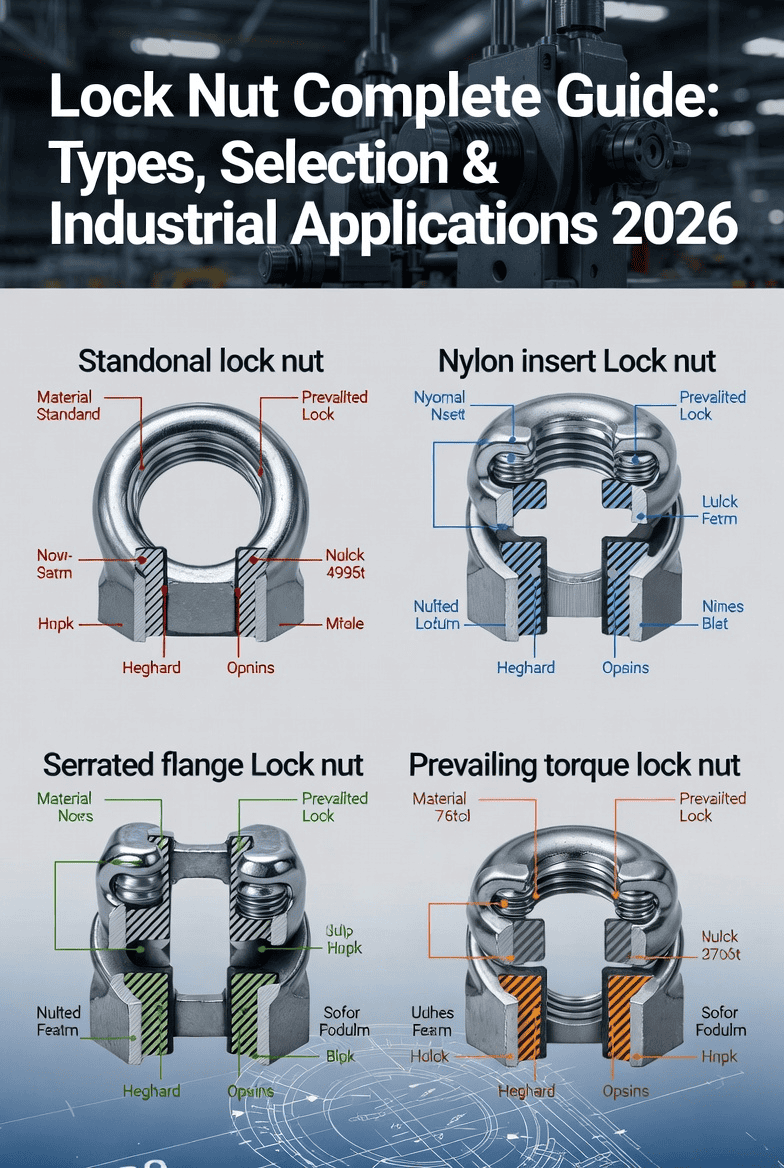
Lock nut technology continues evolving to meet emerging industrial requirements. Based on current research directions and market analysis, several trends will reshape the fastener landscape through 2030.
Lightweight & High-Strength Materials
Automotive and aerospace industries drive relentless demand for weight reduction without compromising strength. Titanium alloy lock nuts are increasingly common in aerospace applications, offering 40% weight savings compared to steel with equivalent strength. Electric vehicle manufacturers are following suit—every kilogram removed extends vehicle range, making premium materials economically justifiable.
Advanced polymer lock nuts using PEEK (polyetheretherketone) and other high-performance thermoplastics compete with metal in specific applications. These materials offer impressive strength-to-weight ratios, corrosion immunity, and electrical insulation properties. We’re seeing adoption in medical devices, electronics, and aerospace interiors where these characteristics outweigh their higher cost (typically 5-10× that of steel lock nuts).
Carbon fiber composite lock nuts remain largely experimental but show promise for ultra-lightweight applications. By 2028-2029, we expect limited commercial availability for specialized aerospace and motorsport applications as manufacturing processes mature and costs decrease.
Smart Lock Nuts with IoT Integration
Industry 4.0 and predictive maintenance create opportunities for “intelligent fasteners.” Prototype sensor-embedded lock nuts already exist, incorporating strain gauges or RFID chips that monitor preload force in real-time. When preload drops below threshold, the fastener wirelessly alerts maintenance systems before failure occurs.
Current implementations focus on critical infrastructure applications—wind turbine blade connections, bridge structural joints, and railway track fasteners—where fastener failure consequences are severe and inspection costs are high. A wind energy operator we consulted with is piloting smart lock nuts on tower flange connections, transmitting preload data to SCADA systems. Early results show 30% reduction in inspection costs and identification of loosening fasteners weeks before they would have caused failures.
Expect broader adoption as sensor costs decrease and standardized communication protocols emerge. By 2027-2028, smart lock nuts may become standard for rotating equipment in factories, enabling condition-based maintenance rather than time-based schedules. The main barrier remains cost—current sensor-equipped lock nuts cost $50-200 each, limiting use to high-value applications.
Sustainable & Eco-Friendly Solutions
Environmental regulations and corporate sustainability goals drive demand for eco-friendly fastener options. Recyclable and recycled-content lock nuts are gaining traction, with some manufacturers now offering lock nuts made from 70-90% recycled steel while meeting full performance specifications.
Bio-based polymer inserts represent an emerging alternative to petroleum-derived nylon. Materials derived from castor oil and other plant sources can match nylon’s performance characteristics while reducing carbon footprint by approximately 40%. Consumer appliance manufacturers are early adopters, responding to corporate sustainability commitments and consumer preferences for eco-friendly products.
Elimination of hazardous coatings is another focus area. Traditional zinc plating involves hexavalent chromium, a carcinogen facing increasing regulatory restrictions. Water-based and mechanical coating alternatives (zinc-nickel, magnesium-based coatings) provide equivalent corrosion protection without toxic substances. By 2026, most major lock nut manufacturers have transitioned away from hexavalent chromium entirely.
Automation-Compatible Designs
Manufacturing automation requires fasteners designed for robotic installation. Lock nuts with features enabling automated handling—chamfered starting threads, non-circular external geometry for positive orientation, and consistent prevailing torque profiles—are becoming standard offerings rather than special-order items.
Assembly line throughput improvements of 15-20% are achievable when fasteners are optimized for automation. This matters enormously in high-volume manufacturing where seconds per unit multiply into hours of production time. We’re seeing automotive suppliers specify automation-compatible lock nuts even at 10-15% price premiums because labor savings and throughput gains justify the cost.
Vision-system-compatible markings (high-contrast logos, QR codes for traceability) facilitate automated quality verification, enabling inline inspection without manual intervention. This trend aligns with zero-defect manufacturing philosophies and Industry 4.0 quality management systems.
Self-Locking Performance Enhancement
Ongoing materials science and manufacturing process innovations continue improving lock nut performance. Next-generation thread deformation techniques using precision cold forming create more consistent prevailing torque profiles with tighter tolerances—±15% instead of the current ±30% typical range.
Hybrid locking mechanisms combining multiple principles (nylon insert plus thread deformation, serrations plus adhesive) are emerging for extreme-vibration applications. These designs target applications like impact tools and demolition equipment where single-mechanism lock nuts occasionally fail despite proper specification.
Research into self-healing locking materials—polymers that reform after deformation—could eventually enable reusable lock nuts with nylon-insert-like performance. While still in laboratory stages, successful development would eliminate the reuse limitations that drive current preferences for all-metal designs in maintenance-intensive applications.
Market Growth & Industry Outlook
The global lock nut market demonstrates steady growth driven by increasing industrialization, infrastructure development, and safety regulation enforcement. Market analysis projects 5.2% CAGR from 2025-2033, with the market reaching approximately $2.8 billion by 2033.
Asia-Pacific dominates growth, accounting for roughly 45% of global demand, driven by manufacturing expansion in China, India, and Southeast Asia. Automotive production growth and infrastructure development projects fuel particular demand for construction-grade and industrial lock nuts in these regions.
North America and Europe represent mature markets with growth concentrated in high-value segments: aerospace, renewable energy, and advanced manufacturing. Replacement and maintenance demand remains strong, while new construction demand grows more slowly than in developing regions.
Specialty lock nuts (high-temperature, corrosion-resistant, smart/sensor-embedded) represent the fastest-growing segment at projected 8-10% annual growth, far exceeding commodity lock nut growth of 3-4%. This reflects ongoing trend toward application-specific optimization rather than generic fastener use.
Conclusion: Making Informed Lock Nut Choices
Lock nuts solve a simple problem—preventing threaded fasteners from loosening—but doing so requires matching the right fastener type to specific application requirements. The core decision framework is straightforward: evaluate operating environment (temperature, corrosion, vibration), load requirements (magnitude and type), maintenance access (reusability needs), and cost constraints.
For most general industrial applications experiencing moderate vibration, nylon insert lock nuts provide excellent performance at reasonable cost. When temperature exceeds 120°C, chemicals threaten nylon, or repeated disassembly is required, transition to all-metal lock nuts. Reserve castellated nuts with cotter pins for safety-critical applications where positive mechanical locking justifies the installation complexity.
We recommend auditing existing fastener specifications to identify applications currently using regular nuts where lock nuts would prevent failures and reduce maintenance costs. The incremental cost of lock nuts—typically $0.10-2.00 per fastener—is trivial compared to downtime costs, repair expenses, or safety incidents resulting from loosened fasteners.
Looking forward, smart lock nuts with integrated monitoring will transform maintenance practices in critical infrastructure and high-value equipment, shifting from reactive repairs to predictive interventions. As these technologies mature and costs decrease, the definition of “critical application” will expand, bringing advanced fastener technology to increasingly common applications. The fundamental physics of threaded fasteners hasn’t changed in centuries, but the materials, manufacturing processes, and monitoring capabilities surrounding them continue advancing, making reliable fastening more achievable across all industrial sectors.