 English
  German
  Spanish
  Portuguese
  French
  Japanese
  Arabic
  Korean
  Vietnamese
  Russian
 When someone first asked us which screws to use for a public restroom fixture, our honest answer was: “It depends on how determined the person trying to remove it might be.” That one sentence captures the entire decision-making process around tamper proof screws.[albanycountyfasteners]
Tamper proof screws — also called security screws, anti-tamper screws, or tamper-resistant fasteners — are designed so that standard screwdrivers and hex keys simply cannot remove them. The drive head is unconventional, modified, or requires a proprietary tool. And once you start looking, you’ll spot them everywhere: public bathroom stalls, subway seats, traffic signs, and the inside panel of your laptop.[aftfasteners]
This guide walks through every major type, how to match them to real-world applications, what the industry actually demands right now, and what the next generation of security fasteners looks like. By the end, you won’t just know what tamper proof screws are — you’ll know exactly which one to specify for your project.
What Makes a Screw “Tamper Proof”?
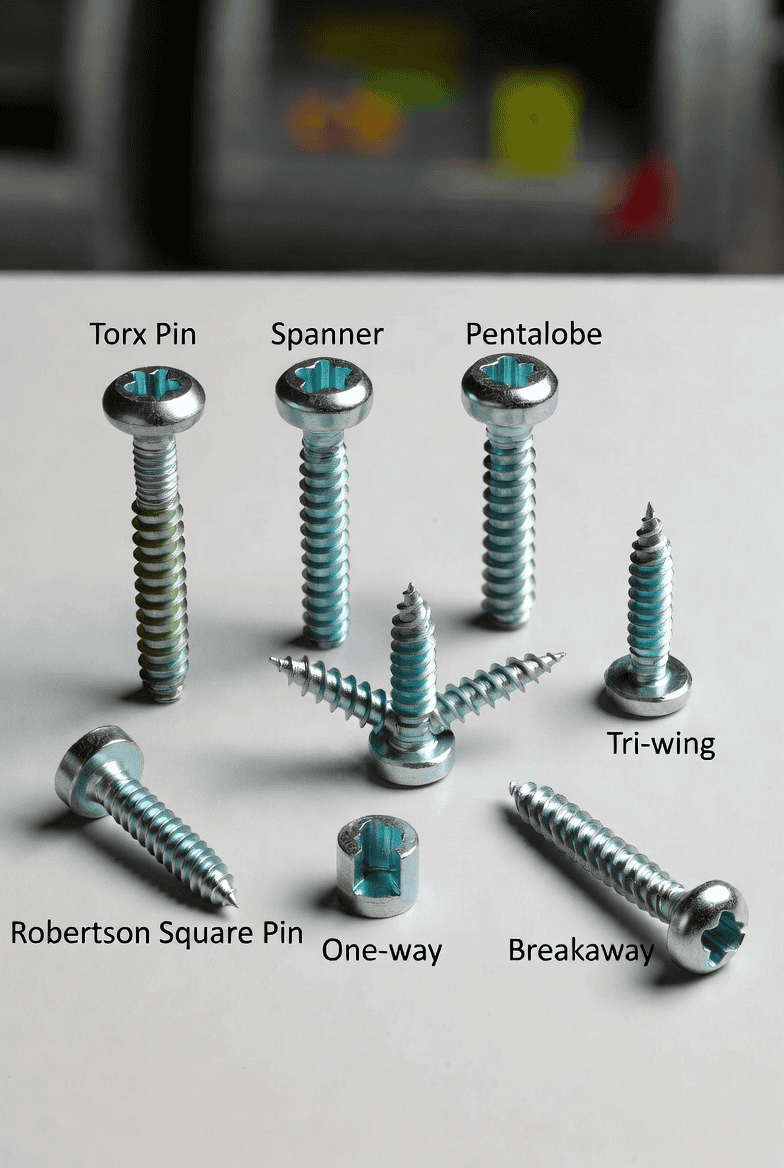
Not all tamper proof screws are created equal, and the terminology itself can be misleading. There is an important distinction:
Tamper-resistant — Harder to remove, but not impossible. Deters casual or opportunistic tampering.
Tamper-proof — Designed to be extremely difficult or practically impossible to remove without the exact proprietary tool.
One-way / permanent — Can be installed but never removed without destructive means.[fastenright]
The level of security you need determines which category to reach for. Installing a one-way screw on a panel that maintenance workers need to access quarterly would be a costly mistake. Using a basic Pin Torx in a correctional facility is equally problematic.[sentinelgrp.com]
The Three Security Levels at a Glance
| Security Level | Typical Drive Type | Removable? | Best Use Case |
|---|---|---|---|
| Standard Security | Pin Torx (Tam-6Lobe), Hex Pin | Yes, with matching bit | Electronics, retail display, low-risk public fixtures |
| High Security | Spanner Head, Tri-Wing, Snake Eyes | Yes, with proprietary tool | Industrial control panels, medical devices, utility meters |
| Permanent / One-Way | Sentinel, Clutch Head, One-Way Slotted | No (destructive removal only) | License plates, public infrastructure, corrections facilities |
brycefastener+2
The most common mistake we see in specifications is choosing a “standard security” screw for an application that clearly needs “high security.” The extra cost per fastener is negligible. The cost of a vandalized or compromised installation is not.
The 8 Primary Types of Tamper Proof Screws
Understanding the drive type is the single most important factor in selecting a tamper proof screw. Here’s a breakdown of every major type, their actual strengths, and where they genuinely perform.[kenenghardware]
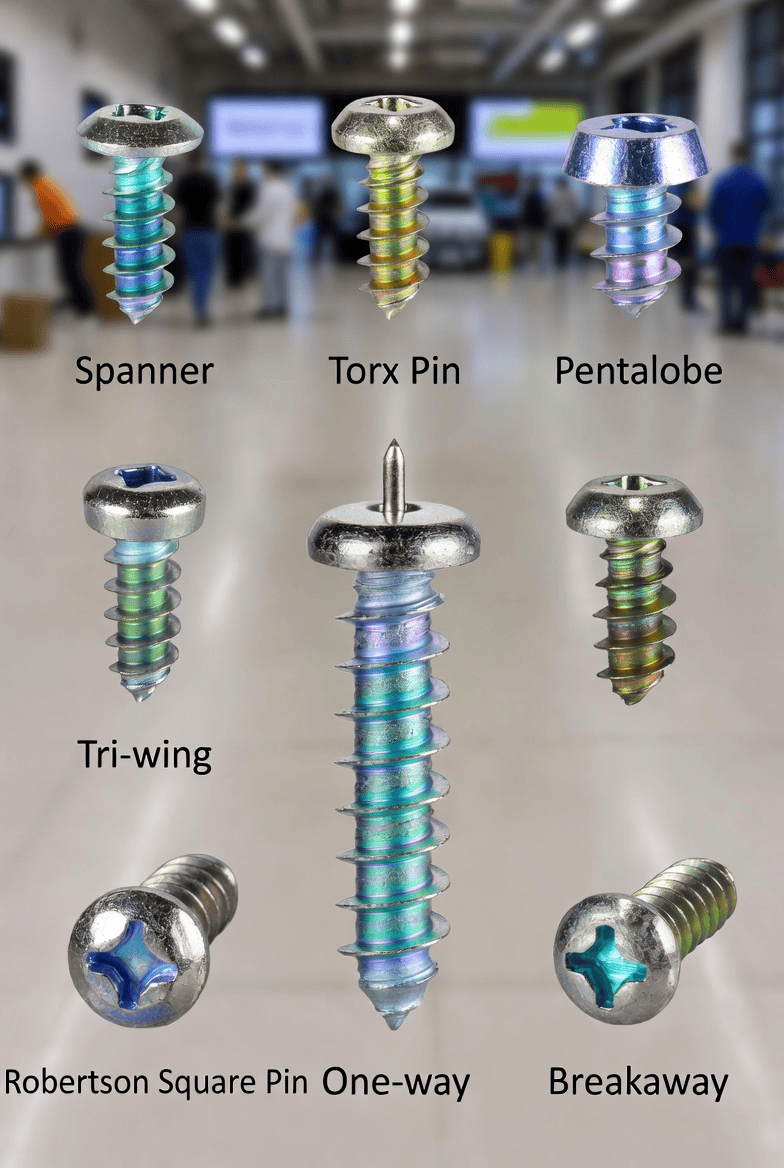
1. Pin Torx (Tam-6Lobe / Security Torx)
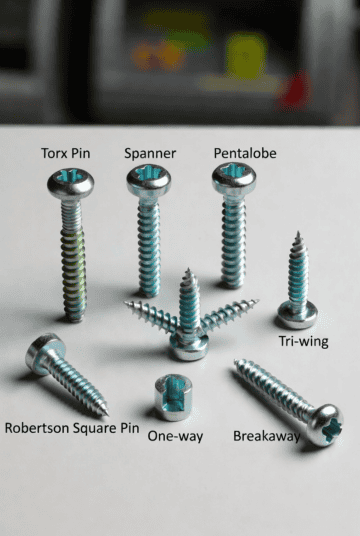
The six-point star head has a hardened center pin that blocks standard Torx drivers from seating. It’s the most widely used tamper-resistant drive in consumer electronics, automotive panels, and general public installations.[insight-security]
Honest limitation: Matching bit tips are commercially available almost everywhere. A determined person who knows what they’re looking at can find the tool. Bryce Fastener explicitly states that Pin Torx screws are “easy to defeat” for this reason, and recommends them only for low-value applications.[brycefastener]
Best for: Electronics assembly, retail fixtures, low-to-medium risk public installations.
2. Hex Pin (Pin Hex)
The classic hex socket with a center pin preventing standard Allen key engagement. It has been used in jail and retail environments for over 60 years. Tight tolerance between bit and screw creates a “stick-fit,” which improves assembly efficiency significantly.[brycefastener]
Best for: Industrial fixtures, control panels, corrections facilities (standard tier), retail anti-theft installations.
3. Spanner Head (Snake Eyes)
Two small circular holes sit opposite each other in the head, requiring a dedicated spanner bit to engage. Unlike Torx variants, there is no standard spanner driver — the matching tool must be specifically sourced.[aftfasteners]
Best for: Security cameras, access panels, enclosures, utility infrastructure.
4. Tri-Wing
Three asymmetrical wings cut into the head require a dedicated tri-wing driver. Common in consumer electronics manufacturing — Apple used versions of these in early products precisely because the bits were hard to find.[kenenghardware]
Best for: Consumer electronics, aerospace components, proprietary device enclosures.
5. One-Way Slotted (Clutch Head / Sentinel)
These install like a normal screw with a flat or pozi driver. The drive geometry is designed so that the driver cams out in reverse — it physically cannot be turned counterclockwise. Once in, it’s in permanently unless you drill it out.[fastenright]
Best for: License plates, outdoor signage, permanent public infrastructure, high-vandalism environments.
6. Opsit Reverse Thread
Rather than a modified drive, this screw has a reversed thread — it tightens counterclockwise and loosens clockwise. Someone attempting to remove it the “normal” way actually drives it deeper. Works best as a secondary security measure combined with a standard drive.[aftfasteners]
Best for: High-vibration environments, secondary theft deterrent on retail displays.
7. Socket Pin Head (Pentalobe / TP3 Triangular)
A newer generation of drive designs offering extremely high engagement precision and minimal cross-section for the pin. The TP3 Triangular drive uses a trilobular geometry requiring a matching specialist tool.[aftfasteners]
Best for: Premium electronics, medical devices, aerospace-grade assemblies where torque precision matters.
8. Phillips Pin Head
A standard Phillips cross with a hardened center pin that prevents engagement of a normal Phillips driver. Easy to install at volume — standard Phillips drivers work for installation, only the tamper-resistant pin blocks removal.[aftfasteners]
Best for: Large-volume assembly operations where installation speed matters and moderate tamper resistance is sufficient.
How to Choose the Right Tamper Proof Screw
This is where most buying decisions go wrong. People search for “tamper proof screws,” find the cheapest Pin Torx in the right size, and call it done. Then they’re surprised when the installation gets compromised within months.
The right selection process follows four questions:
1. Who is the threat?
A curious child or casual opportunist → Standard security (Pin Torx, Hex Pin) is sufficient
A motivated adult with access to hardware stores → High security (Spanner, proprietary drive) is needed
Someone with unlimited time and determination → Permanent fixings or high-security proprietary systems only[brycefastener]
2. Does the assembly need future maintenance access?
Yes, regularly → Avoid one-way screws; choose a proprietary removable drive and keep bits controlled
Rarely or never → One-way or permanent fixings significantly reduce long-term risk[fastenright]
3. What material are you fastening into?
Masonry → Torx Tamper-Resistant UltraCon Masonry Screws with Hi-Lo threads provide superior pullout resistance[resources.tannerbolt]
Metal / sheet metal → Self-drilling or machine thread variants; stainless steel for corrosion resistance[aftfasteners]
Wood / composite → Sheet metal thread in stainless for outdoor applications
4. What environment is the installation in?
| Environment | Recommended Finish | Key Concern |
|---|---|---|
| Indoor, low humidity | Zinc-plated steel | Cost efficiency |
| Outdoor / coastal | 316 stainless steel | Corrosion resistance |
| High UV exposure | Black oxide or hot-dip galvanized | UV and weather degradation |
| Hygiene-critical (food, medical) | Passivated stainless (304 or 316) | Contamination risk |
| High-vibration (automotive) | Nylon-insert locking variant | Vibration loosening |
Industry Applications: Where Tamper Proof Screws Are Actually Used
Tamper proof screws are not a niche product. Once you know what to look for, the scale of their deployment is remarkable.[sentinelgrp.com]
Public Infrastructure & Urban Environments
Streetlights, park benches, bus stop signage, traffic signal control boxes — all rely on tamper proof screws to deter vandalism and prevent theft of copper and electronic components. City maintenance teams have increasingly moved toward proprietary drive systems so that even if a tool is found, it’s unique to their municipality’s supply chain.[kenenghardware]
Electronics & Consumer Technology
Virtually every piece of consumer electronics has some form of tamper-resistant fastener. Manufacturers use them to protect warranty-sealed components, prevent unauthorized modification, and maintain safety certifications. The conversation around right-to-repair legislation has actually increased interest in which security fasteners are used in products — a trend worth watching.[kenenghardware]
Automotive & Aerospace
License plates use one-way screws as a baseline standard in many jurisdictions. Critical fastener positions in both automotive and aerospace applications demand screws that cannot be inadvertently or deliberately backed out. Torque specifications here are precise — the fastener choice must support exact installation torque without stripping.[sentinelgrp.com]
Healthcare & Medical Equipment
Medical device manufacturers require fasteners that prevent unauthorized access to calibrated or drug-delivery components. Stainless steel with passivated finish is standard. The selection process in medical applications also involves sterilization compatibility — the fastener must survive repeated autoclave cycles.[kenenghardware]
Corrections & High-Security Facilities
This is arguably the highest-demand environment for tamper proof screws. Everything — light fixtures, ventilation grilles, toilet fittings, door frames — must be secured against removal, potential use as a weapon, or escape attempt facilitation. Standard Pin Torx is explicitly not recommended here. Proprietary systems with non-commercially-available driver bits are the baseline requirement.[sentinelgrp.com]
Retail & Commercial Display
Anti-theft display fixtures, security camera housings, cash register enclosures, and kiosk panels all use tamper-resistant fasteners. The visual deterrent aspect matters here too — visible security hardware signals that an attempt at unauthorized access will be difficult and time-consuming.[albanycountyfasteners]
Utilities & Energy Infrastructure
Water meters, gas valve housings, electrical distribution panels, and telecommunications enclosures all use tamper proof screws as a front-line defence against unauthorized access and utility theft. Some utility providers go further, using proprietary fastener covers (such as Armour Ring systems) fitted over existing hardware to retrofit security without replacing all existing infrastructure.[sentinelgrp.com]
Material & Finish Reference Table
Getting the material specification right is as important as getting the drive type right. Stainless steel tamper proof screws are the most commonly manufactured, but other options exist for specific applications.[aftfasteners]
| Material | Corrosion Resistance | Strength | Typical Use |
|---|---|---|---|
| 18-8 Stainless Steel (304) | High | Medium-High | General outdoor, marine-adjacent |
| 316 Stainless Steel | Very High | Medium-High | Coastal, chemical environments |
| Brass | Moderate | Medium | Electrical applications, aesthetic fittings |
| Zinc-Plated Carbon Steel | Low-Medium | High | Indoor, budget-sensitive applications |
| Black Oxide Steel | Low | High | Indoor industrial, low-humidity environments |
| Stalgard® Coated Steel | High | High | Masonry applications, outdoor [resources.tannerbolt] |
Future Trends in Tamper Proof Fastener Technology
The tamper proof screw market is not static. Several meaningful developments are reshaping how security fasteners are specified, manufactured, and managed.
Proprietary drive ecosystems are growing. Rather than selecting from a catalogue of standard security drives, more organizations — particularly in utilities, transit, and government infrastructure — are moving to entirely proprietary drive designs where the tool itself is controlled and tracked. This shifts security from “drive design obscurity” to “controlled tool access,” which is a fundamentally stronger model.
Smart and traceable fasteners. Research-level development is underway on fasteners embedded with RFID or micro-engraving to allow installation audit trails. In applications like aerospace and defence, being able to verify that a specific fastener was installed at a specific torque by a specific technician has significant value for maintenance and liability documentation.
Right-to-repair pressure is influencing design. As right-to-repair legislation expands in the US and EU, manufacturers of consumer electronics are being pushed toward drive systems that are secure during warranty periods but not permanently obstructive to repair. This is creating demand for timed or degradable security mechanisms — a nuanced design challenge for fastener engineers.
Corrosion-resistant innovation. With increased infrastructure spending in coastal and high-humidity environments, development of polymer-coated and ceramic-composite security fasteners is accelerating. The goal is tamper resistance plus a 25-to-50-year service life without maintenance in outdoor conditions.
Sustainability and material traceability. Supply chain pressures are driving interest in documented material provenance for security fasteners used in critical infrastructure. Knowing that a stainless steel tamper proof screw used in a water treatment facility was manufactured to verified 316L specifications — not a substituted alloy — is increasingly a procurement requirement, not a nice-to-have.
FAQ
What is the difference between tamper proof and tamper resistant screws?
“Tamper resistant” describes fasteners that are harder to remove — they deter casual tampering but can theoretically be defeated with the right combination of tools and knowledge. “Tamper proof” implies a higher level of security where removal is practically impossible without the exact proprietary driver. In everyday use, the terms are often used interchangeably, but for critical applications, the distinction matters. Always check the manufacturer’s actual security rating rather than relying on marketing language.[fastenright]
Can tamper proof screws be removed if I lose the driver bit?
It depends on the type. For most standard-security and high-security removable tamper proof screws, a replacement driver bit can be sourced from the original supplier — this is one reason to document your fastener specifications at procurement. For one-way or permanent screws, the only removal method is destructive: drilling out the head or using a screw extractor. This is by design. If you regularly need access, do not specify one-way fixings.[fastenright]
Are stainless steel tamper proof screws better?
For most outdoor and public-facing applications, yes. 18-8 stainless steel is the most common material for security screws and provides good corrosion resistance for the majority of environments. For coastal, chemical, or highly corrosive environments, 316 stainless steel is the correct specification. Zinc-plated carbon steel is acceptable for indoor, dry environments where cost is the primary constraint.[aftfasteners]
What tamper proof screws are used in electronics?
Consumer electronics typically use Pin Torx (security Torx), Tri-Wing, and Pentalobe drive screws. The specific type varies by manufacturer and product generation. For anyone performing authorized repair, identifying the exact drive type before starting is essential — attempting to force the wrong driver into a security screw head will damage both.[kenenghardware]
How many tamper proof screws do I need for a secure installation?
This is installation-specific, but a general rule: every fastener that secures a panel or enclosure accessible to unauthorized parties should be a tamper-resistant fastener. Mixing tamper proof screws with standard screws on the same panel creates a weak point — the standard screws will be removed first, providing enough movement to defeat the tamper proof ones.[brycefastener]
Do tamper proof screws meet any industry standards?
Yes. Various national and international standards exist for tamper-resistant fastener applications, particularly in consumer product safety, building and electrical codes, and industrial fastener specifications. Compliance requirements vary by jurisdiction and application — always verify applicable standards for your specific project context.nbk1560+2
Tamper proof screws are a small component with a disproportionately large impact on the security and integrity of the systems they hold together. The right fastener in the right application, properly specified and installed, is genuinely invisible — which is exactly what good security hardware should be.