 English
  German
  Spanish
  Portuguese
  French
  Japanese
  Arabic
  Korean
  Vietnamese
  Russian
 Aluminum Screws: Complete Guide to Types, Grades, and Applications
Aluminum screws are lightweight, corrosion-resistant fasteners made from aluminum alloy, ideal for applications where weight savings and rust resistance matter more than raw tensile strength.
If you’ve ever spec’d fasteners for a marine enclosure, an aerospace bracket, or a consumer electronics housing, you’ve probably asked the same question: steel or aluminum? The answer depends on far more than price per box. Aluminum screws occupy a specific, well-defined niche — and when you’re in that niche, nothing else performs as well. When you’re outside it, they’ll let you down in ways that aren’t obvious until something fails.
This guide covers everything engineers, contractors, and buyers need to know about aluminum screws: the alloy grades that actually matter, the head and drive styles available, how to select for your specific application, and where aluminum beats stainless — or gets beaten by it.

What Are Aluminum Screws?
Aluminum screws are threaded fasteners machined or cold-formed from aluminum alloys. Unlike steel fasteners, they contain no iron, which means they cannot rust — they form a passive aluminum oxide layer on their surface that protects against corrosion even in humid or salt-spray environments.
The trade-off is tensile strength. A typical 6061-T6 aluminum screw offers a tensile strength of roughly 45,000 psi, while a Grade 5 steel screw hits around 120,000 psi. That three-to-one gap means aluminum screws are selected for specific reasons, not as a default.
Why Aluminum Instead of Steel?
Three core properties drive aluminum screw selection:
- Weight — Aluminum is about one-third the density of steel. In aerospace, automotive, and portable equipment applications, replacing a hundred steel screws with aluminum ones can save meaningful grams without sacrificing function.
- Corrosion resistance — The passive oxide layer that forms on aluminum provides excellent resistance to atmospheric corrosion, salt water, and many chemicals. For marine hardware, outdoor enclosures, and coastal construction, this matters enormously.
- Electrical and thermal conductivity — Aluminum conducts electricity well (about 60% the conductivity of copper), which is useful in grounding applications. Its thermal conductivity also exceeds steel’s, which helps in heat-sink mounting scenarios.
How Aluminum Screws Are Made
Most aluminum screws are produced via cold heading — a high-speed process that shapes the fastener blank without cutting, preserving the grain structure and improving fatigue resistance. Thread rolling follows, which again preserves grain flow and produces threads with better surface finish than cut threads. Some specialty screws (socket head cap screws in unusual sizes, for example) are machined from bar stock. According to Wikipedia’s overview of the fastener manufacturing process, cold heading dominates production for high-volume screw production across materials including aluminum.
Types of Aluminum Screws
There is no single “aluminum screw” — the category spans at least six distinct head styles and three primary thread types, each suited to different applications.

By Head Style
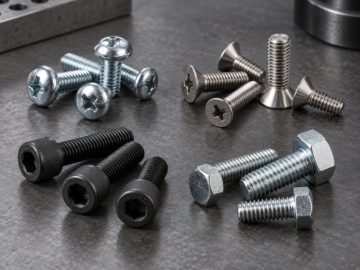
Pan head aluminum screws are the most common general-purpose variant. The low-profile dome head sits above the surface and distributes clamping load well. They accept Phillips, slotted, or combination drives.
Flat head (countersunk) screws are designed to sit flush with or below the mating surface. The 82° or 90° countersink angle must match the countersink in the workpiece. These are common in aluminum sheet metal panels where a clean surface is required.
Oval head screws offer a decorative countersunk option — they sit with a low dome visible above the surface, often used in consumer electronics and trim panels where appearance matters.
Hex head (hex cap screws) are the structural workhorse. The external hex allows high torque with a wrench or socket, and they’re used when clamping force matters in aluminum assemblies. Available in fine and coarse thread.
Socket head cap screws (SHCS) in aluminum are less common than their steel counterparts but are used in precision assemblies where access is limited and a hex key (Allen wrench) must be used. The cylindrical head allows recessing into a counterbore.
Button head socket cap screws offer a low-profile alternative to SHCS with a wider bearing surface — useful in thin-panel mounting where head height is a constraint.
By Thread Type
| Thread Type | Use Case | Key Characteristic |
|---|---|---|
| Machine screw (UNC/UNF) | Metal-to-metal assemblies with nuts or tapped holes | Precise fit, not self-tapping |
| Sheet metal screw | Light-gauge metal, plastic, wood | Aggressive thread, wide pitch, self-tapping capable |
| Self-tapping | Plastics, aluminum extrusions, pre-drilled soft materials | Cuts its own thread on installation |
Self-Tapping Aluminum Screws
Self-tapping aluminum screws deserve special mention. The slightly confusing part: these screws are made of aluminum but are designed to tap threads into softer materials — plastics, wood, and light-gauge sheet metal. Because aluminum has lower hardness than steel, these should only be driven into materials softer than the screw itself. Driving an aluminum self-tapper into hard steel will strip the screw thread, not the workpiece.
For tapping into aluminum extrusions (a common task in framing systems and enclosures), steel or stainless self-tappers are the correct choice — the workpiece is aluminum, but the fastener needs to be harder.
Specialty Types
Machine screws with nylon-insert locking — aluminum body with a nylon patch or collar to resist vibration loosening. Common in vibrating equipment where dissimilar-metal corrosion with steel is a concern.
Shoulder screws in aluminum — used as pivots or spacers in precision assemblies. The ground shoulder diameter controls the fit.
Thumb screws — aluminum body with a wide, knurled or winged head for tool-free adjustment. Found in panel mounting and optical equipment.
Aluminum Alloy Grades for Screws
Not all aluminum screws are equal. The alloy grade determines strength, corrosion resistance, machinability, and anodizing response. Most commercial aluminum screws are made from one of three alloy families.
| Alloy | Temper | Tensile Strength (psi) | Best For |
|---|---|---|---|
| 2024 | T4 | 68,000 | Aerospace, high-stress structural |
| 6061 | T6 | 45,000 | General engineering, marine, anodized |
| 7075 | T6 | 83,000 | Maximum-strength aluminum applications |
| 5052 | H32 | 33,000 | Marine, chemical environments |
6061-T6 is the most common alloy for commercial aluminum screws. It machines cleanly, anodizes well (producing a durable decorative or protective surface), and offers a good balance of strength and corrosion resistance. In practice, we find 6061-T6 covers 80% of general-purpose aluminum screw applications.
2024-T4 offers significantly higher strength but poorer corrosion resistance — it requires anodizing or other surface treatment in anything but dry indoor environments. Aircraft skin panels use it; exposed marine hardware should not.
7075-T6 is the strongest structural aluminum alloy in common use, approaching the tensile strength of mild steel. It’s used in aerospace fasteners where every gram saved matters and where the stress analysis demands it. 7075 is harder to machine and more expensive than 6061.
5052 is the corrosion champion of the group — it’s used specifically in marine environments and chemical processing equipment. Strength is lower, but in salt water applications it outlasts 6061 by a wide margin.
Anodized vs. Raw Aluminum Screws
Anodizing electrochemically thickens the natural oxide layer on aluminum from about 2–10 nanometers (natural) to 5–25 micrometers (Type II anodize) or up to 100 micrometers (Type III hard anodize). The practical effects:
- Corrosion resistance improves significantly, especially for 2024-alloy screws
- Surface hardness increases — hard-anodized aluminum approaches 60–70 Rockwell C
- Appearance — anodizing can be dyed before sealing, producing black, red, blue, gold, and other colors common in consumer electronics and sporting goods
- Thread tolerance — anodizing adds material thickness; threads may need to be chased (re-tapped) after anodizing in precision applications
For cosmetic applications (electronics enclosures, bicycle components, camera gear), anodized aluminum screws are the standard. For structural applications where thread fit is critical, raw 6061-T6 or 7075-T6 with a separate coating is more common.
Industry Applications of Aluminum Screws
The use cases for aluminum screws cluster around three properties: light weight, corrosion resistance, and non-magnetic behavior.
Aerospace and Aviation
Weight is the primary driver. NASA’s Fastener Design Manual details how fastener material selection is integral to structural weight budgets in aircraft and spacecraft. In commercial aircraft, thousands of aluminum screws in interior panels, access doors, and non-structural components contribute measurably to overall weight reduction. The common alloys are 2024-T4 and 7075-T6, both used with anodizing or conversion coating.
Marine and Coastal Environments
Stainless steel (316 grade) is the default marine fastener, but aluminum screws appear where dissimilar-metal corrosion with aluminum hulls and components is a concern. Fastening aluminum to aluminum with aluminum screws eliminates galvanic corrosion entirely — no dissimilar metals in contact, no galvanic cell, no corrosion. This matters on aluminum boat hulls, masts, and deck fittings. 5052 alloy is preferred in these applications.
Electronics and Consumer Devices
Aluminum screws are ubiquitous inside laptops, cameras, drones, and audio equipment. The reasons stack up: they’re lightweight, they won’t rust if condensation forms inside the device, they anodize to whatever color the industrial designer specifies, and they’re non-magnetic (no interference with sensors, speakers, or RF components). In this application, the thread engagement is typically very short — three to five thread engagements into a tapped aluminum boss — so tensile strength is less critical than in structural applications.
Automotive and Performance
Racing and performance automotive applications use aluminum screws in non-structural trim, interior panels, and in areas where the OEM used steel and the builder is stripping weight. The catch: automotive assembly environments often apply significant vibration loads. Aluminum screws in vibrating applications need locking features — nylon-insert locknuts or threadlocking compound — because aluminum’s lower hardness means threads embed slightly over time, reducing clamping force.
Architectural and Construction
Aluminum curtain wall systems, window frames, solar panel racking, and signage mounting all use aluminum fasteners. Here, the corrosion resistance and color-matching capability of anodized aluminum screws make them the obvious choice over zinc-plated steel. The Aluminum Association’s construction guide covers material selection for architectural aluminum components, including fasteners.
How to Choose the Right Aluminum Screws
Most selection mistakes happen because buyers focus on price or availability rather than matching the screw to the specific application. Here is a systematic selection process.

Step 1: Confirm Aluminum Is the Right Material
Ask three questions:
1. Does your design require low weight or dissimilar-metal corrosion avoidance? If yes, aluminum is a candidate.
2. What are the tensile and shear loads on the fastener? If they exceed what a 6061-T6 or 7075-T6 screw can handle, go to steel.
3. Is there a vibration environment? Aluminum screws need locking features in vibrating assemblies.
Step 2: Choose the Alloy
| If you need… | Use this alloy |
|---|---|
| Maximum strength | 7075-T6 |
| Best all-around balance | 6061-T6 |
| Maximum corrosion resistance | 5052-H32 |
| Aerospace high-stress structural | 2024-T4 (with coating) |
Step 3: Select Head Style and Drive
Head style follows from the mechanical and aesthetic requirements of the joint. The drive style is often dictated by the tools available in your assembly environment. Phillips drives are fast in production; hex socket drives allow higher torque and don’t cam out; slotted drives are for manual adjustment in field conditions.
Step 4: Size and Thread Pitch
For machine screws, confirm:
– Nominal diameter — #4, #6, #8, #10, 1/4″, 5/16″, M3, M4, M5, M6, etc.
– Thread pitch — coarse (UNC or metric) for general use; fine (UNF) for vibration resistance or when the tapped hole is in aluminum (fewer threads needed for equivalent strength)
– Length — thread engagement should be at least 1× the screw diameter in steel, 1.5–2× in aluminum, and 2–3× in plastic
Step 5: Surface Finish
- Raw (bare) aluminum — acceptable indoors or in dry environments
- Anodized (Type II, clear or colored) — outdoor, cosmetic, and general corrosion applications
- Hard anodized (Type III) — wear-resistant applications, high-cycle threaded holes
- Chromate conversion (Alodine/Iridite) — aerospace primer preparation, electrical continuity requirement
Common Mistakes to Avoid
Driving aluminum screws into steel without galvanic isolation — aluminum and steel form a galvanic couple that accelerates corrosion of the aluminum. Use nylon or PTFE washers, or choose a different fastener material.
Under-torquing to avoid stripping — aluminum threads are softer than steel and WILL strip if you over-torque, but they also need adequate preload. Use a torque specification appropriate for aluminum threads, typically 30–40% lower than for the same-size steel fastener.
Assuming self-tapping aluminum screws work on aluminum — as noted earlier, an aluminum screw tapping into aluminum workpiece material can work for very light loads, but the thread engagement is weak because both are soft. For tapping aluminum material, use a steel or stainless self-tapper.
Ignoring thread class and fit — aluminum’s lower stiffness means looser thread classes (2A/2B for inch series) work fine in most applications, but precision fits (3A/3B) matter in calibration equipment and optical assemblies. Confirm tolerance requirements before ordering in bulk.
Future Trends in Aluminum Fastener Technology (2026+)
The aluminum fastener market is evolving alongside the broader trends in lightweighting, electrification, and advanced manufacturing.
Aluminum Fasteners in EV Platforms
Battery electric vehicles are driving a massive surge in aluminum fastener demand. Lightweighting is critical for range extension, and according to a Statista market report on automotive aluminum use, the average aluminum content per vehicle is projected to increase from around 208 kg in 2023 to over 250 kg by 2030. Fasteners follow the material trend — EV battery enclosures, motor housings, and structural battery packs are aluminum assemblies that require aluminum or aluminum-compatible fasteners throughout.
The challenge: EV platforms also require repeatable, consistent torque for safety-critical connections in battery packs. This is pushing development of aluminum fasteners with integrated thread-locking features and tighter manufacturing tolerances than traditional commercial-grade aluminum screws.
Additive Manufacturing and Hybrid Fasteners
3D-printed aluminum (specifically AlSi10Mg and Scalmalloy, a high-strength scandium-aluminum alloy) is entering fastener production for ultra-specialized aerospace applications. These printed fasteners can integrate features — undercuts, internal channels, and complex head geometries — impossible to produce with conventional cold heading. Production volumes are tiny today, but the trend toward on-demand, geometry-optimized fasteners is real.
Surface Treatment Advances
Plasma electrolytic oxidation (PEO), also called micro-arc oxidation, creates ceramic-like coatings on aluminum that are significantly harder and more corrosion-resistant than conventional hard anodize. Early commercial applications are in aerospace and defense. Over the next five years, cost reductions in the PEO process are expected to bring this treatment into premium commercial aluminum screw production.
Frequently Asked Questions About Aluminum Screws
What are aluminum screws used for?
Aluminum screws are used in applications that require lightweight fasteners, corrosion resistance without painting or coating, non-magnetic properties, or color-matching with anodized aluminum components. Common applications include aerospace panels, marine hardware, electronics enclosures, consumer devices, and aluminum curtain wall systems.
Are aluminum screws magnetic?
No. Aluminum is not ferromagnetic, so aluminum screws produce no magnetic field and are not attracted to magnets. This makes them the correct choice near magnetic sensors, Hall-effect devices, speakers, and MRI equipment.
Do they make aluminium screws? (British English spelling)
Yes — “aluminium screws” is the British English spelling of “aluminum screws” (American English). They refer to the same product. Both spellings appear in international fastener standards. ISO metric aluminum screws are widely available alongside the inch-series (UNC/UNF) common in North America.
How strong are aluminum screws compared to stainless steel?
A 6061-T6 aluminum screw typically has a tensile strength of around 45,000 psi, while a 316 stainless steel screw reaches approximately 70,000–80,000 psi. That means stainless is roughly 1.5–2× stronger for the same thread size. For structural connections, this matters; for light-duty fastening in electronics or trim panels, it usually doesn’t.
Can aluminum screws rust?
Aluminum does not rust (rust is iron oxide). Aluminum screws form an aluminum oxide layer that is self-protecting. In very aggressive environments (high-chloride salt spray, strong acids or alkalis), bare aluminum can pit over time — anodizing or conversion coating significantly extends service life in these conditions.
What size aluminum screws do I need for solar panel mounting?
Most residential solar racking systems use 5/16″-18 or M8 stainless steel hardware specified by the racking manufacturer. Where the racking is aluminum and the manufacturer approves aluminum fasteners, 6061-T6 hex head cap screws with Grade 5 or equivalent tensile strength specification are appropriate. Always follow the racking manufacturer’s fastener specification — substituting aluminum where stainless is specified can void the structural warranty.
What’s the difference between aluminum screws and aluminum bolts?
The distinction is largely definitional: a screw typically threads into a tapped hole or material it bites into itself; a bolt pairs with a nut. In fastener industry practice, “aluminum hex head cap screws” and “aluminum hex bolts” are often used interchangeably for externally hexagonal threaded fasteners. The more important distinction is whether the joint uses a nut (bolt + nut = fully specified clamping load) or a tapped hole (screw into material = clamping load depends on thread engagement depth and material).

Conclusion
Aluminum screws fill a specific, well-understood role in the fastener world: where weight, corrosion resistance, or non-magnetic properties are the primary requirements, and where tensile loads can be accommodated by an aluminum alloy. The selection decision — which alloy, which head style, which surface treatment — matters more with aluminum than with steel, because aluminum’s narrower performance envelope means mistakes show up faster.
For most general engineering applications at productionscrews.com, 6061-T6 machine screws in the appropriate head style will cover the use case. For demanding structural applications, 7075-T6. For extreme corrosion environments, 5052. When in doubt, reach out — specifying the right aluminum screw the first time is far cheaper than a field replacement.
Related Products
Solutions & Cluster
Related Articles
- Acme Threaded Rod: Complete Buyer’s Guide + Sizing Chart (2026)
- Anti Theft Screws for Licence Plate: The Complete Buyer’s Guide (2026)
- 8.8 Bolt: Complete Guide to Class 8.8 Bolts, Strength, and Applications
- Bolt Screw Guide: Types, Differences, Sizes, and Industrial Applications
- Castellated Nut: Complete Guide to Types, Uses & Installation
- The Complete Guide to Tamper Proof Screws: Types, Applications & How to Choose the Right One
- Stainless Steel Bolt: Complete Guide to Grades, Applications & Selection
- U-Bolt Fasteners: The Complete Guide to Types, Sizes & Applications