 English
  German
  Spanish
  Portuguese
  French
  Japanese
  Arabic
  Korean
  Vietnamese
  Russian
 M2 Screw Size: Complete Dimensions, Types & Selection Guide (2026)
An M2 screw has a 2mm nominal thread diameter, a standard thread pitch of 0.40mm, and is available in lengths from 2mm to 30mm across pan, flat, socket cap, button, and Torx head styles — making it the standard miniature fastener for electronics, optical instruments, robotics, and precision mechanical assemblies.
If you’ve ever built a PC, assembled a camera lens mount, or wired up a drone frame, you’ve handled an M2 screw — or you spent 15 minutes hunting one on the carpet because it’s that small. The M2 screw size is deceptively important: use the wrong length in a motherboard M.2 slot and your NVMe drive rattles loose; use the wrong material grade in a medical enclosure and you’ll fail a certification audit. This guide covers every dimension, every head style, every material grade, and the selection checklist that lets you pick the right M2 screw the first time — whether you’re building a gaming rig or sourcing fasteners for production runs.

What Is an M2 Screw?
An M2 screw is a metric machine screw with a 2mm nominal thread diameter. It belongs to the ISO metric fastener system, where “M” stands for metric and the number specifies thread diameter in millimeters.
According to Wikipedia’s reference on ISO metric screw threads, the standard (coarse) thread pitch for M2 is 0.40mm — the linear distance in millimeters between adjacent thread crests. A fine-pitch variant at 0.25mm exists for precision positioning and high-vibration applications, but the 0.40mm standard is what every major supplier stocks under “M2.” The complete ISO designation is written M2 × 0.4 (or simply “M2” when the coarse pitch is implied).
Where M2 Screw Size Fits in the Metric Fastener Family
The M2 screw size occupies the smallest end of general-purpose metric hardware. Understanding how it compares to neighboring sizes helps you choose correctly and avoid costly thread mismatches:
- M1.6 — used in eyeglass frames, micro-electronics, hearing aid housings
- M2 — PC motherboards, cameras, precision instruments, drone frames, medical device enclosures
- M2.5 — laptop chassis, small consumer electronics, Raspberry Pi mounting hardware
- M3 — standard PC case screws, fan mounts, general electronics enclosures
The M2 screw size is not interchangeable with M2.5 or M3 — a thread mismatch strips the mating material on first installation. Always verify the nominal diameter before procurement.
Thread Geometry and Standards
The M2 screw follows an ISO 68-1 symmetric V-thread profile with a 60-degree included angle. Key thread parameters for the standard and fine pitch variants:
| Parameter | Standard Pitch (Coarse) | Fine Pitch |
|---|---|---|
| Nominal diameter | 2.0 mm | 2.0 mm |
| Thread pitch | 0.40 mm | 0.25 mm |
| Minor diameter (approx.) | 1.509 mm | 1.729 mm |
| Pitch (effective) diameter | 1.740 mm | 1.838 mm |
| Designation | M2 × 0.4 | M2 × 0.25 |
Governing standards: ISO 261 (metric screw thread system overview) and ISO 262 (selected sizes for fasteners). Thread tolerance class for most standard M2 screws is 6g (external thread), pairing with a 6H internal thread.
M2 Screw Dimensions: Full Spec Reference
Understanding M2 screw size dimensions fully means knowing more than the thread diameter. Head diameter, head height, drive recess, and hole preparation sizes all affect whether your assembly works as designed.
Clearance and Tap Drill Holes
For correct hole preparation:
– Clearance hole (through-hole): 2.2 mm nominal (standard), 2.4 mm (close fit)
– Tap drill size: 1.60 mm for 0.40mm pitch (yields ~75% thread engagement in steel)
– Recommended engagement depth: 2× diameter minimum (4 mm) in steel; 3× (6 mm) in aluminum; 4× minimum (8 mm) in plastic or soft materials
Head Dimension Reference by Style
This is the complete M2 screw size chart for the most common head types available from standard catalogs:
| Head Style | Standard | Head Ø (max) | Head Height (max) | Drive | Tool Size |
|---|---|---|---|---|---|
| Pan head | ISO 7045 | 3.8 mm | 1.3 mm | Phillips #0 / Pozi 0 | — |
| Socket cap | ISO 4762 | 3.8 mm | 2.0 mm | Hex socket | 1.5 mm Allen |
| Countersunk flat | ISO 10642 | 4.0 mm | 1.2 mm | Hex socket | 1.5 mm Allen |
| Button head | ISO 7380 | 3.5 mm | 0.85 mm | Hex socket | 1.27 mm Allen |
| Cheese head | ISO 1207 | 3.5 mm | 1.3 mm | Slotted | — |
| Pan head Torx | ISO 14583 | 3.8 mm | 1.5 mm | Torx | T6 |
| Hex head (bolt) | ISO 4017 | 4.0 mm AF | 1.6 mm | External hex | 4.0 mm wrench |
Counterbore note: For an M2 socket cap flush-mount installation, machine the counterbore to 3.9 mm diameter × 2.1 mm depth. This provides a clean flush seat without visible head protrusion in precision housings.
Standard Length Range
M2 screws are catalogued in lengths from 2 mm to 30 mm. Common stock lengths: 2, 2.5, 3, 4, 5, 6, 8, 10, 12, 14, 16, 20, 25, 30 mm. How length is measured depends on head style:
- Pan, socket cap, button, cheese, Torx head: measured from the underside of the head to the tip
- Countersunk flat head: measured from the top face of the head (flush with surface) to the tip
The single most commonly specified M2 screw size in PC builds — for M.2 SSD retention — is M2 × 3mm flat head with Phillips #0 drive. Using M2 × 4mm or longer in a motherboard standoff will bottom the screw before seating the drive, leaving the NVMe module unlocked.
M2 Screw Types by Head Style and Drive
The head style governs three things: how clamping load is distributed across the mating surface, whether the screw sits flush or proud of the surface, and what tool you need for installation. Choosing the wrong head style is a design error, not just an aesthetic preference.

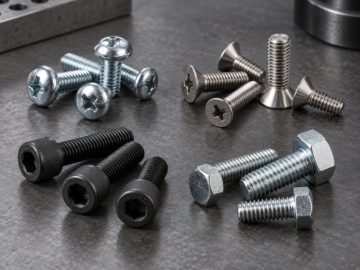
Pan Head M2 Screw
The pan head is the dominant M2 screw type in consumer electronics. Its wide, flat underside distributes clamping load across a generous bearing area, reducing the risk of stress damage to thin PCB laminates or plastic enclosure surfaces. Standard drive is Phillips #0, with Pozidriv 0 used by some European manufacturers (visually similar but subtly different — a Pozi bit engages the four additional flats and is less prone to cam-out).
Pan head M2 screws are what most people picture when they think “electronics screw.” Best for: PCB standoff retention, panel fastening, M.2 SSD mounting (flat-head variant), any non-flush application where a low-profile protruding head is acceptable.
Socket Cap Head M2 Screw (Hex Socket / Allen)
The socket cap (DIN 912 / ISO 4762) uses a 1.5mm internal hex socket that accepts a standard Allen key or ball-end driver. The tall cylindrical head profile and deep socket engagement allow significantly higher installation torque than a Phillips pan head at the same diameter — critical in structural joints where a M2 screw size must carry real mechanical load.
In practice, the socket cap is the preferred M2 type for anything requiring repeatable, controlled torque: motor mounts, camera gimbals, robotic arm joints, CNC machine fixtures. The 1.5mm hex driver is also far more resistant to slipping under torque than a Phillips #0 bit. Best for: structural and semi-structural joints, any assembly removed more than 2–3 times, precision mechanical systems.
Countersunk (Flat Head) M2 Screw
The countersunk flat head (ISO 10642) sinks flush with or below the mating surface in an 82° or 90° countersunk hole. For M2, the standard countersink angle is 90°. This is the type most PC motherboards supply for M.2 SSD retention — the flat head seats into the threaded standoff so the drive surface sits horizontal with no protruding fastener head.
For design purposes: the countersink diameter must be ≥4.0 mm at the surface to accept the M2 flat head fully flush. Best for: flush-mount applications, M.2 SSD installation, optical instrument housings, thin panel assemblies where head height must be zero.
Button Head M2 Screw
The button head (ISO 7380) presents a low-profile rounded dome — shorter than socket cap but with a wider bearing surface than cheese head. Uses a 1.27mm hex key. The button profile is popular in visible external assemblies where appearance matters and high torque isn’t required.
One practical limitation: the shallower hex socket on button head M2 screws means slightly less available torque before the key strips the recess. Never use button head in structural applications. Best for: visible covers, decorative panels, non-structural retention in consumer products.
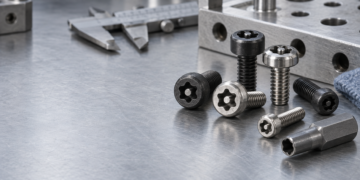
Torx Drive M2 Screw
Torx M2 screws (ISO 14583, T6 drive) have largely replaced Phillips in laptop and smartphone manufacturing, and for good reason. At M2 scale, the Torx star geometry transmits torque vertically without cam-out — a Phillips bit at #0 will slip laterally before reaching target torque in high-cycle automated assembly lines.
In volume production environments, Torx M2 significantly reduces bit wear rate and stripped-head rework compared to Phillips. Best for: high-volume automated assembly, any product opened/closed repeatedly by end-users, medical devices requiring reliable removal torque.
M2 Screw Material Options and Strength Classes
Material choice for M2 screws affects tensile strength, corrosion resistance, magnetic properties, weight, and cost. At 2mm diameter, the cross-sectional area is just 3.14 mm² — small enough that overtightening a brittle high-strength steel screw will shear it before most installers notice. Material selection is not optional engineering detail.
Carbon Steel M2 Screws (Grades 4.8 to 12.9)
Carbon steel is the default material for M2 screws where corrosion protection is handled by surface finish (zinc plating, black oxide, or nickel plating). The ISO 898-1 property class system defines:
| Property Class | Tensile Strength | Proof Load | Typical Application |
|---|---|---|---|
| 4.8 | 400 MPa | 310 MPa | Light-duty electronics, non-critical enclosures |
| 8.8 | 800 MPa | 580 MPa | General mechanical assemblies, structural joints |
| 10.9 | 1000 MPa | 830 MPa | High-load joints, automotive subassemblies |
| 12.9 | 1200 MPa | 970 MPa | Maximum strength; alloy steel, brittle — not for repeated removal |
For socket cap M2 screws in robotic or mechanical assemblies, class 12.9 is the most commonly stocked — the socket cap form implies structural intent. Going below 10.9 at M2 diameter provides inadequate clamping load in most precision mechanical applications. For electronics and PCB work, class 4.8 is sufficient.
Stainless Steel M2 Screws (A2 and A4)
The ISO 3506 standard covers stainless steel fastener property classes using an alphanumeric system separate from the carbon steel 8.8/10.9 scale:
- A2-70 (Grade 304 stainless): 700 MPa tensile strength, excellent corrosion resistance in standard environments, the most common stainless M2 screw size option
- A4-80 (Grade 316 stainless): 800 MPa, molybdenum-alloyed for superior chloride resistance — marine, chemical processing, and medical sterilization applications
A practical caution for stainless: galling. When two stainless surfaces contact under load and motion, microscopic surface welding can occur (cold welding), permanently seizing the fastener. Use an anti-galling compound (nickel-based anti-seize or Molykote 1000) when running A2 stainless M2 screws into stainless threads.
Titanium M2 Screws
Grade 5 titanium (Ti-6Al-4V) M2 screws deliver ~950 MPa tensile strength at roughly half the density of steel — an extraordinary strength-to-weight ratio that justifies the 5–10× cost premium in:
– FPV drone frames and ultra-light robotic structures where every gram of fastener mass competes with payload
– Competitive cycling and motorsport components
– High-performance camera rigs
– Implantable and long-term body-adjacent medical devices (Grade 2 titanium preferred for biocompatibility)
For most applications, A2 stainless is the better cost-performance choice for corrosion resistance. Titanium is for applications with hard weight budgets.
Brass M2 Screws and Standoffs
Brass M2 screws and threaded standoffs are used where electrical conductivity, non-magnetic properties, or machinability matter more than strength. Common applications:
– PCB-to-chassis standoffs providing grounding continuity through the board stack
– RF and microwave assemblies where ferrous hardware would distort field geometry
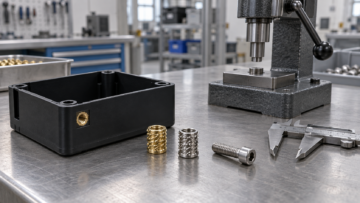
– Plastic enclosures with heat-set brass inserts providing durable reusable threads
Brass tensile strength ranges 350–500 MPa depending on alloy — significantly below steel class 4.8. Brass M2 screws are not structural fasteners. Threading torque into brass more than 10–15% over finger-tight risks stripping the threads in the mating insert.
M2 Screw Applications: From PC Builds to Precision Engineering
The M2 screw size is used far more broadly than the PC-building community’s focus suggests. Any domain requiring miniaturization, precision assembly, and reliable clamping at small scales eventually standardizes on M2 hardware.
PC Building and M.2 SSD Installation
The application that brought M2 screws to mainstream awareness: a flat-head or pan-head M2 × 3mm Phillips screw retains an M.2 SSD at the seated angle (typically 5–7 degrees from horizontal) in the motherboard standoff. Without the screw, the drive sits unseated, creating electrical contact variation at the M-key or B+M-key edge connector. In high-vibration environments with multiple case fans, an unseated NVMe drive produces intermittent read errors and performance throttling.
The M2 × 3mm screw typically ships in the motherboard accessory bag. If lost, replacements are a standard M2 screw size available at hardware stores — but confirm the head type (flat countersunk for most modern boards) before purchasing. An M2 × 4mm or longer screw bottoms out against the PCB substrate before clamping the drive.
Optical and Camera Equipment
Camera lens assemblies, telescope focusers, microscope objective mounts, and cinema gimbal systems rely on M2 socket cap screws for their combination of fine thread pitch (0.40mm provides precise angular adjustment) and hex socket drive (1.5mm key delivers adequate torque for vibration-resistant locking). Field repairs of optical assemblies almost always involve M2 hardware somewhere in the optical path.
Undertorquing is the dominant failure mode in optical assemblies — the short lever arm of a 1.5mm hex key creates a misleading “done” feeling at low torque. Use a precision torque screwdriver set to 0.15–0.18 N·m for structural optical M2 joints.
Robotics and Drone Frames
Sub-250g FPV drones and 3-inch class racing frames use M2 socket cap screws (class 12.9 steel or Grade 5 titanium) throughout: motor mounts, flight controller stack, VTX mounts, camera plates. The M2 screw size delivers adequate structural performance at minimal weight, and the 0.40mm thread pitch provides enough friction to resist vibration-induced back-out in most conditions.
For any M2 fastener in a vibration-prone assembly, thread-locking adhesive (Loctite 243 for permanent, 222 for serviceable) significantly outperforms dry-thread friction at M2 diameter. The small diameter means torsional back-out resistance is very low without locking compound.
Medical Device Enclosures
FDA-regulated and CE-marked medical devices frequently specify A4-70 or A4-80 stainless M2 screws for sensor housings, diagnostic instrument panels, and portable medical equipment enclosures. Key requirements:
– Full material traceability (Certificate of Conformance documenting alloy, heat number, thread tolerance class)
– Autoclave cycle compatibility for instruments requiring steam sterilization (316 stainless handles this; 304 is borderline)
– Thread tolerance class 6g/6H for reliable repeatable torque during sterile field assembly
Electronics and PCB Assembly
Industrial IoT modules, motor driver boards, servo controllers, and power electronics all use M2 hardware for PCB mechanical retention. Design considerations:
– Use M2 brass standoffs when you need a ground connection between the board and chassis
– Use M2 nylon screws in proximity to high-voltage traces where metallic hardware would violate creepage distance requirements (IEC 60664 specifies minimum 2.5mm for 300V CATII — a steel M2 screw head 1mm from a live trace fails this)
– Use M2 steel with nylon insert (prevailing-torque) nuts when you need removal capability without thread-locking compound
How to Select the Right M2 Screw Size for Your Project
Six decisions determine the right M2 screw size specification. Answering them in order eliminates guesswork and prevents expensive late-stage redesign.

Six-Question M2 Screw Selection Checklist
1. What is the clamping load requirement?
Estimate the tensile or shear load the fastened joint must carry. At class 8.8 steel M2, proof load is approximately 580 N. For electronics and light enclosures, class 4.8 is sufficient. For structural robotics or mechanical joints, class 8.8 minimum. Maximum-strength precision joints: class 12.9.
2. What is the mating material and engagement depth?
The M2 thread’s tensile strength is only useful if the mating thread can carry the load without stripping. Minimum engagement depth by material:
– Steel: 2× diameter = 4 mm minimum
– Aluminum (6061, anodized): 2.5–3× = 5–6 mm
– Zinc die-cast: 3.5× = 7 mm
– Plastic (ABS, PC): use brass heat-set inserts — do not thread directly into plastic for repeated assembly
3. Does the joint see vibration or dynamic load?
If yes: apply thread-locking adhesive (Loctite 243 for permanent, 222 for easy removal) or specify a prevailing-torque nut. Dry friction alone is insufficient for M2 in vibration environments. The low torsional cross-section at 2mm diameter means the screw back-out threshold is very low without mechanical or chemical locking.
4. Will the screw be removed repeatedly?
More than 5–10 removal cycles: avoid class 12.9 (brittleness increases risk of head fracture during removal). Prefer A2-70 stainless with anti-seize compound, or class 8.8 steel with appropriate torque-limiting driver. Torx drive outperforms Phillips significantly in high-cycle applications — invest in T6 Torx M2 hardware if your product will be serviced in the field.
5. What is the environmental exposure?
– Indoor, dry environment: zinc-plated steel sufficient
– Humid, outdoor, or cleaning chemical exposure: A2-70 stainless minimum
– Marine, salt spray, chloride exposure, or autoclave sterilization: A4-80 stainless required
– Temperatures above 300°C: specialty high-temperature alloys (Inconel, A286) — rare in M2 sizes but available from aerospace fastener suppliers
6. Head style and tool access?
– Linear tool access only (no lateral space): socket cap hex provides most torque in constrained spaces
– Flush surface required: countersunk flat head with 90° countersink
– High-volume automated screwdriving: Torx T6 pan head
– Visible exterior with aesthetic requirement: button head
– General electronics: pan head Phillips
M2 Screw Installation: Torque, Tools, and Common Mistakes
Installing M2 screws correctly is the step most guides skip — and it’s where most fastener failures actually originate. The small M2 screw size amplifies both under-torque (joint slips, drive comes unseated) and over-torque (stripped threads, fractured screw) consequences.
Recommended Installation Torque
Target torque for M2 screws varies significantly by material and application. These figures are for dry (unlubricated) threads:
| Screw Class | Mating Material | Target Torque | Max Torque |
|---|---|---|---|
| Class 4.8 steel | Steel / hard aluminum | 0.09 N·m | 0.12 N·m |
| Class 8.8 steel | Steel | 0.18 N·m | 0.22 N·m |
| Class 12.9 steel | Steel | 0.24 N·m | 0.30 N·m |
| A2-70 stainless | Anodized aluminum | 0.12 N·m | 0.16 N·m |
| Brass | Plastic / PCB standoff | 0.05 N·m | 0.08 N·m |
With thread-locking compound applied: reduce target torque by ~15% (the compound reduces friction variation, so less torque achieves the same clamp load). With anti-galling lubricant: increase torque by ~10–15% for the same clamp load.
Per the Engineering Toolbox’s fastener assembly reference, thread stripping is the dominant failure mode for small metric screws — not tensile fracture. The stripped-thread load for M2 in 6061 aluminum is approximately 900 N, equivalent to roughly 0.18 N·m at the screw. Exceed this in aluminum without adequate engagement depth and you’re stripping on first assembly.
Tool Selection for M2 Screw Size
| Head Style | Required Tool | Notes |
|---|---|---|
| Pan head / flat head | Phillips #0 | Use new bit; worn #0 cam-out below target torque |
| Socket cap / flat hex | 1.5mm Allen (hex) key | T-handle or driver handle — standard L-key has poor tactile feedback |
| Button head | 1.27mm Allen key | Lower max torque; do not exceed 0.08 N·m |
| Torx | T6 Torx bit | Eliminates cam-out in high-cycle applications |
| Cheese head | Slotted | Avoid in new designs — slotted drives are difficult to use precisely at M2 scale |
For production environments, use a calibrated torque-limiting screwdriver (0.3 N·m capacity, readable to 0.01 N·m). For field assembly and one-off builds, the practical rule is: snug plus one-quarter turn for most non-structural electronics work.
Five Common M2 Screw Installation Mistakes
1. Using a worn Phillips #0 bit: At M2 scale, a worn or wrong-size bit cams out before reaching half the target torque, deforming the head recess. Always use a new #0 bit and apply firm downward pressure (axial force) before rotating. A deformed M2 Phillips head requires a dedicated screw extractor kit — they’re inexpensive but time-consuming.
2. Wrong length in M.2 SSD retention: M2 × 5mm instead of M2 × 3mm will bottom the screw against the PCB before seating the drive. The drive appears mechanically retained but is not actually locked horizontal. Confirm length before installing.
3. Thread galling in stainless-to-stainless joints: Never drive an A2 stainless M2 screw into a stainless-tapped hole without anti-galling compound. Cold-welding can occur within 2–3 cycles. Apply nickel-based anti-seize or Molykote 1000 to threads before installation.
4. Over-torquing into plastic: Direct threads in plastic without brass inserts strip on the first over-torque event. Limit torque to 0.05–0.06 N·m maximum in plastic, or install M2 brass heat-set inserts for permanent, repeatable assembly.
5. No thread-locking in vibration environments: Dry-threaded M2 screws back out in assemblies with repeated vibration. This is not a product defect — it’s physics. Apply Loctite 222 (low-strength, for field serviceability) or Loctite 243 (medium-strength, general structural) to every M2 screw in a vibrating assembly.
M2 Screw Trends and Emerging Standards (2026+)
The M2 screw size remains the dominant miniature metric fastener for electronics and precision engineering — but manufacturing trends are reshaping how M2 hardware is specified and procured.
Automation-Optimized Drive Formats
High-volume electronics manufacturing lines are shifting from Phillips to Torx and Torx Plus drive formats in M2 hardware. According to the Industrial Fasteners Institute’s (IFI) assembly trend data, Torx adoption in precision electronics fasteners grew over 12% annually through 2024, driven by automated screwdriving line requirements: Torx maintains positive driver engagement through ±3° angular variation, while Phillips begins to cam out at ±1.5° — a critical tolerance in pick-and-place assembly heads.
For new product designs targeting automated assembly, specifying Torx T6 M2 pan head or flat head screws eliminates a class of rework defects (stripped heads) that routinely runs 0.3–1.5% of units on Phillips-based lines.
Miniaturization Below M2 Screw Size
Consumer wearables, hearing aids, and implantable medical devices are pushing fastener requirements below M2. M1 and M1.6 metric screws are seeing growing demand in smartwatch mechanisms and wireless earbud housings, where the M2 screw size — despite being tiny by most standards — is now considered “large.” Precision fastener suppliers increasingly maintain M1–M1.6 socket cap and Torx head inventory as standard stock items rather than custom-order items.
For most industrial and electronics applications, however, M2 remains the practical minimum for automated assembly handling and reliable torquing. M1 and M1.6 hardware requires dedicated tooling and handling systems not widely deployed outside watchmaking and micro-device manufacturing.
Ceramic and Non-Metallic M2 Fasteners
Alumina (Al₂O₃) and zirconia ceramic M2 screws are available from specialty suppliers for applications where metallic hardware is unacceptable:
– Semiconductor fabrication equipment requiring non-contaminating fasteners near wafer-processing chambers
– MRI machine components where metallic hardware causes image artifacts
– High-frequency RF assemblies requiring non-conductive fasteners in the near-field region of antennas
– EV battery management modules requiring non-magnetic, non-conductive isolation between cells
Ceramic M2 fasteners are 20–50× the cost of stainless equivalents, require careful handling (ceramic is brittle under impact loading), and need specialized installation tools. But in these niches, no substitute exists.
Frequently Asked Questions About M2 Screw Size
What size is an M2 screw?
An M2 screw is 2mm in nominal thread diameter with a 0.40mm standard thread pitch. Full ISO designation: M2 × 0.4. Available lengths run from 2mm to 30mm in standard catalogs. It is the smallest commonly stocked metric machine screw, used in PC motherboards, cameras, drones, and precision instruments.
What is the difference between M2, M2.5, and M3 screw sizes?
M2 = 2.0mm diameter; M2.5 = 2.5mm; M3 = 3.0mm. Each size requires its own tap drill, clearance hole, and matching nut. M2 and M2.5 are not interchangeable — an M2 screw will spin freely in an M2.5-tapped hole. Thread pitch also differs: M2 standard pitch is 0.40mm, M2.5 is 0.45mm, M3 is 0.50mm. PC motherboard M.2 SSD screws are M2; laptop chassis screws are typically M2.5.
What screwdriver do I use for M2 screws?
It depends on the head type. Phillips pan head and flat head M2 screws use a #0 Phillips bit. Socket cap and countersunk hex M2 screws require a 1.5mm hex (Allen) key. Button head M2 uses a 1.27mm Allen key. Torx M2 screws use a T6 Torx bit. Using a mismatched driver at M2 scale deforms the recess on the first attempt — always verify drive type before installing.
What is the standard M2 screw thread pitch?
The standard (coarse) thread pitch for M2 is 0.40mm — meaning the thread advances 0.40mm per full revolution. A fine-pitch variant at 0.25mm exists for precision positioning and high-vibration resistance. Unless a specification explicitly states “M2 × 0.25,” assume 0.40mm. The two pitches are not interchangeable.
What M2 screw does an M.2 SSD use?
An M2 × 3mm flat head (countersunk) screw with Phillips #0 drive is the standard for M.2 SSD retention on desktop motherboards. Some boards use M2 × 3mm pan head. The 3mm length is critical — longer screws bottom against the PCB before seating the drive; shorter screws don’t fully seat in the standoff thread. The screw typically ships in the motherboard accessory bag.
Can I use an imperial screw instead of an M2?
No. M2 (2.0mm × 0.40mm pitch) does not match any imperial standard screw size. The closest imperial size is #2-56 UNC (2.184mm diameter, 0.454mm pitch) — close in diameter but different thread geometry. Forcing a #2-56 into an M2-tapped hole strips both threads. Always use an M2 metric replacement for M2 applications.
What is the correct torque for M2 screws?
For electronics and PCB applications (class 4.8 steel or brass into standoffs): 0.05–0.08 N·m. For class 8.8 steel structural joints: 0.18–0.22 N·m. For class 12.9 steel precision joints: up to 0.30 N·m. For M.2 SSD retention (flat head into motherboard standoff): finger-tight plus one-quarter turn, approximately 0.03–0.05 N·m. Exceeding these figures in soft metals or plastic strips threads.
Where can I buy M2 screws in bulk for production?
M2 screws for production runs are available from industrial fastener distributors (McMaster-Carr, Grainger, Würth Group), specialty miniature fastener suppliers, and direct from manufacturers. For production procurement, always request a Certificate of Conformance documenting material grade, property class, thread tolerance class (6g/6H), and surface finish. Production Screws supplies metric M2 hardware in bulk with full material traceability and custom packaging for automated assembly lines.

Conclusion
The M2 screw size covers a deceptively broad specification space: eight head styles, four material families, fifteen standard lengths, two thread pitches, and a tensile strength range from 400 MPa to 1200 MPa. Getting it right means matching head style to access and flush-mount requirements, matching material to environment and load (A2 stainless for corrosion resistance, class 12.9 steel for maximum structural load, brass for PCB grounding standoffs), and applying the right torque — especially critical when threading into soft metals or plastic.
For production sourcing, the three parameters that determine M2 screw quality at volume are property class, drive format, and surface finish certification. Everything else in this guide provides the engineering context to make those three decisions intelligently. If you’re sourcing M2 screws for electronics, robotics, optical equipment, or industrial machinery in production quantities, Production Screws supplies metric M2 fasteners in bulk with full material traceability, custom reels and packaging, and specifications ready for automated assembly lines.
Related Products
Solutions & Cluster
Related Articles
- Nylon Spacers: The Complete Guide to Types, Sizes, and Applications
- U-Bolt Fasteners: The Complete Guide to Types, Sizes & Applications
- Bolt vs Screw: What’s the Real Difference and When Should You Use Each?
- Screw Nut Bolt: The Complete Guide to Fastener Types, Grades & Selection
- Exploring the Advantages of Laser Direct Structuring in Modern Design
- One Way Screws: The Complete Guide to Tamper-Resistant Security Fasteners
- Thru Bolt: Complete Guide to Types, Sizes, and Installation (2026)
- Top Sealed Rivet Nut Fast Delivery: Quality Inserts for Quick Projects