 English
  German
  Spanish
  Portuguese
  French
  Japanese
  Arabic
  Korean
  Vietnamese
  Russian
 Stainless Steel Fasteners: Complete Grade & Application Guide (2026)
Stainless steel fasteners are corrosion-resistant bolts, screws, nuts, and washers made from chromium-containing steel alloys, available in grades 304, 316, and 410 for applications ranging from food processing to marine environments.
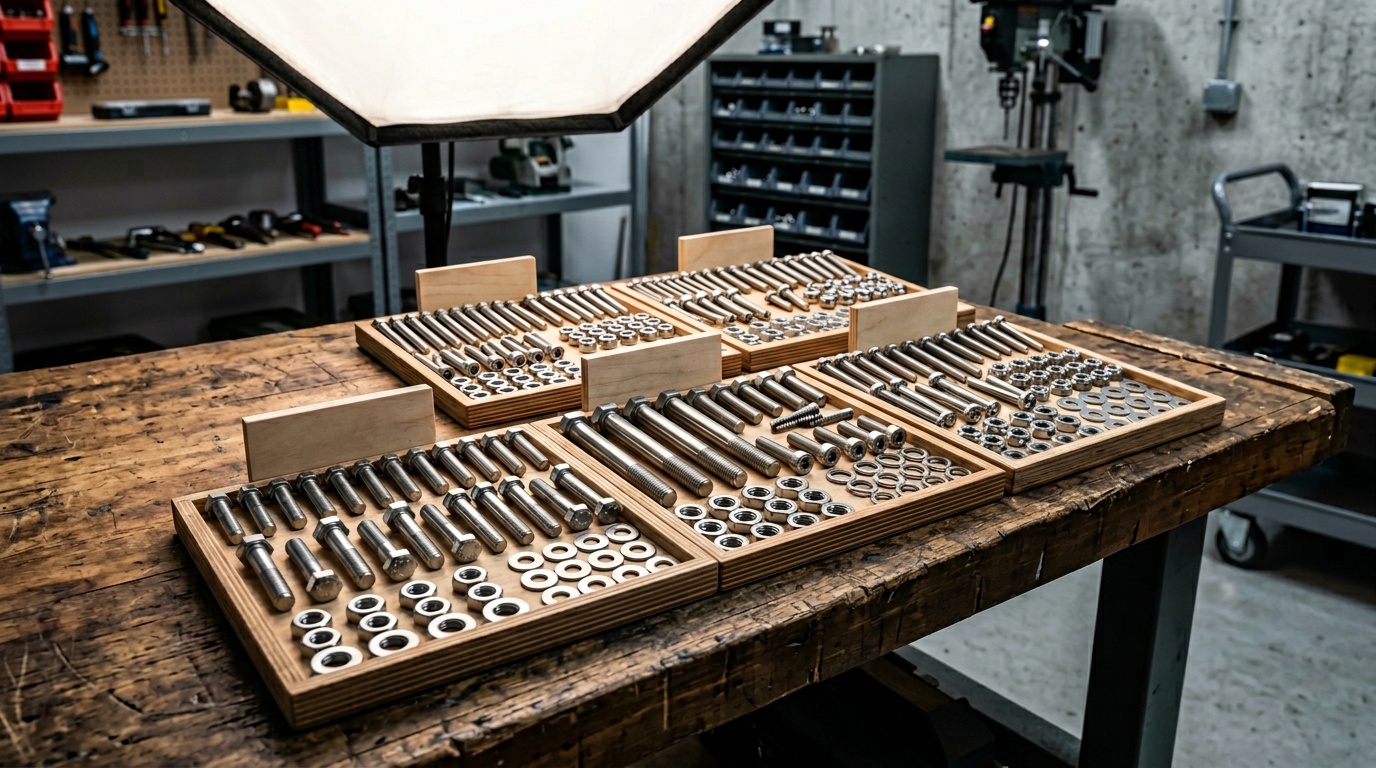
You specify stainless steel fasteners because you need something that won’t rust, won’t seize, and won’t fail six months after installation. But “stainless steel” covers at least a dozen commercial grades, and picking the wrong one — say, using 304 in a saltwater bilge or 316 where you needed magnetic properties — leads to exactly the failures you were trying to prevent. This guide covers every decision point: grade selection, type selection, torque, galling, galvanic corrosion, and the three situations where stainless is actually the wrong choice.
What Are Stainless Steel Fasteners?
Stainless steel fasteners are corrosion-resistant mechanical joining components — bolts, screws, nuts, washers, studs, and anchors — manufactured from steel alloys containing at least 10.5% chromium by mass. That chromium content is the whole story: it reacts with atmospheric oxygen to form a thin, self-repairing chromium oxide passive layer on the surface. Scratch it, and it re-forms within hours in ambient conditions. That’s why stainless doesn’t need paint, plating, or coating the way carbon steel does.
According to Wikipedia’s overview of stainless steel, the alloy family was first developed commercially in the early 20th century, and modern grades are precisely controlled for chromium, nickel, molybdenum, and carbon content to hit specific corrosion-resistance and mechanical-property targets.
How Passivation Works
The passive film on stainless steel is roughly 1–3 nanometers thick — invisible to the eye, but the reason you can leave a 316 socket head cap screw in a saltwater environment for years without visible rust. The film is thermodynamically stable as long as the surface sees oxygen. Seal it off completely (inside a crevice, under a washer, in a blind hole) and the film breaks down. That’s crevice corrosion — one of the main failure modes engineers overlook on paper specs.
Why Stainless Fasteners Cost More
Raw material cost is the primary driver. Nickel, which stabilizes the austenite phase in 304 and 316, trades at commodity prices that swing 20–40% year over year. A single-source nickel disruption in 2022 pushed 316 fastener prices up roughly 35% in three months. You’re also paying for tighter dimensional tolerances — stainless work-hardens rapidly during machining, which shortens tool life and slows production.
Stainless vs. Zinc-Plated Steel
| Property | Stainless 304 | Zinc-Plated Carbon Steel |
|---|---|---|
| Corrosion resistance | Excellent (air/fresh water) | Moderate (coating-dependent) |
| Tensile strength (typical) | 70,000–80,000 psi | 60,000–120,000 psi |
| Magnetic | No (austenitic) | Yes |
| Galling risk | Higher | Lower |
| Cost premium | 3–5× | Baseline |
| Reusability | Good (with anti-seize) | Limited (coating strips) |
For indoor structural applications with no moisture exposure, zinc-plated hardware often makes more engineering sense. Stainless earns its premium in wet, chemical, or food-contact environments.
Stainless Steel Grades Compared: 304, 316, 410, and 18-8
The grade is the single most important selection variable. Most sourcing mistakes happen here — someone orders “stainless” without specifying grade, gets 304 for a marine application, and wonders why there’s red staining on the hull after six months.
304 Stainless Steel (18-8)
Grade 304 contains approximately 18% chromium and 8% nickel, which is why it’s often called 18-8 in fastener catalogs. It’s the most widely produced stainless grade — roughly 50% of all stainless production globally — and covers the majority of general-purpose fastener applications.
Best for: Kitchen equipment, architectural hardware, chemical containers (mild acids), freshwater piping, food processing equipment in non-chloride environments, indoor construction.
Limitations: Susceptible to pitting and crevice corrosion when chloride concentration exceeds roughly 200 ppm. Not suitable for continuous saltwater exposure or marine below-waterline use. Can sensitize (lose corrosion resistance) if welded without proper post-weld treatment, though fasteners are rarely welded.
Tensile strength: 70,000–80,000 psi (Grade 8 carbon steel reaches 150,000 psi — stainless is not a high-strength replacement for hardened steel bolts in structural applications).
316 Stainless Steel (Marine Grade)
The addition of 2–3% molybdenum to the 304 base formula is what makes 316 “marine grade.” Molybdenum dramatically improves resistance to chloride pitting — the passive film is more stable at higher chloride concentrations.
Best for: Marine hardware (above and below waterline), chemical processing with halide exposure, coastal architecture, pharmaceutical equipment, swimming pool hardware, seawater heat exchangers.
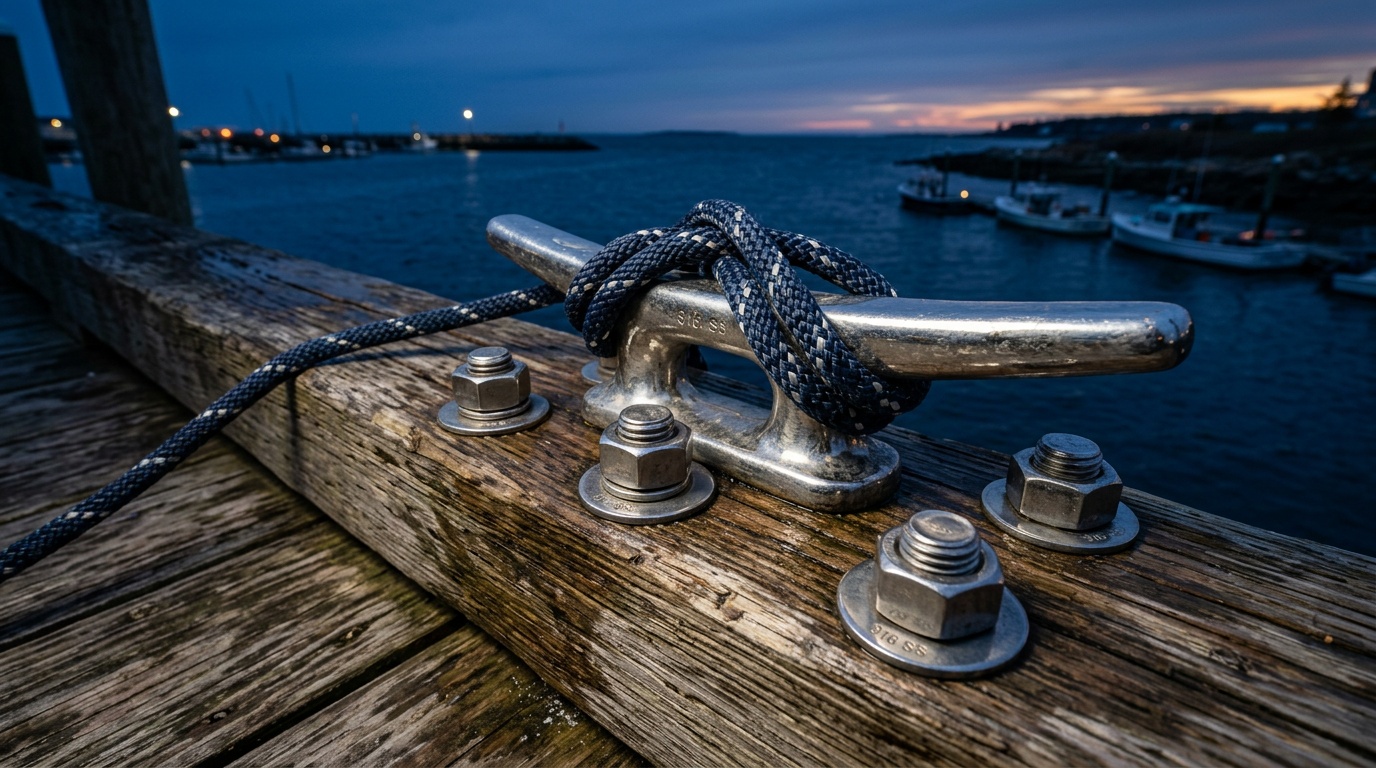
Performance data: In ASTM G48 Method A (6% FeCl₃ immersion at 22°C), 316 passes where 304 fails within 24 hours. In practice, we’ve seen 316 hex bolts on dock cleats hold up for 8–10 years in Pacific Coast tidal zones with no more than annual fresh-water rinse maintenance.
Cost premium over 304: Typically 20–40% depending on lot size and market conditions. Worth it for any marine or chloride-heavy application. Not necessary for indoor use.
316L (Low Carbon)
The “L” designation means carbon is held below 0.03% (vs. 0.08% for standard 316). This prevents sensitization during welding — carbides don’t precipitate at grain boundaries. For fasteners that won’t be welded, 316L offers no practical advantage over 316, but it’s commonly stocked and the price difference is minimal.
410 Stainless Steel (Martensitic)
Grade 410 is a martensitic stainless — it can be heat-treated to high strength, is magnetic, and contains roughly 11–13% chromium with very little nickel. That composition makes it significantly cheaper than 304 or 316, but corrosion resistance is substantially lower.
Best for: Pump shafts, valve components, fasteners in mildly corrosive environments where high strength is needed, applications requiring magnetic properties, screws for plastics and soft metals.
Limitation: In humid outdoor or wet environments, 410 will surface-rust within months. It’s not a corrosion-resistant grade in any serious sense — it’s a stainless grade chosen for machinability, hardenability, and cost.
18-8 vs. 304: Are They the Same?
Yes, with a nuance. “18-8” refers to the nominal composition range (17–19% chromium, 7–9% nickel). Grade 304 is the dominant alloy in that range, but 302 and 303 also fall under the 18-8 umbrella. When a supplier lists “18-8” without specifying 304, the difference is rarely material for general use — but for traceable, spec-controlled work (aerospace, medical, mil-spec), require the specific grade designation and material certification.
Grade Comparison Table
| Grade | Cr% | Ni% | Mo% | Magnetic | Corrosion Resistance | Typical Use |
|---|---|---|---|---|---|---|
| 304 / 18-8 | 18 | 8 | — | No | Good | General purpose |
| 316 | 16 | 10 | 2 | No | Excellent (chloride) | Marine, chemical |
| 316L | 16 | 10 | 2 | No | Excellent (weld zones) | Welded assemblies |
| 410 | 12 | — | — | Yes | Fair | High-strength, dry |
| 17-4 PH | 17 | 4 | — | Partial | Good | Aerospace, high-strength |
Types of Stainless Steel Fasteners
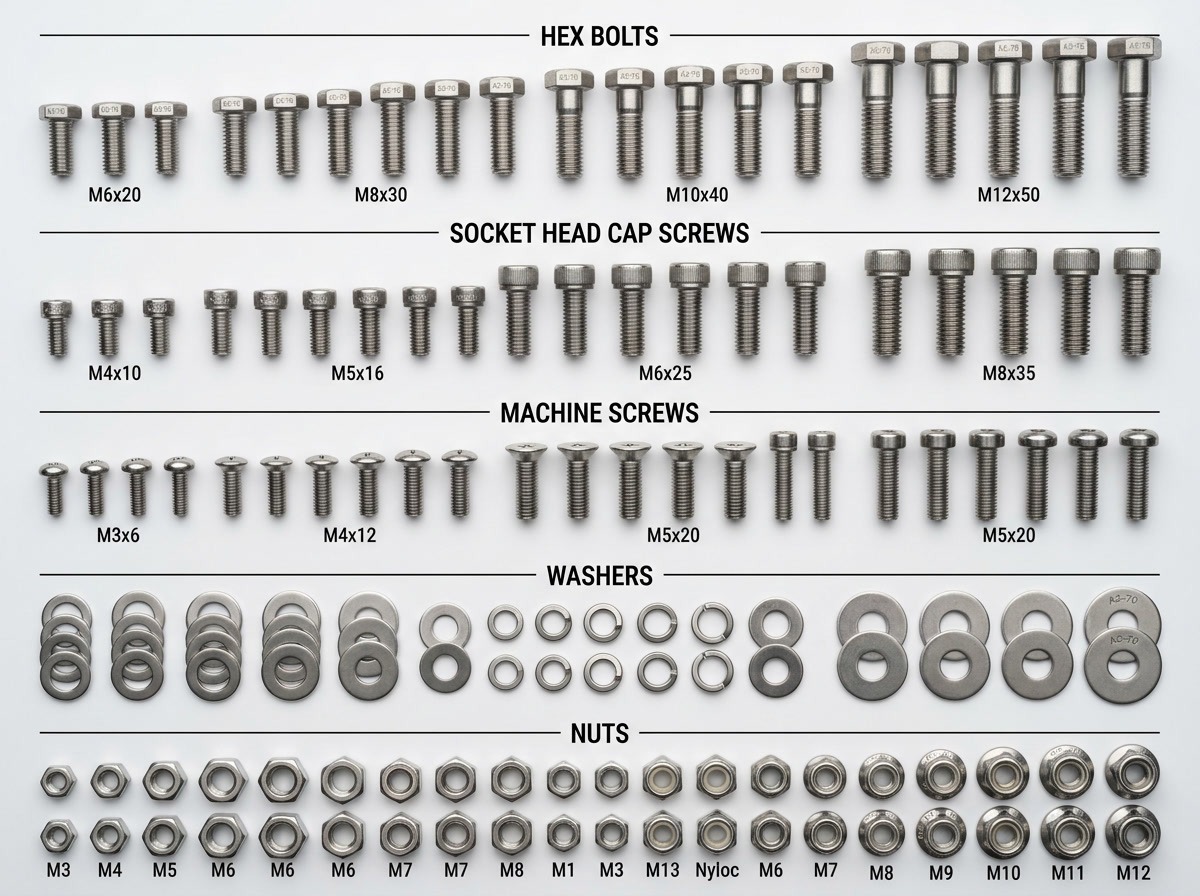
Stainless steel fasteners cover every standard fastener geometry. The corrosion-resistant material, not the shape, is what makes them “stainless” — but the type still matters for load path, installation tooling, and reusability.
Bolts and Hex Cap Screws
The workhorse of structural assembly. Hex cap screws have a trimmed bearing surface and are fully threaded; hex bolts have a larger bearing surface and are partially threaded for through-bolt applications. Both are available in UNC (coarse), UNF (fine), and metric thread pitches.
In structural applications, use hardened stainless washers under both head and nut — bare stainless-to-stainless contact under high clamp load galls aggressively. More on that in the failures section.
Socket Head Cap Screws
Higher strength-to-head-size ratio than hex heads, allowing installation in recessed bores and tight clearances. The Allen/hex drive also allows higher installation torque in limited-access situations. Standard grade 316 socket heads reach 90,000 psi tensile — not as strong as alloy steel, but adequate for most machine-element applications.
Watch: 316 socket heads have been reported to gall at the thread interface more than hex cap screws of the same grade, likely because installation torque is higher and more concentrated. Use nickel-based anti-seize on any stainless-to-stainless socket head installation above M8 or 5/16″.
Machine Screws and Sheet Metal Screws
For light-duty assembly — panel mounting, electrical enclosures, thin-sheet joints. Phillips and hex socket drives are common. In 304 and 316 grades, machine screws are specified for food equipment panels, marine electrical boxes, and outdoor signage where the fastener must not streak rust stains.
Nuts and Washers
Nuts: Always match grade with bolt grade. Mixing 304 nuts on 316 bolts is technically acceptable but creates a galvanic couple where the less-noble alloy corrodes preferentially. In chloride environments, use matched-grade hardware throughout.
Flat washers distribute clamp load and reduce galling at the bearing surface. Lock washers are less effective in stainless because the spring action requires hardness the austenitic grades lack — prefer thread-locking compound or nylon-insert locknuts (prevailing torque nuts) for vibration-resistant stainless assemblies.
Anchor Bolts and Concrete Fasteners
For structural anchoring into concrete in corrosive environments — seawall footings, outdoor structures in coastal zones, chemical plant floors — 316 stainless wedge anchors, sleeve anchors, and adhesive threaded rods are the specification. The Engineering ToolBox guide on anchor bolt loads provides working load calculations for common sizes.
Studs and Threaded Rod
Continuous threaded rod in 316 is standard for through-rod applications in chemical processing and marine structures. Cut to length, use two nuts to create a fixed-length stud. For high-temperature applications (exhaust manifolds, boiler flanges), consult elevated-temperature tensile data — austenitic stainless retains strength better than carbon steel above 800°F, but creep becomes relevant above 1000°F.
Industry Applications: Where Stainless Steel Fasteners Excel
Stainless steel fasteners perform best in wet, corrosive, hygienic, or high-aesthetic environments. In dry indoor structures under purely mechanical load, carbon steel is typically stronger and cheaper — stainless wins when the environment demands it.
Marine and Coastal Construction
Saltwater is the harshest common environment for fasteners. Below-waterline hardware faces constant chloride exposure, oxygen concentration cells (accelerating crevice corrosion), and biofouling. The specification is 316 stainless minimum; for serious offshore applications, some engineers specify 904L or duplex 2205 grades.
Above waterline, dock hardware, marine electrical panels, rigging fittings, and hull hardware all see regular splash and spray. 316 hex bolts and socket heads with a fresh-water rinse schedule hold up reliably. In practice, we’ve seen 304 on dock ladders show surface rust within 18 months at Pacific Coast marinas — 316 on the same ladders shows no visible degradation after six years.
Food Processing and Pharmaceutical
Hygiene regulations (FDA 21 CFR, EU 1935/2004) require food-contact hardware to be non-reactive, smooth, and cleanable. Grade 316 is standard; its lower carbon content and molybdenum addition resist pitting from cleaning agents (chlorinated sanitizers, CIP acids). All exposed fastener heads should be smooth (no external hex on the food-contact side — use socket heads recessed below the surface) to eliminate food-trapping geometry.
Chemical Processing
Stainless fasteners appear throughout chemical plant piping, reactor vessels, heat exchangers, and valve assemblies. Grade selection depends on the specific chemistry:
- Dilute inorganic acids (H₂SO₄ < 10%, HNO₃ < 65%): 304 or 316
- Chloride-bearing media or HCl: 316, duplex 2205, or Hastelloy — 304 will fail rapidly
- Strong oxidizing acids at high concentration: Consult a corrosion engineer; passive film behavior is counterintuitive
ASTM International publishes corrosion data for specific media — ASTM A193 covers alloy-steel and stainless bolting for high-temperature or high-pressure service, specifying mechanical requirements for different grade designations.
Architecture and Construction
Structural glazing, curtain wall systems, exterior cladding anchors, and balustrade hardware in commercial architecture use 304 or 316 depending on coastal exposure. High-end residential hardware — cabinet pulls, door hinges, deck screws — also uses 304 for its combination of aesthetics and corrosion resistance.
Roofing screws in 316 stainless are specified for metal roofing in coastal climates. The EPDM-sealed hex washer head design is standard — the washer seals the penetration while the stainless shank resists corrosion at the drip zone.
Electrical and Electronics
Stainless provides non-magnetic (austenitic grades), non-corrosive mounting in enclosures exposed to weather, industrial washdown, or corrosive atmospheres. Panel screws, DIN rail hardware, and enclosure lid bolts in NEMA 4X and IP66 enclosures are often 316 stainless with nylon-insert nuts for vibration resistance.
How to Choose the Right Stainless Steel Fastener
Start with environment, not price. The grade decision should be made before the size and thread decisions, because a wrong-grade fastener that fails costs far more than the premium for the right grade upfront.
Selection Decision Framework
Step 1 — Classify the environment:
– Indoor, dry, no chemicals → carbon steel or 304 (stainless adds no value in true dry indoor use)
– Outdoor, humid, no salt → 304
– Coastal, splash zone, mild salt → 316
– Marine immersion, chemical process, heavy salt → 316 or duplex
– High temperature (> 800°F) → research grade-specific data; consider 309, 310, or Alloy 20
Step 2 — Identify the load type:
– Static clamp load → standard grade 304/316 sufficient for most applications
– Dynamic/fatigue loading → consider proof load carefully; stainless has lower fatigue limit than alloy steel
– High tensile (> 100 ksi) → 17-4 PH or Inconel; austenitic grades won’t get there without cold-working
Step 3 — Determine thread engagement and size:
– Use the Bolt Depot fastener information guide for dimensional verification of thread pitch, head height, and under-head bearing diameter
– For tapped-hole installations, stainless requires a minimum 1.5× diameter thread engagement (vs. 1.0× for alloy steel) because the softer thread strips at lower load
Step 4 — Specify finish and drive:
– Passivated: standard for most 304/316 fasteners; clean surface improves corrosion resistance
– Electropolished: higher initial corrosion resistance; specified for pharmaceutical and semiconductor
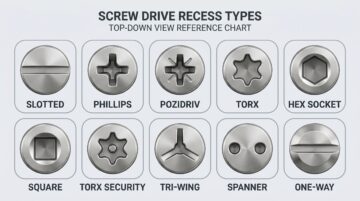
– Drive: prefer hex socket for recessed or torque-critical applications; hex head for ease of field installation; Phillips for light panel work only (cam-out strips stainless heads readily)
Torque Specifications
Austenitic stainless has a higher coefficient of friction and lower hardness than alloy steel, which changes torque specs significantly.
| Bolt Size | 304 SS Torque (ft-lb) | Alloy Steel Grade 8 Torque (ft-lb) | Ratio |
|---|---|---|---|
| 1/4-20 | 4 | 9 | 0.44 |
| 3/8-16 | 14 | 30 | 0.47 |
| 1/2-13 | 30 | 75 | 0.40 |
| 5/8-11 | 60 | 150 | 0.40 |
| 3/4-10 | 100 | 265 | 0.38 |
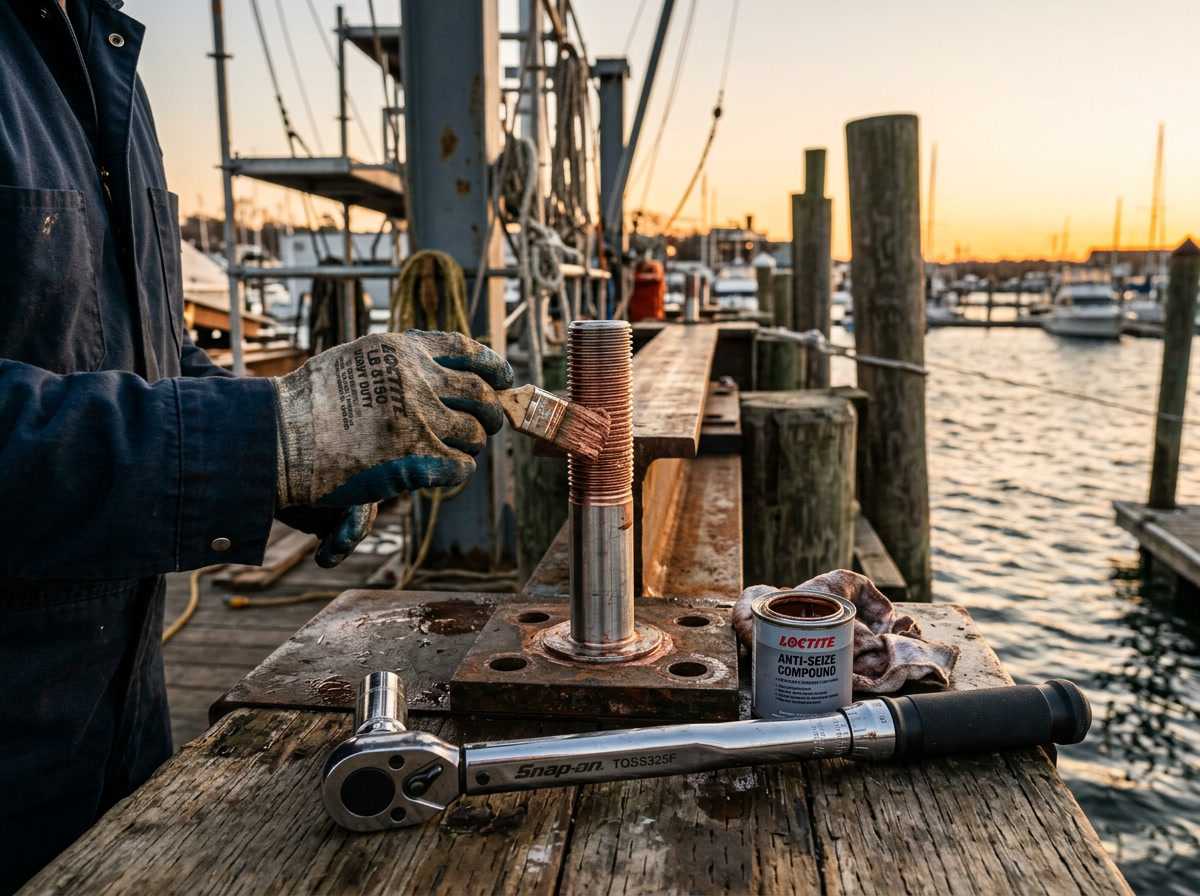
Always apply anti-seize compound (nickel-based preferred for stainless) and reduce installation torque by 20–30% from the dry value to account for the lubricating effect. Stainless-to-stainless thread interfaces without lubrication gall at installation in roughly 30% of cases in our field experience.
Preventing Galling
Galling is cold-welding of the thread interface under pressure and rotation — the threads tear, seize, and permanently lock. It’s more common in stainless than any other common fastener material, and it’s a one-way failure: a galled stainless fastener cannot be removed without destruction.
Prevention protocol:
1. Always use anti-seize on stainless-to-stainless thread contact
2. Install slowly — high-speed pneumatic tools generate heat that accelerates galling
3. Use dissimilar materials at the nut: a bronze nut on a stainless bolt, or vice versa, eliminates the same-material galling mechanism
4. Avoid overtorque — the compressive stress at overtorque crushes the passive film, exposing bare metal for cold welding
Common Mistakes and Failure Modes
Most stainless fastener failures in the field fall into one of five categories. Understanding these pays back more than any grade upgrade.
Mistake 1: Using 304 in Chloride Environments
The classic. Coastal architects specify “stainless” without the grade, get 304, and see surface rust (actually pitting and crevice corrosion) within two years at the fastener heads. Budget 316 from the start — the price premium over 304 is typically 25–35%, far less than remediation cost.
Mistake 2: Ignoring Galvanic Corrosion
Stainless steel is relatively noble on the galvanic series — it will drive corrosion into less noble metals it contacts. Stainless bolts in aluminum structure will corrode the aluminum aggressively in saltwater. Stainless screws in copper alloy fittings can create galvanic couples that pit the copper. Isolate dissimilar metals with PTFE or neoprene washers, or use fasteners that match the base metal’s nobility.
According to Wikipedia’s galvanic corrosion article, the further apart two metals are on the galvanic series, the greater the corrosion driving force when they’re electrically connected in an electrolyte. Stainless and aluminum in salt water is one of the worst common couples.
Mistake 3: Crevice Corrosion Under Washers
Tight contact between a washer and fastener head — or between the fastener and a flanged surface — excludes oxygen from the interface. The passive film breaks down, and an oxygen concentration cell forms: the oxygen-starved zone corrodes while the exposed surface remains passive. Fix: use broad-bearing washers that don’t create tight seals, or specify electropolished fasteners for critical joints.
Mistake 4: Galling During Installation
As described above — the most preventable failure mode. Every stainless-to-stainless thread interface in a joint should get nickel anti-seize before installation. No exceptions.
Mistake 5: Using Stainless Where High Strength Is Required
Grade A2-70 (equivalent to 304, 700 MPa tensile) and A4-70 (316, 700 MPa tensile) are the standard strength designations for stainless fasteners. A4-80 (800 MPa) is the high-strength stainless designation. Compare this to ASTM A490 alloy steel bolts at 1040–1240 MPa. If your application requires more than ~90 ksi, stainless austenitic grades cannot meet it without special processing — you need alloy steel, 17-4 PH, or Inconel.
Future Trends in Stainless Steel Fastener Technology (2026+)
The stainless fastener market is moving toward traceability, specialty alloys, and surface engineering — driven by infrastructure spending, marine renewable energy, and tightening supply chain documentation requirements.
Duplex Stainless Grades Going Mainstream
Duplex stainless alloys (2205, 2507) offer roughly twice the yield strength of 316 with equivalent or better corrosion resistance. Until recently, duplex fasteners were a specialty product for oil & gas and desalination. Falling production costs and growing offshore wind infrastructure are pulling duplex into marine construction and subsea fastener specifications. By 2027, we expect duplex to be a standard stock item at major fastener distributors, not a lead-time-required specialty.
Electropolishing as a Standard Specification
Surface finish directly affects corrosion initiation — electropolished surfaces have no surface iron contamination, no micro-scratches for chloride to lodge in, and a thicker initial passive film. Historically an aerospace/pharmaceutical specification, electropolishing is appearing in coastal architecture specs and marine engineering as awareness grows. The cost premium is roughly 15–25% over standard passivated finish.
Digital Material Traceability
The ASTM and ISO standards bodies are moving toward digital mill certification — QR-coded lot traceability embedded in fastener packaging that links to the heat certificate, tensile test results, and chemical analysis. Major infrastructure projects (bridges, offshore platforms) are beginning to require lot-level traceability documentation. Expect this to become standard for structural-grade stainless by 2027–2028.
| Trend | Current State | 2027 Projection |
|---|---|---|
| Duplex 2205 fasteners | Specialty / long lead time | Standard distributor stock |
| Electropolished finish | Pharma/aerospace spec | Coastal architecture standard |
| Digital traceability | Premium projects only | Required for structural spec |
| Hydrogen embrittlement testing | Research phase | Standard for HV fasteners |
Hydrogen Embrittlement in High-Strength Stainless
High-strength stainless fasteners (17-4 PH, cold-worked A4-80) are vulnerable to hydrogen embrittlement in cathodic protection systems, acid-pickling operations, and hydrogen-rich process environments. This failure mode is slow, brittle, and not visible before fracture. As offshore hydrogen production infrastructure grows, fastener standards for hydrogen service environments are being actively developed. Specifiers in this space should monitor ASTM and ISO working group outputs through 2026–2027.
FAQ
What are the disadvantages of stainless steel bolts?
Stainless steel bolts have three main disadvantages: lower tensile strength than alloy steel, high galling risk on stainless-to-stainless thread contact, and higher cost. Standard 304 and 316 grades reach 70,000–90,000 psi tensile, versus 150,000+ psi for Grade 8 carbon steel. In high-load structural joints, stainless cannot substitute for hardened alloy steel. The galling risk is manageable with anti-seize compound, but must be proactively addressed — ignoring it leads to seized, non-removable fasteners.
What is the difference between 304 and 316 stainless steel fasteners?
Grade 316 adds 2–3% molybdenum to the 304 base formula, which dramatically improves resistance to chloride pitting. In fresh water and mild outdoor environments, there’s no practical performance difference. In salt spray, seawater, or chloride-bearing industrial environments, 316 resists pitting where 304 fails within months. The cost premium is 20–40%; for marine or coastal applications it’s always justified.
When should you not use stainless steel bolts?
Avoid stainless steel bolts when: (1) tensile strength above 90 ksi is required — use alloy steel; (2) the joint requires magnetic properties; (3) the bolt will be in direct contact with aluminum in a wet environment without isolation — galvanic corrosion will attack the aluminum; (4) cost is the primary driver in a fully dry indoor application — carbon steel provides better strength-per-dollar.
Why use stainless steel fasteners?
Stainless steel fasteners provide corrosion resistance without coatings or platings that can be scratched, chipped, or chemically stripped. The passive film is self-repairing in air-exposed conditions. They’re required by food safety regulations for food-contact equipment, specified for marine and coastal hardware where rust streaking and structural corrosion are unacceptable, and preferred for hygienic applications (pharmaceutical, semiconductor cleanrooms) where metal particles from corroding fasteners cannot be tolerated.
How do I prevent galling on stainless steel fasteners?
Apply nickel-based anti-seize compound to all thread contact surfaces before installation. Install at low speed — under 50 RPM for power tools. Consider using a bronze or silicon bronze nut on a stainless bolt to eliminate the same-material galling mechanism. Avoid overtorque by using a calibrated torque wrench and referencing stainless-specific torque tables (not alloy steel tables, which will significantly overtorque stainless).
What does “18-8 stainless” mean?
18-8 refers to the nominal chromium (18%) and nickel (8%) content range — it’s a compositional descriptor, not a grade number. Grade 304 is the dominant alloy in the 18-8 range and the two terms are often used interchangeably in fastener catalogs. For general commercial use, 18-8 and 304 are equivalent. For spec-controlled work requiring material certifications (medical, aerospace, structural), require the specific ASTM grade designation and a mill certificate.
Are stainless steel fasteners magnetic?
Austenitic grades (304, 316) are non-magnetic in the annealed condition but become weakly magnetic when cold-worked during manufacture — so finished stainless fasteners often show slight magnetic attraction without being “magnetic” in the functional sense. Martensitic grades (410, 416) are fully magnetic. If magnetic properties are a hard requirement (or hard exclusion), specify 316 annealed and test incoming lots.
Conclusion
Stainless steel fasteners are not one product — they’re a family of alloys with meaningfully different performance envelopes, and selecting the right grade for your environment is the most consequential decision in the spec. For dry indoor use, you probably don’t need stainless at all. For outdoor, wet, or chemical environments, 304 handles most situations. For marine, coastal, and halide-rich chemical service, 316 is the minimum viable spec. And for any stainless-to-stainless thread interface, anti-seize compound is not optional.
The concrete next action: pull your application requirements (environment, load, temperature, regulatory), run through the four-step selection framework in this guide, and match to the correct grade before sourcing. Buying the right fastener once costs less than replacing the wrong one.
Related Products
Solutions & Cluster
Related Articles
- Sex Screw (Sex Bolt): Complete Guide to Types, Uses & Installation
- Nyloc Nut: Types, Sizes, Standards & Buying Guide (2026)
- Sexbolt Complete Guide: Types, Materials, Applications & Buying Tips (2026)
- What Is a Screw and Nut — and Why Does the Pairing Matter
- A2-70 Bolt: Complete Guide to Grade, Strength, and Applications
- Rivet Nut Ultimate Guide: Installation, Selection & Applications for 2026
- Nut Caging: Complete Guide to Cage Nuts, Types & Installation
- Nylon Spacers: The Complete Guide to Types, Sizes, and Applications