 English
  German
  Spanish
  Portuguese
  French
  Japanese
  Arabic
  Korean
  Vietnamese
  Russian
 A self locking nut is a fastener designed to resist loosening under vibration, shock, or dynamic loads by generating friction between the nut and bolt threads through a nylon insert or a controlled deformation of the nut body.
Every bolted joint fails eventually. The ones that fail fastest are held together by standard hex nuts that let vibration slowly unwind the thread engagement until clamping force disappears — sometimes quietly, sometimes catastrophically. If you work in automotive assembly, heavy machinery, or any environment where equipment vibrates, the self locking nut is one of the most cost-effective reliability upgrades available. The difference between a nyloc and a plain hex nut is a few cents. The difference in joint longevity can be measured in years.
This guide covers how self locking nuts work at a mechanical level, every major type and what it is actually suited for, how to select the right design for your application, and what the installation mistakes that shorten service life look like. By the end, you will have a clear framework for specifying self locking nuts across production environments — and a shorter list of joint failures to troubleshoot.

What Is a Self Locking Nut?
A self locking nut — also called a prevailing torque nut, stiff nut, or locknut — maintains its clamping position on a bolt without relying on friction from the bearing surface alone.
Standard nuts rely on what engineers call “bearing surface friction” and “thread friction” to stay put. Tighten a nut to the correct preload, and those two friction forces keep it from rotating backward. That works fine in static conditions. Add vibration — even low-frequency, low-amplitude vibration of the kind produced by a diesel engine at idle — and the thread surfaces slip microscopically each cycle. Over thousands of cycles, the nut inches backward and clamping force bleeds away.
A self locking nut breaks that failure mode by introducing a third resistance mechanism: prevailing torque. Prevailing torque is the measurable rotational resistance that exists even before the nut bears against any surface. You feel it when you start threading a nyloc onto a bolt: there is friction even with no load applied. That resistance comes from either a non-metallic insert or a deformed thread section, and it is the defining characteristic of any self locking nut.
How Prevailing Torque Works
When a nylon insert self locking nut engages a bolt, the bolt threads cut into the nylon collar. The deformed nylon constantly pushes back against the bolt threads with elastic force. Remove the bolt, and the nylon partially recovers — but the interference fit is what matters while the joint is under load.
All-metal self locking nuts create prevailing torque differently: a section of the nut is deliberately deformed — either pinched oval, staked inward, or given a different pitch — so the bolt threads must cut through a slightly mismatched zone. The metallic friction force that results is higher than nylon per unit area and survives temperatures that destroy nylon. The trade-off is that all-metal nuts tend to damage their bolts more with repeated cycling.
In either design, the key measurable quantity is prevailing torque in Newton-meters. International standards define minimum prevailing torque values for each size and grade. DIN 985 (nylon insert) and DIN 980 (all-metal) both specify prevailing torque ranges; a nut that falls below the minimum is considered failed for the locking function even if the threads are intact.
Self Locking Nut vs. Standard Nut
The distinction is not just material. It is a design philosophy: standard nuts rely entirely on the installer applying enough preload; self locking nuts assume the preload will degrade and add an independent resistance mechanism.
| Feature | Standard Hex Nut | Self Locking Nut |
|---|---|---|
| Vibration resistance | Low — relies on preload only | High — prevailing torque independent of preload |
| Re-use | Unlimited if threads intact | Limited (nylon) / moderate (all-metal) |
| Max service temperature | ~400°C (grade-dependent) | ~120°C nylon, ~300°C+ all-metal |
| Installation torque | Lower — standard torque values | Higher — must overcome prevailing torque |
| Cost | Low | Moderate (1.5–4× standard hex) |
| Thread damage to bolt | Minimal | Moderate (all-metal types) |
| Applications | Static loads, sealed joints | Vibration, shock, dynamic loads |
Types of Self Locking Nuts
Self locking nuts divide into two main families — non-metallic insert types and all-metal types — with several variants in each category serving different temperature, load, and reuse requirements.
Understanding the type matrix is practical because specifying the wrong type in a high-temperature environment or over-torquing a nyloc in an aluminum housing leads to predictable failures. Here is how the types map to real-world use.

Nylon Insert Lock Nuts (Nyloc / DIN 985)
The nyloc — short for nylon lock nut — is the most widely used self locking nut in general manufacturing. A collar of nylon protrudes slightly below the nut body. When threaded onto a bolt, the nylon deforms elastically around the bolt threads and creates consistent prevailing torque.
Why engineers choose nyloc: The nylon insert is gentle on bolt threads. You can remove a nyloc without damaging the bolt, and the bolt can often be reused indefinitely. The nyloc itself is single-use or limited-reuse — the nylon recovers partially but prevailing torque decreases with each removal.
Per the engineering mechanics well-documented in the AskEngineers community, the nylon ring crimped in the nut gets deformed by the bolt threads and then continuously presses against those threads with a spring-like restoring force — the mechanism that makes the lockout effective.
Key limitation: DIN 985 nyloc nuts are rated to approximately 120°C continuous service. Above that threshold, the nylon softens, creeps, and loses its locking function. In engine compartments, exhaust-adjacent applications, or sterilization environments, nyloc is not the correct answer.
DIN 986 (dome nyloc): Same nylon insert mechanism, but the top of the nut is closed with a domed cap — a combination of locknut and acorn nut. Used where thread end protection plus locking is needed, common in marine and outdoor exposed assemblies.
DIN 6926 (flanged nyloc): A nyloc with an integrated washer-flange at the bearing surface. The flange distributes clamp load over a larger area — useful in soft materials like plastics or aluminum where a standard hex nut would indent the surface.
All-Metal Self Locking Nuts (DIN 980 / Stover Nut)
When temperature, chemical exposure, or regulatory requirements rule out nylon, all-metal self locking nuts are the correct choice. These nuts achieve prevailing torque through a distorted thread section — typically the top 2–3 threads are pinched oval or inwardly staked so the bolt must force its way through a controlled interference.
As documented in Wikipedia’s overview of locknuts, all-metal locknuts typically create prevailing torque through deformation of either the nut body or the thread profile, making them suitable for elevated temperature applications where non-metallic inserts would degrade.
DIN 980V / Stover nut: The most common all-metal self locking nut in industrial and automotive applications. The top section is deformed oval. Reliable to 300–450°C depending on material grade; stainless variants extend higher.
DIN 7967 (PAL nut / counter nut): A very thin, stamped all-metal nut used as a secondary lock on top of a standard nut. Inexpensive, but the locking torque is modest — suitable for light loads or where depth is limited.
Aerotight (Philidas) nuts: These use a patented method of deforming the nut collar to create thread interference. The locking zone is separate from the thread-bearing zone, which allows higher residual locking torque after reuse compared to standard all-metal types. Common in aerospace and defense.
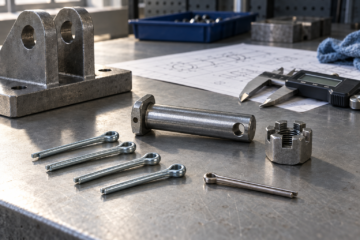
Castle nuts (DIN 935) / Slotted nuts: Not a prevailing torque design. These nuts lock via a cotter pin or safety wire through a drilled hole in the bolt. They are the gold standard for critical aviation applications — the pin provides a positive mechanical lock that is visually inspectable. The limitation is that the hole must align with the slot at the correct clamping position.
Specialty and Application-Specific Types
| Type | Standard | Locking Method | Temperature Limit | Ideal Application |
|---|---|---|---|---|
| Nyloc hex nut | DIN 985 | Nylon insert | ~120°C | General manufacturing, vibration environments |
| Dome nyloc | DIN 986 | Nylon insert + closed top | ~120°C | Marine, exposed outdoor hardware |
| Flange nyloc | DIN 6926 | Nylon + integral flange | ~120°C | Soft substrates, aluminum, plastics |
| All-metal hex (Stover) | DIN 980V | Oval distortion | ~300°C+ | High-temp, automotive exhaust, aerospace |
| PAL nut | DIN 7967 | Thin stamped counter nut | ~300°C | Secondary lock, thin-section applications |
| Castle/slotted nut | DIN 935 | Cotter pin/safety wire | Grade-dependent | Aviation, safety-critical joints |
| Aerotight (Philidas) | — | Collar deformation | ~400°C | Aerospace, defense, high-reuse |
| Cleveloc | — | Slit collar interference | ~250°C | General industrial, medium-reuse |
Industry Applications of the Self Locking Nut
Self locking nuts appear in virtually every sector where bolted joints experience dynamic loads — automotive, aerospace, construction, electronics, and agricultural equipment all rely on them for joint integrity under real operating conditions.
The self locking nut is not a premium option reserved for critical joints. In many industries it is the default specification because the cost of joint failure — warranty claims, downtime, safety liability — far exceeds the incremental cost of the locknut over a standard hex.
Automotive and Heavy Machinery
In automotive assembly, self locking nuts are specified for wheel fasteners, suspension components, exhaust brackets, and powertrain mounts. The operating environment — sustained engine vibration, road-induced shock, thermal cycling — would loosen standard nuts within months.
Wheel assembly specifications frequently call for all-metal self locking nuts on critical studs because the temperature environment near brake rotors exceeds 120°C intermittently, ruling out nyloc. Suspension mounting points, which see constant dynamic loading, often use flange-style nylocs on aluminum subframe components — the flange distributes the clamp load and reduces surface indentation.
In heavy machinery — excavators, mining equipment, agricultural tractors — self locking nuts appear in virtually every articulation point. A broken pin held by a plain hex nut that worked loose is a field repair measured in hours of downtime and thousands of dollars in labor. A nyloc or Stover nut costs a few cents more at the manufacturing stage.
Aerospace and Aviation
Aerospace fastener standards are the most demanding in any industry. According to NASA technical fastener standards, critical aerospace joints require positive locking mechanisms — meaning the lock cannot be defeated by the load path alone. Castle nuts with cotter pins, or all-metal prevailing torque nuts meeting NASM 25027 or AS1175, are the typical answer.
The key aerospace constraint is that nylon insert locknuts are generally not approved for structural applications in fixed-wing aircraft. The FAA and EASA require all-metal self locking nuts for structural, flight-control, and engine-mount applications. Nyloc is sometimes permitted in non-structural, interior, or avionics mounting where temperatures stay within limits.
Aerotight (Philidas) and Cleveloc nuts are popular in aerospace because their all-metal locking mechanism maintains prevailing torque through more installation-removal cycles than standard oval-distortion designs — an important factor when line-replaceable units are removed for scheduled maintenance.
Electronics, Consumer Products, and Light Industry
At the other end of the load spectrum, small-format self locking nuts — M3 to M6 nyloc — are ubiquitous in electronics enclosures, rack-mount equipment, and consumer appliances. The vibration source here is not road shock but fan vibration, motor-induced resonance in HVAC units, and transport shock during shipping.
In server rack applications, M6 DIN 985 nyloc or cage nuts with locking inserts prevent rack-mount equipment from vibrating loose in data centers with high-density cooling airflow. In consumer appliances — washing machines, dishwashers — nyloc nuts on motor and drum-mounting brackets are a factory default that prevents a common source of field failures.
How to Choose the Right Self Locking Nut
Match the locking mechanism to the three key constraints: maximum service temperature, reuse frequency, and substrate material. Every other selection factor is secondary.
Most selection errors come from one of three mistakes: specifying nyloc in a high-temperature environment, specifying a high-torque all-metal locknut in a soft-material substrate, or reusing locknuts past their service limit. A structured selection approach eliminates all three.

Match the Locking Mechanism to the Environment
Step 1: Temperature. If the joint will see sustained temperatures above 120°C — or intermittent peaks above 150°C — nylon insert types are off the table. Use an all-metal design (DIN 980, Stover, Aerotight, or Cleveloc).
Step 2: Chemical exposure. Nylon degrades in strong acids and some solvents. Stainless all-metal locknuts (A2 or A4) are the correct choice in chemical processing, marine, and food-grade environments. Where nylon is acceptable chemically, specify a stainless nyloc to protect the metallic body.
Step 3: Positive locking requirement. If your regulatory environment (aerospace, nuclear, medical) requires a mechanically positive lock — one that cannot rotate backward under any load condition — a prevailing torque nut alone may not satisfy the requirement. Castle nuts with cotter pins, or safety-wired slotted nuts, provide a genuinely positive lock that is also visually inspectable.
Step 4: Reuse frequency. Nyloc nuts lose prevailing torque with each removal-reinstallation cycle. The DIN 985 standard requires that a new nyloc meet its prevailing torque minimum for the first installation; the nut is typically rated for 1–5 reuses before prevailing torque falls below minimum. If your application requires frequent disassembly — maintenance intervals under 100 hours, or more than 5 reuse cycles — specify an all-metal type or plan to replace nyloc nuts at each service.
Size, Thread Pitch, and DIN Standards
Self locking nuts follow standard metric (ISO) and imperial (UNC/UNF) thread systems. The important sizing note: a self locking nut must match the thread specification exactly. A nyloc specified to M10 × 1.5 coarse pitch will not generate correct prevailing torque on an M10 × 1.25 fine pitch bolt — the interference geometry is wrong.
DIN 985 (nyloc) and DIN 980 (all-metal hex) cover M4 through M36 in standard sizes. For aerospace, NASM 25027 (all-metal) and MS21044 (nylon insert) cover the most common inch and metric configurations. Always specify both the thread size and pitch, not just the nominal diameter.
Material Selection
Material choice drives corrosion resistance, temperature limit, and strength class:
| Material | Strength Class | Temp Limit | Corrosion Resistance | Best Application |
|---|---|---|---|---|
| Carbon steel + zinc plate | 8, 10, 12 | ~300°C | Low-moderate | General dry industrial |
| Stainless A2 (304) | 70, 80 | ~400°C | High | Marine, food, chemical |
| Stainless A4 (316) | 70, 80 | ~400°C | Very high | Offshore, severe marine |
| Phosphor bronze | — | ~150°C | Good (non-magnetic) | Electrical, non-sparking |
| Nylon body (plastic) | — | ~80–100°C | Excellent | Lightweight, insulation needed |
| Titanium | Grade 2/5 | ~300°C | Excellent | Aerospace, weight-critical |
One practical note from production experience: mixing material grades between bolt and nut generates galvanic corrosion in wet environments. A carbon steel bolt with a stainless nyloc will corrode at the interface in salt spray. Specify both components in the same material family, or use a barrier coating.
Installation and Reuse Best Practices
The most common cause of self locking nut failures in the field is not the wrong product selection — it is incorrect installation torque or ignoring reuse limits.
Correct Torque Application
Every self locking nut has a higher installation torque requirement than a standard hex nut of the same size, because the wrench must overcome both the prevailing torque and build the target preload. Manufacturers publish total installation torque values — the sum of seating torque plus prevailing torque — and these must be followed, not standard hex nut torque charts.
A common mistake: using the standard torque table for an M10 hex nut (typically 48–54 Nm depending on grade) for an M10 DIN 985 nyloc. The prevailing torque of the nyloc might be 3–8 Nm depending on size and grade. That sounds small, but the preload achieved at a given torque input is reduced by the prevailing torque component. If you apply the standard 54 Nm target, you actually achieve slightly less preload than with a standard nut. Compensate by using the manufacturer’s self locking nut torque table, which accounts for this offset.
In practice: For most standard M6–M16 nyloc applications, add 10–20% to the standard hex torque value when no manufacturer table is available. For all-metal types, the prevailing torque is higher (especially on first installation); add 20–30%.
Use a calibrated torque wrench. Impact wrenches without torque control are inappropriate for self locking nuts because the impact energy tends to mask the prevailing torque feedback, making it easy to over-torque.
Reuse Limits and When to Replace
A self locking nut that has been removed should be inspected before reinstallation. Key inspection points:
- Thread condition: Run your finger along the bolt threads and inside the nut. Damaged, galled, or cross-threaded surfaces indicate the nut should be scrapped.
- Prevailing torque feel: Thread the nut onto a known-good bolt by hand before installing into the assembly. The resistance should be distinctly measurable — if the nut spins freely without noticeable resistance, it has lost its locking function.
- Nylon insert integrity: For nyloc nuts, visually inspect the nylon collar. Melted, cracked, or missing sections indicate heat exposure or mechanical damage beyond service limits.
- Distortion (all-metal types): Oval-distortion all-metal locknuts reduce their distortion over reuse cycles. If the nut shows visible deformation recovery — if it now looks round when it should be oval at the top — replace it.
The conservative rule across most industries: replace nyloc nuts every maintenance cycle. The per-unit cost is negligible; the cost of a joint loosening in service is not.
Future Trends in Self Locking Fastener Technology
The self locking nut is not standing still as a product category. Two trends — high-performance materials for extreme environments and embedded sensing for condition monitoring — are reshaping what a locknut can do.
High-Performance Materials and Coatings
The push into electrified vehicles (EVs) and hydrogen fuel cells is creating new demand for self locking nuts in high-temperature, high-vibration battery enclosures and fuel cell stacks. Polymer insert formulations are evolving to handle sustained temperatures up to 180°C — extending the nyloc design principle into environments where it was previously excluded.
On the metal side, titanium grade 5 (Ti-6Al-4V) all-metal locknuts are increasingly specified in lightweight aerospace and motorsport applications. Titanium provides comparable strength to steel at roughly 40% of the weight, with corrosion resistance that exceeds most stainless grades. The Engineering ToolBox notes that fastener material selection for weight-critical assemblies increasingly considers lifecycle total cost, where titanium’s corrosion resistance reduces maintenance intervals and offset its higher per-unit cost.
Surface coatings are also advancing. Fluoropolymer (PTFE) dry-film coatings applied to all-metal locknuts reduce galling during installation, improve corrosion resistance, and provide consistent friction coefficients — which means more predictable torque-to-preload relationships in production assembly.
Smart Fasteners and IIoT Integration
In industrial maintenance, the emerging concept of the “smart fastener” involves embedding sensors — MEMS accelerometers or piezoelectric elements — directly into the fastener stack to detect changes in vibration signature that indicate clamping force loss. While these are not yet standard self locking nuts in the catalog sense, prototype systems from several fastener manufacturers are already in field trials in wind turbine and rail infrastructure applications.
The practical implication for procurement teams: within the next 5–7 years, critical bolted joints in IIoT-connected manufacturing environments may specify sensor-integrated lock fasteners for condition-based maintenance, replacing time-based replacement schedules. Self locking nuts in those joints will be specified jointly with the monitoring system, not independently.
Frequently Asked Questions About Self Locking Nuts
Answers to the most common questions engineers and procurement teams ask about self locking nut selection, installation, and application.
How do I tell if a nut is a self locking nut?
Thread it onto a matching bolt by hand — a self locking nut will require noticeably more force to turn than a standard hex nut, even before it seats. For nyloc types, you will see a distinct nylon collar at the top of the nut. For all-metal types, look for a slightly deformed, non-round top section or a staked/inward-punched area on the nut face. The prevailing torque is the definitive test: if it spins freely without resistance, it is not locking, or the locking feature has failed.
Can a self locking nut be reused?
Nylon insert self locking nuts can be reused a limited number of times — typically 1 to 5 cycles depending on size and type — before prevailing torque drops below the minimum. All-metal types generally allow more reuse cycles (up to 10–15 for some Aerotight designs) before replacement is required. Always re-check prevailing torque by feel before reinstallation, and follow any manufacturer-specified reuse limits for safety-critical applications.
What is the difference between a nyloc nut and an all-metal lock nut?
The key difference is temperature limit and reuse behavior. Nyloc nuts use a nylon insert for locking (good to ~120°C, gentle on bolt threads, limited reuse). All-metal locknuts use thread deformation (typically rated 300–450°C, harder on bolt threads, more reuse cycles). Choose nyloc for general manufacturing where temperature is moderate; choose all-metal for high-temperature, aerospace, or high-reuse applications.
What direction do I tighten a self locking nut?
The same direction as any right-hand-thread fastener: clockwise when viewed from above. The self locking mechanism works in both rotational directions — the prevailing torque resists both tightening and loosening. No special installation orientation or “locking direction” exists for standard metric self locking nuts.
What DIN standard covers self locking nuts?
DIN 985 covers hex nylon insert lock nuts (nyloc, metric). DIN 980 covers all-metal prevailing torque hex nuts. DIN 986 covers dome-style nyloc nuts, and DIN 7967 covers PAL counter nuts. For aerospace, NASM 25027 (all-metal) and NAS1291 (nylon insert) are the US equivalents, while ISO 7042 covers all-metal and ISO 7044 covers non-metallic insert types at the international level. The ISO standards for fasteners provide the authoritative source for international dimensional and performance requirements.
Are self locking nuts approved for use in aircraft?
Non-metallic insert types (nyloc) are generally not approved for structural or flight-control applications in fixed-wing aircraft per FAA and EASA regulations. All-metal prevailing torque nuts meeting NASM 25027 or equivalent are the standard for structural aerospace applications. Castle nuts with cotter pins remain the preferred solution for critical articulation joints where positive mechanical locking is required and the joint is regularly inspected.
When should I use a self locking nut instead of a thread-locking adhesive (Loctite)?
Use a self locking nut when you need a mechanically reliable, tooling-compatible lock that can be removed and reinstalled without heat or chemical solvents. Thread-locking adhesive is effective for small fasteners, fine threads, and applications where a nut is not practical. The self locking nut has an advantage in production assembly (no cure time, predictable torque), in high-temperature applications where adhesive degrades, and wherever repeated disassembly is planned. The two methods can be combined in extreme vibration environments, but be aware that thread-locking adhesive applied to a nyloc will increase removal torque significantly and may damage the nylon insert.

Conclusion
The self locking nut is a deceptively simple solution to one of the most persistent problems in mechanical engineering: bolted joints that loosen in service. Whether you are specifying M6 nyloc nuts for electronics enclosures or M20 Stover nuts for heavy-machinery pivot points, the selection logic is consistent — match the locking mechanism to the temperature environment, understand the reuse limits, and always apply the manufacturer’s installation torque values rather than standard hex nut tables.
The incremental cost difference between a standard hex nut and a well-specified self locking nut is rarely more than a few cents per joint. The cost of a joint that loosens in production equipment — downtime, warranty exposure, potential safety liability — is rarely less than several hundred dollars. Getting the specification right at the design stage is the highest-return fastener decision you will make.
For sourcing self locking nuts in production volumes — from M4 nyloc to M36 all-metal flanged types — our team can assist with specification matching, material grade selection, and supply-chain planning. Contact us with your drawing or specification requirements.
Related Products
Solutions & Cluster
Related Articles
- Sex Screw (Sex Bolt): Complete Guide to Types, Uses & Installation
- Bolt Screw Guide: Types, Differences, Sizes, and Industrial Applications
- Fasteners, Screws & Bolts: The Complete Selection Guide
- Essential Guide to UNC Fittings: Types, Uses, and Applications
- Thread Forming Screws: Complete Guide to Types, Uses & Selection
- Anti Theft Screws for Licence Plate: The Complete Buyer’s Guide (2026)
- Sex Bolt: The Complete Guide to Barrel Nuts, Chicago Screws, and Through-Bolting Fasteners
- Nyloc Nut: Types, Sizes, Standards & Buying Guide (2026)