 English
  German
  Spanish
  Portuguese
  French
  Japanese
  Arabic
  Korean
  Vietnamese
  Russian
 A castellated nut (also called a castle nut) is a hex nut with slots or notches cut into one end, designed to accept a cotter pin or safety wire that locks the nut in place and prevents it from loosening under vibration, shock loads, or cyclic stress.
Imagine a wheel bearing assembly on a heavy truck rattling down a gravel road for 50,000 miles. Every bump transfers a tiny rotational impulse to every fastener in the axle system. A standard hex nut, even a properly torqued one, can creep loose over thousands of cycles. A castellated nut doesn’t. Its slotted crown, combined with a stainless cotter pin threaded through a matching hole in the bolt shank, creates a positive mechanical lock that vibration simply cannot undo.
That’s the core promise of this guide: by the end, you’ll know exactly which castellated nut to use, how to install it correctly the first time, and how to avoid the mistakes that cause costly rework or dangerous failures in the field.

What Is a Castellated Nut?
A castellated nut is a positive-locking fastener that combines the clamping function of a standard hex nut with a mechanical anti-rotation feature. The name comes from its resemblance to the battlements (called merlons) on a medieval castle tower — the notched, toothed profile along the top face is impossible to miss once you know the reference.
According to Wikipedia’s overview of castellated nuts, the design has been in continuous use since the early 20th century and remains one of the most reliable positive-locking solutions in mechanical engineering. Unlike friction-based lock nuts (nylon insert, prevailing torque), the castellated nut’s locking mechanism is entirely independent of the clamping force.
Design Features That Define the Castellated Nut
The anatomy of a castellated nut has four defining elements:
- Hex body — identical in profile and thread pitch to a standard hex nut; wrench sizing is the same
- Slotted crown — typically 6 slots (occasionally 4 on light-duty variants) machined symmetrically around the top face
- Extended height — a castellated nut is roughly 15–20% taller than a standard hex nut to accommodate the crown slots without sacrificing thread engagement depth
- Matching bolt hole requirement — the fastener assembly only works when the mating bolt has a cross-drilled hole through the shank, positioned so at least one slot aligns after final torque
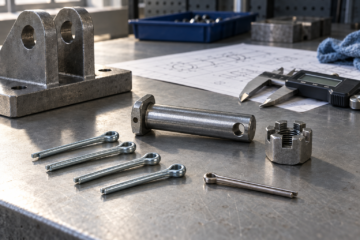
The cotter pin (or in aviation, a safety wire) is then bent through the slot–hole combination and folded against the nut face. Even if the threads were to back off by half a turn, the cotter pin bears against the slot wall and stops rotation completely.
Castellated Nut vs. Regular Hex Nut
Most engineers understand intuitively that a castellated nut locks tighter, but the full comparison is worth laying out clearly.
| Feature | Standard Hex Nut | Castellated Nut |
|---|---|---|
| Locking mechanism | Friction only (thread interference) | Positive mechanical (cotter pin / safety wire) |
| Vibration resistance | Moderate — requires thread-locking compound | Excellent — independent of friction |
| Reusability | Unlimited (no thread damage) | Cotter pin is single-use; nut body is reusable |
| Installation complexity | Simple — torque and done | Moderate — bolt must have cross-drilled hole |
| Height (vs. standard) | Baseline | ~15–20% taller |
| Standards | ISO 4032, ASME B18.2.2 | DIN 935, AN310, MS17825 |
| Typical applications | General fastening | Axles, steering, landing gear, hydraulic fittings |
The trade-off is real: castellated nuts require more design forethought (pre-drilled bolt shanks) and a slightly slower installation. But in any safety-critical assembly where vibration loosening could injure someone or destroy a machine, that trade-off is not a trade-off at all — it’s mandatory.
Types of Castellated Nuts
Not all castellated nuts are the same, and selecting the wrong type can mean a mismatch with your bolt standards, incorrect height clearances, or a failed inspection in aerospace or defense work. Here are the main families.
Standard Hex Castellated Nuts (DIN 935 / SAE J482)
The DIN 935 castellated nut is the workhorse of the category. Manufactured to German Institute for Standardization (Deutsches Institut für Normung) specification, this nut is available in metric threads from M4 through M100, in property classes 6, 8, and 10. The SAE J482 specification covers the inch-series equivalent for North American automotive and industrial applications.
Key characteristics:
– Six symmetrical crown slots
– Available in carbon steel (zinc-plated, hot-dip galvanized, or plain), stainless steel, and brass
– Used with standard DIN 1444 / ISO 1234 cotter pins
– Compatible with DIN 71 cross-drilled clevis pins and axle bolts
The SAE International J482 standard specifies castle nut dimensions, tolerances, and material requirements for automotive and light-truck axle applications — it’s the reference document most North American suppliers work from.
Thin Castellated Nuts (DIN 979)
The DIN 979 thin castle nut is identical in crown geometry to DIN 935 but with a reduced overall height — typically 20–30% shorter. This makes it useful in space-constrained assemblies where a full-height castellated nut would interfere with adjacent components.
The reduced height does mean slightly shorter thread engagement, so thin castle nuts should not be used as direct replacements for standard-height versions without an engineering review of the joint’s tensile load capacity.
Aerospace Castellated Nuts (AN310 / MS17825)
Aviation-grade castellated nuts are manufactured under strict military and aerospace standards. The two most common specifications are:
- AN310 (Air Force/Navy standard, also referred to as MS20310 in some military contexts) — shear-strength hex castle nut in cadmium-plated steel and corrosion-resistant steel (CRES), designed for use with AN bolts and MS bolts in aircraft structures
- MS17825 — a coarser-threaded variant used in engine mounts and other high-stress locations
Both require use with a matching cotter pin (AN380 or AN381) and installation per NASA’s fastener reliability standard NASA-STD-5020, which mandates cotter pin engagement depth, bend geometry, and inspection criteria for flight-critical joints.
| Type | Standard | Thread System | Typical Material | Slot Count |
|---|---|---|---|---|
| Standard hex castle nut | DIN 935 / SAE J482 | Metric / UNF/UNC | Grade 8 steel, SS304 | 6 |
| Thin castle nut | DIN 979 | Metric | Grade 6 steel | 6 |
| Aerospace castle nut | AN310 / MS17825 | AN / MS (inch) | Cad-plated steel / CRES | 6 |
| Fine-thread castle nut | DIN 935 fine | Metric fine pitch | Grade 8 steel | 6 |
| Large-diameter castle nut | Custom / DIN 935 | M42–M100 metric | Alloy steel | 6 or 8 |

Industry Applications of Castellated Nuts
A castellated nut shows up wherever engineers cannot accept even a small probability of a fastener backing off on its own. That covers a surprisingly wide range of industries.
Automotive and Steering Systems
The most common consumer-facing application is the front hub and wheel bearing assembly. On nearly every passenger car and light truck manufactured before the widespread adoption of sealed hub units, the wheel bearing preload is set by torquing a castellated nut to specification, then backing off slightly and inserting a cotter pin. The resulting pre-load retains the bearing’s rolling elements in contact with the races without over-compressing them.
Castellated nuts also appear in:
- Steering tie rod ends and ball joints — where any rotational play in the fastener translates directly into imprecise steering response
- Drag link and pitman arm connections on heavy trucks and agricultural equipment
- Brake camshaft adjusters on drum-brake systems
- Suspension arm pivot bolts on older and heavy-duty vehicle designs
In these locations, a cotter pin failure is a safety event. We’ve seen in practice that undersized cotter pins (using a 1/8 in. pin where a 5/32 in. was specified) are the most common installation mistake — the pin fits loosely in the slot and can migrate out under vibration.
Aerospace and Aviation
Aviation is where the castellated nut became an engineering standard rather than an option. The consequences of fastener loosening on an aircraft are catastrophic, and regulators have codified the requirement for positive locking in every flight-critical joint.
AN310 castle nuts are used extensively on:
– Control surface hinge bolts (ailerons, elevators, rudder)
– Landing gear pivot pins and retraction linkage
– Engine mount bolts (with safety wire rather than cotter pin in high-vibration engine bays)
– Propeller flange bolts on piston aircraft
The FAA’s aviation maintenance technician guidance reinforces that a missing or improperly installed cotter pin on a flight-control fastener is a no-fly discrepancy — the aircraft may not depart until the pin is correctly installed and bent per specification.
Agricultural Machinery and Marine Applications
Agricultural equipment operates in some of the harshest environments for fasteners: constant vibration from power take-off shafts, exposure to grit and moisture, and infrequent maintenance intervals that can stretch to a full crop season.
Castellated nuts are common on:
– PTO shaft yokes and spline ends — where rotational loads plus vibration would walk a regular nut off within hours
– Header attachment bolts on combine harvesters
– Hydraulic cylinder clevis pins — these see alternating tensile and compressive loads with every cylinder stroke
Marine applications leverage stainless steel castellated nuts (typically 316 SS) for their corrosion resistance in salt water, saltwater spray, and bilge environments. Marine drive shaft retaining nuts, rudder pintle bolts, and outboard motor mounting bolts are common examples.
How to Install a Castellated Nut Correctly
Correct installation of a castellated nut is not complicated, but it requires attention to sequence and a few non-negotiable checks. Skip any of these and you’ve defeated the entire purpose of using a positive-locking fastener.
Tools and Materials Required
- Torque wrench (click-type or electronic) calibrated for the target torque range
- Open-end or socket wrench matching the castellated nut’s across-flats dimension
- Correctly sized cotter pin: diameter and length per the bolt manufacturer’s specification
- Needle-nose pliers and diagonal cutters (for bending and trimming the cotter pin)
- Thread-cleaning brush or tap if re-using a previously installed fastener
- Anti-seize compound (optional, but recommended for stainless-on-stainless to prevent galling)
Pro tip: Always verify the cotter pin diameter before installation. The pin must fill at least 75% of the hole diameter to carry meaningful load. An undersized pin can vibrate out; an oversized pin can split the slot and crack the nut crown.
Step-by-Step Installation with Cotter Pin
- Clean the bolt threads — remove any old thread-locking compound, corrosion, or grit with a wire brush. Damaged threads should be chased with the correct die before installation.
- Inspect the castellated nut — check the crown slots for cracks, deformation, or previous cotter pin damage. Discard any nut with a cracked slot.
- Hand-thread the nut — spin the castellated nut onto the bolt until it seats. If it binds, check for thread damage rather than forcing it.
- Torque to specification — use a torque wrench to reach the lower bound of the specified torque range. For most automotive hub bearings this is a defined value (e.g., 100–150 ft-lb for a 1-ton truck hub bearing), not a rough estimate.
- Align a slot with the cotter pin hole — if no slot aligns after reaching minimum torque, advance the nut (tighten further) to the next slot. Never back off to align. If you’ve exceeded the maximum torque before alignment, the bolt hole position needs to be revised.
- Insert the cotter pin — push the pin through the slot and bolt hole until the head seats against the slot wall. The pin should be a snug push-fit, not loose.
- Bend the pin legs — bend one leg toward the bolt axis (over the threaded end) and the other leg back along the nut flat. Cut excess length so neither leg extends more than 1.5× the pin diameter beyond the bend.
- Visual inspection — the bent legs must not contact any rotating or moving component. In a wheel hub, confirm clearance from the hub dust cap and brake dust shield.

Common Installation Mistakes to Avoid
Backing off the nut to align slots. This is the single most common error. Backing off reduces clamping force below the minimum specified value and can cause joint fatigue. Only advance (tighten) to reach alignment.
Using the wrong cotter pin material. The ASTM International material standard for cotter pins (ASTM F1221) covers both low-carbon steel (cadmium or zinc-plated) and stainless steel versions. Using a carbon steel cotter pin in a marine or food-processing environment is a corrosion failure waiting to happen.
Bending the cotter pin at a sharp right angle. Sharp bends crack the pin. Use smooth, controlled bends; a bent pin that breaks under vibration gives you zero positive locking.
Re-using a cotter pin. Cotter pins are single-use fasteners. Once removed and bent back straight for reuse, the metal is work-hardened at the bend point and will fracture under much lower stress.
Omitting the cotter pin. It sounds obvious, but in high-production environments the cotter pin step is sometimes skipped accidentally. A torqued castellated nut without a cotter pin is exactly as safe as a regular hex nut — the slotted crown provides no benefit without the pin.
Selecting the Right Castellated Nut: Material, Grade & Size
Choosing the correct castellated nut for your application is a three-variable problem: material, strength grade, and dimensional specification.
Material Options: Carbon Steel, Stainless Steel, and Brass
Carbon steel (zinc-plated or hot-dip galvanized) is the standard choice for automotive, agricultural, and general industrial applications. It offers high strength-to-cost ratio and is compatible with standard SAE and DIN specifications. Drawback: it will corrode without a protective coating in moisture-rich environments.
Stainless steel 304 offers good corrosion resistance for mildly corrosive environments and is the go-to for food processing equipment, marine deck hardware, and outdoor structures. We’ve found that 304 SS castle nuts are significantly easier to source in metric sizes than 316 SS in small quantities.
Stainless steel 316 adds molybdenum to the alloy, providing superior resistance to chloride stress-corrosion cracking — the failure mode that destroys 304 SS fasteners in saltwater or chlorinated environments. Mandatory choice for submerged marine components, coastal structural applications, and chemical plant equipment.
Brass castellated nuts are used in electrical applications, plumbing fittings, and where non-magnetic or non-sparking properties are required. Brass is softer, so torque values are lower and the joint must not see high tensile loads.
Strength Grades and Standards (SAE, DIN, AN/MS)
| Material | Standard | Grade / Class | Proof Load (MPa) | Typical Use |
|---|---|---|---|---|
| Carbon steel | DIN 935 | Class 6 | 380 | Light industrial, agricultural |
| Carbon steel | DIN 935 | Class 8 | 580 | Automotive, heavy machinery |
| Carbon steel | SAE J482 | Grade 5 equivalent | 552 | North American automotive |
| CRES (17-4 PH) | AN310 | — | 1100+ | Aerospace, defense |
| Stainless 304 | DIN 935 | A2-70 | 560 | Corrosive environments |
| Stainless 316 | DIN 935 | A4-80 | 640 | Marine, chemical |
| Brass | DIN 935 | — | ~120 | Electrical, plumbing |
When in doubt, size up on grade rather than down. The incremental cost difference between a Class 8 and a Class 6 castellated nut is negligible compared to the cost of a joint failure.
Sizing a Castellated Nut: Thread Pitch, Width Across Flats, and Height
Castellated nuts must be dimensionally matched to the bolt — thread pitch and diameter are obvious, but height matters more than most buyers realize. Here’s why: the crown slots must align with the cross-drilled hole in the bolt shank after torquing. If the nut is too short, the slots sit below the hole. If it’s too tall, the cotter pin hole in the bolt is concealed inside the nut bore. Neither condition permits correct cotter pin installation.
When ordering replacement castle nuts, always specify:
– Nominal thread diameter and pitch (e.g., M20×1.5 or 3/4–16 UNF)
– Property class or grade (6, 8, 10 for metric; Grade 5 or Grade 8 for inch series)
– Standard (DIN 935 for metric, SAE J482 for inch, AN310 for aerospace)
– Coating (zinc-plated / Zn-Ni / hot-dip galvanized / plain; confirm Cr3+ compliance if EU export)
For assemblies where you’re designing from scratch, the general rule is to position the bolt’s cross-drill hole so the nearest slot aligns at or just above minimum torque. This gives you the least back-off risk (none — you always advance to align) while keeping the assembly within the bolt’s proof load range. Most bolt manufacturers offer cross-drilling as a purchased option; specify the hole position relative to the last thread as part of your print call-out.
Future Trends in Fastener Locking Technology (2026+)
The castellated nut has been largely unchanged for a century, and that’s a testament to how well the design works. But the broader fastener industry is evolving, and some of those changes are starting to intersect with positive-locking technology.
Digital Torque Monitoring and Smart Fasteners
Embedded torque-sensing fasteners — bolts with micro-strain gauges in the shank that report clamp load wirelessly — are moving from research labs into production vehicles and infrastructure. A number of Tier-1 automotive suppliers are piloting these systems on EV battery pack assemblies and suspension subframes, where periodic torque audits are currently manual and labor-intensive.
For castellated nuts specifically, this creates an interesting hybrid: a castellated nut provides the mechanical lock (eliminating vibration loosening), while the smart bolt shank monitors the actual clamping force over the product’s service life. The combination catches the edge case where the bolt itself has stretched beyond its yield point — a condition that a cotter pin alone cannot detect. Industry data from ASTM International’s fastener technology working groups suggests smart fastener adoption in safety-critical automotive joints will reach meaningful production volumes by 2028.
Sustainable Materials and Manufacturing
Hexavalent chromium (Cr6+) plating — historically the most common corrosion protection for carbon steel castellated nuts — is now heavily regulated under EU REACH and the U.S. EPA due to its carcinogenicity. The industry transition to trivalent chromium (Cr3+) and zinc-nickel (Zn-Ni) plating is substantially complete in automotive supply chains, but older industrial MRO catalogs still list Cr6+ variants.
If you’re sourcing castle nuts for a product sold in the EU or exported to markets with RoHS/REACH compliance requirements, verify the coating specification explicitly — “zinc-plated” alone does not confirm Cr3+ compliance. Reputable suppliers will provide a material safety data sheet and plating bath certification on request.
Additive manufacturing (metal 3D printing) is beginning to produce specialty castellated nuts in exotic alloys — titanium, Inconel, custom high-entropy alloys — for aerospace and motorsport applications where weight or temperature performance requirements rule out standard grades. These are currently low-volume, high-cost parts, but they demonstrate the design’s adaptability.
FAQ
What is the difference between a nut and a castle nut?
A standard nut relies on thread friction alone to resist loosening. A castle nut adds crown slots that, when used with a cotter pin through a cross-drilled bolt shank, create a physical barrier to rotation. The castle nut is always used where vibration or dynamic loads would eventually loosen a standard nut.
What is another name for a castle nut?
The terms castellated nut and castle nut are used interchangeably in the industry and refer to the same part. Older British engineering documents sometimes use slotted nut, though that term can also refer to a different design (a full-hex nut with slots in the face rather than the crown).
What is the difference between a castle nut and a shear nut?
A castle nut is designed for maximum retention — the cotter pin creates a positive mechanical lock. A shear nut (also called a shear bolt nut or breakaway nut) is designed to shear off at a controlled torque value, providing tamper resistance or indicating when a torque threshold has been exceeded. They are used for completely different purposes.
Can you reuse a castellated nut?
The nut body can be reused if the threads and crown slots are undamaged. However, the cotter pin must always be replaced with a new one — bent cotter pins are work-hardened at the bend point and will fail at a fraction of their original load capacity.
What cotter pin size do I use with a castellated nut?
The cotter pin diameter should match the cross-hole in the bolt shank — typically listed in the bolt specification or the assembly drawing. As a general rule, the pin should fill at least 75% of the hole diameter. Common sizes range from 1/16 in. (1.6 mm) for small fasteners up to 1/4 in. (6.4 mm) for heavy truck axles.
Why can’t I back off the castellated nut to align the slots?
Backing off the nut reduces clamp force below the specified minimum. The joint may feel tight but is actually under-clamped — a condition that leads to fatigue failure of the bolt or the mating components. Always advance (tighten) to the next alignment position, not retract.
How do I remove a castellated nut?
Straighten the cotter pin legs carefully with pliers, then pull the pin out using needle-nose pliers or a pin punch. Once the pin is removed, the castellated nut unscrews normally with any wrench matching its across-flats dimension. Discard the used cotter pin.

Conclusion
The castellated nut is one of mechanical engineering’s most enduring solutions precisely because it addresses a fundamental problem — vibration loosening — with a mechanism that requires no friction, no adhesive, and no electrical power. As long as the cotter pin is correctly installed, the nut will not rotate.
Selecting the right castellated nut comes down to three questions: What standard does your application require (DIN 935, AN310, SAE J482)? What environment will the fastener live in (choose material accordingly)? And what strength grade does the joint load demand? Get those three right, follow the installation procedure, and you’ll have a fastener assembly that outlasts almost everything else in the system.
A note on inspection and documentation: in any safety-regulated application (aerospace, automotive OEM, heavy machinery), keep a record of the castellated nut batch number, cotter pin lot number, and the technician who performed the installation. If a joint is ever re-inspected or a component is returned under warranty, that traceability chain is invaluable. In our experience with production line fastening, the facilities that maintain this discipline almost never face fastener-related field failures — not because the parts are different, but because the process discipline that supports documentation also supports correct installation.
Ready to source castellated nuts for your next project? Browse our full range of standard and specialty castle nuts — available in metric and inch sizes, carbon steel and stainless, with same-day shipping on stocked items.
Related Products
Solutions & Cluster
Related Articles
- Essential Screws: Choosing the Right Fasteners for Your Projects
- The Best Weldable Threaded Studs: Applications and Benefits Explained
- Stainless Steel Bolts: The Complete Guide to Types, Grades, and Industrial Applications
- Security Bolts: Complete Guide to Types, Applications & Choosing the Right Fastener
- Thread Forming Screws: Complete Guide to Types, Uses & Selection
- Lock Nut Complete Guide: Types, Selection & Industrial Applications in 2026
- Anti Theft Screws for Licence Plate: The Complete Buyer’s Guide (2026)
- M2 Screws: The Complete Guide to Specifications, Types, and Applications