 English
  German
  Spanish
  Portuguese
  French
  Japanese
  Arabic
  Korean
  Vietnamese
  Russian
 A shear bolt is a deliberately weakened fastener designed to break under excessive load, protecting expensive machine components from damage.
You’re running your snowblower through a heavy drift when suddenly — thunk. The machine seizes. You’ve hit a buried branch or a chunk of ice the size of a fist. If that impact force had reached the impeller shaft, the gearbox, or the auger drive, you’d be looking at a $400–$800 repair. Instead, you spend 90 seconds replacing a $0.35 fastener and get back to work.
That’s a shear bolt doing exactly what it’s engineered to do.
This guide covers everything you need: how shear bolts work, which grades protect your equipment (and which ones will destroy it), size charts with torque specs, application-specific selection advice, and removal techniques. By the end, you’ll be able to pick the right shear bolt for any machine in your shop.
What Is a Shear Bolt and How Does It Work?
A shear bolt is a sacrificial fastener — a bolt engineered to fail at a precise, controlled load so that the more expensive components around it survive. When torque or lateral force exceeds the bolt’s shear strength, it snaps cleanly, breaking the power transmission chain before damage cascades upstream.
The mechanism is straightforward. In a snowblower auger system, for example, the shear bolt passes through the auger shaft and the impeller housing. Under normal operation, the bolt holds the assembly rigid and transmits rotational force. The moment a rock or ice jam creates a spike in resistance — typically a momentary force of 500–1,500 lb-ft depending on the machine — the bolt’s weakest cross-section fails in shear. The auger stops. The engine keeps running. The gearbox is untouched.
The Shear Bolt vs. the Shear Pin: What’s the Difference?
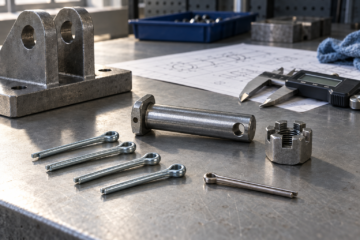
This confusion comes up constantly, and it matters. A shear pin is a smooth cylindrical rod (think a cotter pin or hardened steel dowel) installed in a hole perpendicular to the shaft axis. A shear bolt is a threaded fastener — it has a head, a shank, and threads — and it fails in shear across its thread relief or an intentional notch.
| Feature | Shear Bolt | Shear Pin |
|---|---|---|
| Thread | Yes — standard hex bolt threads | No — smooth cylindrical rod |
| Failure zone | Thread relief or machined notch | Cross-section at shear plane |
| Common applications | Snowblowers, augers, PTO drives, log splitters | Older snowblowers, marine drives, small tillers |
| Replacement speed | Faster — uses standard hardware | Requires cotter pin or snap ring |
| Load precision | Moderate (controlled by grade) | High (controlled by diameter + material) |
| Cost | $0.25–$0.60 per bolt | $0.50–$2.00 per pin |
In practice, post-1990 snowblowers and most agricultural PTO-driven equipment use shear bolts because they’re faster to replace and easier to source. Older machines and marine shaft couplings still use shear pins.
How Shear Force Works at the Fastener Level
When an overload event happens, the force acts perpendicular to the bolt’s long axis — that’s what “shear” means in this context. The bolt doesn’t pull apart (tension failure); it slices across. The shear strength of a bolt is roughly 60% of its tensile strength. For a Grade 5 bolt, that’s about 60% × 120,000 psi = 72,000 psi shear strength.
Manufacturers choose a bolt grade and diameter so that the calculated shear force at failure is safely below the yield strength of the protected components, but reliably above the operating load range. That window is narrower than most people realize — which is why using the wrong grade can either fail prematurely (nuisance trips) or fail to protect the machine at all.
Types of Shear Bolts
Not all shear bolts are the same. They differ in head style, shank design, material, and whether they have a deliberately machined weak point.
Standard (Unmarked) Shear Bolts
These look like ordinary hex bolts but are made from a specified lower-grade steel. The entire thread relief area (where threads end at the shank) acts as the failure zone. Most snowblower OEM shear bolts fall into this category. They’re zinc-plated or plain steel, typically 5/16″-18 or 3/8″-16 thread, and Grade 1 or Grade 2.
Notched or Pre-Scored Shear Bolts
Notched shear bolts have a circumferential groove machined into the shank — a precise reduction in cross-sectional area. This creates a defined, repeatable failure point. They’re more expensive ($0.75–$2.50 each) but offer tighter tolerance on the break force. You’ll find them in agricultural PTO shields, commercial snowblower fleets, and conveyor drives where nuisance trips or under-protection are both unacceptable.
Flanged Shear Bolts
Flanged shear bolts have an integrated flange under the head that distributes clamping load and reduces the risk of the head pulling through a soft-metal housing. Common in die-cast aluminum snowblower auger housings where a standard hex head would brinell (embed) into the soft material over repeated tightening cycles.
Full-Thread vs. Partially-Threaded Shear Bolts
Full-thread bolts (threads running from tip to head) fail across whichever thread valley is under maximum shear stress. Partially-threaded bolts have a smooth shank at the grip length — they fail at the predictable smooth-to-thread transition. The smooth-shank design is preferred in precision applications because the failure location is controlled.
Material Variants: Steel, Stainless, and Zinc Alloy
Most shear bolts are low-carbon steel (Grade 1 or 2) with zinc plating for corrosion resistance. Stainless shear bolts exist for marine and food-processing applications, but be cautious: 304 stainless has lower shear strength than Grade 2 carbon steel, while 316 stainless is weaker still. If your OEM spec says Grade 2 carbon steel, a stainless bolt won’t necessarily be a direct swap — verify the load rating with the manufacturer.
Shear Bolt Grades: Which One Actually Protects Your Equipment
Grade selection is where most equipment damage actually originates. Using the wrong grade doesn’t just fail to protect the machine — it can actively cause catastrophic damage.
Grade Overview
| Grade | SAE Marking | Tensile Strength | Shear Strength (est.) | Typical Use |
|---|---|---|---|---|
| Grade 1 | No marks | 60,000 psi | ~36,000 psi | Snowblowers, light augers |
| Grade 2 | No marks (better quality) | 74,000 psi | ~44,000 psi | Mid-duty agricultural equipment |
| Grade 5 | 3 radial marks | 120,000 psi | ~72,000 psi | General structural use — rarely correct for shear bolt |
| Grade 8 | 6 radial marks | 150,000 psi | ~90,000 psi | High-strength structural — wrong for shear bolt applications |
| Metric 8.8 | “8.8” on head | ~116,000 psi | ~70,000 psi | European/Asian machinery (similar to Grade 5) |
Can I Use a Grade 8 Bolt as a Shear Bolt?
No — and this is the single most common mistake that destroys gearboxes. A Grade 8 bolt has a shear strength roughly 2.5× higher than the Grade 1 or Grade 2 bolt it’s replacing. When an overload happens, the Grade 8 bolt doesn’t break. Instead, the force transmits directly to your auger gearbox, auger shaft, or PTO coupling. We’ve seen $800 gearbox failures that trace directly back to someone “upgrading” from the OEM shear bolt to a Grade 8 because they were tired of the bolts breaking.
The OEM shear bolts break because they’re doing their job. If they’re breaking too frequently, the correct fix is to understand why — not to install a stronger fastener.
Grade 5 is similarly dangerous in most light-equipment shear bolt positions. According to McMaster-Carr’s engineering reference for shear fasteners, shear bolt selection should always begin with the OEM specification, not with general-purpose hardware.
When Does Grade 5 Apply?
Grade 5 shear bolts are correct in heavy-duty commercial applications where the protected components are also heavy-duty — large PTO gearboxes, industrial conveyor drives, commercial-grade wood chippers. The operating loads are higher, so the protection threshold needs to be higher. The key is that the machine’s design must have been validated with that grade.
Shear Bolt Size Chart and Torque Specifications
Size matters both for fit and for shear load. A larger-diameter bolt has greater cross-sectional area, so it requires proportionally more force to shear. Mixing up a 5/16″ bolt with a 3/8″ bolt in the same application changes the break force by roughly 44%.
Common Sizes and Applications
| Size | Thread | Typical Break Force (Grade 2) | Common Application |
|---|---|---|---|
| 1/4″-20 | Coarse | ~850 lb | Small tillers, hedge trimmers |
| 5/16″-18 | Coarse | ~1,400 lb | Snowblowers (most single-stage) |
| 3/8″-16 | Coarse | ~2,100 lb | Two-stage snowblowers, small augers |
| 7/16″-14 | Coarse | ~2,900 lb | Mid-size agricultural equipment |
| 1/2″-13 | Coarse | ~3,800 lb | Heavy PTO equipment, log splitters |
| M8×1.25 | Metric | ~1,600 lb | European equipment equivalents |
| M10×1.5 | Metric | ~2,500 lb | European mid-duty equipment |
These break-force figures are approximate for Grade 2 (SAE) carbon steel. Actual values depend on exact material composition and heat treat; always verify against your OEM service manual.
Torque Specs for Shear Bolts
This is where many technicians get it wrong. Shear bolts should be tightened to snug plus one-quarter turn — not to the standard torque specification for that bolt size. Over-torquing pre-stresses the shank and lowers the actual shear failure point unpredictably. Under-torquing creates fretting wear and fatigue that also lowers the break force over time.
Most snowblower service manuals specify 12–18 ft-lb for 5/16″ shear bolts and 20–28 ft-lb for 3/8″ shear bolts. When in doubt, use a torque wrench — not a ratchet at arm’s length.
Top Applications for Shear Bolts
The shear bolt shows up wherever rotating equipment needs overload protection at a lower cost than a slip clutch or torque limiter. Here are the highest-volume use cases.
Snowblower Auger Drive
The most recognizable application. Single-stage machines use two shear bolts passing through the auger paddle shaft; two-stage machines protect the auger-to-impeller connection. Ariens, Husqvarna, Toro, Cub Cadet, Honda, and Craftsman all use OEM shear bolt specs in the 5/16″-18 to 3/8″-16 range, Grade 1 or Grade 2. Replace both bolts any time one breaks — a single-side shear creates an imbalance that accelerates wear on the remaining bolt.
Agricultural Equipment and PTO Drives
PTO-driven equipment — rotary cutters, hay balers, post hole diggers, grain augers — use shear bolts at the input shaft to protect the gearbox from sudden impacts (rocks, stumps, frozen ground). Agricultural shear bolts are often metric on European-origin equipment. A critical note: on PTO drive shafts, some shear bolt positions are safety-critical per OSHA’s agricultural machinery guarding standards. Using the wrong grade doesn’t just risk equipment damage — it risks guard failure under impact.
Log Splitters and Wood Chippers
Log splitters with horizontal ram designs use shear bolts at the hydraulic pump drive coupling. Wood chippers use them on the chipper disc drive. The failure modes here tend to be more violent (large, sudden overloads from knotty hardwood), so pre-scored notched shear bolts are common.
Conveyor Systems and Industrial Machinery
Manufacturing conveyor lines use shear bolts as the last line of mechanical overload protection between the motor and the drive shaft. In food processing and packaging, stainless shear bolts are specified. The advantage over electronic torque limiters: a mechanical shear bolt fails instantly with no control system dependency.
Snow Plow Trip Edge Systems
Heavy-duty snow plow blades use shear bolts on the trip-edge springs. When the blade hits a curb or storm drain cover at plowing speed, the shear bolt releases the trip edge, allowing the blade to fold back rather than transmitting the full impact force to the truck’s front suspension. These bolts are typically larger (1/2″-13 or 5/8″-11) and in Grade 2 or Grade 3.
How to Choose the Right Shear Bolt
Start with the OEM specification. Everything else follows from there.
Step 1: Find the OEM Part Number
Your equipment’s service manual lists the shear bolt part number, and from that you can determine the grade, size, and length. Don’t skip this step. Even if the bolt looks like a standard hardware-store item, it may have a specific material spec that a generic bolt doesn’t meet.
Step 2: Identify the Failure Mode You’re Solving For
Ask yourself: is the bolt breaking too often under normal operation, or is it failing to break when it should? These are opposite problems with opposite solutions.
Breaking too often: Check for a build-up of debris in the bolt holes causing misalignment, worn auger paddles putting extra load on the drive, or ice jamming in the impeller housing rather than at the shear point. Installing a stronger bolt is not the fix.
Not breaking (machine damage occurring): The installed bolt is too strong for the application. Verify grade — someone may have substituted a Grade 5 or Grade 8 at some point.
Step 3: Match Grade to Application Duty
| Application | Correct Grade |
|---|---|
| Consumer snowblower (single-stage) | Grade 1 or OEM Grade 2 |
| Two-stage snowblower | Grade 2 (OEM spec) |
| Light agricultural equipment (< 20 HP PTO) | Grade 2 |
| Mid-duty agricultural (20–60 HP PTO) | Grade 2 or Grade 5 per OEM |
| Heavy PTO equipment (> 60 HP) | Grade 5 per OEM spec |
| Industrial conveyor (engineered drive) | Consult drive engineering spec |
Step 4: Check Thread and Length
A bolt that’s too long will bottom out in the threaded hole before clamping the assembly, leaving the shank under tension rather than shear. A bolt that’s too short won’t engage enough threads for reliable clamping. Standard grip length for a shear bolt equals the thickness of the material being clamped plus one diameter.
Step 5: Consider Environmental Factors
Outdoor equipment in humid climates should use zinc-plated or hot-dipped galvanized shear bolts to prevent corrosion bonding (more on this in the removal section). Food-processing and marine environments require stainless, with careful attention to the grade substitution issue discussed earlier.
According to research compiled by the American Society of Mechanical Engineers on fastener failure analysis, corrosion is the leading cause of premature shear bolt failure in outdoor equipment — not overload events.
Shear Bolt Removal and Replacement
A shear bolt that has done its job is broken. Getting the broken half out of the threaded hole is the practical skill most guides skip entirely.
Tools You Need
- Replacement shear bolts (always keep 6–10 on hand; they come in multi-packs)
- Torque wrench (set to OEM spec)
- Needle-nose pliers
- Penetrating oil (PB Blaster or equivalent)
- EZ-Out extractor set (3/16″ to 3/8″ sizes)
- Center punch and hammer
- Drill with left-hand drill bits (8mm and 5/16″ recommended)
Removing a Clean Break (Flush Break)
When the bolt breaks cleanly and the fractured end sits roughly flush with the hole surface, the easiest method:
- Apply penetrating oil and wait 10 minutes.
- Use needle-nose pliers if any of the broken end protrudes.
- If flush, center-punch the exact center of the broken end.
- Drill a pilot hole with a left-hand drill bit at low speed — left-hand bits often back the broken stud out before you need an extractor.
- If the left-hand bit doesn’t remove it, drive an EZ-Out extractor (counterclockwise turning motion) into the pilot hole.
Removing a Below-Surface Break
When the bolt breaks below the hole surface — typically happens when a bolt was overtorqued or had corrosion bonding — you need more patience:
- Soak with penetrating oil overnight if possible.
- Use a carbide-tip center punch to create a clean center mark.
- Drill carefully with the smallest feasible left-hand bit, staying centered.
- Switch to an EZ-Out and apply steady, slow torque. Do NOT impact-drive an extractor — it will fracture and become much harder to remove than the original broken bolt.
In the worst case (extractor broken in hole), an EDM (electrical discharge machining) shop can remove it without damaging the threads — this costs $80–$200 but saves a housing that costs $300+.
Preventing Future Difficult Removals
Apply a thin coat of anti-seize compound to the shear bolt shank (not the threads — only the shank that contacts the hole bore) before installation. This prevents corrosion bonding without significantly affecting the shear load. Never apply anti-seize to the threads on a shear bolt — it reduces friction and alters clamping force unpredictably.
When to Replace vs. Inspect Further
Replace the shear bolt every time it shears. Inspect the hole for elongation, fretting wear marks, or cracks radiating from the bolt hole edges. If the hole is visibly elongated, the housing or shaft is worn and the new bolt will shear prematurely. According to Wikipedia’s reference on mechanical fastener fatigue), hole elongation from repeated impact loading is a common precursor to shaft or housing failure — address it before it becomes catastrophic.
Future Trends in Shear Bolt Technology (2026+)
The shear bolt is 150+ years old as a concept, but it’s seeing meaningful innovation driven by smart agriculture, predictive maintenance, and materials science.
Smart Shear Bolts with Embedded Sensors
Several agricultural equipment manufacturers — including AGCO and CNH Industrial — are piloting shear bolts with embedded strain gauges and short-range wireless transmitters. The bolt still shears at its rated load, but in the milliseconds before failure, the sensor logs peak force, operating temperature, and cycle count. That data feeds into predictive maintenance systems: if a bolt is experiencing near-shear force events 20× more frequently than baseline, the system flags the auger housing for inspection before the next catastrophic jam.
A 2024 report by McKinsey & Company on smart agriculture infrastructure estimated that predictive maintenance in agricultural equipment could reduce unplanned downtime by 30–40% by 2030 — sensor-embedded shear bolts are one of the lower-cost implementations of that capability.
Composite and Ceramic Shear Elements
For high-cycle industrial applications (conveyors, packaging lines running 24/7), composite shear elements made from engineered thermoplastics (PEEK, PPS, glass-filled nylon) are gaining traction. They offer a tighter failure tolerance band (±5%) compared to standard Grade 2 steel bolts (±15–20%), faster replacement (no stuck broken ends), and zero corrosion issues. Cost per element is 3–5× higher, but in a facility replacing shear protection elements 50+ times per year, the labor and downtime savings more than offset the material cost.
Adjustable Torque Limiters as Shear Bolt Alternatives
In applications where the shear bolt shears too frequently under legitimate overloads (e.g., a snowblower in unusually heavy wet snow conditions), adjustable friction-slip clutches and cam-action torque limiters offer a re-engageable alternative. These don’t “break” — they slip at a preset torque, then re-engage once resistance drops. They cost $40–$200 installed versus $0.35 for a shear bolt, but for commercial operators who can’t afford downtime for bolt replacement, the economics can work.
Frequently Asked Questions About Shear Bolts
Can I use a grade 8 bolt as a shear bolt?
No. A Grade 8 bolt has 2.5× the shear strength of the Grade 1 or Grade 2 bolt it would replace. Under overload, it won’t break — instead, the force transmits to your gearbox, shaft, or impeller housing, causing far more expensive damage. Grade 8 bolts are for structural connections. Never use them where a shear bolt is specified.
What causes shear bolts to break?
Shear bolts break when the applied force exceeds their designed shear strength — that’s their job. Premature or frequent breaking usually points to a secondary problem: frozen debris in the auger housing, worn paddles increasing drive resistance, bolt hole wear causing misalignment, or incorrect replacement bolts installed previously. If bolts are breaking under normal operation, diagnose the root cause rather than installing a stronger replacement.
How many shear bolts should I keep on hand?
For a single-stage snowblower, keep at least 6–8 OEM-spec bolts on hand at the start of winter. For a two-stage machine, 10–12. Buy them in packs — they’re cheap, and running out mid-storm is a genuine problem. Always replace both bolts on a two-bolt auger when one shears, even if the other looks intact.
Are shear bolts universal, or do I need OEM bolts?
They’re not universal. While a shear bolt may look like a standard hex bolt, the OEM specifies grade, length, and sometimes a specific material composition. Using generic hardware-store bolts in Grade 2 from the same size family is often acceptable as a backup, but verify grade markings carefully. If no marks are visible on the bolt head, it’s Grade 1 — confirm that matches your OEM spec before installing.
What’s the difference between shear bolt and shear pin size charts?
Shear bolt size charts list thread diameter, thread pitch, grip length, and grade. Shear pin size charts list diameter and length of a smooth cylindrical rod. They’re not interchangeable — a machine designed for shear pins has smooth holes in the shaft, not threaded holes. Attempting to use a bolt where a pin is specified (or vice versa) will either fail to engage properly or fail at the wrong load.
Can I weld a broken shear bolt to remove it?
Yes — this is a legitimate technique. Weld a nut to the broken stub using a MIG welder, let it cool, then remove with a socket. The heat from welding also helps break the corrosion bond. This works well on larger bolts (3/8″ and above) where the stub is deep enough to get a good weld. It doesn’t work on small bolts with minimal exposed stub material.
How often should I inspect shear bolt holes on my snowblower?
Inspect at the start of each winter season and after any shear event. Look for oval elongation of the bolt hole (indicates repeated side-loading and wear), cracks radiating from the hole edge, and surface damage or burring on the shaft where the bolt engages. Elongated holes need professional repair — the shaft or housing needs to be built up or replaced before the next season.
What’s the correct way to store spare shear bolts?
Keep them in a labeled zip-lock bag in your equipment’s tool compartment or zip-tied to the machine’s frame near the auger. Don’t store them loose in a toolbox where they mix with other hardware — you need the correct bolt when conditions are worst and you’re working fast. Include a spare nut (they often get lost when the bolt shears) and a small sheet with your machine’s torque spec written on it.
Conclusion
The shear bolt is the least expensive and most ignored form of mechanical overload protection in rotating equipment. A $0.35 fastener stands between a 90-second field repair and a $600 gearbox replacement. The engineering behind it is precise: grade selection, diameter, torque spec, and installation technique all affect whether the bolt protects the machine or becomes a liability.
The single most important takeaway: use the OEM-specified grade. Don’t upgrade to Grade 5 or Grade 8 thinking stronger is better. Understand that a bolt breaking is usually success, not failure. And keep a stock of the right bolts on hand so that when the overload event happens — and it will — you’re back in service in under two minutes.
For equipment-specific shear bolt specifications, size charts, and replacement packs for your machine make and model, browse related: snowblower shear bolt kits or reach out to our technical support team for custom specification matching.
Related Products
Solutions & Cluster
Related Articles
- Nut Lock Complete Guide: Types, How They Work & Choosing the Right One
- Aluminum Screws: Complete Guide to Types, Grades, and Applications
- The Ultimate Guide to Double End Threaded Stud Screw Bolt Applications
- Security Bits: Complete Guide to Types, Uses, and Choosing the Right Set
- Nylon Lock Nuts: The Complete Guide to Types, Sizes, Specs & Applications (2026)
- Wing Nuts and Bolts: The Complete Buyer’s and User’s Guide (2026)
- Exploring the Advantages of Laser Direct Structuring in Modern Design
- Thread Forming Screws: Complete Guide to Types, Uses & Selection