 English
  German
  Spanish
  Portuguese
  French
  Japanese
  Arabic
  Korean
  Vietnamese
  Russian
 Fasteners are mechanical hardware devices—including screws, bolts, nuts, and rivets—used to join two or more objects. Screws thread directly into a material for their holding power; bolts pass through materials and clamp with a nut on the other side.
Walk into any hardware aisle and the sheer number of fastener options is staggering. Hex bolts, machine screws, lag bolts, carriage bolts, self-tapping screws, drywall anchors—hundreds of variations, each engineered for a specific job. Pick the wrong one and you get stripped threads, loosening under vibration, rust in outdoor applications, or worse, a structural failure. Pick the right one and your assembly holds for decades with zero maintenance. This guide covers every major category of fasteners, screws, and bolts, explains the underlying engineering principles, and gives you a clear selection framework for any application.

What Are Fasteners, Screws, and Bolts? Understanding the Difference
Fasteners are any device that mechanically joins or affixes two or more objects. Screws, bolts, nuts, rivets, pins, clips, and staples all fall under this umbrella. The word is both category name and shorthand—when someone says “I need fasteners,” they usually mean threaded fasteners specifically.
Fasteners Defined: The Broad Category
A fastener creates a joint. That joint can be permanent (rivets, weld bolts) or removable (screws, bolts and nuts). Removable fasteners dominate construction, manufacturing, and DIY because they allow disassembly for maintenance, repair, or reconfiguration.
The fastener industry produces an estimated hundreds of billions of fasteners annually worldwide. That’s not surprising when you consider that a single commercial aircraft contains over 1 million fasteners, a mid-size automobile uses roughly 3,500, and a standard residential home uses thousands of screws, bolts, and nails in framing, drywall, and finish work alone.
Screws vs. Bolts: The Key Distinction
This is the most common source of confusion. Here’s the engineering definition:
- A screw is a threaded fastener that derives its clamping force by threading directly into a material (wood, metal, plastic, or a pre-tapped hole). The threads cut into or mate with the base material itself.
- A bolt is a threaded fastener designed to pass completely through a material and be tightened by a nut on the other end. The bolt + nut system is what creates clamping force.
In practice, language gets loose. Hex cap screws and hex bolts are nearly identical geometrically, and many people call hex cap screws “bolts.” The structural difference is whether the fastener relies on a nut or on the base material for its grip.
Table 1: Screws vs. Bolts vs. Nuts — Key Characteristics
| Feature | Screw | Bolt | Nut |
|---|---|---|---|
| Clamping mechanism | Threads into material | Works with nut | Mates with bolt |
| Nut required? | No | Yes | N/A |
| Typical drive | Phillips, Torx, slotted | Wrench (hex, socket) | Wrench |
| Typical use | Wood, drywall, metal | Structural, machinery | Paired with bolt |
| Reusability | Moderate | High | High |
| Thread standard | Coarse or fine (UNC/UNF) | Coarse or fine (UNC/UNF) | Matches bolt |
Washers are a fourth element in most bolted joints—flat, split (lock), or fender washers distribute load and prevent loosening.
Types of Fasteners: A Complete Breakdown
Fasteners, screws, and bolts come in hundreds of configurations. The breakdown below focuses on the configurations you’ll encounter in construction, manufacturing, and maintenance.
Screws by Application
Wood Screws have coarse threads optimized for gripping wood fibers. The thread pitch is steep, and the shank near the head is often unthreaded to allow the screw to draw two pieces of wood tight together without the top piece being carried along with the threads. Common sizes run from #6 to #14 diameter.
Drywall Screws are thin-shank, bugle-head screws with a coarse thread (for wood studs) or fine thread (for metal studs). The bugle head countersinks without tearing the gypsum paper face. They are not structural—use them only for drywall attachment, not for wood-to-wood structural connections.
Machine Screws are designed for use with a pre-tapped hole or with a nut. Threads run the full length of the shank. Common heads: flat (countersunk), pan, round, and truss. Used extensively in electronics, appliances, and precision equipment.
Self-Tapping Screws cut their own threads as they’re driven. Sheet metal screws are a subset—type A has pointed tips and wide thread pitch for thin sheet metal; type B is blunt-tipped for thicker sheet. Type AB combines both. In practice we’ve found that self-tapping screws stripped into aluminum faster than rated when the pilot hole diameter was undersized by even 0.2mm—pilot hole diameter is critical.
Lag Screws (Lag Bolts) are heavy-duty wood fasteners with hex or square heads. Despite the “bolt” nickname, they’re screws—they thread into wood without a nut. Used for ledger board attachment, deck framing, and any high-load wood connection. Always pre-drill to avoid splitting.
Set Screws (Grub Screws) have no head—they’re driven entirely below the surface or into a threaded hole. Used to lock a shaft to a hub (like a pulley to a motor shaft). Common drive types: hex socket (Allen), square, and slotted.
Bolt Types
Hex Bolts (also called hex cap screws in fully threaded form) are the workhorse of structural fastening. The six-sided head accepts a wrench or socket. Available in grades 2, 5, and 8 for inch fasteners; 8.8, 10.9, and 12.9 for metric.
Carriage Bolts have a round, domed head with a square neck that locks into wood when the bolt is tightened, preventing rotation. Ideal for wood-to-wood or wood-to-metal connections where you need a smooth, snag-free surface on one side. Frequently used in playground equipment, deck railings, and furniture.
Eye Bolts have a looped head for attaching cables, chains, or hooks. Load-rated eye bolts must not be side-loaded unless they are shoulder-type eye bolts specifically rated for angular loading. A standard shank-type eye bolt side-loaded at 45° loses roughly 70% of its vertical load rating.
U-Bolts are U-shaped with threaded ends—used to attach pipes, cables, and round bar to a flat surface. The pipe saddle (the plate opposite the U) distributes the clamping load.
Anchor Bolts are embedded into concrete during a pour or installed post-pour with epoxy. They provide the connection point for structural columns, sill plates, and equipment bases.
Specialty Fasteners
Rivets are permanent fasteners. Solid rivets require access to both sides and a bucking bar; blind rivets (pop rivets) can be installed from one side using a rivet gun. The Pop Rivet mechanism, originally developed for aircraft assembly, is now used in everything from sheet metal enclosures to outdoor furniture.
Toggle Bolts and Drywall Anchors provide holding power in hollow walls where no stud is present. Toggle bolts (spring wings open behind the wall) are stronger; plastic anchors work for lighter loads but fail unpredictably when overloaded.
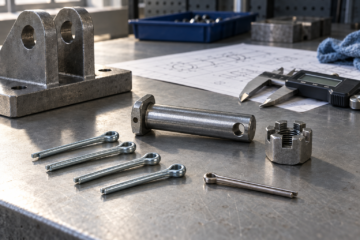
Cotter Pins pass through a drilled hole in a shaft to retain a clevis pin or axle nut—preventing it from backing off under vibration. Standard in trailer hitches, agricultural equipment, and steering linkages.

Table 2: Fastener Type Quick-Selection Guide
| Application | Recommended Fastener | Key Consideration |
|---|---|---|
| Wood framing (structural) | Structural screw or lag screw | Check load rating; pre-drill |
| Drywall to stud | Drywall screw | Not structural |
| Machine/equipment assembly | Machine screw + nut or tapped hole | Match thread pitch exactly |
| Steel-to-steel structural | Hex bolt + nut, Grade 5 or 8 | Torque to spec |
| Sheet metal | Self-tapping screw, Type B | Pilot hole diameter critical |
| Concrete anchoring | Wedge anchor or epoxy anchor | Follow embedment depth |
| Hollow wall (no stud) | Toggle bolt or self-drilling anchor | Rate the load carefully |
| Outdoor/deck | Stainless or hot-dip galvanized | Match coating to exposure |
Fastener Materials and Grades: Matching Strength to Application
The material of a fastener determines its strength, corrosion resistance, and cost. Choosing the wrong material is one of the most common fastener mistakes in both professional and DIY work.
Steel Grades for Inch Fasteners
Steel fasteners are graded by the SAE International standard, which specifies minimum tensile strength and proof load:
- Grade 2 (no markings): Low-carbon steel, minimum tensile strength ~60,000 psi. For light-duty, non-critical applications. Avoid structural use.
- Grade 5 (3 radial lines on head): Medium-carbon steel, minimum tensile ~120,000 psi. The most common structural grade—works for most machinery, automotive, and construction applications.
- Grade 8 (6 radial lines on head): Medium-carbon alloy steel, minimum tensile ~150,000 psi. High-strength applications: suspension components, engine mounts, critical structural connections.
For metric fasteners, the property class is stamped on the head:
- 8.8: Equivalent strength range to Grade 5
- 10.9: High-strength, equivalent to Grade 8
- 12.9: Highest common metric grade, alloy steel, 180,000+ psi
Never substitute a lower grade for a higher grade in a critical joint. In practice we’ve seen Grade 2 bolts installed in leaf spring shackles—they fail without warning under dynamic road loads where a Grade 8 bolt would hold.
Stainless Steel, Zinc, and Coatings
18-8 Stainless Steel (304 SS) is the most common stainless for fasteners. It resists rust in most environments but can gall (seize) when stainless threads contact stainless threads under high torque—use an anti-seize compound. Tensile strength is roughly 65,000–100,000 psi depending on cold-working.
316 Stainless Steel adds molybdenum for enhanced resistance to chlorides—the right choice for marine, coastal, or chemical environments where 304 SS would pit.
Zinc plating (electroplating) provides a thin layer (0.0002″–0.0005″) of zinc—adequate for indoor use but not for exterior exposure. You’ll see bolts turn orange in months when used outdoors without additional coating.
Hot-Dip Galvanizing applies a much thicker zinc layer (~1.7–3.9 mils on bolts) by dipping in molten zinc at 840°F. Nuts must be re-tapped after galvanizing to accommodate the thicker coating. The right choice for exterior structural steel and pressure-treated lumber connections—ACQ-treated lumber is corrosive to plain steel.
Dacromet / Geomet / Mechanical Zinc are alternative corrosion-resistant coatings common in automotive fasteners that need to avoid hydrogen embrittlement (a risk with electroplating on high-strength steel).
The 3-Thread Rule and Thread Standards
The 3-thread rule states that at least 3 full threads of a fastener must engage the mating material for the joint to develop the fastener’s rated strength. Fewer than 3 threads of engagement and the threads will strip before the bolt itself breaks.
Practically: a 1/2″-13 bolt (13 threads per inch) into a 1/4″-thick steel plate gives you only 3.25 threads of engagement—borderline. In thin sheet metal connections, this is why structural engineers specify a minimum material thickness or require nut plates on the opposite side.
Thread standards in North America:
- UNC (Unified National Coarse): Coarser pitch, faster assembly, higher resistance to cross-threading. Example: 1/4-20 (1/4″ diameter, 20 threads per inch).
- UNF (Unified National Fine): Finer pitch, higher tensile area, better vibration resistance. Example: 1/4-28.
- Metric (ISO): Pitch expressed in mm. M8 × 1.25 = 8mm diameter, 1.25mm pitch.
Coarse threads are preferred for assembly speed and where cross-threading risk is high. Fine threads are used in precision applications, high-vibration environments, and thin-wall tapped holes.
How to Choose the Right Fastener for Your Project
Matching Fastener to Base Material
The base material is your starting point:
Wood: Use wood screws or structural screws for most wood-to-wood connections. For high-load structural connections (ledger boards, beam hangers), use lag screws or structural hex bolts per the applicable building code span tables. Never use drywall screws for structural wood connections—they’re brittle in bending and have no rated shear value.
Steel to Steel: Machine screws into tapped holes, or bolts with nuts. Grade 5 or 8 hex bolts for structural connections. Ensure thread engagement meets the 3-thread minimum—for thin steel, a nut on the back is usually required.
Aluminum: Use stainless steel or aluminum fasteners. Steel fasteners in aluminum create a galvanic couple that accelerates aluminum corrosion, especially in wet environments. Apply isolating washers or use 300-series stainless when mixing metals is unavoidable.
Concrete: Post-installed anchors include wedge anchors (mechanical expansion), screw anchors (Tapcon-style, for lighter loads), and epoxy anchors (for heavy loads or cracked concrete per ICC ESR reports). Always check the anchor manufacturer’s ICC ESR report for rated load values—never use catalog load tables for life-safety applications.
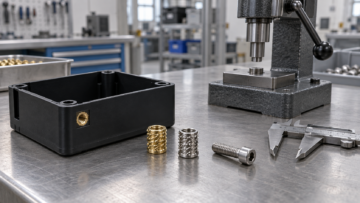
Plastics: Use fine-thread screws (lower pitch = less stress concentration) or heat-set inserts for thermoplastics. Boss screws designed specifically for plastic have wide, shallow threads to avoid cracking. Overtightening plastic bosses is the single most common assembly failure in consumer electronics.
Load Type: Tension vs. Shear
A fastener in tension is being pulled along its axis. An eye bolt supporting a load, an anchor bolt under an uplift load, a bolt holding a bracket against a wall—these are tension-loaded.
A fastener in shear has forces perpendicular to its axis. A bolt connecting two plates that slide against each other, a rivet in a lap joint, a pin in a hinge—these are shear-loaded.
Most fasteners have lower rated capacity in shear than in tension. Bolts in structural steel connections are often designed for shear (the plates slide relative to each other). Always check: the rated tensile strength on a bolt spec sheet is NOT the same as the shear rating.
Torque Specifications and Installation Mistakes
Proper torque is the most underappreciated factor in fastener performance. A bolt that is under-torqued will loosen under vibration; a bolt that is over-torqued stretches past its yield point and weakens.
Torque values depend on fastener size, grade, and lubrication state. A well-referenced table for dry (unlubricated) fasteners:

Table 3: Approximate Torque Values (Dry, Grade 5 Steel, Inch Fasteners)
| Bolt Size | Grade 5 Torque (ft-lb) | Grade 8 Torque (ft-lb) | Notes |
|---|---|---|---|
| 1/4″-20 | 6–9 | 9–12 | Use torque screwdriver |
| 5/16″-18 | 13–17 | 19–25 | |
| 3/8″-16 | 23–31 | 34–45 | Common structural size |
| 1/2″-13 | 57–75 | 80–109 | Use torque wrench |
| 5/8″-11 | 113–150 | 160–215 | Always torque wrench |
| 3/4″-10 | 200–267 | 280–375 |
Key rules:
- Reduce these values by 25–30% if the threads are lubricated with oil or anti-seize
- Torque in a star (crisscross) pattern for multi-bolt flanges
- Re-torque after initial heat cycling (gasket joints, exhaust systems)
Common mistakes that lead to joint failure:
- Replacing a bolt with the next-larger diameter without re-engineering the joint—the tapped holes or clearance holes may not accommodate it
- Mixing stainless and carbon steel without understanding galvanic corrosion
- Ignoring corrosion protection on treated lumber connections (use hot-dip galvanized or stainless only)
- Using the wrong thread pitch—a 1/2″-13 bolt will start into a 1/2″-20 hole but strip on the first full turn
- Not using thread lock in vibrating machinery—medium-strength Loctite 243 is the industry standard for fasteners that must be removable but can’t loosen
Industry Applications: Where Fasteners, Screws, and Bolts Are Used
Fasteners, screws, and bolts are present in virtually every manufactured product and built structure. These are the highest-demand sectors.
Construction and Structural Applications
Construction is the largest single consumer of fasteners. Structural framing relies on joist hanger screws (specified by the hanger manufacturer, not the framer’s preference), anchor bolts connecting sill plates to foundations, lag screws in ledger-to-rim-joist connections, and through-bolts in multi-ply beam assemblies.
Concrete construction uses a separate vocabulary: headed anchor bolts cast in place, post-installed mechanical anchors (expansion and undercut), and adhesive anchors for high-load and seismic applications. The 2015 IBC adopted ACI 318-14 Appendix D for anchorage design—every anchor bolt diameter, embedment depth, and edge distance has a calculated value, not a rule-of-thumb.
Roofing uses annular ring shank nails and roofing screws engineered to resist wind uplift—the connection between a metal roof panel and purlins is a calculated fastener pattern, not a “nail it down” job.
Manufacturing and Assembly Lines
High-volume manufacturing demands consistency in fastener installation. Automotive assembly plants use DC electric torque tools with real-time feedback—each fastener is torqued to a window (min/max) and logged. Critical fasteners (brake caliper bolts, engine mounts, steering components) have 100% audit trails.
The shift to EV platforms has changed fastener specifications: battery pack bolts must seal against coolant, tolerate more thermal cycling than ICE vehicles, and in some designs, must be removable thousands of times over the vehicle’s service life. Titanium and specialty stainless alloys are displacing plain carbon steel in some of these applications.
Printed circuit boards use ultra-small machine screws (M2, M2.5, #2-56) with plastic standoffs. Stainless is common, but brass is used where the small added mass of a denser material helps with board resonance damping. Overtorquing is universal in this context—use a calibrated torque driver, never a powered tool.
Automotive and Aerospace
Automotive fasteners operate in extreme conditions: temperature swings from -40°F to 300°F at the exhaust, constant vibration, road salt, and mechanical shock. Thread-forming screws in aluminum are widely used for oil pans and valve covers to eliminate separate threaded inserts.
Aerospace fasteners are the tightest-tolerance segment. Hi-Lok pins and collars are the aerospace equivalent of a bolt-and-nut system, but with a controlled preload set by the breakaway torque of the installation collar—human error in torque is eliminated. Titanium fasteners cut weight (40% lighter than alloy steel at equivalent strength), and Inconel fasteners are used where operating temperatures exceed the range of stainless.
Every aerospace fastener has a part number, manufacturer, material certification, and lot traceability. The paperwork that accompanies one bag of 50 aerospace bolts can be thicker than this article.
Future Trends in Fastener Technology (2026+)
Smart Fasteners and Load Monitoring
The fastest-growing niche in the fastener market is instrumented fasteners—bolts with embedded strain gauges or piezoelectric sensors that transmit real-time load data. In bridge construction, wind turbine assembly, and industrial pressure vessel maintenance, continuously knowing whether anchor bolts are at the correct preload is worth a significant cost premium.
Current implementations use ultrasonic measurement (external clamp-on sensors measuring bolt elongation) or embedded RFID tags that encode torque-at-installation. The next generation embeds strain sensors with Bluetooth Low Energy (BLE) transmitters—a single hub interrogates hundreds of fasteners in a structure every few minutes.
The global smart fastener market was valued at approximately $XXX billion in 2024 and is projected to grow at a compound annual rate of 8–12% through 2030, driven by infrastructure spending and industrial automation requirements.
Sustainable Materials and Coatings
Hexavalent chromium (Cr-VI) plating, once common for corrosion resistance, is being eliminated globally under RoHS and REACH regulations. The replacement coatings—trivalent chromium, Dacromet, and Geomet—achieve similar or better corrosion performance without the carcinogenicity of Cr-VI. Most automotive OEMs completed this transition between 2015–2022; industrial and fastener distributors are following suit.
Recycled steel content in fastener manufacturing is rising, driven by mill economics (electric arc furnaces using scrap) and customer sustainability mandates. High-grade fasteners require controlled alloy chemistry, but Grade 2/5 fasteners can incorporate significant recycled content without sacrificing performance.
Bio-based polymer fasteners are emerging in electronics and automotive interiors—lightweight, non-conductive, and easier to separate for recycling at end-of-vehicle-life. Load capacity is lower than metal, but in non-structural applications they compete well on total installed cost.
FAQ — Fasteners, Screws, and Bolts
What is the difference between fasteners, bolts, and screws?
Fasteners is the broad category that includes screws, bolts, nuts, rivets, and all other mechanical joining devices. A screw threads into a material directly (wood, metal, plastic) and doesn’t require a nut. A bolt passes completely through a material and is tightened by a nut on the other end. The practical bottom line: if it needs a nut, it’s a bolt; if it threads into the material itself, it’s a screw.
What is the 3-thread rule?
The 3-thread rule states that a threaded fastener needs at least 3 full threads engaged in the mating material to develop its rated load capacity. Fewer engaged threads will cause the threads to strip rather than the bolt to break at its full tensile strength. The practical implication: in thin materials, a nut on the back side is mandatory if the material thickness doesn’t provide 3+ threads of engagement.
What are the four main types of fasteners?
The four primary fastener categories are: (1) Threaded fasteners (screws, bolts, nuts, studs); (2) Non-threaded fasteners (rivets, pins, clips, staples, nails); (3) Integral fasteners (formed features like snap fits, tabs); and (4) Specialty/chemical fasteners (adhesives and sealants used in joining). Threaded fasteners dominate engineered assembly because they’re removable, load-calculable, and available in precise grades and materials.
What grade of bolt should I use for outdoor structural applications?
For outdoor structural applications with standard steel materials, Grade 5 (or metric 8.8) is the minimum. For connections to pressure-treated lumber, use hot-dip galvanized or 316 stainless steel fasteners—ACQ-treated lumber is corrosive to plain and zinc-plated steel. For highly corrosive environments (coastal, industrial), 316 stainless is the standard choice. Never use Grade 2 bolts for structural connections.
How do I know what size screw or bolt to use?
Diameter is the starting point, then length. For wood screws, the rule of thumb is that 2/3 of the screw length should penetrate into the lower piece. For bolted connections, length is determined by material stack thickness plus washer and nut height (with 2–3 threads projecting past the nut). Diameter is determined by the load—most residential construction uses #8, #10, or 1/4″ fasteners for general framing; structural connections require calculation or code-specified sizes.
Can I mix stainless steel and regular steel fasteners?
Avoid it wherever moisture is present. Stainless steel and carbon steel are dissimilar metals—when in contact in the presence of an electrolyte (water), galvanic corrosion accelerates the degradation of the less noble metal (carbon steel). In outdoor, marine, or wet industrial environments, use all stainless or isolate the metals with non-conductive washers. In dry indoor environments, mixing is generally acceptable with no significant corrosion risk.
What is the strongest fastener for concrete anchoring?
For high-load concrete anchoring, epoxy (adhesive) anchors using tested anchor rods or threaded rod with ICC ESR-rated epoxy systems deliver the highest load capacity, especially in cracked concrete and close to edges. Mechanical wedge anchors are simpler and strong in uncracked concrete at standard edge distances. The anchor diameter, embedment depth, and concrete strength must all be calculated per ACI 318-14 for any life-safety application—don’t rely on catalog maximums as design values.

Conclusion
Fasteners, screws, and bolts are deceptively simple objects that carry enormous engineering consequence. The right fastener—correct material, grade, thread type, and installation torque—is invisible in service. The wrong one fails at the worst possible moment.
The selection process comes down to four questions: What are you joining (materials)? What loads will the joint carry (tension, shear, vibration)? What environment will it operate in (corrosion, temperature)? And how often does it need to come apart (reusability, tooling access)? Answer those four questions and the appropriate fastener type, material, and grade follow logically.
Whether you need a handful of drywall screws or a thousand structural hex bolts for a commercial project, explore our complete fastener catalog to find the exact specification you need—with bulk pricing and fast shipping on every order.
Related Products
Solutions & Cluster
Related Articles
- Essential Guide to Triangle Bolt Applications and Removal Techniques
- Screws and Bolts: The Complete Guide to Types, Differences, Grades, and Choosing the Right Fastener
- Castellated Nut: Complete Guide to Types, Uses & Installation
- Nylon Screws: Complete Guide to Types, Sizes & Applications (2026)
- Anti-Theft License Plate Bolts: The Complete Guide to Securing Your Plates (2026)
- Bolt Nut and Washer: The Complete 2026 Guide to Choosing and Using Fasteners Correctly
- Top China M2-M12 Stud Screw Manufacturing Guide: Quality & Process Insights
- What Is a Screw? The Complete Guide to Types, Uses & Selection for Production