 English
  German
  Spanish
  Portuguese
  French
  Japanese
  Arabic
  Korean
  Vietnamese
  Russian
 Titanium Bolts: The Complete Guide to Grades, Applications & Installation (2026)

Titanium bolts are lightweight, corrosion-resistant fasteners made from titanium alloy (typically Grade 5 Ti-6Al-4V), offering roughly 45% weight savings over steel at comparable tensile strength, with no rust risk in virtually any environment.
If you’ve spent time maintaining a performance bike, motorcycle, or custom build, you’ve heard the titanium bolt debate. They cost 5–10× more than equivalent steel hardware. Yet serious riders, aerospace engineers, racing teams, and custom builders reach for them without hesitation. That gap between price and performance is exactly what this guide unpacks — so you can decide whether titanium bolts are right for your application, pick the correct grade, install them without destroying them, and avoid the three most common (and expensive) mistakes beginners make.
What Are Titanium Bolts?
Titanium bolts are fasteners machined from titanium or titanium alloy stock. The appeal is a combination of properties that no single competing material matches: low density (4.5 g/cm³ vs. 7.8 g/cm³ for steel), outstanding corrosion resistance, and tensile strength that rivals many steel alloys. That combination is why titanium bolts appear everywhere from Formula 1 suspension links to mountain bike saddle rails to surgical implant hardware.
According to Wikipedia’s overview of titanium alloys, titanium alloys are classified into three structural categories — alpha, alpha-beta, and beta — each offering a different balance of strength, ductility, and machinability. For fasteners, the vast majority of titanium bolts fall into the alpha-beta class, specifically Ti-6Al-4V.
Titanium Grade 2 vs Grade 5 (Ti-6Al-4V): Which Matters for Bolts
Not all titanium bolts are the same alloy. The two grades you’ll encounter most often:
Grade 2 (Commercially Pure Titanium)
– Composition: ≥ 99% pure titanium
– Tensile strength: ~340–440 MPa
– Better corrosion resistance and ductility than Grade 5
– Softer and more prone to galling
– Common in chemical processing, marine hardware, and medical implants
Grade 5 (Ti-6Al-4V)
– Composition: Ti + 6% aluminum + 4% vanadium
– Tensile strength: ~900–1000 MPa (comparable to Grade 8 steel)
– The dominant choice for structural titanium bolts in bikes, motorsport, and aerospace
– Harder than Grade 2, still galls without anti-seize, but far more forgiving under torque
– Often sold as “aerospace grade” titanium bolts
For any structural or load-bearing application — axle bolts, stem bolts, rotor bolts, suspension bolts — Grade 5 titanium bolts are the only acceptable choice. Grade 2 titanium bolts are better suited for non-structural uses where maximum corrosion resistance is the priority and loads are low.
Titanium vs Steel vs Stainless Steel Bolts: A Direct Comparison
Here is where the material trade-offs become concrete. The table below compares Grade 5 titanium bolts against the most common alternatives across the properties that actually matter for fastener selection:
| Property | Titanium Grade 5 | Steel Grade 8 | Stainless 316 | Aluminum 7075 |
|---|---|---|---|---|
| Density (g/cm³) | 4.43 | 7.87 | 7.99 | 2.81 |
| Tensile Strength (MPa) | 900–1000 | 1033 | 579 | 572 |
| Weight vs. Steel | ~44% lighter | Baseline | ~2% heavier | ~64% lighter |
| Corrosion Resistance | Excellent | Poor (rusts) | Good | Moderate |
| Fatigue Life | Excellent | Good | Moderate | Poor |
| Cost (relative) | 5–10× steel | 1× | 2–3× | 1–2× |
| Galling Risk | High (needs anti-seize) | Low | Medium-high | Low |
| Recommended Use | Performance builds | General structural | Marine / food-grade | Ultralight (low-load) |
The key takeaway: titanium bolts sit in a unique position — nearly as strong as Grade 8 steel, yet 44% lighter and essentially immune to corrosion. Aluminum bolts are lighter still, but their fatigue life is poor and they are not suitable for suspension, braking, or any dynamic load path.
Types of Titanium Bolts and Their Uses
Titanium bolts come in a wide range of head styles, thread configurations, and finishes. Understanding the type matters because titanium’s lower modulus of elasticity (roughly half that of steel) affects how each head style handles clamp load differently.
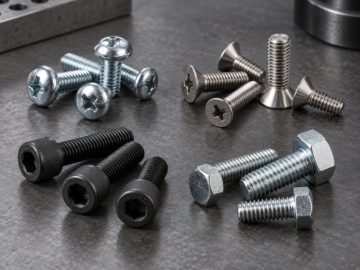
Hex Bolts, Socket Head Cap Screws, and Countersunk Bolts
The three most common titanium bolt head styles:
Socket Head Cap Screws (SHCS)
The workhorse of performance titanium bolts. Hex socket drive allows high torque in tight spaces. Used extensively in bicycle crank arms, brake calipers, derailleur mounts, and motorcycle engine covers. Grade 5 socket head titanium bolts in M5–M8 are the most frequently replaced fasteners in cycling upgrades.
Hex Bolts (Hex Head)
Larger titanium bolts for suspension, axle, and structural applications in motorsport. A 12mm hex titanium bolt on a race car front upright saves meaningful rotating mass — manufacturers like Formula 1 teams use them specifically for this. Less common in cycling due to the wrenching access limitations.
Countersunk (Flat Head) Bolts
Used where the bolt head must sit flush or below the surface — common in cycling bottle cage mounts, computer mount plates, and fender hardware. The countersink angle (typically 82° or 90°) must match the receiving surface exactly; titanium’s lower hardness makes countersunk holes in aluminum frames more forgiving compared to steel counterparts.
Flange Bolts
A flanged head distributes clamp load over a wider area, reducing the risk of crushing composite surfaces. Titanium flange bolts are popular on carbon fiber frame builds where point loading under a standard hex head can cause micro-cracking.
Metric vs Standard (Imperial) Titanium Fasteners
The majority of titanium bolts sold for cycling, motorcycles, and European motorsport use metric threads (M4, M5, M6, M8, M10). Standard (Imperial) titanium bolts (¼-20, 5/16-18, 3/8-16) are more common in North American automotive and custom builds.
Critical point: titanium bolts use the same thread standards as steel equivalents. An M6×1.0 titanium bolt threads directly into an M6×1.0 steel or aluminum nut or threaded insert. No adapters, no special tools beyond what you already own.
Coated and Anodized Titanium Bolts
Raw titanium bolts have a silvery-gray finish that develops a natural oxide patina over time. Several finish options add color or additional surface properties:
- Anodized (Type II / Type III): Creates a colored oxide layer — gold, blue, purple, black — widely sold for aesthetic cycling upgrades. Anodizing does not significantly increase hardness but can marginally reduce galling risk.
- PVD Coatings: Thin physical vapor deposition coatings (TiN, DLC) are used in high-performance applications where galling must be minimized without anti-seize compound. More expensive.
- Passivated: Standard industrial finish for medical and aerospace titanium bolts — a controlled oxide layer for maximum corrosion resistance without color change.

| Bolt Type | Typical Applications | Size Range | Drive Type |
|---|---|---|---|
| Socket Head Cap Screw | Cycling, motorcycle bodywork, precision equipment | M4–M12 | Hex socket (Allen) |
| Hex Head Bolt | Suspension, axles, automotive chassis | M8–M20 | Hex wrench / socket |
| Countersunk / Flat Head | Flush-mount panels, fenders, bottle cages | M4–M8 | Hex socket |
| Flange Bolt | Carbon fiber interfaces, engine covers | M6–M12 | Hex socket |
| Shoulder Bolt | Pivot points, linkage bolts | M6–M10 | Hex socket |
| Button Head | Low-profile aesthetic applications | M4–M8 | Hex socket |
Industry Applications: Where Titanium Bolts Actually Get Used
Cycling and Mountain Biking (MTB, Road, Gravel)
Cycling is the single largest consumer market for titanium bolts outside of aerospace. The logic is straightforward: on a bike, every gram removed from a rotating or reciprocating component is worth approximately 5× the equivalent gram removed from a static one. A set of titanium bolts replacing standard stainless hardware across a full mountain bike — saddle clamp, stem, handlebar, bottle cages, rotor bolts, cleat hardware — can remove 60–120 grams of unsprung or rotating mass.
Key positions where titanium bolts are used in MTB and road cycling:
– Stem bolts (M5×0.8, typically 4×): One of the most popular first upgrades
– Bottle cage bolts (M5×0.8, typically 2×): Cheap entry point, visible upgrade
– Saddle clamp bolts (M6×1.0 or M8×1.25 depending on post design)
– Derailleur mounting bolts: Eliminates rust from wet-weather riding
– Rotor bolts (M5×0.8, Torx T25, 6× per rotor): High-vibration environment where fatigue life matters
For MTB riders who frequently ride in wet conditions, the corrosion resistance of titanium bolts is often the primary motivation — not weight. A seized steel rotor bolt can require drilling out and retapping, destroying an expensive hub; titanium bolts simply do not rust.
Motorcycles and Electric Bikes (Surron, Super73)
Motorcycle applications for titanium bolts have expanded from elite MotoGP teams to accessible aftermarket upgrades for street and adventure riders. Engine cover bolts on a modern 4-cylinder motorcycle may number 30–40 fasteners; replacing them with titanium bolts can save 250–400 grams and eliminates the cosmetic rust that steel hardware develops after one wet season.
Surron and Super73 electric bikes have become a particularly active segment of the titanium bolt aftermarket. These off-road e-bikes use standard metric hardware throughout, and their owners — many coming from a mountain bike customization background — actively seek bolt kits. Surron titanium bolt kits typically cover the frame, motor mount, suspension, and footpeg hardware. Super73 titanium bolts focus on the frame loop, battery cover, and fork hardware.
The critical limitation: electric bike motor mount titanium bolts must be torqued correctly. Surron’s motor mount uses M8×1.25 fasteners that should be torqued to 25–30 Nm. At this torque range, Grade 5 titanium bolts are well within their load rating, but anti-seize application is non-negotiable (see installation section).
Automotive and Motorsport
In production motorsport — club racing, amateur rally, track day cars — titanium bolts are used selectively where mass savings per dollar are highest: brake caliper mounting bolts, wheel hub bolts, and suspension geometry links. Formula 1 uses titanium fasteners extensively throughout the chassis and powertrain; per-bolt costs in F1 contexts run into the hundreds of dollars for custom thread-formed parts.
Road car applications are more restrained. A titanium bolt swap on a road car’s decorative engine cover is aesthetic; the same swap on brake caliper mounting bolts or wheel bolts is potentially a significant weight and durability upgrade.
Important note for automotive users: some fastener positions in cars have specific torque-yield requirements — engine head bolts, wheel hub bolts, and lug nuts are typically torque-to-yield (TTY) steel fasteners that are not substitutable with titanium without engineering analysis. Do not replace TTY fasteners with titanium bolts unless the application has been specifically approved for the platform.
Aerospace, Medical, and Industrial
Aerospace is where titanium bolts originated. Aircraft frames, engine mounts, and control surface hardware rely on titanium fasteners for the combination of low weight, high fatigue resistance, and immunity to salt atmosphere corrosion. According to Boeing’s published material use statistics, titanium accounts for approximately 15% of airframe weight in modern aircraft.
Medical applications use Grade 2 and Grade 23 (ELI — Extra Low Interstitial) titanium fasteners for bone screws, implant attachment hardware, and surgical instruments. The body does not reject titanium — its oxide layer is biocompatible — making it the default choice for orthopedic implants.
Industrial uses include chemical processing plants (where corrosion resistance is worth the cost premium), desalination equipment, and offshore marine hardware where salt spray would destroy steel fasteners within months.
How to Choose the Right Titanium Bolt — Buying Guide
Grade, Thread Pitch, and Head Style
Choosing titanium bolts for your application requires answering four questions:
1. What grade?
For any structural load-bearing use: Grade 5 (Ti-6Al-4V). For decorative or low-load applications where corrosion resistance is the only goal: Grade 2 is acceptable and cheaper.
2. What thread spec?
Match exactly to the OEM specification. Most cycling hardware is metric. Measure thread pitch with a pitch gauge if you’re unsure — M5×0.8 and M5×0.9 will cross-thread and can damage aluminum threads. When in doubt, remove the OEM bolt and measure it directly.
3. What head style?
– Socket head cap screws for most cycling and motorcycle applications (compact head, high torque)
– Flanged hex for carbon fiber interfaces (wider load distribution)
– Countersunk for flush-mount positions
4. What length?
Titanium bolts must achieve the same thread engagement as the OEM fastener they replace — do not substitute a shorter bolt assuming titanium’s higher strength will compensate. Thread engagement (typically 1.0–1.5× bolt diameter in aluminum) is the primary factor in pullout resistance, not bolt material.
What to Watch Out for When Buying
The titanium bolt market has a significant counterfeiting and misgrading problem. Bolts sold as “Grade 5 titanium” from unverified sources may be Grade 2, lower titanium alloys, or in some cases stainless steel anodized to look like titanium (magnets won’t stick to either real titanium or stainless, so the magnet test is unreliable).
Indicators of reputable titanium bolt suppliers:
– Material certification available on request (mill certificate or Certificate of Conformance)
– Clear grade labeling (Grade 5 / Ti-6Al-4V vs. “titanium alloy”)
– Head markings (reputable manufacturers stamp head grade codes)
– Price: Grade 5 M6×20mm socket head titanium bolts should cost $3–8 each from reputable US/EU suppliers. Below $1 each is a red flag.
The Reddit thread identified by our research — where mountain bikers discuss trusted titanium bolt sources — echoes this: community consensus consistently flags cheap Amazon titanium bolt sets as misgraded or counterfeit.

How to Install Titanium Bolts Without Galling
Galling is the single most common failure mode with titanium bolts. It occurs when two titanium surfaces — or titanium against aluminum — experience adhesive wear under load, causing the surfaces to cold-weld. When you attempt to remove a galled titanium bolt, the thread material shears rather than releasing cleanly. The bolt spins but won’t back out; in severe cases, the head twists off entirely.
Step-by-Step Installation with Anti-Seize
What you need:
– Clean titanium bolts (inspect threads for burrs or damage before installation)
– Nickel-based or copper-based anti-seize compound (NOT grease, NOT threadlocker)
– Calibrated torque wrench
– Correct hex key or bit (use quality bits — titanium bolt heads round out faster than steel under worn drivers)
Step-by-step:
- Clean the threaded hole — blow out debris, chase threads with a tap if they show corrosion or damaged peaks
- Apply anti-seize to the male threads — a thin coat on the last 3–4 threads is sufficient; do not pack the threads or apply to the head underside
- Thread in by hand until finger-tight — if there is any resistance starting, back out and check alignment; do not force titanium threads
- Torque to spec with a reduction factor — because anti-seize reduces friction, you’ll achieve the same clamp load at 75–85% of the “dry” torque specification. If the position calls for 6 Nm dry, torque to 4.5–5 Nm with anti-seize
- Do not use threadlocker on titanium bolts unless a low-strength formula (blue Loctite 243) is specifically called for; high-strength threadlocker chemically attacks titanium’s oxide layer over time
Pro tip from experience: For titanium bolts going into anodized aluminum — water bottle cage bosses, handlebar clamp faces — we apply anti-seize to the threads AND run a clean tap through the boss before installation. Anodizing adds a hard, slightly uneven layer to thread peaks that accelerates galling on first installation. A single pass with a matching tap removes the oxide and produces clean contact — the bolt will thread in noticeably smoother and remain removable years later.
Torque Specs and Retorquing
Titanium’s lower modulus of elasticity (roughly 116 GPa vs. 200 GPa for steel) means titanium bolts stretch more per unit of applied torque. This affects two things:
Lower torque settings: Titanium bolts typically require 15–25% less torque than equivalent steel fasteners to achieve the same clamp force. Follow the application-specific torque spec, not the torque spec for the steel OEM bolt.
Retorquing requirement: Titanium bolts in high-vibration environments (motor mounts, suspension pivots, frame bolts on off-road bikes) should be re-checked at the first service interval. Titanium’s higher elasticity means it is excellent at maintaining clamp load under vibration — but initial settling on freshly machined surfaces can result in slight relaxation during the first 50–100 miles or kilometers of use.
Common torque specs for titanium bolts in cycling (apply anti-seize correction — multiply by 0.8):
| Position | OEM Spec (dry, steel) | Titanium Spec (with anti-seize) |
|---|---|---|
| Stem bolts (M5×0.8) | 5–6 Nm | 4–5 Nm |
| Bottle cage (M5×0.8) | 3–4 Nm | 2.5–3 Nm |
| Saddle clamp (M8×1.25) | 8–10 Nm | 6.5–8 Nm |
| Disc rotor bolts (M5 T25) | 4 Nm | 3.2 Nm |
| Surron motor mount (M8×1.25) | 25–30 Nm | 20–24 Nm |
Titanium Bolts vs Steel: Detailed Cost-Benefit Analysis
The “are titanium bolts worth it” question has no universal answer. It depends entirely on what you’re optimizing for. Here is the honest analysis:
When titanium bolts are clearly worth it:
– Weight-critical applications on moving/rotating components — The 44% mass reduction matters most on components that accelerate and decelerate. On a bike wheel or rotor bolt, this is categorically different from the same weight savings on a static rack mount.
– Corrosion-exposed positions — Frame bolts, rotor bolts, and derailleur hardware on a bike ridden in salt air, mud, or rain will seize in 1–3 seasons with steel hardware. One seized bolt requiring professional removal often costs more than a full set of titanium bolts.
– Show-quality custom builds — Titanium’s aesthetic (natural silver, or anodized color) is a legitimate reason if the build demands a premium finish.
– Long-term ownership with minimal removal — Titanium bolts installed correctly with anti-seize survive decades without thread damage. Steel hardware in aluminum frames cross-threads and corrodes; the cumulative maintenance cost of replacement often exceeds the titanium bolt premium.
When titanium bolts are not worth it:
– Torque-to-yield (TTY) positions — Never replace TTY fasteners without application engineering review.
– High-temperature environments — Titanium’s strength drops faster than steel above 300°C. Engine head bolts, exhaust manifold studs, and brake rotor mounting where rotors exceed 350°C are not suitable for titanium bolts.
– Budget builds where weight is not a target — If the frame and components have not been weight-optimized elsewhere, titanium bolts are the wrong priority.
This 2026 instructional video by a professional motorcycle mechanic covers the practical trade-offs clearly: Titanium Bolts Explained | How to Size, Measure & Install for Moto.
Future Trends in Titanium Fasteners (2026+)
Additive Manufacturing and Custom Titanium Parts
The cost barrier for titanium bolts is primarily machining — titanium is slow to machine, requires sharp carbide tooling, and generates significant tool wear. Additive manufacturing (3D printing) in titanium — laser powder bed fusion (LPBF) using Ti-6Al-4V powder — is changing this for custom and low-volume production. Printed titanium fasteners are already used in aerospace prototyping and custom motorsport applications.
By 2028, analysts tracking additive manufacturing adoption expect 3D-printed titanium fasteners to reach cost parity with CNC-machined parts at volumes below 500 units per batch. For the custom bicycle and motorcycle aftermarket, this means fully bespoke titanium bolt kits for specific frame models will become economically viable — produced on demand without minimum order quantities.
Growing Demand in E-Bike and EV Markets
The e-bike market — particularly off-road performance segments (Surron, Super73, Talaria, KTM Freeride E) — is the fastest-growing application segment for aftermarket titanium bolts. As noted in research from the Wikipedia overview of Ti-6Al-4V, the alloy’s combination of high strength and low density positions it naturally for applications where reducing unsprung mass directly translates to handling improvement — exactly the case in electric off-road bikes where battery weight is fixed and frame/suspension hardware is the accessible optimization target.
Electric vehicles broadly are driving titanium fastener demand upward: EV structural battery enclosures use titanium bolts because their non-magnetic, non-reactive properties reduce interference with battery management electronics. Between 2023 and 2026, titanium fastener demand from the EV sector grew at a compounded annual rate estimated at 14–18%, accelerating faster than any other non-aerospace application.
The medical device sector continues its steady growth — robotic surgery systems and next-generation orthopedic implant attachment systems require smaller, higher-precision titanium bolts than traditional surgical hardware. This is pulling investment into tighter machining tolerances and improved surface treatments that will eventually flow downstream to consumer applications.
FAQ: Titanium Bolts — Common Questions Answered
Q: Are titanium bolts stronger than steel bolts?
Grade 5 titanium bolts have tensile strength of 900–1000 MPa, comparable to Grade 8 steel bolts (≈1033 MPa) — at 44% lower weight. They are not stronger per unit cross-section, but stronger per unit weight. For fatigue loading (repeated stress cycles), titanium actually outlasts steel in most environments due to its superior fatigue ratio.
Q: Why do titanium bolts gall?
Galling happens because titanium’s oxide layer — the same layer that gives it corrosion resistance — is hard and adhesive. When two titanium surfaces (or titanium in aluminum) slide under compressive load, the oxide layers break down, and the base metals cold-weld. Anti-seize compound lubricates the contact zone and prevents oxide-to-oxide contact. Always use anti-seize on titanium bolts.
Q: Can I use titanium bolts on carbon fiber?
Yes, with one important caution: titanium bolts on carbon fiber components require careful attention to clamp load. Carbon fiber crushes and deforms irreversibly above its design clamp load. Use a torque wrench, follow the carbon-specific torque spec (often 4–5 Nm for M5 stem bolts on carbon bars), and use a flanged head titanium bolt or a washer to distribute load. Titanium’s lower stiffness can actually help here — it stretches slightly rather than crushing the carbon when torqued at the interface.
Q: How do I tell if a titanium bolt is real?
Genuine Grade 5 titanium bolts are non-magnetic (use a strong magnet — though stainless steel also fails this test). A more reliable test: titanium when scratched with a steel file produces bright white sparks (similar to magnesium), whereas steel produces orange sparks and stainless produces no sparks. Weight is another check — a real M6×20mm titanium socket head bolt weighs approximately 1.8–2.0 grams; a steel equivalent is approximately 3.2–3.5 grams.
Q: What torque should I use for titanium bolts?
There is no single answer — torque spec depends on bolt size, material, and application. As a general rule, apply 75–80% of the dry steel specification when using anti-seize. Always verify against your specific application’s service manual. Undertorquing is actually a more common failure mode than overtorquing for titanium bolts in cycling — loose bolts vibrate out; over-tightened bolts simply stretch slightly and hold.
Q: Are titanium bolts worth it for an e-bike like Surron or Super73?
For the frame, suspension, and wheel hardware: yes, with a clear benefit-to-cost ratio. Surron Light Bee titanium bolt kits replacing the frame hardware save approximately 80–120 grams from suspension linkage and motor mount bolts — meaningful on a bike where battery weight is fixed. For non-structural positions (body panels, plastic covers), Grade 2 titanium bolts or standard stainless are adequate and cheaper.
Q: Can titanium bolts rust?
No. Titanium forms a passive titanium dioxide (TiO₂) oxide layer on contact with oxygen or moisture. This layer is self-healing — if scratched, it reforms within microseconds. Titanium bolts stored in salt water for years show no measurable corrosion. This makes them categorically superior to steel in any marine, cycling, or outdoor application.

Conclusion
Titanium bolts occupy a specific and well-defined performance niche. They are not universally superior to steel — they are lighter, more corrosion-resistant, and longer-lived in the right applications, at a significant cost premium. The decision framework is simple: if weight savings on a moving component matter to you, if corrosion in a wet or salty environment is a real threat to your hardware, or if you are building something that will remain in service for a decade without major disassembly — titanium bolts pay back their cost over time.
Get the grade right (Grade 5 for structural applications), use anti-seize without exception, respect application-specific torque specs, and source from suppliers who provide material documentation. A correctly installed titanium bolt, torqued once with anti-seize applied, will still thread out cleanly 15 years later. That durability — invisible until you need it — is what separates titanium bolts from being a luxury item and makes them a rational maintenance decision.
For your next build or upgrade, related: titanium fastener installation guide and related: fastener grade selection guide are worth reading before you order.
Related Products
Solutions & Cluster
Related Articles
- High Strength Bolts: Grades, Materials, Uses, and Selection Guide for 2026
- M2 Screw Size: Complete Dimensions, Types & Selection Guide (2026)
- Lock Nut Complete Guide: Types, Selection & Industrial Applications in 2026
- Barrel Nuts: The Complete Guide to Types, Sizes, Uses, and Installation
- Top China M2-M12 Stud Screw Manufacturing Guide: Quality & Process Insights
- The Complete Guide to Tamper Proof Screws: Types, Applications & How to Choose the Right One
- Top Sealed Rivet Nut Fast Delivery: Quality Inserts for Quick Projects
- How Do You Use a Rivet Gun? Step-by-Step Guide for Clean, Strong Blind Rivets