 English
  German
  Spanish
  Portuguese
  French
  Japanese
  Arabic
  Korean
  Vietnamese
  Russian
 You’ve been handed a bolt that “almost fits” a threaded hole. Frustrating, right? That half-millimeter gap between snug and stripped often comes down to one thing: thread pitch. Whether you’re sourcing fasteners for industrial machinery, working on a precision automotive assembly, or just trying to replace a stripped screw without a trip back to the hardware store — understanding thread pitch isn’t optional. It’s the difference between a joint that holds for decades and one that fails under the first real load.
This guide covers everything you actually need: what thread pitch means, how to measure it, the standards that govern it, and how to choose the right pitch for your specific application. We’ve also included real-world industry examples, current engineering trends, and a few hard-learned lessons about what goes wrong when thread pitch is ignored.
What Is Thread Pitch?
Thread pitch is the distance between two adjacent thread crests measured parallel to the thread axis — typically expressed in millimeters (metric system) or as threads per inch (TPI) in the imperial system. Think of it as the spacing rhythm of a screw: the closer the threads, the finer the pitch; the further apart, the coarser it is.plastiform
That definition sounds simple. But the implications run deep.
A screw with an M8 × 1.25 designation, for example, has a major diameter of 8mm and a thread pitch of 1.25mm. That means for every full revolution of the screw, it advances exactly 1.25mm along the axis. Change that pitch to 1.0mm (a fine-pitch variant) and the screw suddenly needs more rotations to travel the same distance — but it also grips harder, resists vibration better, and handles thinner material more cleanly.monsterbolts
Key formula: Thread pitch (P) = 1 ÷ Threads Per Inch (TPI). So a bolt with 20 TPI has a thread pitch of 0.05 inches, or approximately 1.27mm.
Thread Pitch vs. Thread Lead
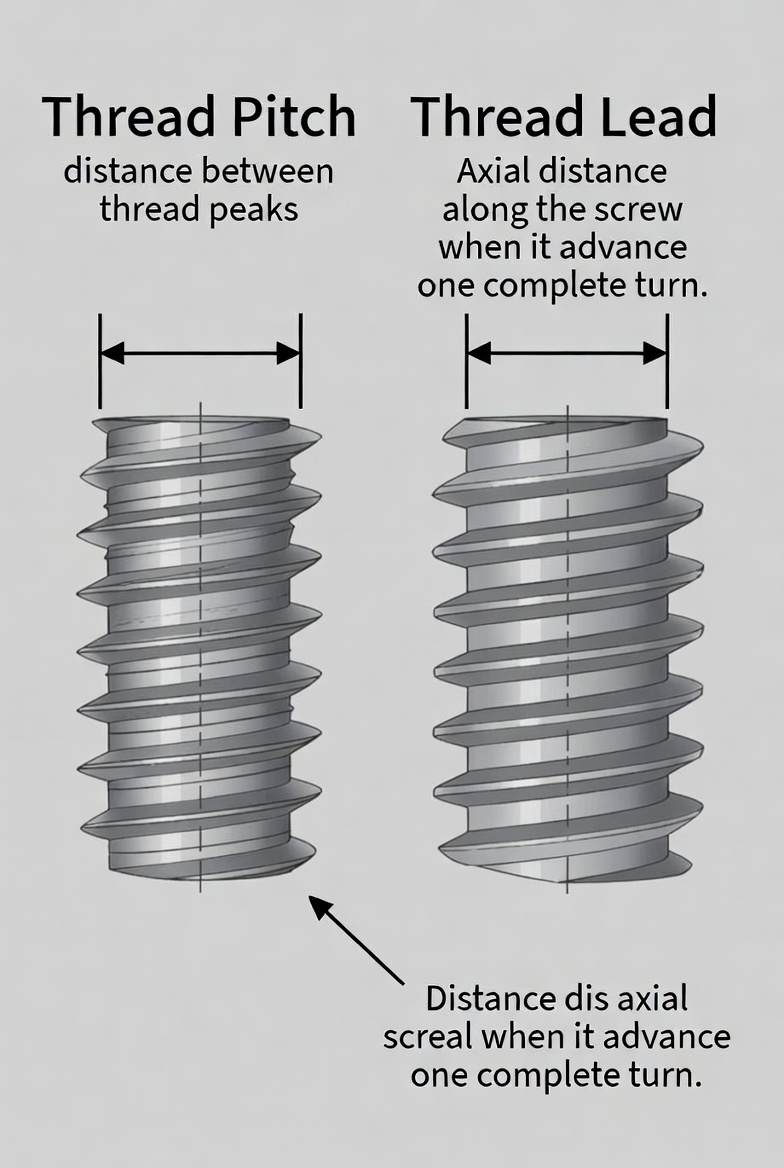
These two terms often get confused, and it matters.
Thread pitch = distance between adjacent threads on a single helix
Thread lead = distance the fastener travels per full rotation
For a single-start thread (the most common type), pitch and lead are equal. A multi-start thread — used in applications where rapid assembly is needed — has a lead that’s a multiple of its pitch. Most standard fasteners you’ll encounter use single-start threads, so pitch and lead are functionally the same thing.sciencedirect
How to Measure Thread Pitch
Knowing the theory is one thing. Getting an accurate reading in a workshop, on a production floor, or out in the field is another. There are three reliable methods, and each has its place depending on context and available tools.
Method 1: Thread Pitch Gauge
The fastest and most widely used method. A thread pitch gauge (also called a thread comb gauge) is a fan-style tool with multiple blades, each cut to a specific pitch. You press blades against the thread until one fits flush — no light showing through, no wobbling. That blade’s marked value is your thread pitch.
Best for: Quick field identification, incoming inspection, workshop use
Limitation: Won’t distinguish between thread forms (V-thread vs. ACME vs. buttress) that happen to share the same pitch spacing
Method 2: Vernier Caliper or Micrometer Measurement
Here you’re measuring the distance across a set number of thread peaks, then dividing by the number of intervals. Measure across 10 thread crests, divide by 9 (the number of gaps between 10 crests), and you have your thread pitch. This method works when you don’t have a gauge handy, but requires careful technique — especially on worn or corroded threads.openjournal.unpam
Best for: Verification, workshop environments with precision measurement tools
Limitation: User error risk is higher; works better on external threads than internal
Method 3: Optical Profile Projector or CMM
For production quality control and engineering verification, an optical profile projector or coordinate measuring machine (CMM) gives you both thread pitch and thread form data simultaneously. This is the method used in manufacturing environments where traceability matters — aerospace components, medical implants, and precision machine tools all require this level of documentation.openjournal.unpam
Best for: Manufacturing QC, engineering validation, high-stakes applications
Limitation: Expensive equipment, lab or production environment required
Thread Pitch Standards: Metric vs. Imperial
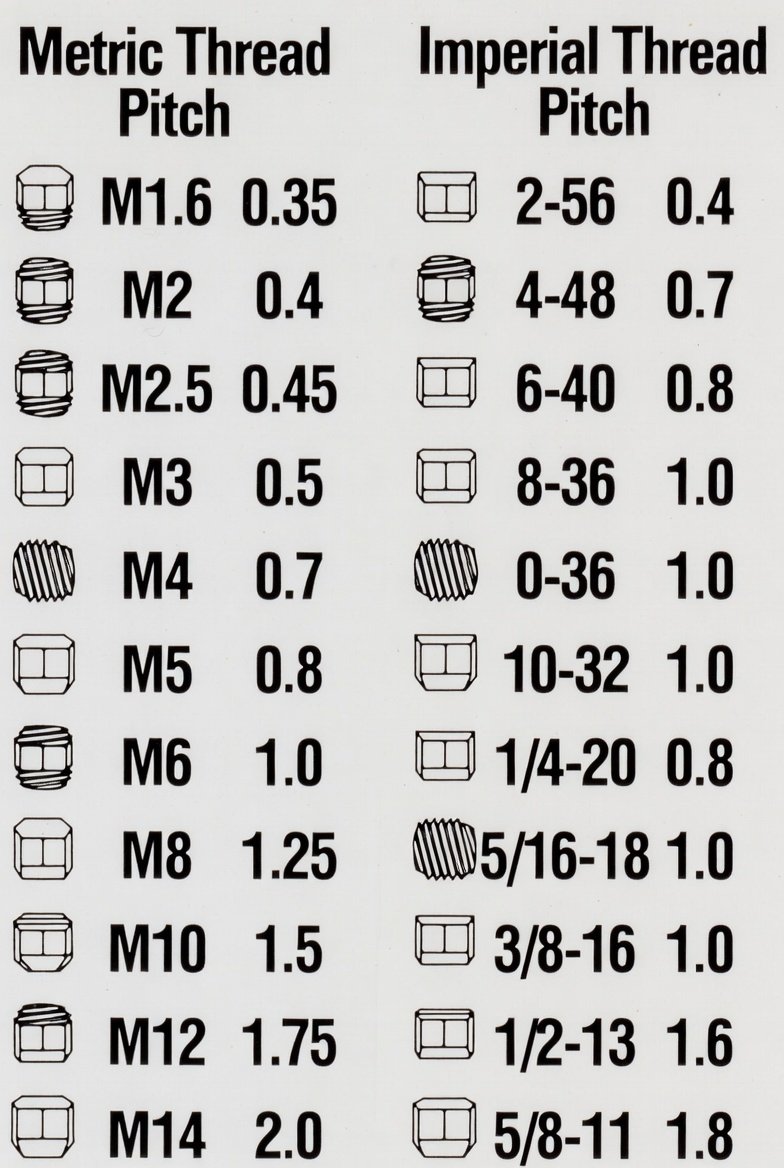
Here’s where things get genuinely confusing for anyone sourcing fasteners internationally. The world operates on two main standards, and they are not interchangeable — even when the screws look similar.
Table 1: Metric ISO vs. Imperial UNC Thread Pitch Standards
albanycountyfasteners+1
The metric system defines thread pitch as a direct distance value: an M10 × 1.5 screw has threads spaced 1.5mm apart. The imperial (UNC/UNF) system works backwards — it tells you how many threads fit into one inch. A 1/4-20 bolt has 20 threads per inch, which converts to a pitch of roughly 1.27mm.scribd
Why does this matter practically? Because a 1/4-20 bolt and an M6 × 1.0 bolt are close in diameter but have completely different thread pitches. Thread them together and you’ll either strip the threads, cross-thread the joint, or get a connection that seems to hold but will back out under vibration. We’ve seen exactly this happen in facilities that mix domestically sourced and imported equipment.
British Standards (BSW/BSF) — Still Alive in Legacy Applications
Don’t assume the metric-imperial divide covers everything. The British Standard Whitworth (BSW) thread uses a 55° thread angle (not 60°) and its own pitch values. If you’re servicing older British machinery, vintage motorcycles, or heritage industrial equipment, you may encounter BSW threads that won’t accept modern metric or UNC fasteners at all.sciencedirect
Coarse vs. Fine Thread Pitch: Which One Do You Actually Need?
This is the question engineers debate most — and the answer is genuinely “it depends,” which isn’t a cop-out. It’s context. Let’s break down what each pitch type is actually good at.
Table 2: Coarse vs. Fine Thread Pitch Performance Comparison
apmhexseal+1
Coarse thread pitch is the default for a reason. It assembles quickly, tolerates surface contamination, and doesn’t strip easily even with hand tools. That’s why most structural bolts, wood screws, and general-purpose machine screws use coarse pitch — speed and forgiveness matter more than ultimate holding power.
Fine thread pitch is where things get specific. A tighter pitch means more thread engagement per unit of axial length, which translates to better resistance against loosening under vibration. That’s critical in automotive engine assemblies (cylinder head bolts, for example), aerospace structures, and precision instruments where you simply cannot afford a fastener backing out. Fine pitch also allows for more precise torque control, which matters in applications where preload has to be dialed in accurately.oreateai
Practical rule of thumb: Start with coarse pitch. Move to fine only when vibration resistance, thin material, or precision adjustment is a documented requirement.
For a broader overview of how thread pitch fits into the larger fastener selection picture, Fastenright: Fasteners, Screws, Nuts & Bolts offers extensive resources on matching the right fastener type to your application.
Thread Pitch in Industry: Where It Actually Gets Applied

Thread pitch isn’t abstract engineering — it’s the reason aircraft don’t fall out of the sky and surgical implants stay in place. Let’s look at how specific industries think about and apply thread pitch selection.
Aerospace & Defense
Aerospace fasteners operate in environments where temperature swings from -55°C to +200°C, vibration is constant, and failure is catastrophic. Fine thread pitches dominate here because the higher thread engagement per length provides better fatigue resistance and more consistent preload. Aerospace standards like AS8879 and NAS specify exact thread pitch requirements for every fastener classification.calculatorsconversion
Medical Devices & Orthopedic Implants
Bone screws used in orthopedic surgery represent some of the most nuanced thread pitch engineering in any field. Cancellous bone screws (used in soft, spongy bone) use coarse pitch to maximize purchase in low-density material. Cortical bone screws, engaging the hard outer bone layer, use a finer thread pitch to develop higher pull-out strength in denser material. A recent multi-center study tracking 1,035 femoral neck fracture patients showed that thread design — including pitch — had a direct, measurable effect on clinical failure rates.astm+2
Automotive Manufacturing
Engine components, suspension systems, and safety-critical assemblies all have tightly controlled thread pitch specifications. Fine pitch bolts secure cylinder heads (where consistent clamping force across the head gasket matters enormously), while coarser pitches handle less critical chassis fasteners. Thread pitch mismatches in automotive assembly lines have historically caused warranty claims in the thousands, which is why most major OEMs specify pitch explicitly on engineering drawings rather than leaving it to supplier judgment.
Construction & Structural Engineering
Structural bolts (ASTM A325, A490, or ISO 8.8/10.9 equivalents) typically use coarse thread pitch. In concrete anchor applications, thread pitch affects how anchor bolts distribute load into the substrate — an engineering consideration that goes beyond simple fastener-to-fastener compatibility.mechanics-industry
Electronics & Precision Instruments
Thread pitch in electronics is often extra-fine — pitches of 0.35mm or less for miniature screws securing circuit boards, lens assemblies, or instrument housings. Here, the tolerance between thread pitch and thread form is so tight that even small manufacturing deviations can prevent assembly or cause intermittent electrical contact.
How Thread Pitch Affects Joint Performance
We’ve touched on this throughout, but it deserves its own treatment because the mechanical relationship between pitch and joint behavior is often misunderstood.
Clamping Force & Preload
The relationship between applied torque and clamping force is directly influenced by thread pitch. A finer pitch produces less clamping force per unit of applied torque because the mechanical advantage changes. This matters in bolted joint design: if you’re calculating torque specifications, the thread pitch value has to be in your formula.mechanics-industry
Load Distribution Along Thread Length
Research on bolted joint mechanics consistently shows that the first engaged thread carries a disproportionate share of the load — often 30-40% of the total axial force. Using a slightly different pitch between bolt and nut (intentional mismatch within tolerance) can redistribute that load more evenly, improving fatigue life significantly. This is an advanced technique used in high-cycle applications, but it illustrates how sensitive joint performance is to even small thread pitch variations.mechanics-industry
Vibration Loosening
Vibration causes screws to rotate slightly backward with each cycle, reducing preload incrementally. Fine thread pitch resists this mechanism better because the helix angle is shallower — the thread acts more like a wedge that’s harder to back out. In dynamic environments (engines, HVAC equipment, industrial machinery), selecting the right thread pitch can eliminate the need for thread-locking compounds or lock washers entirely.apmhexseal+1
Common Thread Pitch Mistakes — and How We’ve Seen Them Fixed
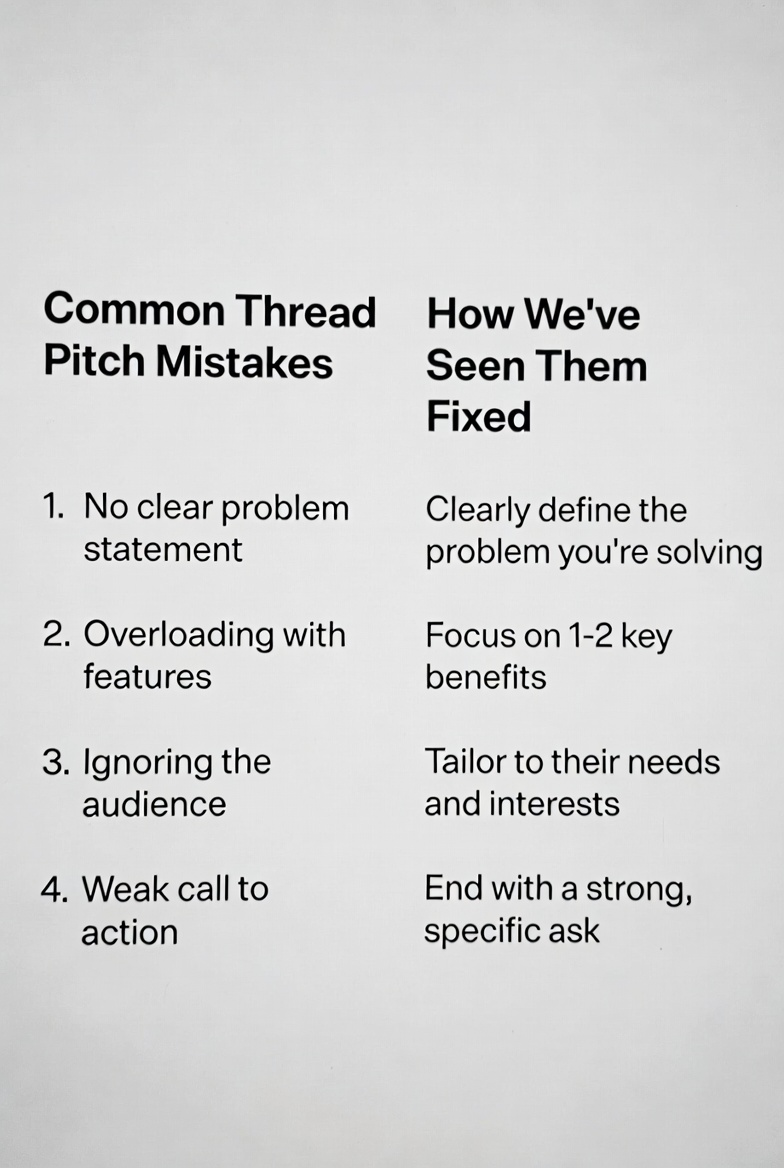
No guide would be complete without the failure modes. These aren’t hypothetical. They’re the kind of mistakes that show up in field service reports and root cause analyses.
1. Assuming “close enough” means compatible
An M8 × 1.25 and an M8 × 1.0 bolt are the same diameter. Thread them into the same hole and the finer-pitch bolt will seem to thread in for a few turns before binding — and the threads it cuts into the coarser-pitch tapping will be damaged, potentially ruining an expensive part.
2. Using coarse pitch in high-vibration environments without locking provisions
Coarse pitch fasteners in vibrating machinery without some form of thread locking (adhesive, prevailing torque nut, or mechanical locking device) will loosen. It happens every time. The fix is either to switch to fine thread pitch, add a locking provision, or both.
3. Ignoring pitch when re-tapping damaged threads
When a tapped hole is damaged and needs re-tapping, using the next available tap size without maintaining the original thread pitch creates a mismatched interface for future fasteners. Always match the original pitch specification when repairing threaded holes.
4. Mixing metric and imperial fasteners in the same assembly
This one seems obvious but happens constantly in maintenance environments where fasteners are grabbed from mixed stock. The visual similarity between M6 × 1.0 and 1/4-20 is enough to cause incorrect assembly, especially when torque specs are borrowed from the wrong standard.
Thread Pitch Reference: Common Sizes at a Glance
Table 3: Standard Thread Pitch Values for Common Screw Sizes
fastenright+2
These values represent the ISO and ASME standard coarse and fine thread pitch specifications for the most commonly used fastener sizes. When ordering or specifying fasteners, always confirm both the nominal diameter and the thread pitch — diameter alone is insufficient.
Future Trends in Thread Pitch Engineering
The fundamentals of thread pitch measurement haven’t changed dramatically in decades. What is changing is how thread pitch is designed, verified, and applied — particularly in emerging industries that are pushing fastener technology into genuinely new territory.
Digital Thread Measurement & AI-Assisted QC
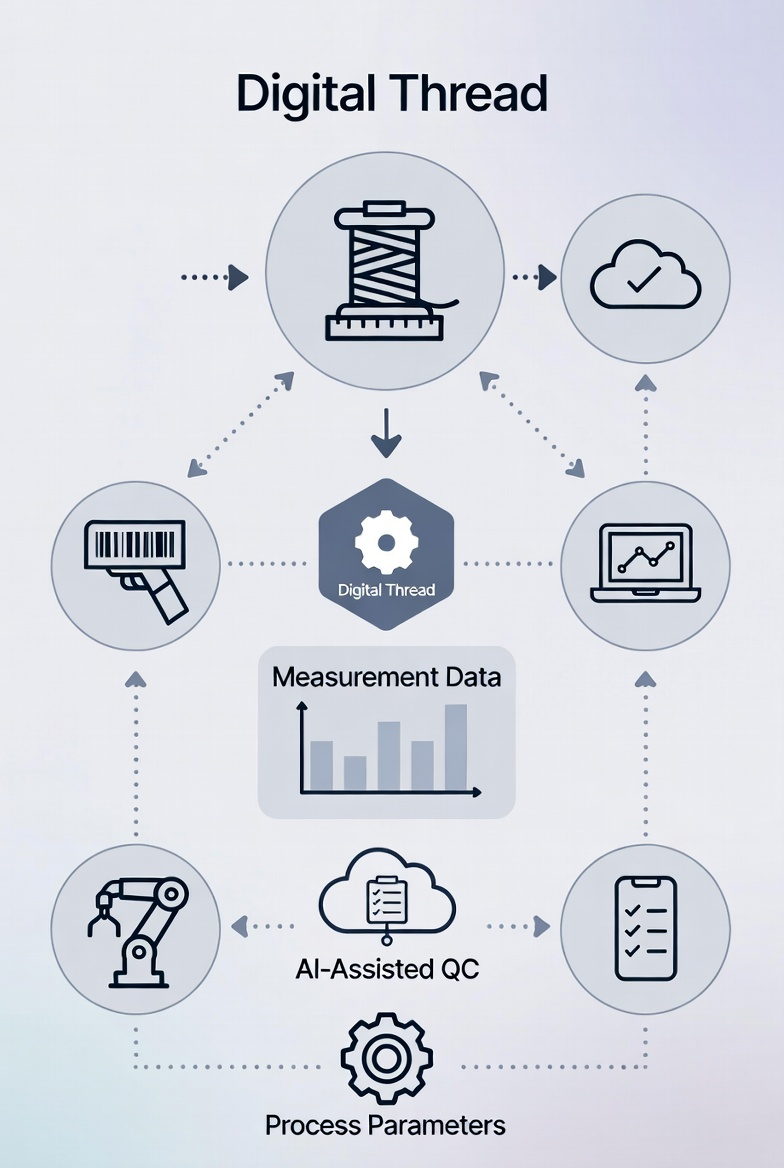
Optical metrology systems paired with machine learning algorithms can now scan and classify thread pitch at production speeds that would’ve been unthinkable five years ago. Instead of sampling-based QC, some facilities are moving toward 100% in-line thread pitch verification using structured light or laser profilometry. For medical device manufacturers (where a single out-of-spec bone screw pitch can result in a field recall), this shift is less a trend and more a regulatory inevitability.calculatorsconversion
Variable Thread Pitch Designs
Research into pedicle screws for spinal surgery has produced a new category of fastener: the variable-pitch screw, where thread pitch changes along the screw’s length. The distal tip uses fine pitch to engage cortical bone; the proximal region uses coarser pitch to anchor in cancellous bone. This same principle is beginning to appear in industrial fastener design — particularly in composite materials where different layers have different density and mechanical properties.linkinghub.elsevier
Additive Manufacturing and Thread Pitch Complexity
3D printing in metals (laser powder bed fusion, directed energy deposition) has made it economically viable to produce custom thread geometries that would have been impossible or prohibitively expensive with conventional machining. Variable-lead screws, non-circular thread paths, and gradient pitch designs are all entering production in aerospace and defense applications. The challenge — and active research area — is standardizing metrology for these non-standard geometries, since traditional thread gauges are useless on them.calculatorsconversion
Sustainable Fastener Design
Thread pitch influences how many passes a manufacturing process requires — finer pitches often require more machining steps, more tool wear, and higher energy consumption. There’s growing interest in optimizing thread pitch not just for mechanical performance but for manufacturing efficiency and material reduction. Some researchers are exploring thread pitch profiles that maintain strength while reducing the volume of material removed during tapping, a small but meaningful contribution to sustainable manufacturing.e3s-conferences
Coatings and Thread Pitch Interaction
As surface coatings become more sophisticated — DLC (diamond-like carbon), PTFE-based lubricating coatings, anti-corrosion treatments — their thickness becomes a thread pitch issue. A coating that adds 15–20 microns to a thread’s surface changes the effective thread pitch slightly and can affect fit class. Specifying thread pitch in conjunction with coating thickness and class of fit is becoming standard practice in precision engineering, where it used to be an afterthought.www-eng.lbl
Selecting the Right Thread Pitch: A Practical Framework
After everything above, here’s how to actually make the decision in practice — without overcomplicating it.
Step 1: Define your environment
Is the assembly static or dynamic? Will it experience vibration, thermal cycling, or impact loads? Dynamic and high-vibration environments push toward fine pitch.
Step 2: Consider your material
Thin sheet metal, plastics, and soft alloys benefit from fine thread pitch (more threads engaged per thickness). Thick structural steel, cast iron, and general fabrication work handle coarse pitch better — less risk of stripping.
Step 3: Check your standard
Are you working in a metric or imperial system? What’s the prevailing standard in your industry or region? Don’t mix standards unless there’s a documented engineering reason.
Step 4: Assembly speed and maintenance
Equipment that requires frequent disassembly — maintenance access panels, inspection ports, service covers — benefits from coarse thread pitch. Faster threading in and out means lower maintenance labor costs.
Step 5: Confirm with hardware supplier resources
For detailed pitch charts, fit class tables, and application guidance, resources like Thread Types Explained: UNC vs UNF, Coarse vs Fine, Metric Pitch Guide, Thread Pitch – Definition & Charts, and The Importance of Thread Pitch and How to Select the Right Fastener provide verified reference data.
For engineering-level depth on thread mechanics, UNC vs UNF vs Metric Threads – Thread Pitches, Fit Classes & Where Each Shines is a thorough technical resource. Academic and scientific depth on thread behavior is available through Thread Pitch – ScienceDirect Engineering Topics.
Thread pitch is one of those engineering parameters that sits quietly at the center of almost every mechanical assembly. It doesn’t get the attention that material grades or surface finishes do — but get it wrong, and the consequences are immediate and often expensive. Get it right, and joints last exactly as long as they’re designed to.
The fundamentals here — measurement, standards, coarse vs. fine selection, industry context — cover the vast majority of real-world decisions you’ll encounter. For anything beyond that: verify against your specific standard, use calibrated measurement tools, and don’t assume that visual similarity means mechanical compatibility.
Related Products
Solutions & Cluster
Related Articles
- What Is a Screw and Nut — and Why Does the Pairing Matter
- Screw Definition: What It Is, How It Works, and Why It Matters More Than You Think
- Lock Nut Complete Guide: Types, Selection & Industrial Applications in 2026
- UNS Thread Complete Guide: Specifications, Charts & Applications
- All Thread Rod Complete Guide: Types, Applications & Selection Tips (2026)
- One Way Screws: The Complete Guide to Tamper-Resistant Security Fasteners
- Bolt Nut and Washer: The Complete 2026 Guide to Choosing and Using Fasteners Correctly
- What Is a Shear Bolt? Types, Grades, Sizes & Selection Guide