
 English
  German
  Spanish
  Portuguese
  French
  Japanese
  Arabic
  Korean
  Vietnamese
  Russian
 DIN913 Flat Point Set Screw Manufacturer
DIN913 hexagon socket set screws (grub screws) with flat point — M1.6 to M24, carbon steel hardness class 45H, stainless A2/A4, and nylon. ISO 4026 equivalent. EN 10204 3.1 certificates supplied. ISO 9001:2015 certified.
- M1.6–M24 · Custom Lengths Available
- Hardness Class 45H (min 45 HRC surface) / A2-70 / A4-70 / Nylon
- ISO 4026 equivalent — DIN913 Flat Point (no surface damage)
- Lead Time: 3–5 Days (Stock) / 5–10 Days (Custom)
- EN 10204 3.1 Certificates · RoHS Compliant Options
500+
B2B Clients Worldwide
15+ Years
Fastener Manufacturing
ISO 9001:2015
Quality Management
24 Hours
Quotation Response
DIN913 Set Screw Quick Specifications
Standard
DIN913 / ISO 4026
Thread Size
M1.6 – M24
Point Type
Flat (non-damaging)
Hardness
45H / A2-70 / A4-70
What Is a DIN913 Set Screw?
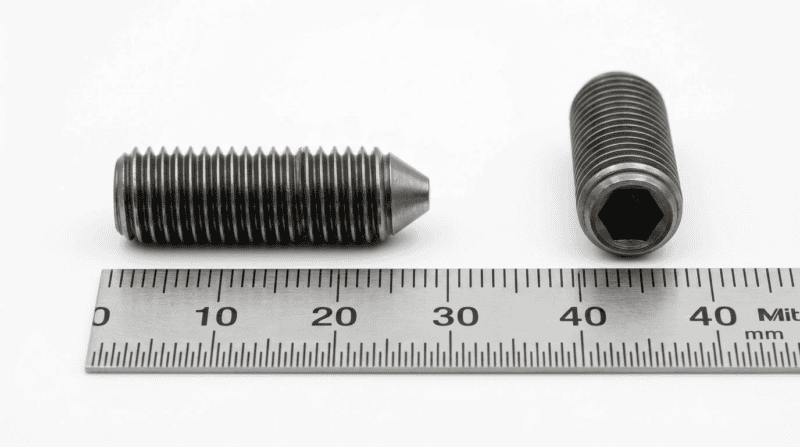
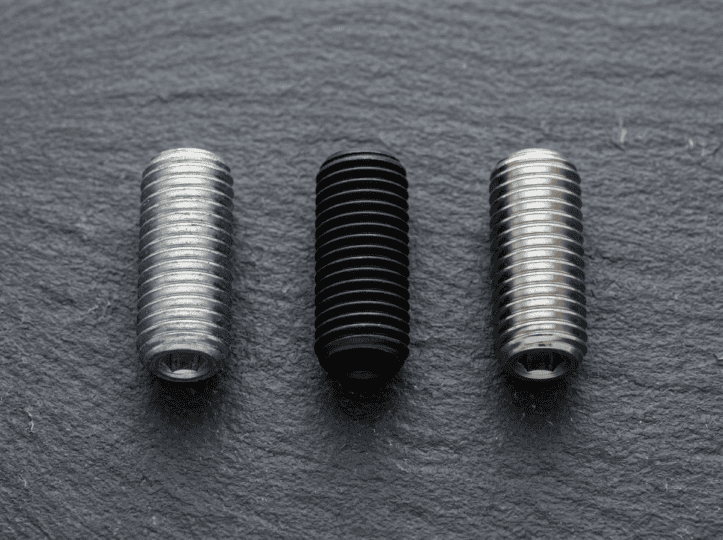
DIN913 is a headless hexagon socket set screw with a flat point, also commonly called a grub screw or Allen set screw. Unlike standard cap screws, DIN913 is fully threaded with no head — it sits flush with or below the workpiece surface, driven by a hex key (Allen key) inserted into the socket at the top.
The flat point (smooth disc end) is the defining feature: it contacts the mating surface without biting in or scoring it. This makes DIN913 the preferred choice for hard surfaces, frequent adjustments, and assemblies where the mating component must remain undamaged.
Key technical characteristics:
- Fully threaded body — entirely thread-engaged, no unthreaded shank
- Driven by hex key (Allen key) via recessed socket
- Hardness class 45H for carbon steel: min. 45 HRC surface, 33–39 HRC core
- Product grade A per DIN EN ISO 4759-1
- ISO equivalent: ISO 4026 (dimensionally identical)
DIN913 vs DIN914 vs DIN915 vs DIN916 — Point Type Comparison
All four standards share the same hex socket headless body — they differ only in the end (point) shape. Choosing the correct point type is critical: the wrong choice can damage mating surfaces, reduce holding force, or make future disassembly impossible.
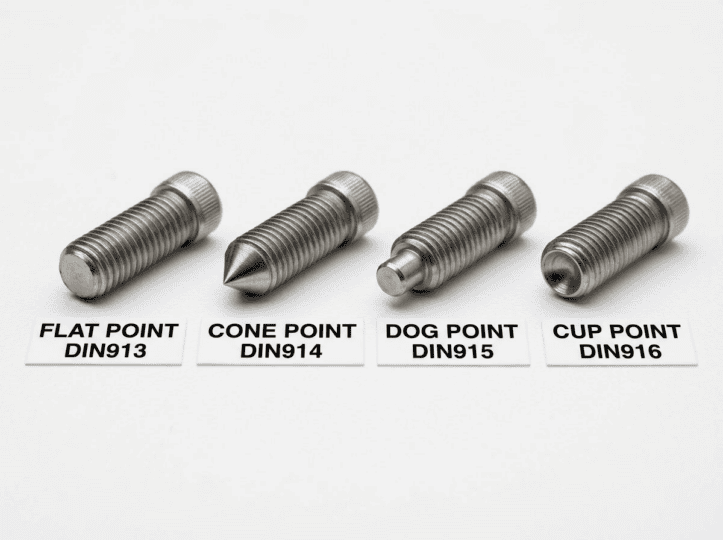
| Feature | DIN913 Flat Point | DIN914 Cone Point | DIN915 Dog Point | DIN916 Cup Point |
|---|---|---|---|---|
| ISO Equivalent | ISO 4026 | ISO 4027 | ISO 4028 | ISO 4029 |
| End Shape | Flat, smooth disc | Tapered sharp cone | Protruding cylinder pin | Concave cup / ring |
| Surface Damage Risk | Minimal | High (pierces) | None (pre-drilled hole) | Moderate (ring mark) |
| Locking Mechanism | Friction / pressure | Cone digs in | Pin in hole — precision | Cup rim grips |
| Reusability | High | Low–Medium | High | Medium |
| Best For | Hard surfaces, frequent adjustment | Soft metals, one-time lock | Precise axial location | General locking, shaft collars |
| Common Applications | Jigs, fixtures, stops | Set-once shaft lock | Gear hubs, shaft locating | Pulleys, collars, handles |
DIN913 Full Dimensions Table (M1.6 – M24)
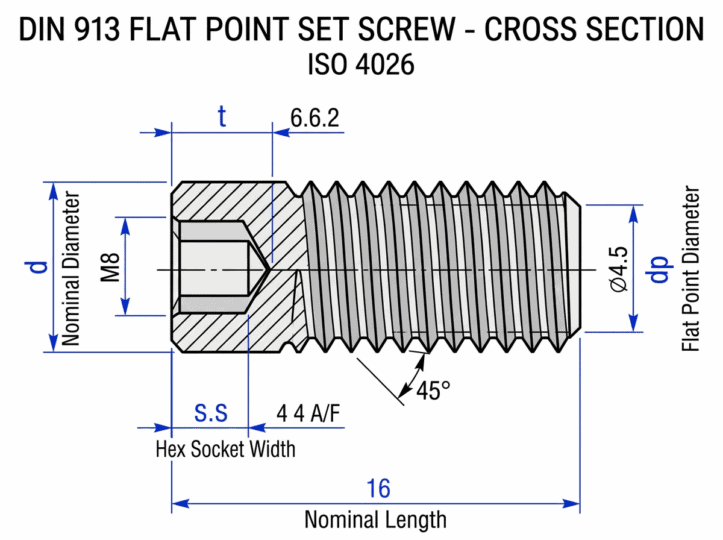
Per DIN913 / ISO 4026. dp = flat point diameter. s = hex socket AF (Allen key size).
t = minimum socket engagement depth (short / long screws). All dimensions in mm.
| Thread d | Pitch P (mm) | dp max (mm) | dp min (mm) | Socket e min (mm) | Hex s nom (mm) — Allen key | t short min (mm) | t long min (mm) |
|---|---|---|---|---|---|---|---|
| M1.6 | 0.35 | 0.80 | 0.55 | 0.809 | 0.7 | 0.7 | 1.5 |
| M2 | 0.40 | 1.00 | 0.75 | 1.011 | 0.9 | 0.8 | 1.7 |
| M2.5 | 0.45 | 1.50 | 1.25 | 1.454 | 1.3 | 1.2 | 2.0 |
| M3 | 0.50 | 2.00 | 1.75 | 1.733 | 1.5 | 1.2 | 2.0 |
| M4 | 0.70 | 2.50 | 2.25 | 2.303 | 2 | 1.5 | 2.5 |
| M5 | 0.80 | 3.50 | 3.20 | 2.873 | 2.5 | 2.0 | 3.0 |
| M6 | 1.00 | 4.00 | 3.70 | 3.443 | 3 | 2.0 | 3.5 |
| M8 | 1.25 | 5.50 | 5.20 | 4.583 | 4 | 3.0 | 5.0 |
| M10 | 1.50 | 7.00 | 6.64 | 5.723 | 5 | 4.0 | 6.0 |
| M12 | 1.75 | 8.50 | 8.14 | 6.863 | 6 | 4.8 | 8.0 |
| (M14) | 2.00 | 10.00 | 9.64 | 6.863 | 6 | 5.6 | 9.0 |
| M16 | 2.00 | 12.00 | 11.57 | 9.149 | 8 | 6.4 | 10.0 |
| (M18) | 2.50 | 13.00 | 12.57 | 11.429 | 10 | 7.2 | 11.0 |
| M20 | 2.50 | 15.00 | 14.57 | 11.429 | 10 | 8.0 | 12.0 |
| (M22) | 2.50 | 17.00 | 16.57 | 13.716 | 12 | 9.0 | 13.5 |
| M24 | 3.00 | 18.00 | 17.57 | 13.716 | 12 | 10.0 | 15.0 |
Sizes in parentheses (M14, M18, M22) are non-preferred per ISO 4026; availability may be limited. dp = flat point diameter. s = hex socket AF (Allen key size). t = socket depth (short/long screws). Hardness class 45H: min 45 HRC surface, 33–39 HRC core.
Materials & Hardness Grades
DIN913 uses hardness classes — not the 8.8/10.9 bolt grade system. Class 45H is standard for carbon steel set screws (min. 45 HRC surface hardness). Stainless grades use the A-class system (A2-70, A4-70).
| Material | Grade | Best For |
|---|---|---|
| Carbon Steel | 45H | General mechanical assembly, jigs, fixtures |
| Carbon Steel — Black Oxide | 45H | Tooling, aesthetic finish, mild corrosion resistance |
| Stainless A2 (304) | A2-70 | Food equipment, light corrosion, reusability |
| Stainless A4 (316) | A4-70 | Marine, chemical, outdoor exposure |
| Plastic (Nylon / PVDF) | — | Non-marring, electrical insulation, soft mating surfaces |
For plastic set screws, specify: Nylon DIN913 M6 × 12 — no grade needed.
Key Applications
- ✔ Locking shaft collars and hubs against axial movement
- ✔ Adjustable stop screws in jigs and fixtures
- ✔ Retaining knobs, handles, and levers on shafts
- ✔ Position locking in linear guides and slides
- ✔ Electronics: securing potentiometers and rotary controls
- ✔ CNC machine tooling: component registration stops
- ✔ Furniture fittings: invisible connector locking
- ✔ Hydraulic / pneumatic: needle valve adjustment retention
How to Install DIN913 Set Screws Correctly
Step 1 — Select the Correct Hex Key Size
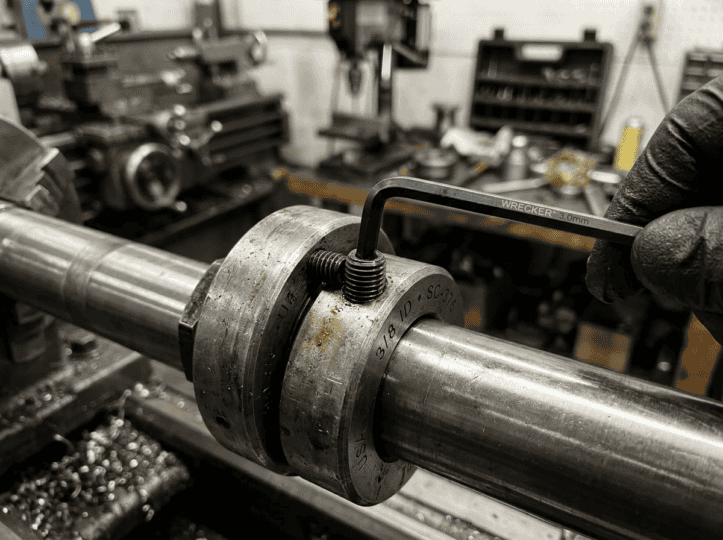
Match the hex key (Allen key) to the s value in the dimensions table. For example: M6 uses a 3mm hex key, M8 uses 4mm, M10 uses 5mm. Use a T-handle or L-key with the long arm for full torque transfer. Low-quality hex keys with rounded corners can strip the socket — invest in quality tool steel keys.
Step 2 — Thread Engagement Depth
Minimum recommended engagement depth: 1× the thread diameter. For example, M8 should thread in at least 8mm into the tapped hole. For vibrating assemblies: use 1.5× diameter engagement. Always verify thread engagement before applying final torque.
Step 3 — Apply Correct Tightening Torque
Recommended indicative torques for DIN913 flat point set screws:
| Size | 45H Carbon (Nm) | A2/A4 Stainless (Nm) |
|---|---|---|
| M6 | 4.8 | 3.8–4.1 |
| M8 | 12 | 9.6–10.2 |
| M10 | 24 | 19.2–20.4 |
| M12 | 40 | 32–34 |
Reduce stainless torque 15–20% to prevent galling. Values are indicative — verify with assembly engineer.
Step 4 — Apply Thread Locking Compound If Needed
For vibrating environments: apply medium-strength threadlocker (e.g. Loctite 243) to screw threads before installation. This prevents back-off under vibration without permanent locking. Do not use thread locking compound with plastic/nylon set screws — the chemical may attack the nylon material. Ensure the mating thread is clean and free of cutting fluid before applying locking compound.
How to Order DIN913 — Specification Format
Use the standard designation format when placing orders to avoid confusion:
Set Screw DIN913 – M8 × 20 – 45H
- M8 — nominal thread diameter (in mm)
- 20 — nominal length in mm (= total screw length, since DIN913 has no head)
- 45H — hardness class (carbon steel). For stainless: use A2 or A4
Stainless example: Set Screw DIN913 – M8 × 20 – A2
Note: nominal length equals total screw length for DIN913. Unlike cap screws (where length excludes head), the headless DIN913 length IS the full length.
DIN913 or DIN916 — Quick Selection Guide
- → Surface must not be damaged → Choose DIN913 (flat point)
- → Stronger grip needed, surface impression acceptable → Choose DIN916 (cup point)
- → Precise axial pin location required → Choose DIN915 (dog point)
- → One-time installation in soft metal, maximum grip → Choose DIN914 (cone point)
Quality Certifications & Documentation
Every DIN913 set screw order ships with full traceability documentation.
ISO 9001:2015
Certified QMS covering DIN913 production, inspection, and delivery.
EN 10204 3.1 Certificates
Full material test certificates for every batch — chemistry and mechanical properties.
SGS Third-Party Testing
Independent hardness and tensile verification available on request.
RoHS Compliant Materials
Black oxide and zinc-plated finishes comply with EU RoHS 2011/65/EU.
Why Source DIN913 Set Screws From Us?
We manufacture DIN913 flat point set screws using precision CNC thread rolling with full ISO 4759 tolerance control. Each batch undergoes hex socket depth, hardness, and thread gauge inspection. No middlemen — direct factory pricing with complete documentation.
- Stock: M4–M20 in 45H and A2-70 — ready in 3–5 business days
- Custom: M1.6–M24, any length, 45H / A2 / A4 / Nylon, MOQ 500 pcs
- CNC thread rolling, ISO 4759 tolerances, 100% hex socket depth checked
- EN 10204 3.1 material certificates included with every order
- Surface options: plain, black oxide, zinc plated, A4 passivated
- OEM packaging: custom labelling, reel/bag/box, export-ready
- Quote turnaround: 24 hours standard / 48 hours specials
- Save 25–35% vs European distributor pricing on comparable DIN grades
Related Fastener Standards
Need DIN913 Set Screws in Bulk or Custom Specifications?
We supply DIN913 flat point set screws in carbon steel 45H, stainless A2/A4, and nylon. Sizes M1.6–M24, custom lengths available. MOQ from 500 pcs. RoHS-compliant materials and EN 10204 3.1 certificates available on all orders.
Frequently Asked Questions — DIN913 Set Screws
Technical questions about DIN913 flat point set screw selection, ordering, installation, and standards.