
 English
  German
  Spanish
  Portuguese
  French
  Japanese
  Arabic
  Korean
  Vietnamese
  Russian
 DIN939 Double End Stud Bolt Manufacturer
Metric tap-end stud bolts with 1.25d screwing-in length — M4 to M52, carbon steel, stainless steel, and alloy steel grades. ISO 9001:2015 certified production, EN 10204 3.1 certificates supplied. Equivalent to ISO 4028.
- M4–M52 Thread Sizes · Custom Lengths Available
- Grades: 4.8 / 8.8 / 10.9 / 12.9 / A2-70 / A4-70 / A4-80 / 42CrMo4
- b1 = 1.25×d (DIN 939 / ISO 4028 compliant)
- Lead Time: 3–5 Days (Stock) / 7–15 Days (Custom)
- EN 10204 3.1 Material Certificates on Request
500+
B2B Clients Worldwide
15+ Years
Fastener Manufacturing
ISO 9001:2015
Quality Management
24 Hours
Quotation Response
DIN939 Stud Bolt Quick Specifications
Standard
DIN 939 / ISO 4028
Thread Size
M4 – M52
Tap End (b1)
1.25 × d
Grades
8.8 / 10.9 / A2-70 / A4-70
What Is a DIN939 Double End Stud Bolt?
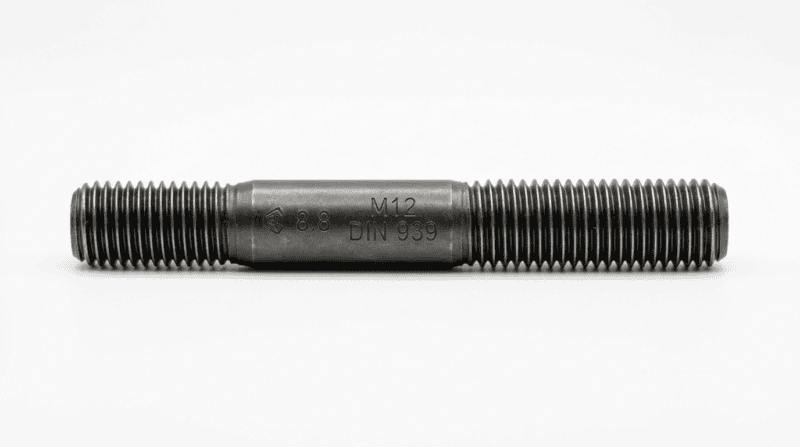
DIN939 Double End Stud Bolt is a German metric standard for tap-end double-end stud bolts
where the screwing-in end length equals 1.25 times the nominal thread diameter (b1 = 1.25d).
This 25% longer engagement compared to DIN938 provides greater thread pull-out resistance,
making DIN939 the most widely-used general-purpose stud bolt standard globally — equivalent to ISO 4028.
The 1.25d tap-end suits a broader range of base materials than DIN938’s 1d, including cast iron,
grey iron castings, and light aluminium alloys used in gearboxes, engine blocks, and compressor housings.
DIN939 vs DIN938 vs DIN940 — screwing-in length comparison:
| Standard | b1 (Screwing-in End) | Base Material | Best For |
|---|---|---|---|
| DIN 938 | 1.0 × d | Steel, cast steel (≥ 200 HB) | Light load, steel-to-steel joints |
| DIN 939 | 1.25 × d | Cast iron, steel, aluminium alloy | General machinery, medium-to-heavy load |
| DIN 940 | 1.5 × d | Light alloys, soft metals, plastics | Heavy load, deep engagement in soft material |
DIN 939 is the most widely-used standard — its 1.25d engagement balances pull-out strength against installation depth across the widest range of base materials.
DIN939 Dimension & Property Class Tables
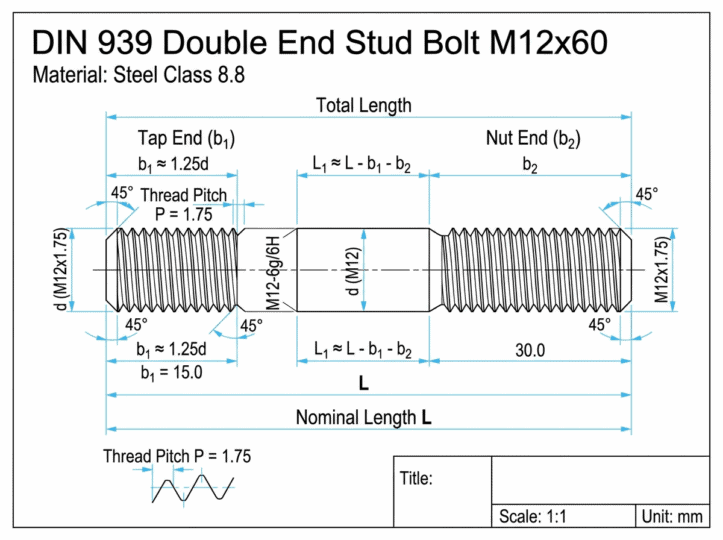
Complete M4–M52 dimension table per DIN 939 / ISO 4028, plus property class mechanical benchmarks. All values in millimetres. b1 values highlighted in amber.
All dimensions in mm per DIN 939 / ISO 4028. b1 = 1.25d (tap/screwing-in end). Nominal length L excludes b1; total stud length = L + b1. Example: M10×50 → total length = 50 + 12 = 62 mm.
| Thread d | Pitch (mm) | b1 (mm) | b2 L≤125 | b2 125<L≤200 | b2 L>200 | x1 | x2 |
|---|---|---|---|---|---|---|---|
| M4 | 0.70 | 5 | 14 | 20 | — | 1.75 | 0.9 |
| M5 | 0.80 | 6.5 | 16 | 22 | — | 2.0 | 1.0 |
| M6 | 1.00 | 7.5 | 18 | 24 | — | 2.5 | 1.25 |
| M8 | 1.25 | 10 | 22 | 28 | — | 3.2 | 1.6 |
| M10 | 1.50 | 12 | 26 | 32 | 45 | 3.8 | 1.9 |
| M12 | 1.75 | 15 | 30 | 36 | 49 | 4.3 | 2.2 |
| M14 | 2.00 | 18 | 34 | 40 | 53 | 5.0 | 2.5 |
| M16 | 2.00 | 20 | 38 | 44 | 57 | 5.0 | 3.2 |
| M18 | 2.50 | 22 | 42 | 48 | 61 | 6.3 | 3.2 |
| M20 | 2.50 | 25 | 46 | 52 | 65 | 6.3 | 3.2 |
| M24 | 3.00 | 30 | 54 | 60 | 73 | 7.5 | 4.0 |
| M27 | 3.00 | 34 | 60 | 66 | 79 | 7.5 | 4.0 |
| M30 | 3.50 | 38 | 66 | 72 | 85 | 9.5 | 4.0 |
| M36 | 4.00 | 45 | 78 | 84 | 97 | 9.5 | 5.0 |
| M42 | 4.50 | 52 | 90 | 96 | 109 | 11.0 | 5.0 |
| M48 | 5.00 | 60 | 102 | 108 | 121 | 11.0 | 6.0 |
| M52 | 5.00 | 65 | 110 | 116 | 129 | 11.0 | 6.0 |
Property Class & Material Mechanical Properties (ISO 898-1 / ISO 3506)
| Grade | Material | Min Tensile | Min Yield (0.2%) | Hardness | Best For |
|---|---|---|---|---|---|
| 4.8 / 5.8 | Low-carbon steel | 400–500 N/mm² | 320–400 N/mm² | ≤ 250 HV | Light structural, low-load |
| 8.8 | Carbon steel | 800 N/mm² | 640 N/mm² | 22–32 HRC | General structural, standard |
| 10.9 | Carbon steel | 1040 N/mm² | 940 N/mm² | 33–39 HRC | High-strength structural |
| 12.9 | Alloy steel | 1220 N/mm² | 1100 N/mm² | 39–44 HRC | Precision / critical joints |
| A2-70 | Stainless 304 | 700 N/mm² | 450 N/mm² | ≤ 250 HV | Food, chemical, indoor |
| A4-70 | Stainless 316 | 700 N/mm² | 450 N/mm² | ≤ 250 HV | Marine, chloride exposure |
| A4-80 | Stainless 316 | 800 N/mm² | 600 N/mm² | ≤ 250 HV | High-load + corrosive |
| 42CrMo4 | Alloy steel | 1000+ N/mm² | 900+ N/mm² | 30–38 HRC | Pressure vessels, flanges |
DIN939 Material Grades & Property Classes
Select the correct grade for your load, temperature, and corrosion requirements.
Carbon Steel
Grades: 4.8 / 5.8 / 8.8 / 10.9 / 12.9
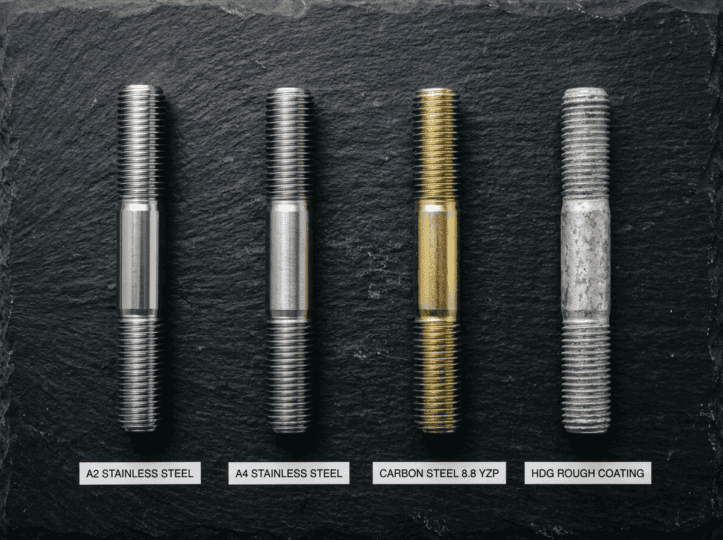
The most economical choice. Grade 8.8 for general machinery; 10.9/12.9 for high-strength structural joints. Zinc plating or Dacromet coating recommended.
Stainless Steel
Grades: A2-70 / A4-70 / A4-80
Corrosion-resistant grades for chemical, food-grade, and marine environments. A4-70/80 (AISI 316 with Mo) preferred for chloride exposure. Non-magnetic.
Alloy Steel
Grades: 42CrMo4 / 25CrMo4
High-strength, high-temperature grades for pressure vessels, petrochemical flanges, and power-generation equipment. Per ISO 898-1 and EN 10269.
Surface Treatment Options
For grade 10.9 and 12.9 DIN939 studs, Dacromet or mechanical zinc eliminates hydrogen embrittlement risk associated with electroplating.
Plain / Black
Standard mill finish. Suitable for oiled, coated, or indoor assemblies.
Zinc Plated
5–8 µm electroplated zinc. General-purpose, RoHS compliant.
Hot-Dip Galvanized
40–80 µm zinc. Outdoor structural and heavy-duty applications.
Dacromet / Geomet
Chrome-free zinc flake, 8–12 µm, 720 h salt-spray. Avoids H-embrittlement on 10.9/12.9.
PTFE / Fluoropolymer
Chemical-resistant, low-friction. Food-grade and clean-room environments.
DIN939 Stud Bolt Applications
Pressure Vessel & Pipe Flanges
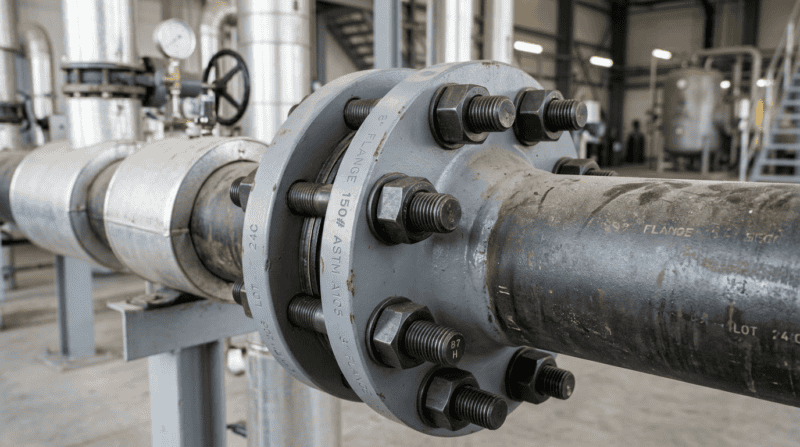
ASME B16.5 and EN 1759 flanged joints in refineries, heat exchangers, and pressure vessels. Alloy steel 42CrMo4 or B7/L7 grades used for high-temperature service.
Automotive Engine & Drivetrain
Cylinder head studs, exhaust manifold bolts, and transmission housings (M10–M14). Grade 10.9 or 12.9 for vibration-resistant clamp force.
Heavy Machinery & Steel Structures
Base-plate connections, gearbox covers, and machine tool frames (M20–M52). Hot-dip galvanized finish for outdoor and exposed installations.
Wind Turbine Tower Flanges
M36–M52 DIN939 studs in property class 10.9, Dacromet-coated, for tower segment and nacelle flange bolting in high-humidity, salt-air environments.
Quality Certifications & Documentation
Every DIN939 stud bolt batch ships with full traceability documentation. Our ISO 9001:2015 process ensures consistent dimensional accuracy and material compliance.
ISO 9001:2015
Certified QMS covering DIN939 design, production, inspection, and delivery.
EN 10204 3.1 Certificates
Full material test certs with chemistry and mechanical results per heat/batch.
SGS Third-Party Testing
Independent tensile, hardness, and thread gauge verification available on request.
RoHS Compliant Coatings
Zinc-plated and Dacromet finishes comply with EU RoHS Directive 2011/65/EU.
Why Source DIN939 Stud Bolts From Us?
We manufacture DIN939 tap-end stud bolts from cold-forged blanks using precision CNC thread rolling, holding dimensional accuracy within ISO 4759 tolerances. Every batch undergoes hardness, tensile, and thread gauge inspection before shipment. No middlemen — direct factory pricing with complete documentation.
- Stock: M8–M36 in grades 8.8, A2-70, A4-70 — ready in 3–5 business days
- Custom production: M4–M52, any length, any grade, MOQ 500 pcs
- Thread rolling: CNC precision, ISO 4759 tolerances, 100% pitch gauge checked
- EN 10204 3.1 material certificates included with every batch
- Surface options: zinc plated, HDG, Dacromet, Geomet, Black oxide, PTFE
- OEM packaging: custom labelling, box/bag/pallet, export-ready
- Quote turnaround: 24 hours for standard items, 48 hours for specials
- Save 25–35% vs European distributor pricing on equivalent DIN grades
Related Fastener Products
Need Custom DIN939 Stud Bolts?
Send us your thread size, nominal length, material grade, surface treatment, and quantity. Our engineering team will confirm availability and issue a quotation within 24 hours. Standard stock ships in 3–5 business days worldwide.
Frequently Asked Questions — DIN939 Stud Bolts
Technical questions from engineers and buyers about DIN939 / ISO 4028 stud bolt selection, ordering, and applications.