
DIN914 is a headless hexagon socket set screw with a tapered cone point (120° or 90°), identical to ISO 4027, used for permanent shaft locking in Class 45H carbon steel or stainless A2/A4.
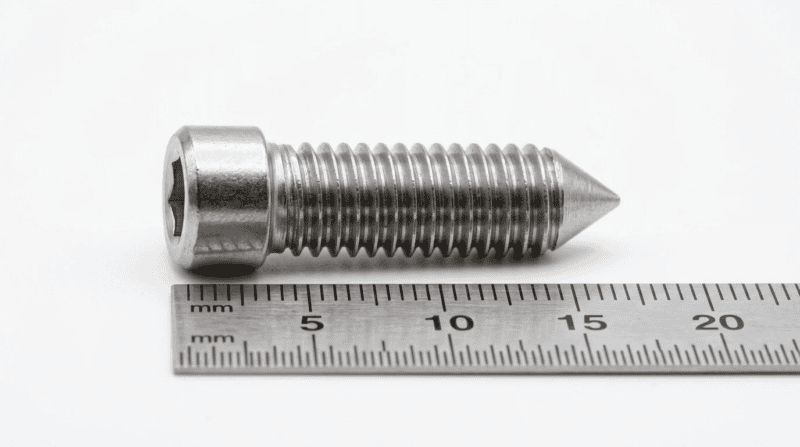
A DIN914 set screw is a fully headless hexagon socket set screw with a cone point — a tapered, pointed tip that concentrates clamping force into a precise contact zone on the mating surface. Also known as a cone point grub screw, DIN914 is fully threaded from end to end, meaning the nominal length equals the total screw length with no unthreaded shank.
The cone tip is the defining feature. Under tightening torque, the tip penetrates the surface of the shaft or workpiece, creating a mechanical indent that resists both axial sliding and torsional rotation. This makes DIN914 the highest-retention set screw type in the DIN standard family — more secure than DIN913 flat point or DIN916 cup point in single-use installations.
Key technical characteristics:
Critical design trade-off: The sharp cone tip bites into the mating surface under tightening load. This creates higher axial and torsional holding force than a flat point, but leaves a permanent cone indent. DIN914 is best suited for applications where the joint is set once and the surface impression is acceptable.
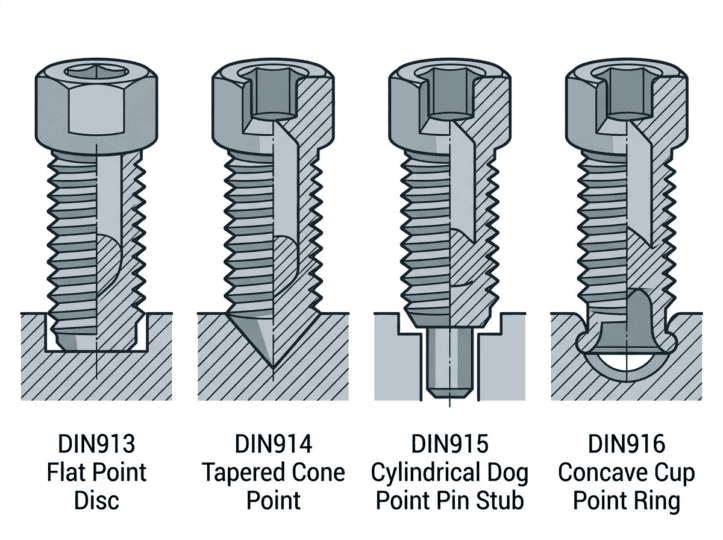
All four DIN hex socket set screw standards share the same headless body — they differ only in tip geometry. Choosing the wrong tip type can damage mating surfaces, reduce holding force, or make disassembly impossible.
DIN914 ranks highest for holding force and vibration resistance, but lowest for reusability. The embedded cone tip resists dynamic loosening under vibration in a way that cup or flat point set screws cannot match.
| Feature | DIN913 Flat Point | DIN914 Cone Point | DIN915 Dog Point | DIN916 Cup Point |
|---|---|---|---|---|
| ISO Equivalent | ISO 4026 | ISO 4027 | ISO 4028 | ISO 4029 |
| Point Shape | Flat smooth disc | Tapered sharp cone | Protruding cylinder pin | Concave cup / ring |
| Holding Force | Low–Medium | High ★ | Medium–High | Medium–High |
| Surface Damage | Minimal | Permanent cone indent | None (pre-drilled hole) | Ring impression |
| Reusability | High | Low | High | Medium |
| Vibration Resistance | Low | High ★ | High | Medium–High |
| Cone Tip Angle | — | 120° (≥M6) / 90° (<M6) | — | — |
| Best Application | Hard surfaces, frequent adjustment | One-time shaft lock, soft metals | Precision axial location | General collars, handles |
★ DIN914 cone point generates approximately 1.4× the torsional resistance of DIN916 cup point at equal tightening torque (same thread size). Source: Engineering Toolbox fastener friction data.
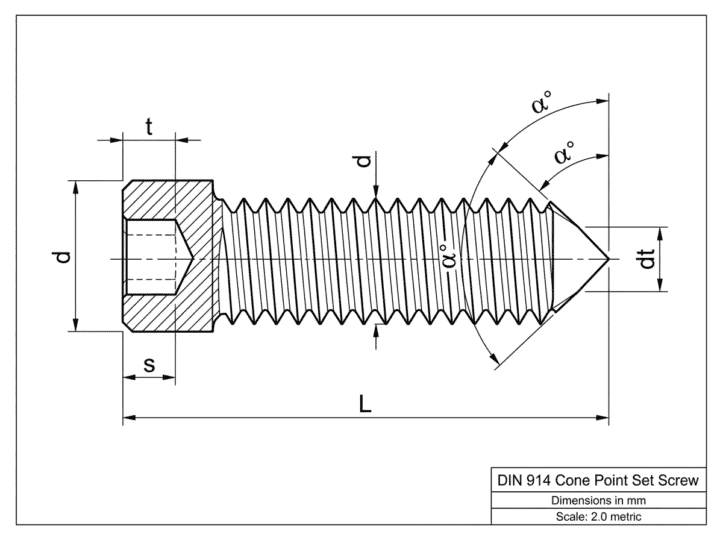
dt = cone tip flat diameter. s = hex socket AF (Allen key size). t = socket engagement depth. L = nominal / total length.
Per DIN914 / ISO 4027. All dimensions in mm. Cone angle: 120° for M6 and above; 90° for M5 and below.
| Thread d | Pitch P (mm) | dt max (mm) | dt min (mm) | Socket e min (mm) | Hex s nom (mm — Allen key) | t short min (mm) | t long min (mm) |
|---|---|---|---|---|---|---|---|
| M1.6 | 0.35 | 0.40 | — | 0.809 | 0.7 | 0.7 | 1.5 |
| M2 | 0.40 | 0.50 | — | 1.011 | 0.9 | 0.8 | 1.7 |
| M2.5 | 0.45 | 0.65 | — | 1.454 | 1.3 | 1.2 | 2.0 |
| M3 | 0.50 | 0.75 | — | 1.733 | 1.5 | 1.2 | 2.0 |
| M4 | 0.70 | 1.00 | — | 2.303 | 2 | 1.5 | 2.5 |
| M5 | 0.80 | 1.25 | — | 2.873 | 2.5 | 2.0 | 3.0 |
| M6 | 1.00 | 1.50 | 0.90 | 3.443 | 3 | 2.0 | 3.5 |
| M8 | 1.25 | 2.00 | 1.40 | 4.583 | 4 | 3.0 | 5.0 |
| M10 | 1.50 | 2.50 | 1.90 | 5.723 | 5 | 4.0 | 6.0 |
| M12 | 1.75 | 3.00 | 2.40 | 6.863 | 6 | 4.8 | 8.0 |
| (M14) | 2.00 | 4.00 | 3.25 | 6.863 | 6 | 5.6 | 9.0 |
| M16 | 2.00 | 4.00 | 3.25 | 9.149 | 8 | 6.4 | 10.0 |
| (M18) | 2.50 | 5.00 | 4.25 | 11.429 | 10 | 7.2 | 11.0 |
| M20 | 2.50 | 5.00 | 4.25 | 11.429 | 10 | 8.0 | 12.0 |
| (M22) | 2.50 | 6.00 | 5.25 | 13.716 | 12 | 9.0 | 13.5 |
| M24 | 3.00 | 6.00 | 5.25 | 13.716 | 12 | 10.0 | 15.0 |
Sizes in parentheses (M14, M18, M22) are non-preferred per ISO 4027; availability may be limited. dt = cone tip flat diameter. s = hex socket AF (Allen key size). t = socket depth (short / long screws). Cone angle: 120° for M6 and above; 90° for M5 and below. Hardness class 45H: min 45 HRC surface.
DIN914 uses hardness classes — not the 8.8/10.9 bolt grade system. Class 45H is standard for carbon steel set screws (min. 45 HRC surface, 33–39 HRC core). Stainless grades use the A-class system (A2-70, A4-70).
Important: stainless DIN914 sacrifices hardness for corrosion resistance. A2-70 surface hardness is approximately 200 HV — adequate for soft metal shafts (aluminum, brass) but not for steel shafts above 200 HV.
| Material | Grade | Typical Application |
|---|---|---|
| Carbon Steel (plain) | 45H | Standard shaft locking, jigs, indoor machinery |
| Carbon Steel — Black Oxide | 45H | Tooling, precision instruments, black finish required |
| Stainless A2 (304) | A2-70 | Food equipment, light corrosion, aluminum/brass shafts |
| Stainless A4 (316) | A4-70 | Marine, chemical, outdoor chloride environments |
Limitation: Not suitable for frequently re-adjusted joints — each installation cycle deepens the cone indent and degrades grip accuracy.
DIN914 is the only set screw standard in the DIN family that uses two different cone angles depending on screw size — a point of frequent confusion in specifications.
Ordering note: Buyers do not need to specify the cone angle — the standard defines it automatically for each size. The correct geometry is supplied when you order by thread size.
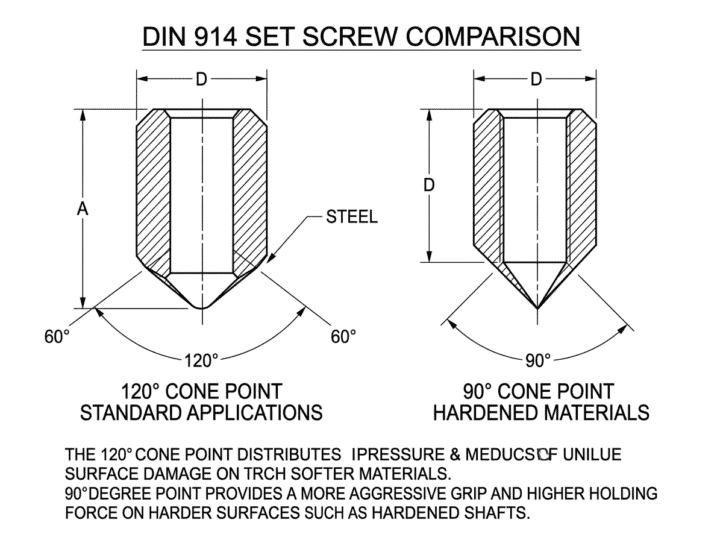
Left: 120° cone (M6+) — wider base, more surface contact. Right: 90° cone (M5 and below) — sharper penetration for smaller screw torque. See the ISO 4027 standard for authoritative angle assignments per size.
Set Screw DIN914 – M8 × 20 – 45H
For security variant: Set Screw DIN914 Pin Hex – M8 × 20 – 45H
Technical questions about DIN914 selection, ordering, cone angles, materials, and ISO 4027 equivalence.
Complete your assembly with complementary socket fastener standards from our range.
Reduced-head hexagon socket cap screw — ideal for space-constrained assemblies.
We supply DIN914 cone point set screws in carbon steel 45H, stainless A2/A4, plain, black oxide and zinc finish. Sizes M1.6–M24, custom lengths available. MOQ from 500 pcs. EN 10204 3.1 certificates and RoHS declarations available on all orders.
 English
  German
  Spanish
  Portuguese
  French
  Japanese
  Arabic
  Korean
  Vietnamese
  Russian