 English
  German
  Spanish
  Portuguese
  French
  Japanese
  Arabic
  Korean
  Vietnamese
  Russian
 Walk into any hardware store and ask for “something to hold these two pieces together” — and the answer is almost always going to involve screws and bolts. Most people use the terms interchangeably. Most engineers do not, and for good reason: screws and bolts are genuinely different fasteners, designed on different mechanical principles, and selecting the wrong one for a structural application isn’t a minor inefficiency. It’s a failure waiting to happen.
This guide covers the actual differences between screws and bolts, how each type works mechanically, the major categories you’ll encounter in real projects, material grades and what they mean, industry-specific selection considerations, and where fastener technology is heading. If you’ve ever looked at a hardware tray full of mixed fasteners and genuinely had to think about what to grab — this guide resolves that, concretely and permanently.
Screws vs. Bolts: The Distinction That Actually Matters
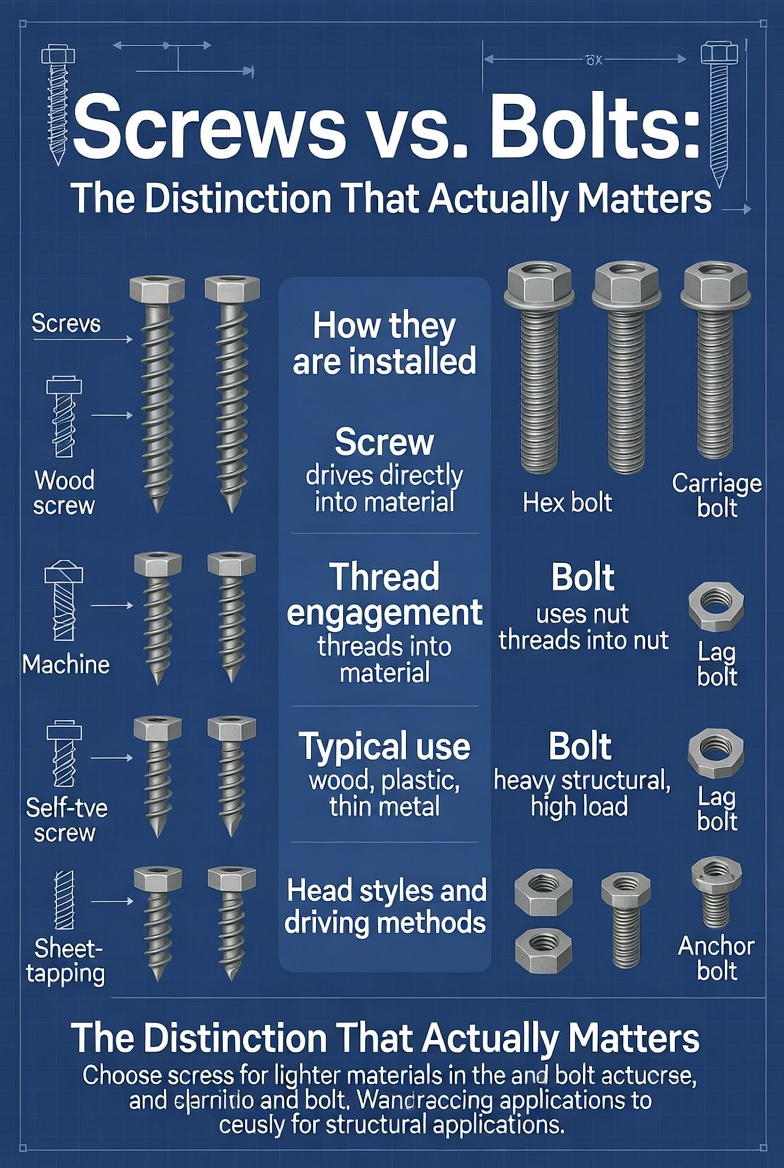
The most common explanation is that bolts use nuts and screws don’t. That’s a useful starting point, but it misses the engineering logic underneath. Here’s the fuller picture.
A bolt is a fastener designed to pass through unthreaded clearance holes in the parts being joined, with clamping force generated by a nut on the opposite side. Bolts are typically partially threaded — there’s a plain shank section between the head and where the threads begin. That plain shank is intentional: it sits in the clearance holes of the joined parts, and its full cross-section resists shear loads far more effectively than a threaded section would.fastenright+1
A screw is a fastener whose threads engage directly with the material being fastened — either a pre-tapped hole, or in the case of self-tapping screws, the material itself. Screws are almost universally fully threaded, right to the head. The friction between threads and material is what generates clamping force, without requiring a nut at all.donghefastener
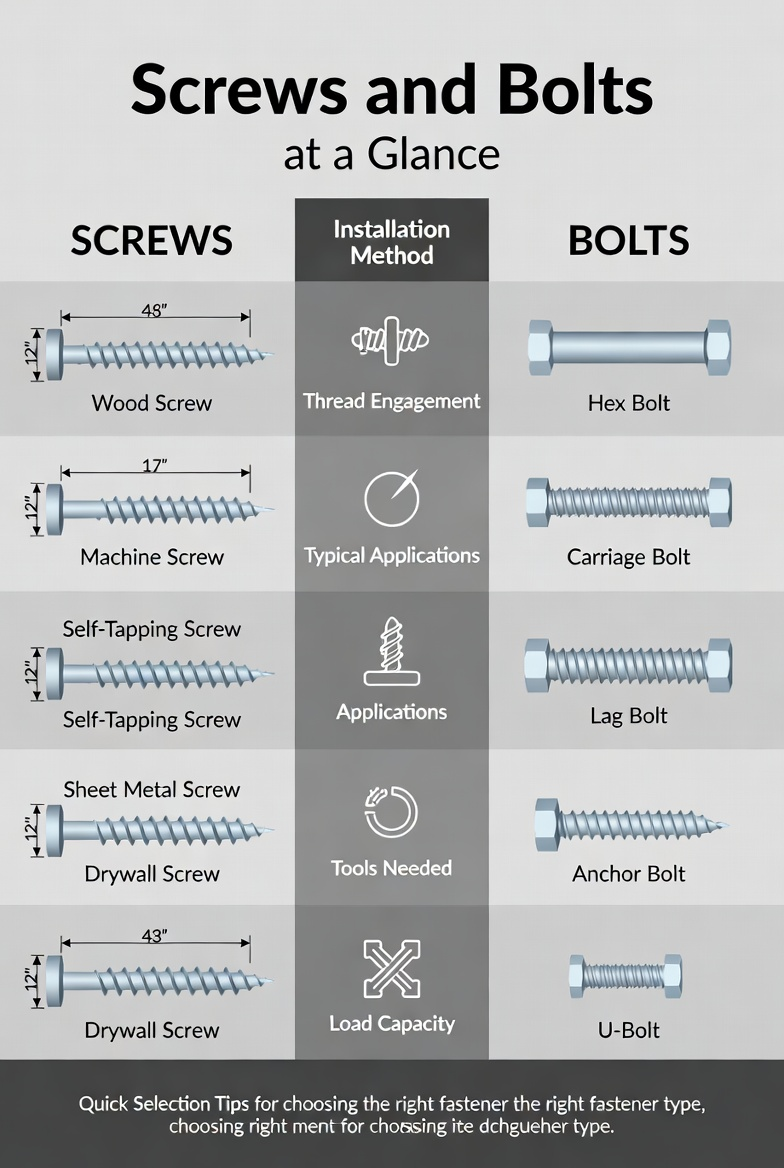
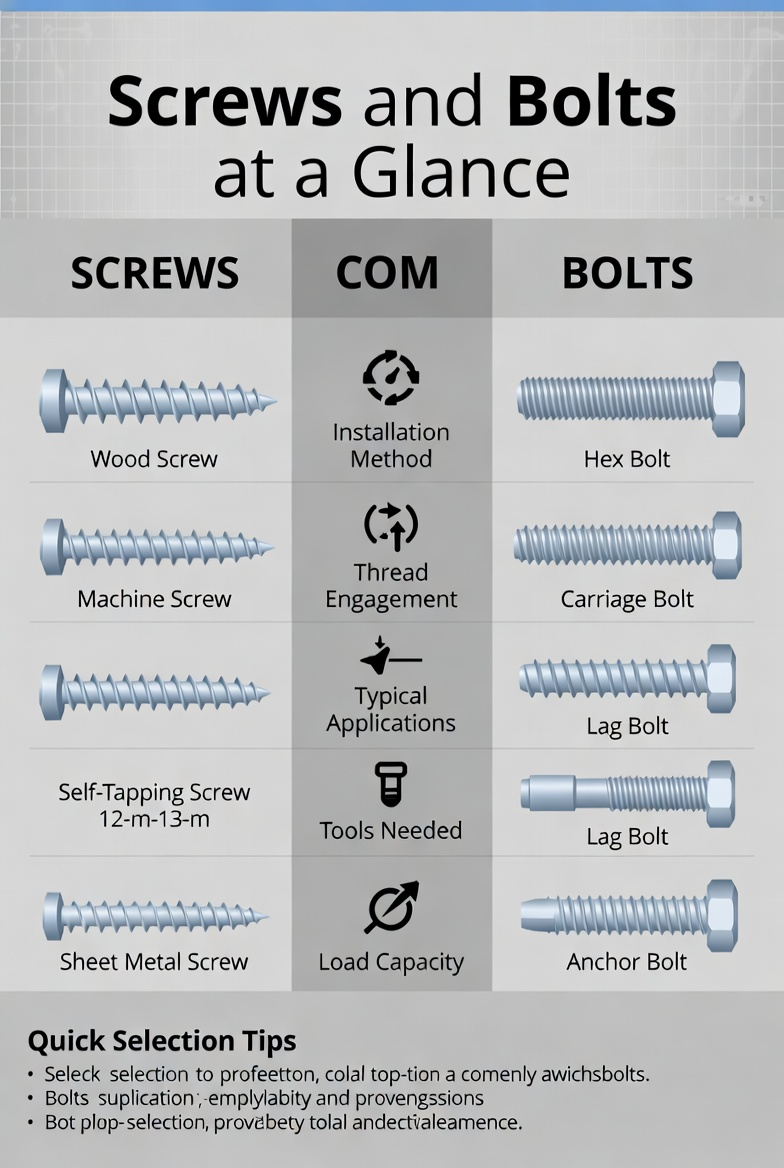
The practical consequence of this distinction:
Bolts are preferred where shear loads are significant and where the joint may need to be disassembled and reassembled.essentracomponents
Screws are preferred where direct thread engagement into a part is sufficient, assembly is straightforward, and access to both sides of the joint isn’t available or necessary.factorydirectsupplyonline
One common point of confusion: machine screws used with a nut. Are they bolts? Technically, when a machine screw passes through clearance holes and fastens with a nut, it’s functioning as a bolt — but it’s still called a machine screw because of its design and threading convention. This overlap is real and engineers know it. The more important question is always: what does this joint actually need?
Types of Screws: The Major Categories
Screws divide into families based on the material they’re intended to fasten, the drive type, and how they create their thread engagement. Understanding these families prevents the common mistake of using the right-looking fastener for the completely wrong application.misumi-ec
Wood Screws
Designed specifically for fastening into wood fiber. They have a coarse thread pitch, a tapered shank, and a sharp point that penetrates wood without pre-drilling (in most applications). The thread form cuts into and compresses wood fiber, creating holding strength through friction. Wood screws are not appropriate for metal-to-metal applications — the thread form and point geometry are entirely wrong for that purpose.
Machine Screws
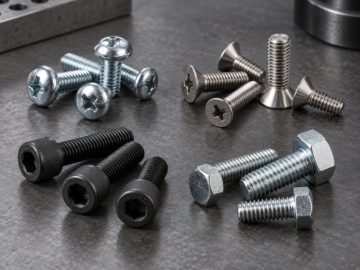
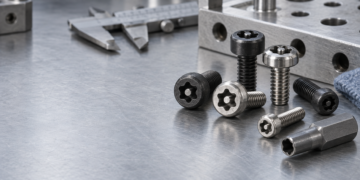
Uniform, fine-threaded screws designed to mate with pre-tapped metal holes or paired with nuts. Available in a wide range of head types (pan head, flat head, hex head, button head) and drive types (Phillips, slotted, Torx, hex socket). Machine screws are the standard fastener in electronics assemblies, precision instruments, motor housings, and any application where a controlled thread engagement into machined metal is required. Sizes range from tiny (#0-80, roughly 1.5mm diameter) up to 3/4″ or larger in metric and imperial equivalents.monroeengineering
Self-Tapping Screws
These cut their own thread as they’re driven — eliminating the need for a pre-tapped hole. They’re subdivided into thread-forming screws (which displace material without cutting, generating a strong interference fit, used in ductile metals and plastics) and thread-cutting screws (which remove material to create the thread, used in harder materials). Sheet metal screws are the most common self-tapping variant, widely used in HVAC ductwork, automotive body panels, and light gauge steel framing.donghefastener
Concrete and Masonry Screws
Carbide-tipped with a specialized hardened thread designed to cut directly into concrete, brick, or masonry. Products like Tapcon screws have become standard in construction for anchoring fixtures to masonry without requiring separate anchor inserts. Requires a pre-drilled pilot hole matching the screw’s minor diameter.
Set Screws
Headless screws used to lock a component onto a shaft — a gear, pulley, or collar. The screw sits entirely within a threaded hole and bears against the shaft surface, preventing rotation. No protruding head means they won’t snag in rotating machinery. Cup point, cone point, and flat point varieties provide different shaft engagement characteristics.
Shoulder Screws (Stripper Bolts)
Have a precise unthreaded cylindrical section (the shoulder) between the head and the threaded portion. The shoulder provides a bearing surface for rotating components — bushings, spacers, rollers — while the threads anchor the assembly. Common in die and mold tooling, and in pivot point assemblies throughout industrial machinery.
Types of Bolts: What Each Design Is For
Bolts diversify by head type, intended installation method, and structural function. The diversity isn’t cosmetic — different bolt types exist because different applications have genuinely different structural and installation requirements.amerifastsupply
Hex Bolts (Hex Cap Screws)
The most common bolt type globally. Six-sided head accommodates standard wrenches and sockets. Available in an enormous range of diameters, lengths, grades, and materials. Hex bolts are the default structural fastener in construction, heavy machinery, automotive assemblies, and industrial equipment.monsterbolts
Carriage Bolts
A domed, smooth head with a square section beneath it. When driven into a square hole in wood or a matching square countersink, the square neck prevents the bolt from rotating during nut tightening — allowing single-person assembly without holding the bolt head. Standard in timber construction, outdoor structures, and wood-to-metal connections.
Flange Bolts
Incorporate a built-in washer-style flange under the head. The flange distributes clamping load over a larger bearing area without requiring a separate washer, and its serrated underside (on many variants) provides rotation resistance. Common in automotive and heavy equipment applications where washers might be lost during assembly or where a serrated flange’s grip is specifically needed.
Anchor Bolts
Embedded in concrete during pour or installed into drilled holes with epoxy or mechanical expansion anchors. Used to secure structural steel columns, equipment bases, and building frames to concrete foundations. Cast-in-place anchor bolts are specified under ASTM F1554, and post-installed anchors fall under ACI 318 Appendix D requirements.ssfwashers
Eye Bolts and Hook Bolts
Eye bolts have a looped or ringed head for attaching cables, rigging, or hooks. The thread section anchors into the structure while the eye provides a connection point for lifting hardware. Load rating is critical — eye bolts have rated working load limits (WLL) based on bolt diameter, grade, and loading angle.
U-Bolts
Curved into a U-shape with threads on both straight ends, designed to wrap around pipes, tubes, or round structural members. Common in pipe clamp assemblies, exhaust system mounts, leaf spring attachments on vehicles, and structural pipe support systems.
Stud Bolts
Fully threaded rods with no head, designed to be permanently screwed into tapped holes with nuts on the exposed ends. Common in high-pressure flange connections in oil and gas piping, pressure vessels, and chemical processing equipment where both ends of the fastener must be accessible for assembly.misumi-ec
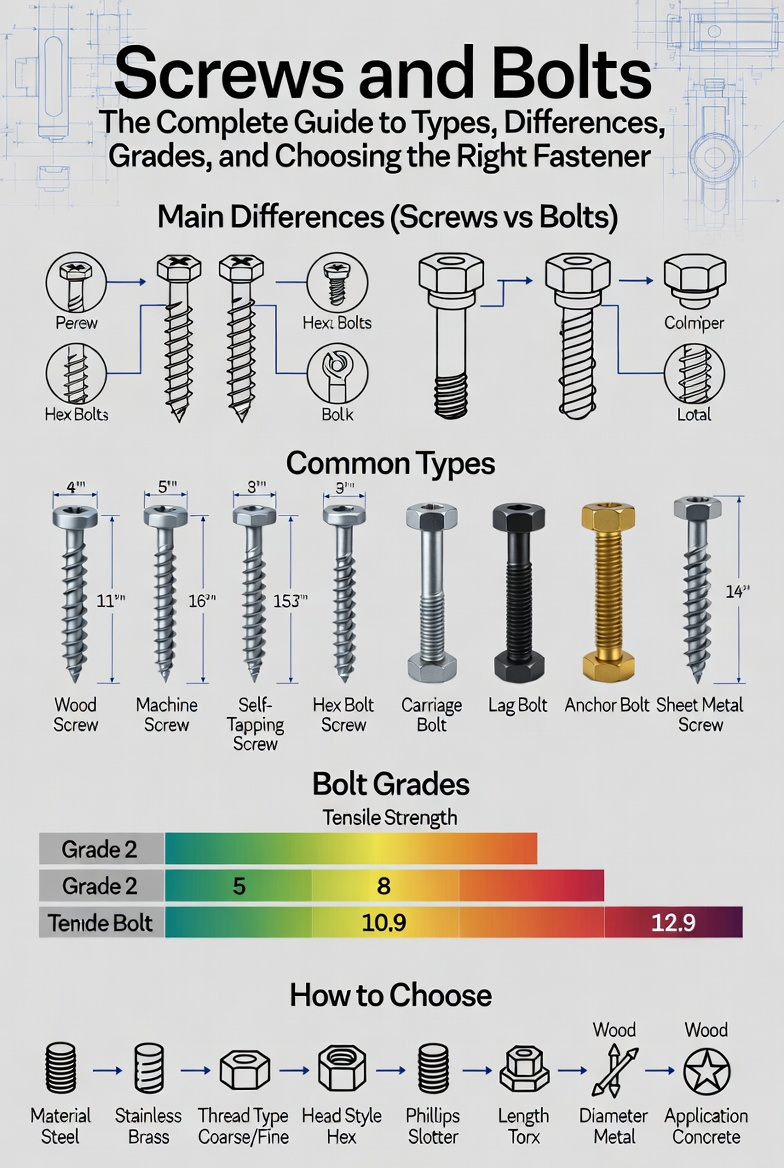
beskamold+4
Bolt and Screw Grades: What the Numbers and Markings Mean
This is where a lot of engineers and technicians develop blind spots. Grade markings exist for a reason, and the difference between an SAE Grade 2 bolt and a Grade 8 bolt in the same application can mean the difference between a joint that holds for 20 years and one that shears under first load.boltdepot
SAE Grades (Imperial)
SAE J429 governs inch-series bolts:
Grade 2: Low or medium carbon steel. Minimum tensile strength 74,000 psi for smaller diameters. General-purpose, non-critical applications. No head markings.boltdepot
Grade 5: Medium carbon steel, quenched and tempered. Minimum tensile strength 120,000 psi. Three radial lines on the hex head. Automotive, machinery, and general structural use.monsterbolts
Grade 8: Medium carbon alloy steel, quenched and tempered. Minimum tensile strength 150,000 psi. Six radial lines on the hex head. Heavy machinery, aerospace support structures, high-stress applications.monsterbolts+1
ISO Metric Property Classes
Metric bolts use a two-number system stamped on the head — for example, 8.8, 10.9, or 12.9:
The first number × 100 = nominal tensile strength in MPa (8.8 → 800 MPa)
The first number × second number × 10 = yield strength in MPa (8.8 → 640 MPa)
So an 8.8 bolt has 800 MPa tensile strength and 640 MPa yield strength. A 12.9 bolt has 1,200 MPa tensile strength — approximately equivalent to SAE Grade 8 but in metric sizing.ssfwashers
Stainless Steel Grades
Stainless fasteners are graded differently. The most common marking is A2-70 or A4-80:
A2 = 304 stainless steel (general corrosion resistance)
A4 = 316 stainless steel (marine and chemical environment resistance)
The number (70, 80) indicates tensile strength class in MPa × 10
Stainless screws and bolts are not automatically stronger than carbon steel — A2-70 is roughly equivalent to Grade 5, significantly weaker than Grade 8 or 10.9 metric. Using stainless fasteners for corrosion resistance in structural applications without checking the strength class is a documented failure pattern in marine and outdoor construction.ssfwashers
Grade Markings Reference
boltdepot+2
Industry Applications: How Different Sectors Use Screws and Bolts
Screws and bolts appear in every sector that makes or maintains physical things. But how different industries select, specify, and manage them varies considerably — and those differences reflect the stakes involved.amerifastsupply+1
Construction and Structural Engineering
Structural bolts in buildings and bridges are governed by ASTM A325 (SAE Grade 5 equivalent) and ASTM A490 (Grade 8 equivalent) standards, installed using either turn-of-nut methods, direct tension indicators, or tension-control bolt systems. Getting the installation method wrong — under-tensioning a structural bolt — doesn’t look different from a correct installation until the joint slips or fatigues.ssfwashers
Concrete anchor bolts in structural applications are designed under ACI 318 for both tensile (pullout) and shear failure modes. The common mistake in field construction is using wedge anchors where epoxy anchors are specified, or vice versa — the two have different behavior in cracked versus uncracked concrete, and substituting one for the other isn’t engineering-equivalent.
Wood construction uses screws — specifically, structural wood screws with documented load values under NDS (National Design Specification) — rather than nails for moment connections in seismic and high-wind applications. The shift from nails to screws in timber framing over the past decade is driven entirely by documented seismic performance data: properly specified screws outperform nails in withdrawal loads and hold-down connections.
Automotive Manufacturing
Automotive fastener specifications are among the most precise in any manufacturing sector. Different zones of a vehicle carry different fastener grades: safety-critical joints (steering, braking, suspension) require Grade 8 or metric 10.9 minimum; body panel fasteners use lower grades where failure consequence is minor.monsterbolts
One practical issue that appears in both OEM assembly and aftermarket repair: metric and inch fasteners that are dimensionally similar but not interchangeable. An M10 × 1.5 bolt and a 3/8″-16 bolt are close enough in diameter to start threading together — but they will cross-thread and damage the nut or tapped hole within a few turns. Both fasteners look similar in a mixed parts tray. This problem is especially common in facilities that service both domestic and imported vehicles.
Thread engagement matters acutely in automotive aluminum components. Aluminum has lower thread shear strength than steel, meaning the engaged thread length must be longer to achieve equivalent joint strength. Standard rules of thumb for steel engagement length (1× diameter minimum) are insufficient for aluminum tapped holes — 1.5× to 2× diameter is the industry practice for aluminum threads under load.mdpi
Electronics and Precision Assembly
Electronics assembly uses machine screws almost exclusively — specifically, fine-threaded variants in #4-40, #6-32, M3, and M4 sizes that are industry standards for PCB mounting, chassis assembly, and component attachment. The typical failure mode in electronics isn’t structural bolt failure — it’s overtorquing small screws by technicians without torque-limiting drivers, stripping the tapped holes in aluminum chassis or PCB standoffs.monroeengineering
Self-tapping screws appear in electronics housings and sheet metal enclosures where tapped inserts aren’t cost-justified for the assembly volume. The trade-off is reduced reusability — self-tapped holes degrade with repeated assembly and disassembly faster than properly tapped and threaded holes.
Aerospace and Defense
Aerospace fastener standards are the most demanding and documented of any industry. Every fastener is traceable — bolt material certifications, installation torque records, and reuse status are documented and retained. MS (Military Standard), NAS (National Aerospace Standard), and AN (Air Force-Navy) specifications govern every fastener type used in flight-critical assemblies, with explicit grade, material, coating, and installation requirements.boltdepot
Aerospace screws and bolts in aluminum structures are overwhelmingly made from titanium or high-alloy steel with specific corrosion-resistant coatings — cadmium plating (being phased out under REACH regulations) or increasingly, zinc-nickel plating and Geomet coatings. Stainless fasteners in aluminum structures can cause galvanic corrosion at the contact interface, which is why aerospace material pairing specifications are strict about coating compatibility.ssfwashers
Marine and Offshore
Stainless A4-80 bolts and 316 stainless machine screws dominate above-waterline marine applications for corrosion resistance. Below-waterline hardware typically uses silicon bronze or naval brass — both provide cathodic protection in seawater that stainless steel cannot. Grade 5 and 8 carbon steel fasteners have essentially no place in saltwater marine applications without heavy coating protection and active maintenance — salt air alone will corrode unprotected carbon steel fasteners to failure faster than most boat owners expect.ssfwashers
Common Mistakes With Screws and Bolts — and How to Avoid Them
These patterns appear repeatedly in failure analyses, warranty returns, and field service documentation across industries.
Using screws where bolts are needed for shear resistance. When two components need to resist sliding relative to each other, a screw threading into one of them provides much less shear capacity than a bolt with a plain shank spanning both parts. The threaded section has reduced cross-sectional area at the root and fails at lower shear loads. In frame connections, bracket attachments, and pivot points, using bolts isn’t just conservative — it’s mechanically correct.
Ignoring grade requirements. Replacing a marked Grade 8 bolt with an unmarked hardware-store bolt because “it’s the same size” is a genuine engineering failure. Grade 2 hardware-store bolts can have less than half the tensile strength of Grade 8. In a structural joint, that’s not a safety factor margin — it’s a direct path to failure under design loads.
Mixing metric and inch fasteners. M10 × 1.5 and 3/8″-16 are close enough to start threading, different enough to destroy both the bolt and the tapped hole. Especially dangerous in maintenance environments with mixed inventory. Label everything clearly or separate metric and inch stock physically.
Over-tightening small machine screws. Particularly in aluminum and PCB assemblies. Without torque-limiting drivers, technicians frequently strip small tapped holes. The fix is inexpensive: torque-limiting screwdrivers set to the fastener’s specification. The repair when a stripped hole needs thread repair or Helicoil installation is neither fast nor cheap.
Specifying standard stainless for structural loads. A2-70 stainless screws and bolts are not equivalent to SAE Grade 8 or metric 10.9. If corrosion resistance is required in a high-load joint, the correct approach is high-strength stainless (A4-80 minimum) or high-grade carbon steel with appropriate protective coating — not a direct grade substitution based on appearance.
For sourcing screws and bolts across grades, materials, head types, and drive configurations, Fastenright: Fasteners, Screws, Nuts & Bolts provides comprehensive fastener inventory and technical selection resources — including the Fastenright team’s own detailed breakdown of bolts and screws and what makes them different.
Future Trends in Screws and Bolts
The screws and bolts market is larger and slower-moving than high-tech industries, but it isn’t static. Several directions are actively reshaping how fasteners are designed, specified, and supplied.
Smart Fasteners with Embedded Sensing
Instrumented bolts — with embedded ultrasonic transducers or strain-sensing elements — are moving from research tools into production applications. Real-time bolt load monitoring is now deployed in wind turbine flanges, critical bridge connections, and large industrial machinery where continuous preload verification is valuable enough to justify the cost premium. The technology also enables predictive maintenance: monitoring bolt load trend over time identifies joints that are slowly losing preload before they reach failure — rather than discovering the issue during scheduled inspections.mdpi
Lightweight Fastener Materials
Titanium screws and bolts have been aerospace standard for decades. The cost reduction in titanium machining over the past decade — driven by CNC process improvements and increased supply — is making titanium fasteners cost-competitive in more applications: high-performance automotive, premium cycling and sporting equipment, and consumer electronics where weight is a genuine differentiator. Carbon fiber composite structural fasteners are an active research area, though the challenge of directional strength properties in composites creates design complexity that metal fasteners don’t face.
Coatings and Corrosion Protection Evolution
Cadmium plating — long the aerospace standard for corrosion-resistant fasteners — is being phased out under REACH regulations due to cadmium’s toxicity. Replacement coatings including zinc-nickel alloy plating, Geomet (water-based zinc-flake coating), and Dacromet are entering aerospace qualification programs. Each has different salt spray resistance, hydrogen embrittlement risk, and compatibility with anodized aluminum — creating an active specification engineering challenge as the industry transitions away from cadmium.ssfwashers
Digital Manufacturing and Custom Fastener Production
CNC machining centers and multi-axis turning centers have made economically viable custom screw and bolt production in small quantities — prototype quantities, replacement parts for obsolete machinery, specialty sizes for emerging applications. Combined with digital thread measurement and AI-assisted quality control, it’s now realistic to order custom screws and bolts to exact specifications with shorter lead times than previously associated with custom machined parts.arxiv
Supply Chain Traceability
Post-pandemic supply chain disruptions accelerated investment in fastener supply chain traceability — material certifications, mill test reports, and country-of-origin documentation have become procurement requirements for an expanding range of customers, not just aerospace. 2D datamatrix codes laser-marked on individual bolt heads, digital material certification databases, and blockchain-based supply chain tracking are all being piloted in industrial fastener distribution. The goal is straightforward: when a safety-critical joint fails, investigators need to know exactly which fastener was installed, from which batch, with which material certification.monsterbolts
For comprehensive selection, specifications, and procurement of screws and bolts across all grades, drive types, and materials — from general industrial to high-strength structural — Fastenright: Fasteners, Screws, Nuts & Bolts provides reliable technical inventory and application support.
Authority References:
Related Products
Solutions & Cluster
Related Articles
- M2 Screw Size: Complete Dimensions, Types & Selection Guide (2026)
- Bolts and Screws: The Complete Guide to Types, Differences, and Choosing the Right Fastener
- Thread Forming Screws: Complete Guide to Types, Uses & Selection
- UNF Thread: Complete Guide to Unified National Fine Thread Specifications
- Through Bolts: Complete Guide to Types, Uses, and Installation
- Nylon Nut Guide: Types, Applications, and How to Choose the Right One
- Nylon Screws: Complete Guide to Types, Sizes & Applications (2026)
- Rivet Nut Ultimate Guide: Installation, Selection & Applications for 2026