 English
  German
  Spanish
  Portuguese
  French
  Japanese
  Arabic
  Korean
  Vietnamese
  Russian
 ISO7380 Button Head Socket Cap Screw
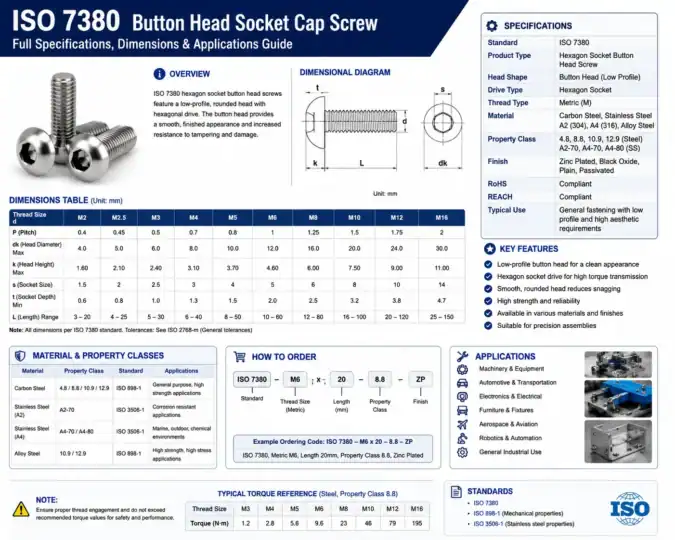
ISO 7380 defines the button head socket cap screw — a fully threaded metric fastener with a low-profile domed head and hexagon socket drive. Available as Part 1 (plain button head, M3-M20) and Part 2 (flanged button head, M5-M16). Equivalent to DIN 7380.
What Is an ISO 7380 Button Head Socket Screw?
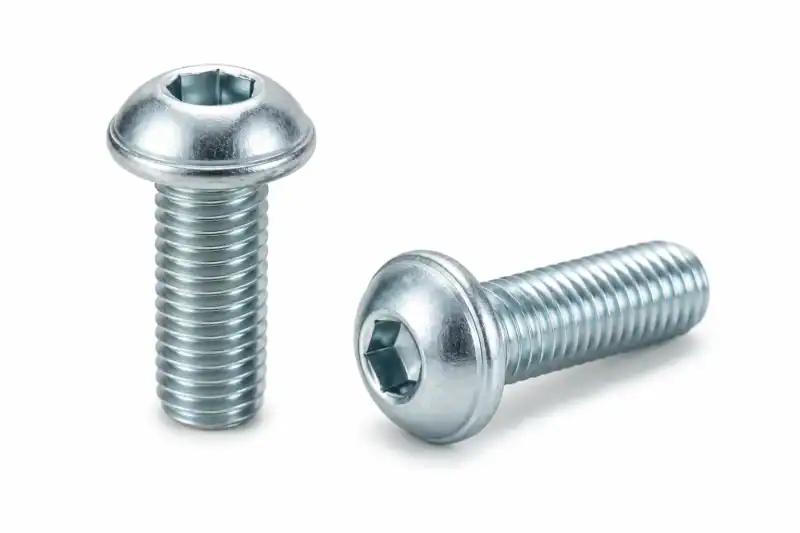
The ISO 7380 button head socket cap screw is a metric fastener characterised by its low-profile, dome-shaped head with an internal hexagon (Allen) socket. The button head profile provides a sleeker appearance than a standard socket cap head while delivering reliable clamping force for general-purpose assemblies.
ISO 7380 is published in two parts:
- ISO 7380-1 — Button head hexagon socket head cap screw (plain dome head, M3-M20)
- ISO 7380-2 — Button head hexagon socket head cap screw with flange (M5-M16)
ISO 7380 is functionally equivalent to DIN 7380 and is widely manufactured in China, Germany, Taiwan, and India for global industrial supply chains.
How the ISO 7380 Button Head Works
The button head geometry achieves a balance between a low installation profile and an adequate bearing surface. The dome radius distributes underhead compressive stress across the mating surface, and when tightened to the specified torque, the large-diameter head face generates sufficient friction to maintain joint preload under vibration.
Key geometry: The head diameter-to-shank ratio of ISO 7380-1 is approximately 1.75x, giving a bearing area roughly 200% larger than the screw cross-section. The flanged ISO 7380-2 extends this further, making it preferable for aluminium extrusions, plastic panels, or thin sheet metal where a washer would otherwise be needed.
Drive system: The hexagon socket (Allen drive) provides high torque in a compact space, prevents slipping (unlike Phillips/Pozidriv), and allows installation where external wrenching is impossible.
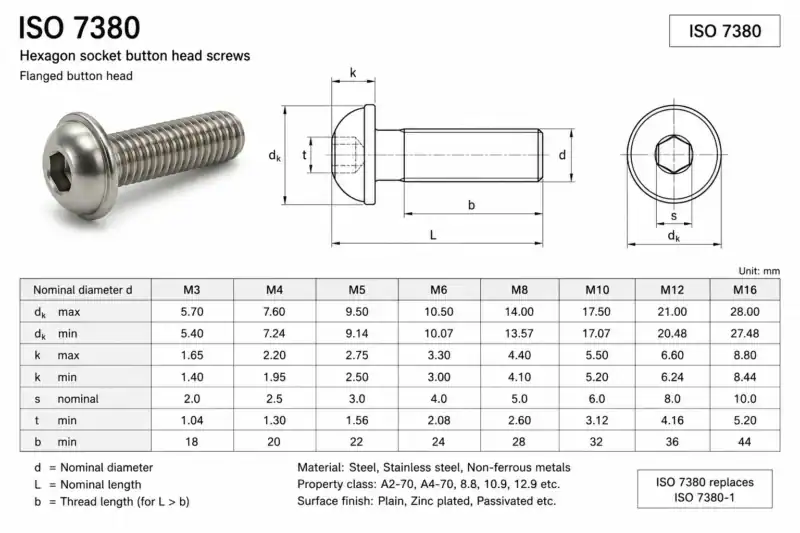
ISO 7380-1 Full Dimensions Table (M3-M20)
Complete dimensional data per ISO 7380-1:2011. All values in millimetres.
| Thread (d) | Pitch (P) | Head Dia. dk max | Head Height k max | Socket (s) | Socket Depth t min | Key Engage. e min |
|---|---|---|---|---|---|---|
| M3 | 0.50 | 5.70 | 1.65 | 2 | 1.04 | 2.30 |
| M4 | 0.70 | 7.60 | 2.20 | 2.5 | 1.30 | 2.87 |
| M5 | 0.80 | 9.50 | 2.75 | 3 | 1.56 | 3.44 |
| M6 | 1.00 | 10.50 | 3.30 | 4 | 2.08 | 4.58 |
| M8 | 1.25 | 14.00 | 4.40 | 5 | 2.60 | 5.72 |
| M10 | 1.50 | 17.50 | 5.50 | 6 | 3.12 | 6.86 |
| M12 | 1.75 | 21.00 | 6.60 | 8 | 4.16 | 9.15 |
| M16 | 2.00 | 28.00 | 8.80 | 10 | 5.20 | 11.43 |
| M20 | 2.50 | 33.00 | 11.00 | 12 | 6.24 | 13.72 |
All dimensions in mm. Per ISO 7380-1:2011. Tolerance: 6g thread, h15 head.
ISO 7380-2 Flanged Variant Dimensions (M5-M16)
The flanged version adds a washer-style flange at the base of the head, increasing the bearing area and reducing the risk of head pull-through in soft substrates.
| Thread (d) | Pitch (P) | Head Dia. dk | Flange Dia. dc | Head Height k | Socket (s) | Socket Depth t |
|---|---|---|---|---|---|---|
| M5 | 0.80 | 9.50 | 11.50 | 2.75 | 3 | 1.56 |
| M6 | 1.00 | 10.50 | 13.00 | 3.30 | 4 | 2.08 |
| M8 | 1.25 | 14.00 | 17.00 | 4.40 | 5 | 2.60 |
| M10 | 1.50 | 17.50 | 21.50 | 5.50 | 6 | 3.12 |
| M12 | 1.75 | 21.00 | 25.00 | 6.60 | 8 | 4.16 |
| M16 | 2.00 | 28.00 | 34.00 | 8.80 | 10 | 5.20 |
ISO 7380-2 flanged variant. Flange provides wider bearing area, reducing substrate stress. Dimensions in mm.
Recommended Tightening Torques
The following torques achieve approximately 90% of yield load for each property class under dry conditions. Reduce values by 20% when using lubrication. Always apply anti-galling compound to stainless steel threads before assembly.
| Size | Grade 10.9 (Nm) | A2-70 Stainless (Nm) | A4-70 Stainless (Nm) |
|---|---|---|---|
| M3 | 1.3 | 1.0 | 1.0 |
| M4 | 2.9 | 2.4 | 2.4 |
| M5 | 5.7 | 4.6 | 4.6 |
| M6 | 9.7 | 7.8 | 7.8 |
| M8 | 23.6 | 18.9 | 18.9 |
| M10 | 46.7 | 37.4 | 37.4 |
| M12 | 81.2 | 65.0 | 65.0 |
| M16 | 196 | 157 | 157 |
| M20 | 385 | 308 | 308 |
Dry (unlubricated) condition. Reduce 20% with lubrication. Apply anti-galling compound to stainless threads.
ISO 7380 vs ISO 4762 vs DIN 916 — Comparison
Selecting the correct screw type depends on the application load, clearance, and appearance requirements.
| Property | ISO 7380-1 (Button Head) | ISO 7380-2 (Flanged Button) | ISO 4762 (Socket Cap) | DIN 916 (Set Screw) |
|---|---|---|---|---|
| Head Type | Low dome | Low dome + flange | Tall cylindrical | Headless |
| Profile Height | Low | Low | High | Flush/recessed |
| Clamping Force | Moderate | Higher (wider bearing) | High | N/A (locking) |
| Soft Material Use | Good | Excellent | Moderate | Specialist |
| Aesthetic Appeal | High | High | Industrial | Minimal |
| Typical Grade | 10.9 / A2 / A4 | 10.9 / A2 / A4 | 12.9 / A2 / A4 | 45H / A2 / A4 |
| Size Range | M3-M20 | M5-M16 | M1.6-M36 | M1.4-M24 |
Materials & Property Classes
ISO 7380 screws are manufactured in the following materials and grades. Always specify the grade when ordering to ensure correct mechanical properties.
| Material | Grade | Tensile Strength | Hardness | Best For |
|---|---|---|---|---|
| Carbon Steel | 10.9 | 1040 MPa min | 33-39 HRC | General machinery, automotive, structural |
| Stainless Steel | A2-70 | 700 MPa min | Max 250 HV | Food equipment, mild corrosion environments |
| Stainless Steel | A4-70 | 700 MPa min | Max 250 HV | Marine, chemical, high-moisture |
| Stainless Steel | A2-80 | 800 MPa min | Max 250 HV | Higher-strength corrosion-resistant needs |
| Titanium Grade 5 | Ti-6Al-4V | 895 MPa min | 30-36 HRC | Aerospace, cycling, weight-critical |
Note on stainless steel (A2/A4): Stainless button head screws are prone to galling (cold welding of threads during tightening). Always apply a copper-based anti-galling lubricant (e.g., Molykote 1000 or Copaslip) before assembly. Tighten slowly and steadily.
Key Applications of ISO 7380 Screws
The low-profile dome head makes ISO 7380 the preferred fastener where clearance is limited, aesthetics matter, or substrate damage must be minimised:
- Electronics & enclosures — PCB mounting, chassis assembly, control panel covers
- Aluminium extrusion profiles — T-slot framing, CNC machine guards, conveyor frames
- Consumer products & furniture — Flat-pack assemblies, display fixtures, retail shelving
- Automotive trim & interior — Interior trim panels, dashboard components, light clusters
- Bicycle & sports equipment — Stem clamps, derailleur guards, water bottle mounts
- Medical devices — Equipment casings, surgical trolleys (A4-70 for sterile environments)
- Marine & outdoor — Grade A4-70 for rigging hardware, deck equipment, pontoon fittings
How to Install ISO 7380 Screws — 5 Steps
- Select the correct hex key: Match the socket size (e.g., 5 mm for M8). Use a T-handle or L-key for best torque control. Never use a worn or oversized key.
- Prepare the thread: Ensure tapped holes are clean and free of chips. For stainless screws, apply anti-galling lubricant to both the thread and underhead bearing surface.
- Hand-start the screw: Thread in by hand until finger-tight. Cross-threading at this stage will damage both the screw and the tapped hole.
- Apply torque with a calibrated torque wrench: Tighten to the specified value in a single smooth movement. Avoid rapid or jerky tightening, especially with stainless.
- Inspect the installed head: The dome should sit flush or just above the mating surface. Tilting or socket damage indicates insufficient thread engagement or misalignment.
Minimum thread engagement: 1x diameter in steel; 1.5-2x in aluminium; 2-3x in plastic or zinc die-cast.
How to Order ISO 7380 — Specification Format
- ISO 7380-1 = Button head socket screw (plain head)
- ISO 7380-2 = Flanged button head socket screw
- M8 = Nominal thread diameter
- x 25 = Nominal length in mm
- A2 = Grade: A2 stainless (or 10.9 for carbon steel, A4 for marine)
For surface treatment, add: plain (self-colour), zinc-plated, black oxide, or hot-dip galvanised.