 English
  German
  Spanish
  Portuguese
  French
  Japanese
  Arabic
  Korean
  Vietnamese
  Russian
 A bolt is tightened by a nut through a clearance hole; a screw threads directly into the material. Both are threaded fasteners but they carry load differently.
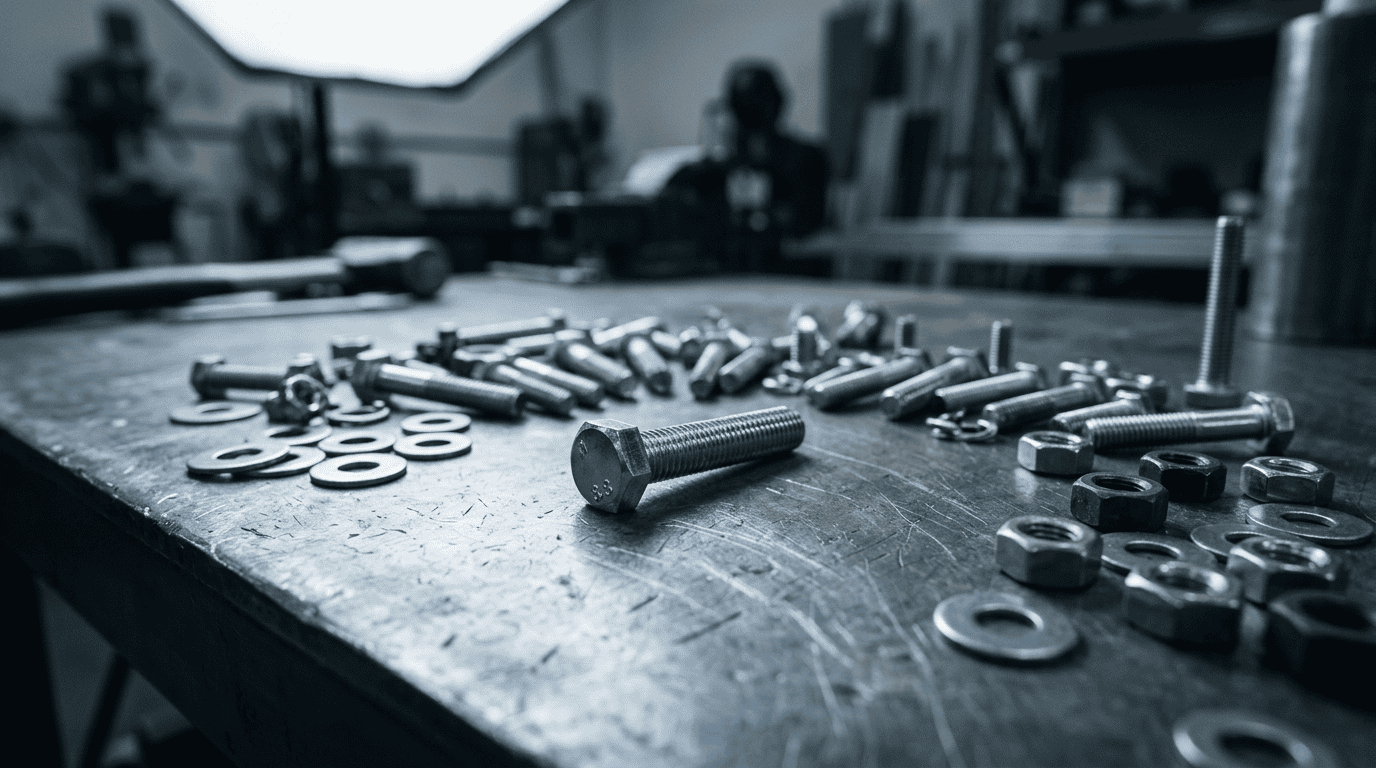
Walk onto any production floor and you’ll see the same thing: bins of bolt and screw inventory stacked against the wall, color-coded by grade, length, and head style. The people who run those plants don’t think of bolt and screw stock as commodity hardware — they think of it as the single most underestimated point of failure in the entire assembly. Pick the wrong bolt and screw combination and your warranty curve gets ugly. Pick the right one and nobody ever calls you about it again.
This guide is built for buyers, design engineers, and plant managers who need to make every bolt and screw decision well. We’ll cover what actually separates a bolt from a screw, the dozen-or-so types you’ll encounter in real manufacturing, how to spec one for a specific load, and the standards your QC team will hold you to. Most guides on this topic stop at the dictionary definition. We don’t, because in practice the dictionary definition doesn’t ship parts.
What Is the Difference Between a Bolt and a Screw?
A bolt is a threaded fastener designed to pass through a clearance hole and be tightened by a nut on the other side. A screw threads directly into a tapped hole or into the material itself and tightens by its head. That single mechanical distinction — whether the holding force comes from a mating nut or from the threaded engagement in the workpiece — is the only definition that holds up across every industrial standard we’ve worked with.
If you’ve ever read a thesaurus, you’ll see screws and bolts listed as synonyms. That’s fine for crossword puzzles. It’s a disaster for engineering specs. According to the Wikipedia entry on bolted joints), the technical literature has formalized this distinction since the early twentieth century, even though everyday language still mixes the two freely.
How a Bolt Actually Works
A bolt does its job by clamping. You push the unthreaded shank through a clearance hole, spin a nut onto the threaded end, and torque it until the joint is preloaded. The clamping force — not the threads — is what holds the joint together. The threads are just the wedge that converts your wrench torque into axial tension.
That’s why bolted joints can be designed for very predictable load behavior. You can calculate clamping force, residual tension after thermal cycling, joint stiffness, fatigue life. None of that is possible with a fastener whose holding power comes from biting into wood fibers or sheet metal.
How a Screw Actually Works
A screw, by contrast, generates its holding force through the engagement of its threads with the parent material. A wood screw bites into wood fibers. A self-tapping screw cuts its own thread in sheet metal. A machine screw threads into a pre-tapped hole in steel or aluminum.
Because the holding power lives in the thread engagement itself, screws don’t need a clearance hole on the back side. That makes them faster to assemble — one part instead of two, one tool instead of two — but it also means the joint integrity is bounded by how strong the tapped material is. A machine screw into thin aluminum is going to strip long before the screw itself fails.
The Blurred Middle: When a Fastener Is Called Both
There is honest ambiguity at the boundaries. A hex cap screw — a fastener with a hex head, fully threaded shank, and machined bearing surface — looks like a bolt and is often called one. It can be torqued with a nut or threaded into a tapped hole. The standards bodies handle this by classifying based on use, not appearance: if you intend to torque it with a nut, it’s a bolt; if you intend to thread it into the workpiece, it’s a screw.
In our experience, getting this right matters more for documentation and spare-parts ordering than for the assembly line itself. But the documentation matters: a service tech who orders “bolts” when the print specifies machine screws can end up with stock that doesn’t fit the tapped holes.
| Attribute | Bolt | Screw |
|---|---|---|
| Holding mechanism | Clamping force from mating nut | Thread engagement in workpiece |
| Hole type | Clearance (unthreaded) | Tapped or self-cut |
| Typical assembly | Two-tool (wrench + holding) | One-tool |
| Load calculation | Predictable, formula-driven | Bounded by parent-material strength |
| Reuse on disassembly | Excellent | Degrades with each cycle |
| Common standards | ASTM A307, A325, ISO 4014 | ISO 1207, ASME B18.6.3 |
Bottom line for buyers: if your assembly drawing calls out a thread engagement depth and a tapped hole, you need a screw. If it calls out a clearance hole and a torque-to-yield value with a nut, you need a bolt. Mixing them up is the single most common returns-and-reorder mistake we see on inbound POs.
Types of Bolts and Screws Used in Manufacturing
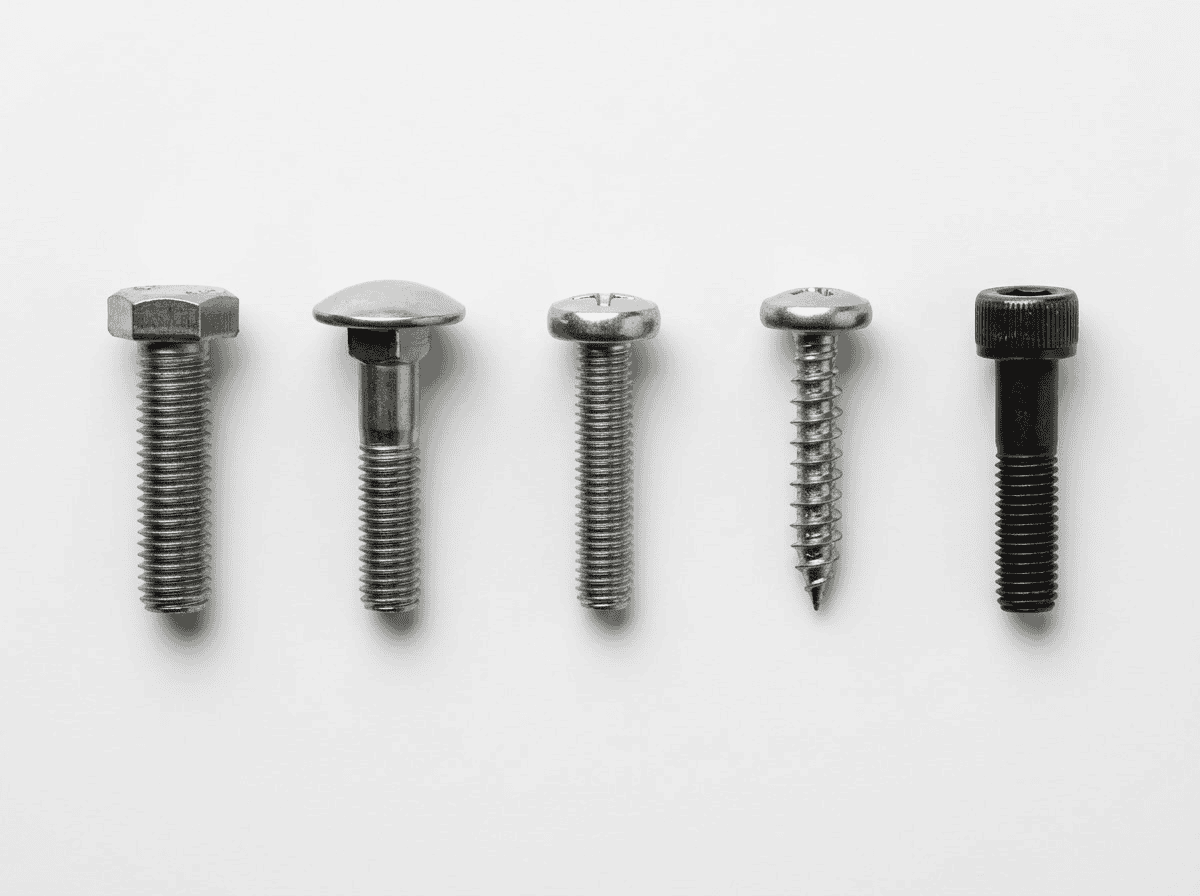
There are dozens of head styles, drive recesses, and shank profiles in the standard catalogs, but in production environments the same eight or nine show up over and over. Knowing them by sight saves time on every BOM review.
Common Bolt Types
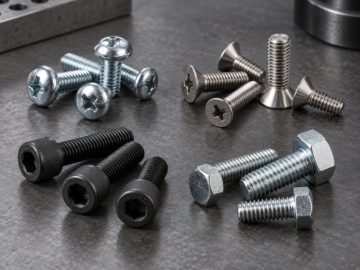
Hex bolt. The default. Six-sided head, partial or full thread, drives with an open-end or socket wrench. Used everywhere structural steel, automotive chassis, and heavy machinery live. When someone says “bolt” without qualification, they almost always mean this.
Carriage bolt. Round, smooth head with a square neck just under it. The square neck digs into wood or soft metal so the bolt can’t spin while you tighten the nut. Standard in wood-to-steel construction, deck framing, and any joint where you can only access one side.
Eye bolt. A bolt with a looped head, usually for lifting or rigging. The grade and rated load capacity matter enormously — a decorative eye bolt is not the same as a forged shoulder eye bolt rated for overhead lifting. Don’t substitute.
U-bolt. Bent into a U with threaded ends on both sides. Clamps pipe, tube, or muffler to a frame. The radius of the U has to match the OD of what you’re clamping or the joint will be uneven.
Anchor bolt. Used to fasten machinery, steel columns, or structural members to concrete. Cast in place during the pour or installed via epoxy or wedge anchors afterward. Pull-out strength depends as much on the concrete and embed depth as on the bolt grade itself.
Common Screw Types
Machine screw. Uniform-diameter shank, threaded full length, designed to thread into a tapped hole in metal. Pan-head, flat-head (countersunk), or button-head are the three most common. Drive recess is usually Phillips, slotted, or hex socket.
Self-tapping screw. Cuts its own thread as it’s driven into sheet metal, plastic, or thin material. The point geometry varies — type AB for thin metal, type B for thicker, type C (or self-drilling, often called “Tek screw”) drills its own pilot hole. Picking the wrong point type strips threads or breaks tips.
Wood screw. Tapered shank, coarse threads, deep flutes between threads to clear chips. Modern production wood screws have largely been replaced by deck screws with corrosion-resistant coatings — but the underlying geometry is the same.
Sheet-metal screw. A self-tapping screw optimized for sheet metal: aggressive threads, sharp gimlet point, hardened steel. Holds well in thin-gauge work where a machine screw would have nothing to bite into.
Set screw. Headless, threaded full length, with a hex socket or slotted drive. Threads into a tapped hole and bottoms against a shaft to hold a pulley, gear, or collar. The tip — cup, cone, dog, or flat — determines how it grips and whether it damages the shaft.
Specialty Fasteners
Shoulder bolt (also called a stripper bolt): an unthreaded ground shank between the head and the threaded tip. Used as a pivot pin or guide post in dies and tooling. Precision-ground for sliding fit.
Socket cap screw. Cylindrical head with an internal hex drive. High strength (often alloy steel, grade 12.9), used where space is tight or where a hex wrench is the only practical tool. Default in jig and fixture work.
Flange bolt. Hex bolt with an integrated washer-like flange under the head. Distributes load and resists loosening, common in automotive and HVAC.
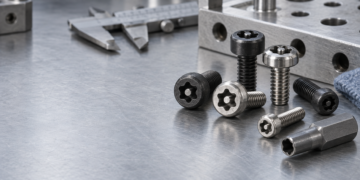
Tamper-resistant screws. One-way slot, pin-in-Torx, snake-eye, or Bryce-style heads. Found wherever you don’t want a field tech (or a customer) opening something casually.
| Type | Drive Style | Primary Use | Where You’ll See It |
|---|---|---|---|
| Hex bolt | Hex head (external) | Structural clamping | Frames, chassis, machinery |
| Carriage bolt | Domed head + square neck | Wood-to-steel | Deck, fence, gate hardware |
| Machine screw | Phillips / slot / hex socket | Tapped-hole assembly | Electronics, panels, brackets |
| Self-tapping | Phillips / hex | Sheet-metal / plastic | Appliances, HVAC ducting |
| Wood / deck screw | Star (T-25) / Phillips | Wood framing | Construction, joinery |
| Set screw | Internal hex / slot | Shaft retention | Pulleys, collars, gears |
| Socket cap | Internal hex | High-load tapped joints | Dies, fixtures, hydraulics |
| Shoulder bolt | Internal hex | Pivot / guide | Tooling, die sets |
The catalog goes deeper — flat-head undercut machine screws for thin sheet flush mounting, flange-head sheet-metal screws for vibration resistance, security screws with bizarre drive recesses — but those nine cover the overwhelming majority of production volume.
Industry Applications: Where Production-Grade Bolts and Screws Are Used
Every assembled product made of more than one piece uses a bolt and screw somewhere in its construction. The interesting question isn’t where they’re used; it’s how the application changes the spec.
Automotive and Heavy Machinery
Automotive assemblies use thousands of fasteners per vehicle, and almost none of them are interchangeable. Engine head bolts are torque-to-yield, single-use, and grade-rated for cyclic thermal load. Suspension bolts are designed for shear under impact. Body panel fasteners are corrosion-coated for road salt exposure.
In our work supplying production-line buyers, the difference between a passenger-car bolt and a commercial-truck bolt isn’t always the size — it’s the grade, the coating system, and the surface finish under the head where preload is generated. A wrong coating means inconsistent torque-tension correlation, which means warranty claims.
Construction and Structural Steel
Structural fasteners live by ASTM F3125 (the consolidated standard covering A325 and A490). Per the ASTM fastener standards catalog, each grade has specific tensile, yield, and proof load requirements that the mill certifies on a per-lot basis.
Field crews don’t usually torque structural bolts to a calculated value. They use turn-of-nut, twist-off, or direct-tension-indicator washers — methods that verify clamping force without requiring a calibrated torque wrench in the rain. That’s a deliberate engineering choice: torque is a poor proxy for tension when friction varies, which it always does on a job site.
Electronics, Appliances, and Consumer Goods
The other end of the scale: M2, M2.5, and M3 machine screws holding circuit boards, screens, and plastic housings. The volumes are enormous, the per-piece cost is fractions of a cent, but the quality requirements are punishing. A machine screw with a malformed head crashes a robotic driver bit and stops the entire line.
Production buyers in this space don’t just care about the screw itself — they care about packaging (tape-and-reel for automated feeders), drive geometry consistency (so the bit doesn’t cam out), and head height tolerance (because the finished product has to close).
How to Choose the Right Bolt and Screw (Without Over-Spending)
Most over-spec’d assemblies we audit have one thing in common: somebody picked a Grade 8 bolt because Grade 8 sounded safer than Grade 5. It’s not safer. It’s stiffer and more brittle, and in a vibration-loaded joint it often performs worse than the lower grade it replaced. Picking a fastener is a balance, not a max-out exercise.
Step 1 — Define the Load
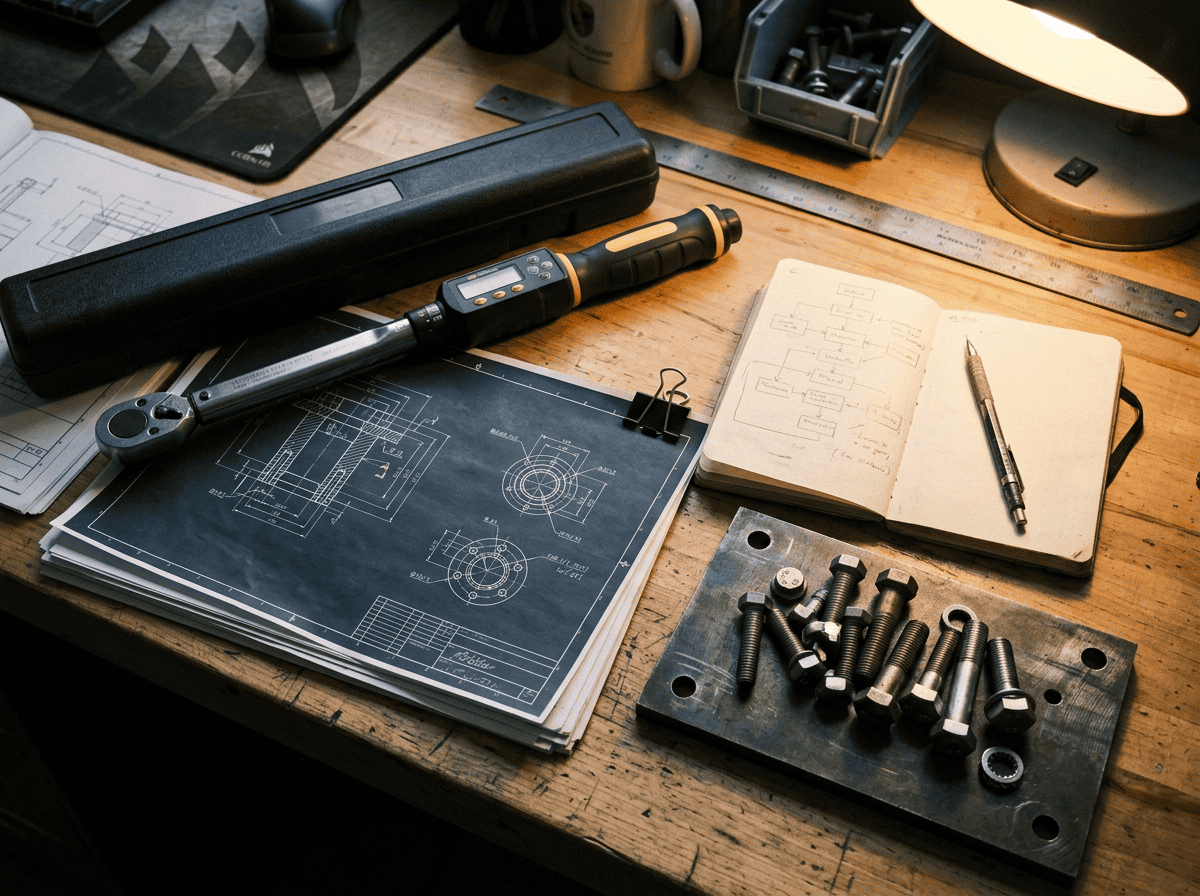
Three loads matter: tension (pulling the joint apart), shear (sliding one plate against another), and fatigue (cyclic loading from vibration or thermal cycling). Most fasteners fail in fatigue, not in static overload. That changes the priority list.
For a static tension load, grade and preload are everything. For shear, the bolt diameter and how it’s installed (snug-tight vs. slip-critical) matter more than the grade. For fatigue, you actually want a lower-grade, more ductile bolt with a controlled preload and ideally rolled (not cut) threads — work documented on the Bolt Science resource on self-loosening is the clearest published reference we know on this failure mode.
Step 2 — Match Grade and Material
Carbon steel grade 5 (SAE J429) or class 8.8 (ISO 898) covers the bulk of general-purpose mechanical work. Grade 8 / class 10.9 buys you higher tensile strength at the cost of ductility. Stainless A2 (304-equivalent) or A4 (316-equivalent) handles corrosion but has lower yield than carbon steel of similar grade — a fact that bites teams who substitute stainless one-for-one and end up with stripped threads.
Alloy steel socket caps in grade 12.9 are useful for tight-space, high-load tapped joints. Aluminum, brass, and nylon fasteners exist for weight, conductivity, or electrical isolation — niche but important.
Step 3 — Pick the Right Head, Drive, and Length
Head style is driven by the joint geometry: do you have a flush surface requirement (flat head), a clearance issue (low-profile button or pan head), or a need for repeated assembly (hex socket cap with a clean drive that doesn’t cam out)?
Length is calculated, not guessed. The general rule: the bolt or screw should engage at least one nominal diameter of thread in the parent material for steel, 1.5 to 2 diameters for aluminum, and 2 to 3 diameters for plastic. Over-length protrudes past the nut and looks unprofessional; under-length strips threads.
Common Bolt and Screw Selection Mistakes We See at the Plant
- Substituting stainless for carbon steel one-for-one. The grades don’t map. A2-70 stainless is roughly equivalent to class 5.8 carbon steel, not 8.8.
- Mixing coatings under preload. Zinc-plated bolt with a yellow-chromate nut and a black-oxide washer — three different friction coefficients in the same joint. Torque-to-tension prediction is meaningless.
- Reusing torque-to-yield bolts. Engine head bolts, ARP rod bolts, suspension stretch bolts — once they’ve been preloaded past yield, they’re done. Use new ones. Always.
- Specifying length to the head instead of under-head. For socket caps and pan heads, length is measured under the head. For flat-head countersunk screws, length includes the head. Document which.
Grades, Standards, and Material Specs You Actually Need to Know
Standards are dense and most of them you can ignore until you need them. Here are the three you’ll touch every week.
ASTM, ISO, SAE — The Three You’ll See Daily
ASTM (American Society for Testing and Materials) covers structural bolts (F3125 / A325 / A490), high-temperature service (A193), and a long list of specialty applications. Cert sheets from a reputable mill will reference ASTM.
ISO is the global metric standard. ISO 898-1 defines mechanical properties for steel fasteners (class 4.6 through 12.9). The official ISO metric thread standards index is the authoritative source for thread profiles, tolerances, and gauge specifications. Most non-U.S. production runs reference ISO directly.
SAE J429 covers inch-system grades in the U.S. — grades 2, 5, 8, and so on. Marked on the head with radial lines: no lines for grade 2, three lines for grade 5, six lines for grade 8. Easy to read once you’ve seen it twice.
Reading a Bolt Head Marking
The marking on top of the bolt head is your primary verification that what you got matches what you ordered. It always includes the grade indicator (radial lines for inch, raised digits like “8.8” or “10.9” for metric) and usually the manufacturer’s identifier — a two- or three-letter stamp registered with the Industrial Fasteners Institute.
Counterfeit fasteners are real and have caused real failures. If you’re sourcing internationally for safety-critical applications, ask for a mill test report (MTR) per lot and spot-check the radial line / class marking against the cert. Production-grade suppliers will provide this without complaint.
A Quick Reference on Metric Thread Pitches
| Diameter (mm) | Coarse Pitch (mm) | Fine Pitch (mm) | Typical Use |
|---|---|---|---|
| M5 | 0.8 | 0.5 | Electronics, light machinery |
| M6 | 1.0 | 0.75 | General assembly |
| M8 | 1.25 | 1.0 | Mechanical, automotive |
| M10 | 1.5 | 1.25 | Structural light, machinery |
| M12 | 1.75 | 1.25 | Structural mid, frames |
| M16 | 2.0 | 1.5 | Heavy structural |
| M20 | 2.5 | 1.5 | Heavy machinery, lifting |
Coarse pitch is the default; fine pitch is used where vibration resistance, finer adjustment, or higher tensile area matters. The Engineering ToolBox reference on ISO 724 metric threads carries the full table with major and minor diameters if you need to specify tooling.
Future Trends: Bolt and Screw Manufacturing in 2026 and Beyond
The hardware itself looks the same as it did fifty years ago — turned, headed, rolled, heat-treated, coated. The interesting changes are happening at the surface, in the coatings, and in the data layer wrapped around the fastener.
Coating Chemistry: From Zinc to Non-Chrome Passivates
Hex chrome (Cr⁶⁺) corrosion-resistant coatings have been phased out under RoHS and REACH in most major markets. The replacement: trivalent chromium passivates and zinc-nickel alloy plating. According to industry data published by major coatings suppliers and tracked across recent ASTM B117 salt-spray comparisons, modern zinc-nickel can deliver 720+ hours of red-rust protection — three to five times the durability of standard zinc plating, at a cost premium of roughly 25–40%.
For automotive fasteners exposed to road salt and underbody splash, that durability premium pays for itself in warranty avoidance within one season.
Smart Fasteners and Torque Telemetry
A small but growing share of high-value joints — wind turbine blade bolts, aerospace structural fasteners, critical pressure-vessel studs — now embed strain gauges or RFID tags directly in the bolt. The data layer reports preload at install, monitors residual tension over service life, and flags joints that have relaxed past a threshold.
It’s not coming to commodity hardware any time soon — the cost per bolt is one to two orders of magnitude higher than a conventional fastener. But for joints where a failed inspection means crane time and a six-figure crew callout, the math already works.
Sustainability and Reshoring
Two structural pressures are reshaping the supply side. First, sustainability: customer audits now ask about coating chemistry, scrap recycling rates, and embodied carbon. Second, reshoring: tariff volatility and post-pandemic supply chain trauma have pushed a meaningful share of Tier-2 and Tier-3 bolt and screw demand back to regional suppliers in North America and Europe.
For buyers, the practical effect is shorter lead times on standard parts (good) but pricing pressure that ebbs and flows with the underlying steel and coatings market (less predictable than the old just-in-time global model).
| Coating | Salt Spray Hours (typical) | Relative Cost | Best For |
|---|---|---|---|
| Black oxide | 8–24 | 1.0× | Indoor, low corrosion |
| Zinc plating (clear) | 96 | 1.2× | General indoor / mild outdoor |
| Zinc plating (yellow trivalent) | 120–192 | 1.3× | Automotive, equipment |
| Hot-dip galvanized | 600+ | 1.8× | Outdoor, structural |
| Zinc-nickel | 720+ | 2.5× | Automotive underbody, marine |
| Dacromet / Geomet | 1000+ | 3.0× | Severe corrosion, aerospace |
| Stainless A4 | Indefinite (material) | 4–6× | Marine, food-grade, chemical |
FAQ
What are the four types of fasteners?
Threaded fasteners (bolts and screws), pins, rivets, and washers are the four primary categories. Threaded fasteners do clamping work. Pins do alignment and pivot work. Rivets are permanent. Washers distribute load. Every assembled product uses some combination of these four. In production environments, threaded fasteners — the bolt and screw family — account for roughly 70–80% of fastener volume by piece count.
Is a screw stronger than a bolt of the same size?
No — at the same diameter and grade, a bolt and screw have effectively the same tensile strength. What changes is how that strength is delivered. A bolt’s clamping force is bounded by the nut and the joint members. A screw’s clamping force is bounded by the parent material the threads engage. In a tapped aluminum hole, a steel screw will strip the aluminum long before the screw itself fails — so the joint capacity, not the fastener capacity, is the real number to spec to.
What is the difference between Grade 5 and Grade 8 bolts?
Grade 8 is roughly 25% stronger in tensile strength but more brittle and more expensive than Grade 5. Grade 5 (yellow chromate, three radial head lines) has minimum tensile of ~120,000 psi. Grade 8 (gold or zinc, six radial lines) hits ~150,000 psi but has lower elongation at failure. For vibration-loaded joints, the lower ductility of Grade 8 can actually shorten fatigue life. Pick based on the load type, not the bigger number.
Can I use a regular bolt and screw outdoors?
Only if it’s coated or made of a corrosion-resistant material. Bare carbon steel will start red-rusting within weeks of outdoor exposure. Minimum acceptable spec for outdoor mild-environment use is zinc plating with yellow chromate (192-hour salt spray); for direct weather, hot-dip galvanized; for marine or de-icing salt exposure, zinc-nickel or stainless A4 (316). Substituting up is fine; substituting down is the source of nearly every outdoor fastener failure complaint we field.
How do I know if I need a metric or inch-system fastener?
Match what’s already in the design — never mix metric and inch threads in the same joint. M6×1.0 and 1/4-20 are close enough in diameter to thread two or three turns into the wrong hole and then strip. That kind of failure usually shows up six months later in field service. If you’re designing greenfield, default to ISO metric unless your supply chain is U.S.-domestic for legacy reasons. Most modern production tooling is metric-native.
What’s the right torque for a bolt and screw?
Manufacturer torque charts assume specific friction conditions — verify them or use a calibrated torque-tension tool. Generic torque tables (e.g., 25 ft-lb for a 3/8-16 grade 5 bolt) are starting points, not specs. Friction under the head, in the threads, and from any coating changes the torque-to-tension relationship by 30% or more. For critical joints, qualify the actual fastener-and-coating combination on a load-cell tool. For non-critical, follow the chart for the matching coating spec and call it done.
Where do production buyers source bolt and screw inventory at scale?
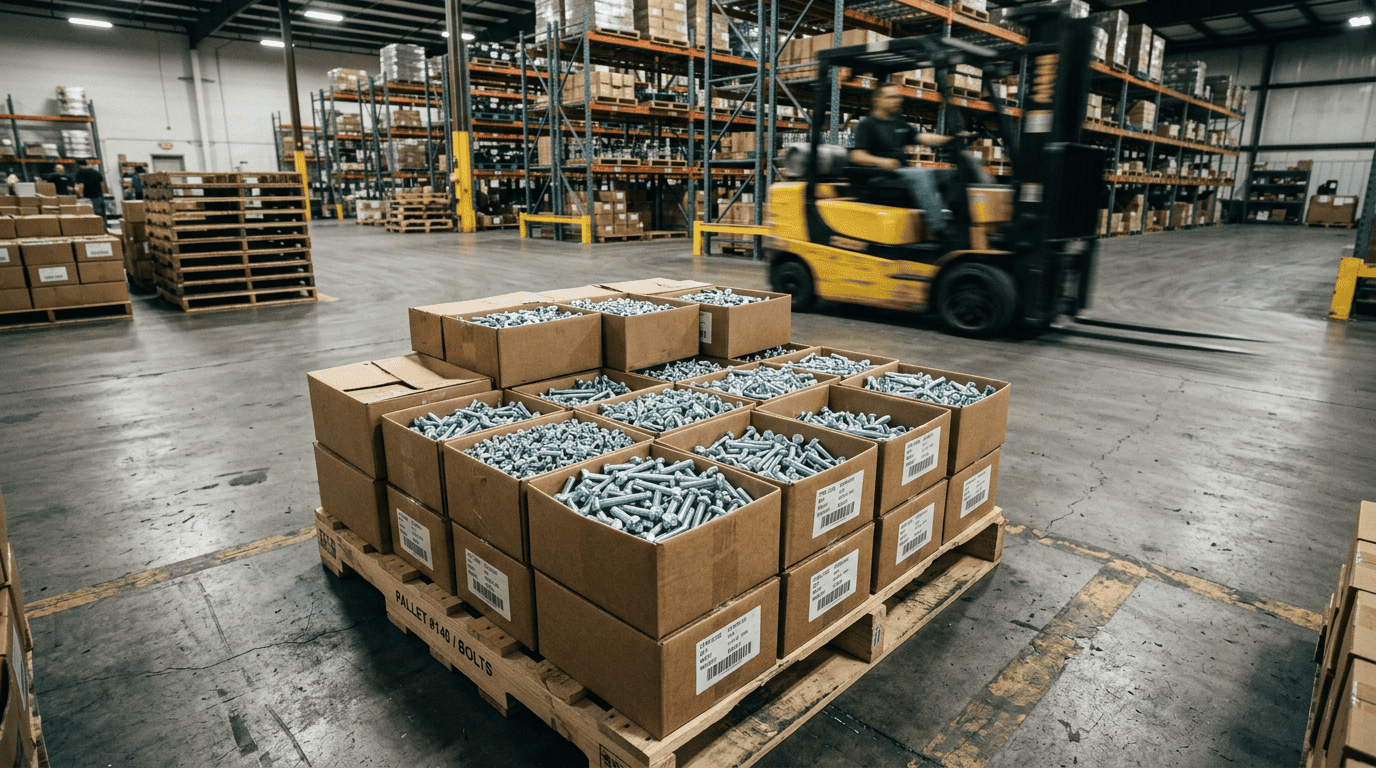
Direct from manufacturers for high-volume standard parts; from full-line distributors for mixed BOMs and short lead times. Manufacturer-direct gets the best per-piece pricing but requires forecasting accuracy and minimum order quantities measured in pallets. Distributors charge a margin but carry breadth — they’ll cross-ship the one bin of M8×30 class 10.9 you need for a rush job. Most production shops use both: direct for the top 20 SKUs by volume, distributors for everything else.
The Bottom Line
A bolt and screw aren’t interchangeable, even when they look it. The right choice depends on whether the joint holds together by clamping against a nut or by threading into the parent material, and that single mechanical question drives every downstream decision: grade, coating, length, drive style, torque method. Get it right and the joint becomes the most reliable part of the assembly. Get it wrong and it becomes the only part anybody ever talks about.
If you’re sourcing bolt and screw inventory for production, the next concrete step is to audit your current BOM against the load type, grade, and coating triad outlined above. The fastest payback on a fastener review isn’t usually the per-piece price — it’s the elimination of one or two SKUs you’ve been over-specifying without knowing it, plus the prevention of one warranty event that would have eaten the year’s savings in a single afternoon.
Related Products
Solutions & Cluster
Related Articles
- Bolt Nut and Washer: The Complete 2026 Guide to Choosing and Using Fasteners Correctly
- Rivet Nut Ultimate Guide: Installation, Selection & Applications for 2026
- What Is a Screw? The Complete Guide to Types, Uses & Selection for Production
- Plastic Spacers: Complete Guide to Types, Materials & Selection
- Locking Nuts: Complete Guide to Types, Selection, and Installation
- Essential Guide to Triangle Bolt Applications and Removal Techniques
- UNF Thread: Complete Guide to Unified National Fine Thread Specifications
- Sex Bolts: Complete Guide to Barrel Fasteners, Sizes & Installation