 English
  German
  Spanish
  Portuguese
  French
  Japanese
  Arabic
  Korean
  Vietnamese
  Russian
 A screw threads into a material or forms its own threads; a bolt passes through a clearance hole and clamps with a nut on the opposite side.

Walk into any hardware store and the screw-and-bolt aisle looks like organized chaos — hundreds of bins, dozens of drive types, five finishes, metric and imperial sitting three feet apart. Most people grab whatever looks right and hope for the best. That works until a structural connection fails at 3 a.m. or a machine screw strips out after its third assembly cycle. This guide tells you exactly what separates a screw from a bolt, which type fits which job, how specs map to real-world performance, and the handful of mistakes that cause most fastener failures in production and construction.
What Is the Difference Between a Screw and a Bolt?
A screw threads into material directly; a bolt passes through a clearance hole and clamps with a nut.
That one-sentence answer covers most situations. But the formal engineering definition goes deeper, and knowing it prevents expensive mismatches.
Thread Design and Shank Profile
The mechanical distinction between a screw and a bolt comes down to thread engagement. A screw is designed to mate with a pre-tapped hole or to cut and form its own threads as it’s driven. The thread typically runs along most or all of the shank — machine screws, for example, are fully threaded from tip to head and engage a tapped hole or threaded insert.
A bolt typically has a smooth, unthreaded shank section near the head, with threads only at the tip end. The smooth shank spans the joint; the threaded portion engages a nut on the opposite face. The bolt doesn’t rotate into material — it passes through a clearance hole and is tightened from the nut side.
According to ASME B18.2.1 and the American Society of Mechanical Engineers, a bolt is formally defined as an externally threaded fastener designed for insertion through holes and tightened by torquing a nut, while a screw is designed to mate with a pre-formed thread or form its own.
How They Attach — With vs. Without a Nut
| Feature | Screw | Bolt |
|---|---|---|
| Thread engagement | Into material or tapped hole | Into a nut |
| Shank profile | Fully or mostly threaded | Often partially threaded |
| Tightened by | Turning the head | Torquing the nut |
| Pre-drilled hole | Optional (self-tapping) or tapped | Clearance hole required |
| Common drive types | Phillips, Torx, hex socket, slotted | Hex head, wrench flats, socket cap |
| Primary strength mechanism | Thread engagement in substrate | Bolt pre-load and nut clamping |
Pro tip: Threading a bolt into a tapped block — without a nut — technically makes it function as a screw. The ASME definition is functional: what matters is how the fastener develops clamping force, not what it’s called on the bin label.
The practical consequence: screws are generally better where space or weight doesn’t allow a nut on the back, or where frequent disassembly is needed without access to both sides. Bolts are the choice for high-load structural or safety-critical connections where pre-load must be controlled and a nut can be torqued to spec.
Types of Screws: A Complete Breakdown
Six major screw types cover nearly every application; the right one depends on material, load, and whether you have a pre-tapped hole.
Choosing the wrong screw type — not just the wrong size — is the leading source of fastener callbacks in production environments. Here’s how each type works and where it belongs.
Machine Screws
Machine screws are fully threaded fasteners designed to mate with a pre-tapped hole or threaded insert. Available in both metric (M2 through M12 for most electronics and machinery) and unified inch series (UNC/UNF). Drive styles include Phillips, Torx, hex socket (socket cap), and slotted.
Thread form matters: UNC (unified national coarse) is the default for general assembly — faster threading, more tolerant of minor damage, easier disassembly. UNF (unified national fine) has more threads per inch, producing higher pre-load for a given torque. Specify UNF when vibration resistance is the priority — engines, gearboxes, rotating equipment. Don’t add fine thread complexity without a real reason.
Per ASTM F593 for stainless machine screws and ASTM A307 for carbon steel, minimum tensile strength for Grade 5 carbon steel machine screws runs 120,000–150,000 psi; alloy Grade 8 reaches 150,000–180,000 psi.
Self-Tapping Screws
Self-tapping screws cut or form their own threads as they’re driven, eliminating the need for a pre-tapped hole. Two subtypes with very different behaviors:
- Thread-cutting (Type 1, 23, 25): physically remove material as they enter. Best for hard plastics, thin sheet metal, and light aluminum. Chips are produced — don’t use these in blind holes in sealed electronics where chips can cause short circuits.
- Thread-forming (Type AB, B, TAPTITE® style): displace and cold-work the material rather than cutting. No chips, stronger thread engagement, but require more torque to drive and need a pilot hole sized correctly for the material. Standard in automotive interior assembly since the 1980s — forming rather than cutting gives consistent strip-out torque even as the plastic ages and becomes more brittle.
Wood Screws
Wood screws have a tapered shank, coarser thread pitch (8–14 TPI), and typically a sharp point for self-starting in lumber. The upper shank is smooth and unthreaded — as the screw tightens, the smooth shank section pulls the near board toward the far board rather than threading through both.
For structural applications, plain wood screws have no published load values. ICC-ES-listed structural screws (Simpson SDS, GRK R4, LedgerLOK) do — they’re tested per ASTM F1575 and F1667 and publish allowable shear and withdrawal loads that engineers can use in permit-required work. Substituting a deck screw for an SDS screw in a ledger connection is a code violation.
Sheet Metal Screws
Sheet metal screws have fully threaded shanks, hardened steel bodies, and sharp tips for threading into thin-gauge metal (28-gauge to 10-gauge, approximately 0.015″ to 0.134″). Type A has coarser threads; Type B has finer threads with a blunter point; Type AB combines both characteristics and is the most commonly stocked.
In HVAC and enclosure work, the standard spec is #8 or #10 hex-washer-head sheet metal screws with a hex driver bit. Outdoors or in corrosive environments, specify hot-dipped galvanized or stainless steel.
Set Screws
Set screws have no head — they’re entirely threaded, designed to sit flush with or recessed below a surface. Most common use: securing a pulley, gear, collar, or sprocket to a shaft. Cup-point set screws bite into the shaft for high torque-holding capacity; flat points spread load across softer materials.
Standard grade for demanding shaft applications: Class 45H (carbon steel) or alloy steel for high-torque environments. Threadlocking compound (Loctite 243 blue or equivalent) is standard practice in vibrating machinery — set screws are notorious for backing out at operating temperature if dry.
Specialty Screws
Three specialty types that appear regularly in production:
- Shoulder screws (stripper bolts): the precisely machined unthreaded shoulder is the functional feature — used as a pivot pin, linear guide, or punch/die alignment post. Diameter tolerance held to ±0.001″. Common in injection mold tooling and precision mechanisms.
- Captive screws: pressed into a panel and retained even when fully backed out — used in server chassis, access panels, and instrument covers where dropped fasteners are a FOD (foreign object debris) risk.
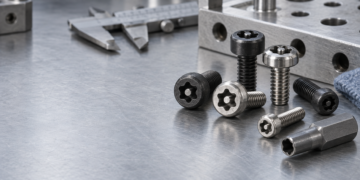
- Security screws: one-way drive, Torx-Plus, or pin-in-hex heads to deter tampering. Required for some consumer electronics enclosures and utility meter covers.
| Screw Type | Substrate | Thread | Drive | Typical Application |
|---|---|---|---|---|
| Machine screw | Tapped metal / insert | UNC, UNF, or Metric | Phillips, Torx, hex socket | Electronics, machinery, appliances |
| Self-tapping (cutting) | Sheet metal, hard plastic | AB, B | Phillips, hex | HVAC, enclosures, control panels |
| Self-tapping (forming) | Thermoplastic, soft metal | TAPTITE® | Torx, Phillips | Auto interiors, consumer goods |
| Wood screw | Lumber | Coarse, tapered shank | Phillips, square drive, Torx | Framing, cabinetry, decking |
| Sheet metal screw | Sheet metal | Fine, sharp tip | Hex washer head | Roofing, appliance panels, HVAC |
| Set screw | Shaft / bore | UNC cup / flat / oval point | Hex (Allen) socket | Shaft collars, gears, pulleys |

Types of Bolts: From Hex to Structural
Six bolt families cover most industrial and construction needs; match the bolt to joint geometry first, then specify grade and coating.
The spec sheet gives tensile strength. What it doesn’t tell you is whether a hex or carriage or U-bolt is the right geometry for your joint — that’s where most over-engineering happens.
Hex Bolts
Hex bolts are the workhorses of structural and mechanical assembly. Six-sided head, available from 1/4″ to 1-1/2″ (SAE/ASME B18.2.1) and M5 to M36 (ISO). Partial or full thread. SAE grade markings stamped into the head indicate strength:
- Grade 2 (no markings): low-carbon steel, 74,000 psi min tensile, for light non-critical joints
- Grade 5 (3 radial lines): medium carbon, 120,000 psi min tensile, the default for machinery and most structural steel connections
- Grade 8 (6 radial lines): alloy steel, 150,000 psi min, required for automotive, heavy equipment, and high-load connections
- ISO metric equivalents: 8.8 ≈ Grade 5; 10.9 ≈ Grade 8; 12.9 exceeds Grade 8 at 177,000 psi min
Flange bolts add a built-in washer flange under the head, distributing bearing load over a larger area without a loose washer. Standard in automotive suspension and exhaust systems where a dropped washer during assembly is not acceptable.
Carriage Bolts
Carriage bolts have a smooth domed head and a square shoulder below the head that bites into wood or a punched square hole in metal, preventing rotation as the nut is tightened. No wrench needed on the bolt-head side.
Primary applications: deck construction, dock and pier framing, timber connections, playground equipment. A 3/8″ × 3.5″ hot-dipped galvanized carriage bolt is the standard fastener for treated-lumber deck ledger connections per IRC R507. Hot-dip galvanizing (minimum 1.7 oz/ft² per ASTM A153) is mandatory in contact with ACQ-treated lumber — plain zinc plate corrodes within one to two seasons.
Eye Bolts and Rigging Hardware
Eye bolts have a circular loop at one end rather than a head. Used for lifting, rigging, and cable attachment. Critical design rule: never use a shoulder-less eye bolt for angular loads. ASME B30.26 derating tables are specific: a 1/2″ forged eye bolt rated 1,500 lb straight-pull drops to 530 lb at 45° side loading. Use swivel hoist rings or machinery eye bolts for applications where the load angle cannot be guaranteed — they pivot freely and maintain rated capacity regardless of load direction.
Anchor Bolts
Anchor bolts embed in concrete or masonry to provide attachment points for structural steel columns, base plates, and equipment pads. Two main categories:
- Cast-in-place (L-bolt, J-bolt, headed stud): set before the concrete pour. Load develops through embedment depth, hook geometry, and bearing on the concrete. ICC-listed embedment tables in ACI 318-19 Chapter 17 govern minimum depths for code-compliant design.
- Post-installed (epoxy anchor, wedge anchor, undercut anchor): installed after concrete cures. Epoxy anchors (Hilti HIT-RE 500 V3, Simpson SET-3G) consistently outperform mechanical wedge anchors in cracked concrete and seismic applications — they develop full load through chemical bond rather than mechanical expansion.
According to ACI 318-19 Chapter 17, design values depend on concrete compressive strength (f’c), edge distance, and whether the concrete is cracked or uncracked at the anchor location.
ASTM F1554 governs anchor bolt material grades: Grade 36 (36 ksi yield, mild steel), Grade 55, and Grade 105 (high-strength, for industrial equipment pads with high dynamic loads).
U-Bolts
U-bolts wrap around a pipe, tube, or structural section, clamping with two nuts at the open ends. Common in exhaust system mounting, pipe hangers and conduit support, and leaf spring retention on truck suspensions. Thread form and grade matter critically in suspension: a Grade 5 U-bolt in a heavy-duty truck application is a liability — specify Grade 8 (SAE) or 10.9 (metric), and replace at every suspension rebuild.
Torque for 1/2″ Grade 8 U-bolts on leaf spring assemblies: typically 70–100 ft-lb — always confirm against the OEM or spring manufacturer’s torque table for the specific vehicle.
| Bolt Type | Key Feature | Primary Use | Grade / Standard |
|---|---|---|---|
| Hex bolt | 6-sided head, versatile | Machinery, construction, general structural | Grade 5 or 8 (SAE); 8.8 or 10.9 (ISO) |
| Carriage bolt | Domed head, square shoulder | Timber framing, decking, wood-to-metal | ASTM A307, hot-dip galv for ACQ lumber |
| Eye bolt | Loop head for rigging | Lifting, cable attachment, rigging | ASME B30.26 |
| Anchor bolt | Cast or post-installed in concrete | Structural base plates, equipment pads | ASTM F1554 Grade 36 / 55 / 105 |
| U-bolt | U-shape with 2 nuts | Pipe supports, exhaust mounting, suspension | Grade 8 / ISO 10.9 for suspension |
| Flange bolt | Built-in washer flange | Automotive, anywhere dropped washers cause hazards | SAE Grade 8 or ISO 10.9 |
Industry Applications of Screws and Bolts
Application environment drives fastener selection: material, load direction, temperature, and chemical exposure all determine the right screw and bolt combination.
Construction and Structural Engineering
Structural fasteners in construction are code-governed. For wood framing, plain drywall screws have zero published structural values and are illegal in permitted structural connections. ICC-ES-approved structural screws publish shear and withdrawal values tested to ASTM F1575 standards — values engineers can use in permit calculations.
For concrete anchoring, anchor bolt design falls under ACI 318-19. Required design inputs: concrete compressive strength (f’c, typically 3,000–4,000 psi), embedment depth, edge distance, and seismic design category. Getting anchor bolt embedment wrong in a high-seismic zone is how base plates walk — a failure mode with serious life-safety consequences.
Explore our production screw catalog for construction applications to find structural fasteners with published load values for code-compliant projects.
Automotive and Aerospace Manufacturing
Automotive assembly lines consume millions of fasteners per day. The industry-wide shift from Phillips to Torx drive in the 1990s was driven by assembly automation: Torx bits cam out significantly less than Phillips, allowing robots to maintain consistent torque across millions of cycles without bit-wear-induced variation affecting final torque values.
Aerospace fasteners operate in a different universe. AN (Air Force/Navy), MS (Military Standard), and NAS (National Aerospace Standards) hardware is held to dimensional and material tolerances that civilian hardware never sees. AS9100-certified traceability is mandatory — one undocumented substitution can trigger an FAA Airworthiness Directive affecting an entire aircraft type. Titanium Ti-6Al-4V fasteners used in airframe structure offer tensile strength comparable to Grade 8 steel at approximately 43% of the weight.
Electronics and Consumer Products
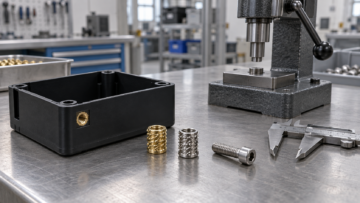
Electronics assembly uses miniature fasteners — M1.6 to M4 machine screws, thread-forming screws into plastic bosses, and captive-nut solutions for serviceability. Torque specifications here are extremely low: an M2 screw into a brass insert typically torques to 0.15–0.25 N·m. Strip-out is a frequent failure mode when assemblers hand-drive without calibrated torque drivers.
The broad standardization of screw and bolt thread forms that makes global supply chains possible traces to ISO 261 (metric threads) and ANSI B1.1 (unified inch threads) — a coordination effort that reduced thousands of regional thread standards to two primary families over the 20th century.
How to Choose the Right Screw or Bolt
Match fastener to substrate, load direction, environment, and installation access — in that order.
Most fastener selection failures trace to the wrong family being chosen before specs are even considered. Get the family right first.
Material, Grade, and Coating Selection
Environment determines coating before grade determines steel:
- Indoor, dry conditions: zinc-plated (electroplated) steel per ASTM B633 SC1 is adequate. This provides approximately 0.2 mil of zinc — sufficient for controlled indoor environments without moisture or chemicals.
- Outdoor, treated lumber, or high humidity: hot-dipped galvanized (HDG) per ASTM A153, or stainless steel (Type 304 minimum). Standard electroplated zinc corrodes within two to three seasons in contact with ACQ-treated lumber. HDG provides 1.7+ oz/ft² of zinc; stainless eliminates corrosion concerns entirely.
- Saltwater or marine exposure: Type 316 stainless steel minimum. The molybdenum added to 316 vs. 304 dramatically improves pitting resistance in chloride-rich environments.
- High-temperature service (exhaust, furnace, kilns above 800°F): high-temperature alloys (Inconel 625, A286) or at minimum 430 stainless steel. Carbon steel bolts at operating temperatures above 800°F oxidize rapidly and lose clamping pre-load, causing joint loosening in service.
| Grade (SAE) | ISO Equivalent | Min. Tensile (psi) | Typical Use |
|---|---|---|---|
| Grade 2 | — | 74,000 | Light non-structural connections |
| Grade 5 | 8.8 | 120,000 | General machinery, structural steel |
| Grade 8 | 10.9 | 150,000 | Automotive, heavy equipment, safety-critical |
| — | 12.9 | 177,000 | High-stress, aerospace-adjacent, extreme loads |
Size, Thread Pitch, and Load Requirements
For any structural or mechanical application, three numbers matter:
- Tensile stress area: the effective cross-section that resists tension load. For UNC threads:
A_t = 0.7854 × (d − 0.9743/n)²where d = nominal diameter, n = threads per inch. - Proof load: approximately 85–92% of tensile strength depending on grade. The bolt must not yield during torqueing — the proof load is the design ceiling.
- Required pre-load: typically 75% of proof load for joints subject to dynamic loading; 65–70% for static-only joints.
A practical reference: Grade 5 1/4″-20 bolt provides roughly 2,400 lb proof load; 3/8″-16 provides approximately 5,700 lb. These are the forces at which permanent elongation begins — not working loads, which carry an additional safety factor.
Common Mistakes to Avoid
1. Mixing metric and imperial threads. An M8 bolt (8mm diameter, 1.25mm pitch) and a 5/16″-18 bolt are dimensionally close enough to appear to engage for 1–2 turns before cross-threading permanently. Always confirm thread family and pitch before threading any fastener into a new receiving part.
2. Under-torquing “for safety.” Most fastener field failures come from under-torque, not over-torque. A properly torqued bolt stretches slightly — it acts as a spring, maintaining clamping force through vibration and thermal cycling. Under-torqued bolts fatigue in thousands of cycles instead of millions.
3. Using a lubed torque spec dry (or vice versa). Published torque specifications assume a specific friction condition — either dry or lubricated with a specific product. Applying a lubed spec dry under-torques the joint by 30–40%. Confirm the lubricant assumption before using any torque table.
4. Substituting drywall screws in structural wood applications. Drywall screws are case-hardened and brittle — they snap under shear loads without warning and carry zero published structural values. Structural screws are ductile and ICC-listed. The visual similarity causes the substitution; the mechanical behavior difference causes the failure.
5. Ignoring galvanic corrosion. Stainless steel fasteners in direct contact with bare aluminum in a saltwater environment create a galvanic cell that corrodes the aluminum within one season. Isolate with neoprene or EPDM washers, use aluminum fasteners where appropriate, or apply anti-corrosion paste at the interface.

Future Trends in Fastener Technology (2026 and Beyond)
Smart fasteners and advanced coatings are shifting what screws and bolts can do beyond simple mechanical clamping.
Structural Monitoring and Smart Fasteners
Embedded load-sensing bolts have moved from aerospace R&D into industrial production. Ultrasonic bolt tension monitoring measures actual bolt elongation via ultrasound — a direct measurement of pre-load, not a proxy via torque. This approach is now standard in wind turbine hub assemblies, where access for routine re-torquing is physically difficult and bolt fatigue failure carries severe consequences. The technique eliminates the ±30% scatter inherent in torque-based pre-load inference.
RFID-tagged fasteners are entering aerospace and high-value automotive manufacturing for part-level traceability. A passive RFID chip embedded in the bolt head can carry full manufacturing provenance — material heat number, torque history, inspection records — without external documentation. Both Boeing and Airbus have active programs as of early 2026.
Advanced Coatings and Surface Treatments
Fluoropolymer (PTFE-based) coatings applied to fastener threads reduce friction coefficients to 0.04–0.08, tightening torque-to-clamp-load scatter from ±30% (dry steel) to ±10%. This matters directly to assembly line defect rates: tighter pre-load scatter means fewer joints re-torqued under warranty.
Zinc-nickel electroplating (12–15% nickel content) is replacing cadmium in aerospace fastener applications following REACH and RoHS restrictions on cadmium use. Zinc-nickel provides equivalent salt-spray performance — 1,000+ hours to red rust in neutral salt spray per ASTM B117 — using a non-hazardous deposition process. It’s now the standard aerospace cadmium replacement specified in Boeing D6-17487 and Airbus AIMS 03-02-007.
| Technology | Status (2026) | Primary Industry | Key Benefit |
|---|---|---|---|
| Ultrasonic bolt tension sensors | Full production deployment | Wind energy, heavy machinery | Eliminates torque-scatter uncertainty |
| RFID-embedded fasteners | Aerospace trials, early adoption | Aerospace, high-value manufacturing | Full lifecycle traceability per fastener |
| Zinc-nickel plating | Mainstream production | Aerospace, automotive | Cadmium replacement, 1,000h+ salt spray |
| PTFE-coated structural bolts | Growing adoption | Auto assembly lines | ±10% pre-load scatter vs. ±30% dry |
| Additive-manufactured fasteners | Early, niche adoption | Prototyping, extreme environments | Geometry-on-demand in titanium or Inconel |
Frequently Asked Questions
What is the main difference between a screw and a bolt?
A screw threads into material; a bolt passes through and clamps with a nut. The formal ASME distinction: a screw mates with a pre-formed internal thread or forms its own; a bolt is designed to pass through clearance holes and be tightened by a nut. In practice, bolts typically have a partially unthreaded shank; screws are usually fully threaded. The line blurs when a bolt is threaded into a tapped block — functionally it’s acting as a screw.
Can I use a bolt without a nut?
Yes — threading a bolt into a tapped hole makes it function as a screw. This is common in machinery and equipment assembly. The bolt/screw label describes design intent, not hard limits on use. Just confirm the thread engagement is sufficient: structural joints require a minimum of 1× diameter of thread engagement in steel, or 1.5× in aluminum.
What do Grade 5 and Grade 8 markings mean on a bolt?
They indicate minimum tensile strength. Grade 5 (3 radial lines on the head) = 120,000 psi minimum tensile; Grade 8 (6 radial lines) = 150,000 psi minimum. The ISO metric equivalents are 8.8 (≈ Grade 5) and 10.9 (≈ Grade 8). Never substitute a lower grade for a higher grade in structural or safety-critical applications — the visual appearance is nearly identical but the failure load is dramatically different.
What is the difference between coarse (UNC) and fine (UNF) thread?
Coarse thread installs faster and tolerates damage better; fine thread holds higher pre-load. UNC has fewer threads per inch — faster assembly, more tolerant of minor thread damage, preferred in dirty or corrosive environments. UNF has more threads per inch — higher clamp load for a given torque, better vibration resistance. Specify UNF when: the application vibrates continuously (engines, compressors), the wall thickness limits thread engagement to fewer than 4 full threads, or maximum pre-load is needed.
Why do stainless steel bolts sometimes seize and gall?
Stainless galls when the oxide film is destroyed during thread engagement and bare metal surfaces weld under pressure. The same oxide film that makes stainless corrosion-resistant is destroyed by thread friction — leaving bare metal-on-metal contact that cold-welds. Prevention: use an anti-galling lubricant (Molykote G-Rapid Plus, Never-Seez, or Loctite 8009), specify different alloys for bolt and nut (e.g., A2 bolt with A4 nut), or use surface-treated fasteners. Once galling starts, it cannot be reversed by backing out and re-attempting.
What anchor bolt should I use for concrete?
Start with the manufacturer’s ICC-ES report or ACI 318-19 Chapter 17. Required inputs: concrete compressive strength (f’c), design load, embedment depth, edge distance, and cracked-vs.-uncracked concrete condition. For non-engineered light-commercial work — equipment pads, fence posts, sign bases — 3/8″ or 1/2″ wedge anchors at 3–4″ embedment handle most loads in 3,000 psi concrete. For seismic zones, specify epoxy anchors (Hilti HIT-RE 500 V3 or Simpson SET-3G) over wedge anchors — they maintain design load in cracked concrete where wedge anchors lose significant capacity.
What causes bolts to loosen in vibrating machinery?
Transverse vibration overcomes the friction in the bolt head and nut bearing surfaces — the joint “walks” loose progressively. Solutions, in order of effectiveness: (1) increase initial pre-load to the fastener’s proof load; (2) add a positive locking element — Nord-Lock wedge-lock washers or anaerobic threadlocker (Loctite 243 for most applications, 271 for permanent); (3) switch to fine thread for higher friction coefficient; (4) use a prevailing-torque nut (nylon-insert or all-metal Stover-type). Split-lock washers alone do not reliably prevent loosening — laboratory testing shows they can actually increase loosening tendency compared to plain hardened washers.

Conclusion
Screws and bolts are not interchangeable terms — the difference in thread engagement method, joint mechanics, and failure mode is real and consequential. Get the family right first: screw vs. bolt, then which subtype, then grade, coating, and torque spec. Most fastener failures trace to one of five root causes: wrong family for the substrate, wrong grade for the load, wrong coating for the environment, incorrect torque, or a stainless galling problem nobody addressed at the design stage.
For production procurement, the practical playbook: standardize on Grade 5 hex bolts for general machinery, Grade 8 for structural and automotive, hot-dipped galvanized or Type 316 stainless for outdoor and marine, and a solid range of Torx-drive self-tapping screws for sheet metal and plastic enclosures. That covers 90% of production needs. Specialty fasteners — anchor bolts, eye bolts, shoulder screws, captive hardware — are application-specific; specify them when joint geometry or code explicitly requires them.
Related Articles
- Production Screws: Types, Standards, and Sourcing Guide
- Hex Bolt Grades Explained: SAE Grade 5 vs. Grade 8 vs. ISO 10.9
- Self-Tapping Screws: Thread-Cutting vs. Thread-Forming Compared
- Fastener Coatings: Zinc, Hot-Dip Galvanized, Stainless, and PTFE
- Anchor Bolts for Concrete: Cast-in-Place vs. Post-Installed Selection Guide