
 English
  German
  Spanish
  Portuguese
  French
  Japanese
  Arabic
  Korean
  Vietnamese
  Russian
 DIN6921 Hex Flange Bolt Manufacturer
DIN6921 is a metric hexagon bolt with an integrated flanged washer under the head that distributes clamping load over a wider surface, available in plain and serrated variants.
This guide covers full dimension tables M5–M20, flange depth data, material grades 8.8 through A4-80, serrated vs plain selection, and a direct comparison with DIN931 and DIN933.
What Is a DIN6921 Hex Flange Bolt?
DIN6921 is a metric hexagon bolt defined by Germany’s Deutsches Institut für Normung (DIN) featuring an enlarged circular flange disc integrated into the underside of the bolt head. The flange acts as a built-in washer — it distributes the clamping load over a significantly wider bearing surface than a standard hex head alone.
The standard covers two distinct variants:
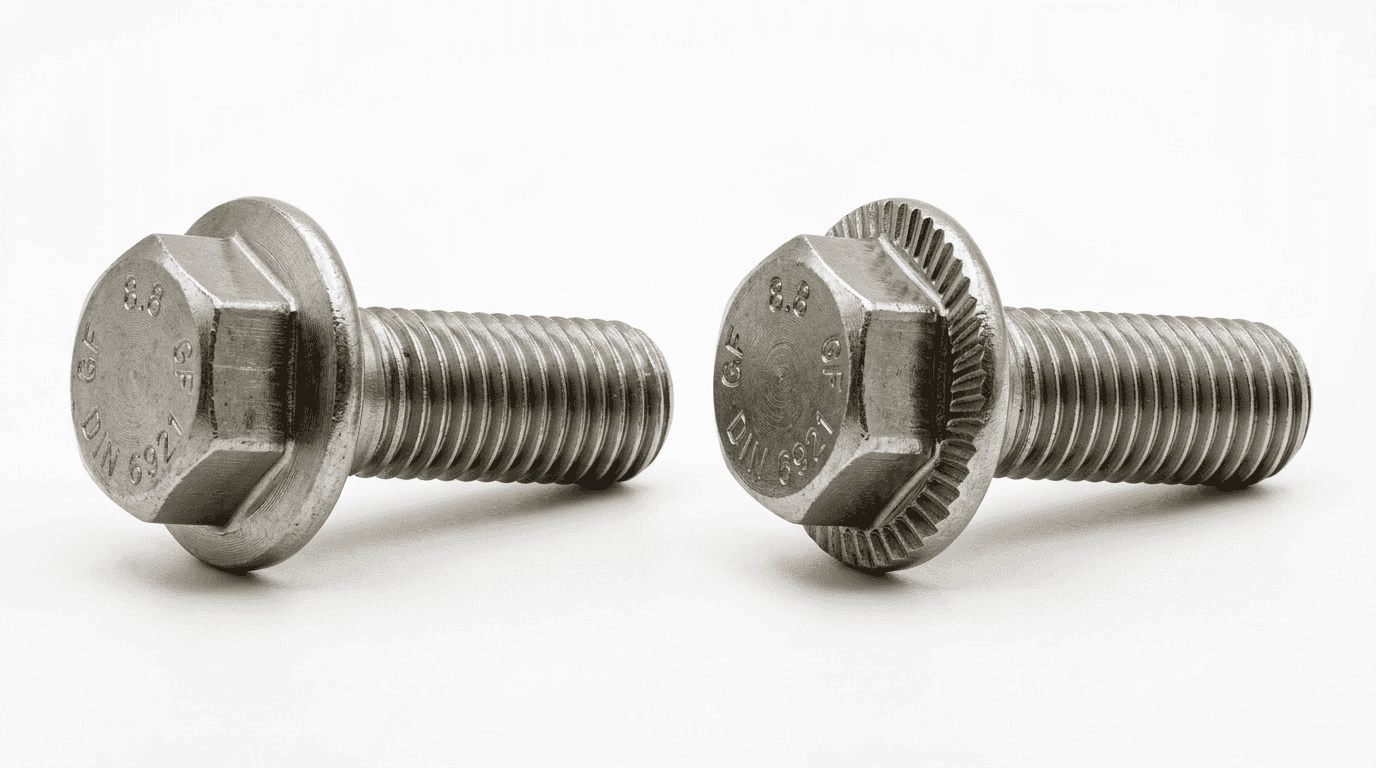
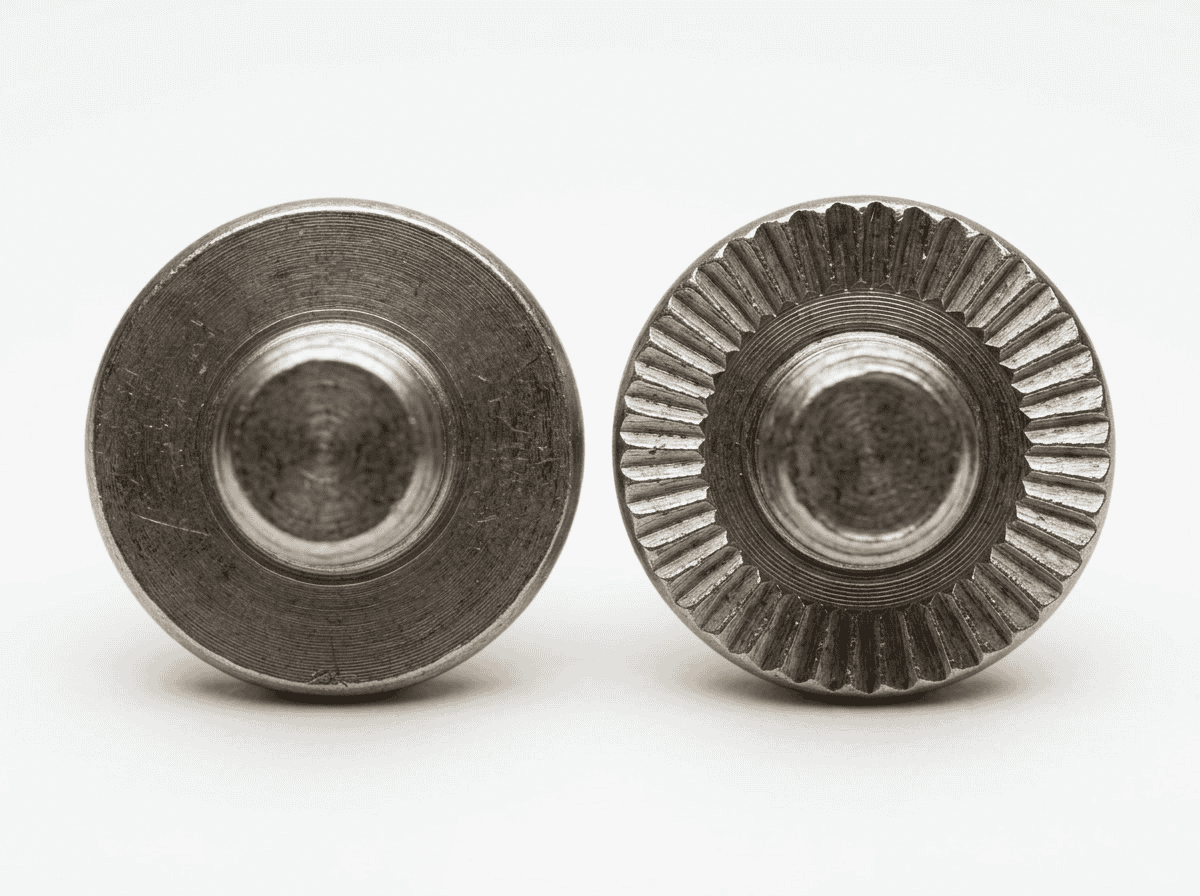
- Plain flange (smooth bearing surface): The underside of the flange is smooth. Used where the workpiece surface must remain undamaged — coated panels, painted surfaces, soft alloys, and plastics all benefit from this variant.
- Serrated flange (knurled/ribbed underside): Radial teeth are pressed into the flange underside during manufacture. When the bolt is tightened, these teeth bite into the workpiece surface and create a mechanical self-locking effect.
Per DIN EN ISO 4759-1, DIN6921 is manufactured to Product Grade A (precision tolerances). The standard is dimensionally compatible with ISO 15071 (non-serrated) and ISO 15072 (serrated).
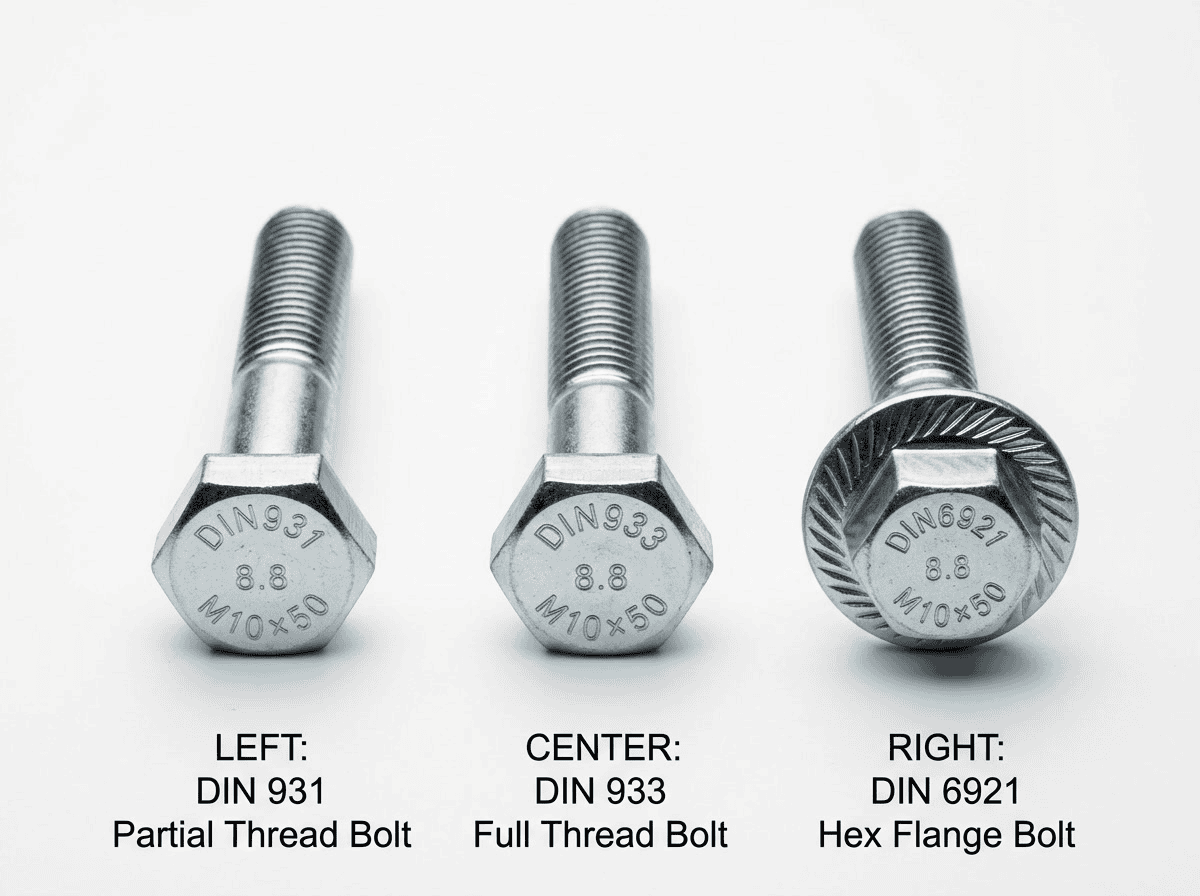
The simplest way to think about it: DIN6921 = DIN933 + integrated washer + optional self-locking teeth.
DIN6921 vs DIN931 vs DIN933 — Key Differences
DIN6921 differs from DIN931 and DIN933 primarily in its integrated flange disc, which eliminates the need for a separate flat washer and — in the serrated variant — replaces the lock washer as well.
The three standards share the same hex drive geometry and materials. Here’s where they diverge:
| Feature | DIN931 (Partial Thread) | DIN933 (Full Thread) | DIN6921 (Flange Bolt) |
|---|---|---|---|
| Integrated Flange | No | No | Yes — built-in |
| Bearing Surface | Under head only | Under head only | Flange extends area |
| Serrated Locking | No | No | Yes (serrated variant) |
| Separate Washer | Usually yes | Usually yes | Usually no |
| Vibration Resistance | Standard | Standard | Higher (serrated) |
| Typical Application | General structural | General fully-threaded | Auto, thin panels, vibration |
| ISO Equivalent | ISO 4014 | ISO 4017 | ISO 15071 / ISO 15072 |
The practical decision rule: if your assembly involves thin panels, vibration, or you want to reduce component count, DIN6921 beats both DIN931 and DIN933. One nuance the spec sheets rarely mention: the flange adds 3–8mm to the effective head diameter — check dc against your clearance requirements before substituting DIN6921 for DIN933 in a redesign.
DIN6921 Full Dimensions Table (M5–M20)
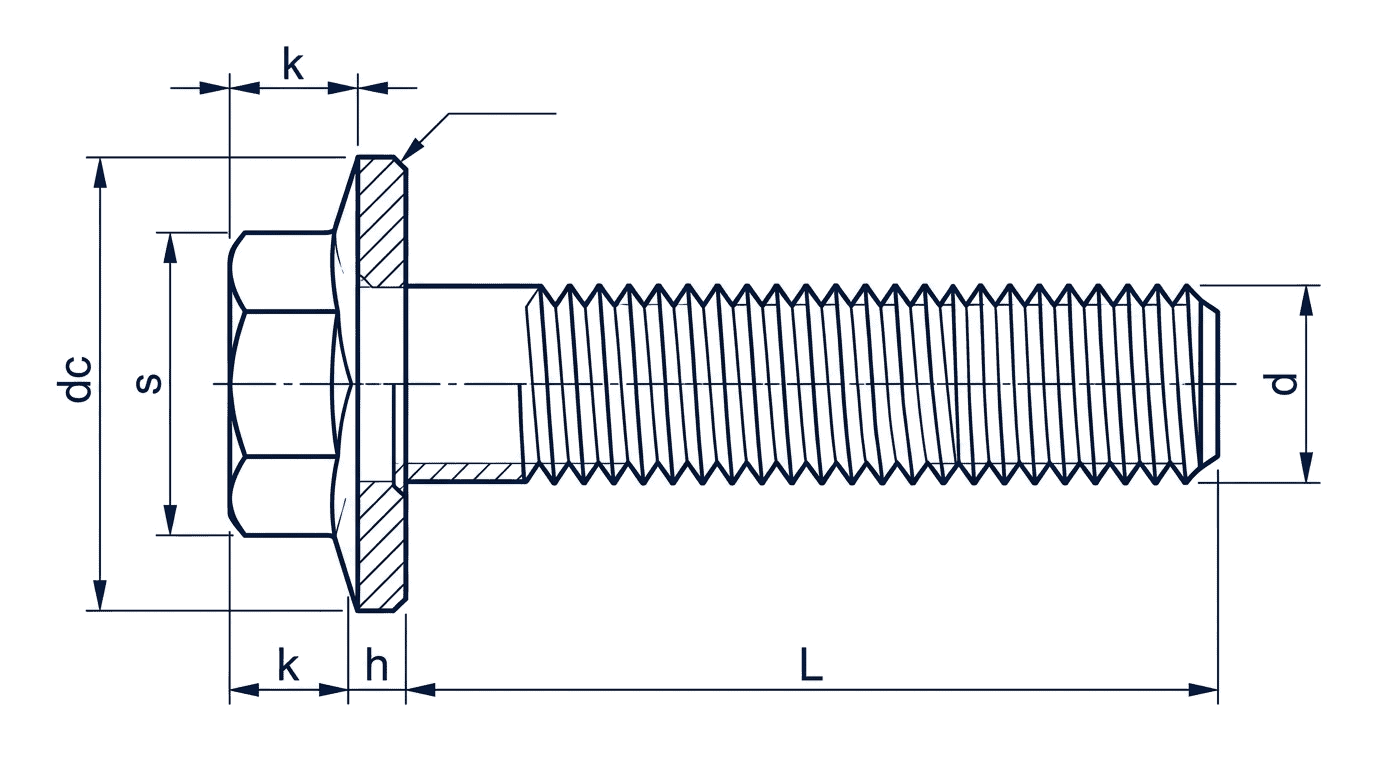
DIN6921 is produced from M5 through M20, with flange diameters ranging from 11.8mm (M5) to 43mm (M20) and head heights from 2.8mm to 9.5mm. Thread lengths follow the same b-dimension logic as other DIN hex bolts, varying by nominal length.
| Thread d | Pitch P (mm) | Head Height k (mm) | Flange Dia. dc (mm) | Width Flats s (mm) | Width Corners e (mm) | Thread Length b ≤125 | Thread Length b 125–200 |
|---|---|---|---|---|---|---|---|
| M5 | 0.80 | 2.8 | 11.80 | 8 | 8.79 | 16 | — |
| M6 | 1.00 | 3.4 | 14.20 | 10 | 11.05 | 18 | — |
| M8 | 1.25 | 4.2 | 18.00 | 13 | 14.38 | 22 | — |
| M10 | 1.50 | 5.7 | 22.30 | 15 | 16.64 | 26 | 32 |
| M12 | 1.75 | 6.1 | 26.60 | 16 | 17.62 | 30 | 36 |
| (M14) | 2.00 | 8.0 | 31.00 | 18 | 20.03 | 34 | 40 |
| M16 | 2.00 | 8.7 | 35.00 | 21 | 23.15 | 38 | 44 |
| (M18) | 2.50 | 9.0 | 39.00 | 24 | 26.75 | 42 | 48 |
| M20 | 2.50 | 9.5 | 43.00 | 27 | 29.56 | 46 | 52 |
Sizes in parentheses (M14, M18) are non-preferred. dc = flange outer diameter. Fine thread versions available for M8×1, M10×1.25, M12×1.5, M16×1.5.
DIN6921 Flange Depth and Bearing Surface Data
The flange depth h ranges from 3.0mm (M5) to 8.5mm (M20). This data is critical when calculating total installed height (k + h) and when specifying counterbore depth in aluminum or composite parts.
| Thread d | Flange Depth h (mm) | Bearing Width m (mm) | Flange Min. m' (mm) |
|---|---|---|---|
| M5 | Max 3.0 | Min 1.7 | Min 0.7 |
| M6 | Max 3.5 | Min 2.2 | Min 1.0 |
| M8 | Max 4.5 | Min 2.8 | Min 1.5 |
| M10 | Max 5.0 | Min 3.3 | Min 1.8 |
| M12 | Max 6.0 | Min 4.2 | Min 2.2 |
| M16 | Max 7.5 | Min 5.0 | Min 2.8 |
| M20 | Max 8.5 | Min 5.8 | Min 3.2 |
Materials and Strength Grades
DIN6921 is available in carbon steel grades 8.8 through 12.9 and stainless steel grades A2-70 through A4-80, with tensile strength ranging from 800 MPa to 1220 MPa.
According to ISO 898-1, the international standard for mechanical properties of fasteners, grade designation directly encodes tensile and yield strength:
Carbon Steel:
- Grade 8.8: 800 MPa tensile, 640 MPa yield. Workhorse grade for automotive and general machinery.
- Grade 10.9: 1040 MPa tensile, 940 MPa yield. Alloy steel. For safety-critical automotive joints.
- Grade 12.9: 1220 MPa tensile. Motorsport, high-cycle fatigue, precision preload applications.
Stainless Steel:
- A2-70 (304 SS): 700 MPa. General corrosion resistance, food equipment, indoor environments.
- A4-70 (316 SS): 700 MPa. Superior chloride/marine resistance due to molybdenum content.
- A4-80 (316 SS, high-strength): 800 MPa. Petrochemical, offshore, pharmaceutical — strength + corrosion.
Surface finishes: Plain / Zinc white / Yellow zinc dichromate / Hot-dip galvanized / Dacromet / Black oxide
Note: HDG DIN6921 serrated variant is uncommon — the thick zinc layer (85–100µm per ISO 1461) fills serration teeth. Use Dacromet (5–10µm) instead to preserve tooth geometry.
| Material | Grade | Typical Application |
|---|---|---|
| Carbon Steel | 8.8 | General automotive, machinery, electrical cabinets |
| Carbon Steel | 10.9 | High-strength structural, yellow zinc standard finish |
| Carbon Steel | 12.9 | Critical load joints, motorsport, fatigue-sensitive |
| Stainless | A2-70 | Food, light industrial, indoor environments |
| Stainless | A4-70 | Marine, chemical, outdoor, coastal |
| Stainless | A4-80 | High-torque corrosive environments, offshore |
Key Applications of DIN6921
DIN6921 is specified wherever a wider bearing surface, reduced component count, or vibration resistance is needed — most heavily in automotive OEM, sheet metal, and vibrating machinery.
- Automotive engine & chassis assembly: Major OEMs specify DIN6921 in engine covers, suspension subframes, and exhaust brackets — the flange eliminates the separate washer that would be loose during robotic assembly.
- Sheet metal and thin panel fastening: The enlarged flange prevents pull-through into panels thinner than 2–3mm, where a standard hex head would dimple or punch through under load.
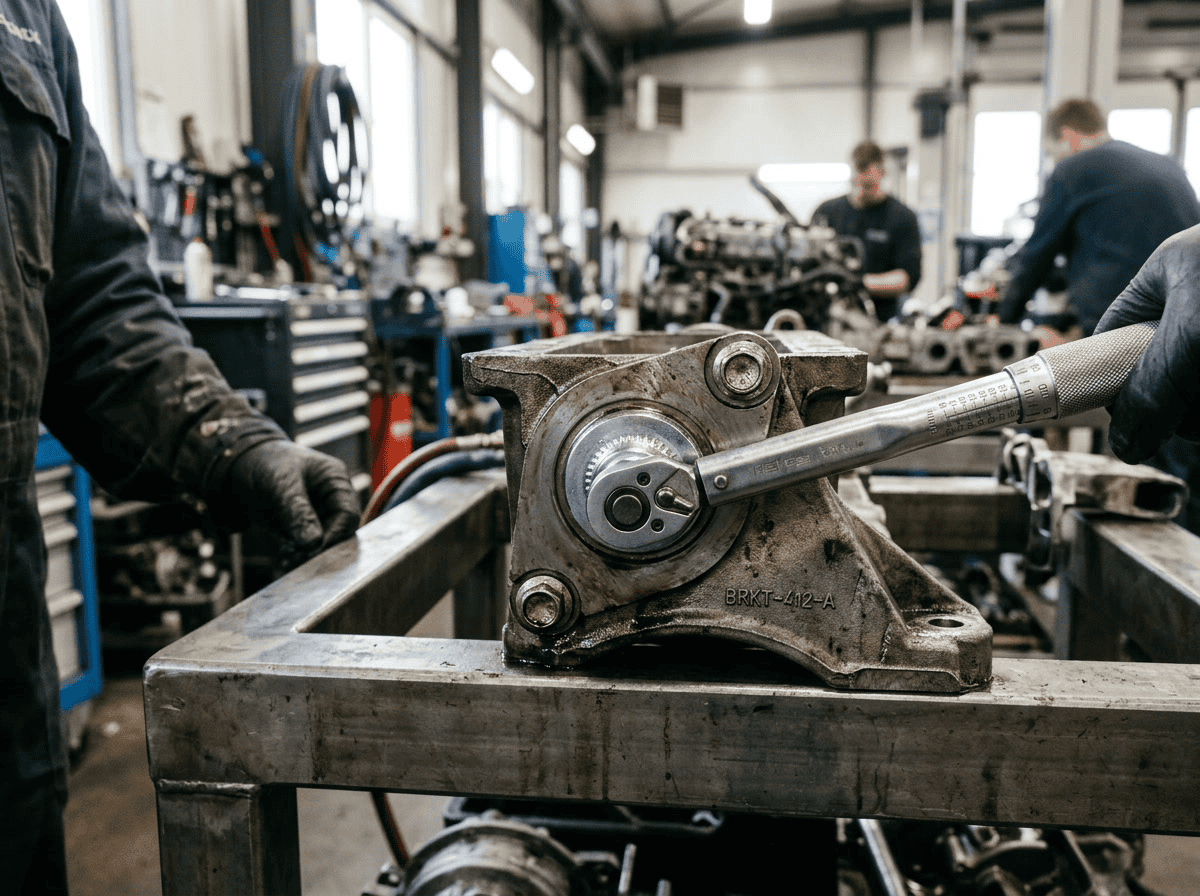
- Vibrating machinery and equipment: The serrated variant provides self-locking against vibration-induced loosening without an additional lock washer, Nyloc nut, or threadlocker.
- Plastic component mounting: The flange distributes clamping load to prevent crush damage in thermoplastic housings. Use plain flange only — serrations will crack plastic surfaces.
- HVAC ductwork and frame assembly: High-volume sheet metal assemblies where single-fastener efficiency reduces labor cost per joint.
- Agricultural & off-highway equipment: High-vibration environments with grit-contaminated surfaces benefit from the self-locking serrated flange.
- Electrical cabinet & enclosure assembly: M5 and M6 DIN6921 is standard for DIN rail and panel mounting — the flange provides good grounding contact surface area.
Serrated vs Non-Serrated DIN6921 — Which to Choose?
Choose serrated DIN6921 for vibrating or dynamic-load assemblies on hard steel surfaces; choose plain flange for soft materials, coated surfaces, or joints that will be repeatedly disassembled.
This is the decision most buyers get wrong — they default to serrated because it “sounds better,” then discover it stripped a painted surface or damaged an aluminum boss.
Decision rules:
- Painted or coated surfaces → Plain flange. Serrations will strip the coating and create a corrosion initiation point. If vibration resistance is needed, use plain flange + Loctite 243.
- Vibrating / dynamic load on bare steel → Serrated flange. Serrated flanged fasteners show 3–5× better resistance to self-loosening under transverse vibration compared to plain-head bolts with flat washers.
- Aluminum or plastic housings → Plain flange only. Serrations will indent or crack soft materials. For aluminum, use A2 or A4 stainless DIN6921 to avoid galvanic corrosion.
- High-cycle reuse joints (fixtures, jigs) → Plain flange. Serrations cause cumulative surface damage that reduces joint integrity after multiple disassembly cycles.
| Property | Non-Serrated (Plain Flange) | Serrated (Knurled Flange) |
|---|---|---|
| Locking Function | None — separate lock washer needed | Built-in — teeth bite into workpiece |
| Reusability | High | Reduced — serrations damage soft surfaces |
| Surface Compatibility | All materials including coated/painted | Steel and hard materials only |
| Vibration Resistance | Standard | Significantly higher |
| Use When | Precision clamping, reusable joints, soft substrates | Vibrating assemblies, one-time installations on bare steel |
How to Order DIN6921 — Specification Format
The standard ordering format for DIN6921 is: Bolt DIN6921 – [Thread] × [Length] – [Grade] – [Serrated or blank].
Example: Bolt DIN6921 – M10 × 30 – 8.8 – Serrated
- M10 = Nominal thread diameter (coarse thread is default; add pitch for fine: M10×1.25)
- 30 = Nominal length in mm, measured from the underside of the flange — NOT including flange depth h
- 8.8 = Strength grade (or stainless: A2-70, A4-80, etc.)
- Serrated = Specify explicitly for knurled flange. Default (no suffix) = plain flange
When to choose DIN6921 over DIN931/DIN933:
- To eliminate the separate flat washer from the bill of materials — DIN6921 typically costs 15–25% more per fastener but eliminates the washer entirely, reducing total joint cost and assembly time
- When the application sees vibration and you want a single-component self-locking solution (serrated variant)
- When bolting into thin sheet metal below 3mm where pull-through resistance matters
- When a robot or automated torque system is installing fasteners and loose washers create feeding or jamming problems
- When the bearing surface under a standard hex head creates unacceptable stress concentrations on a soft or composite workpiece
Frequently Asked Questions About DIN6921
What is the difference between DIN6921 and DIN933?
What does the serrated version of DIN6921 do?
How is the nominal length measured on a DIN6921 flange bolt?
Can DIN6921 be used with aluminum or plastic components?
What is the ISO equivalent of DIN6921?
Ready to Order DIN6921 Hex Flange Bolts?
Browse our complete range by size, grade, and surface finish. Bulk pricing from 500 pieces. Technical support for custom lengths and fine thread variants.