 English
  German
  Spanish
  Portuguese
  French
  Japanese
  Arabic
  Korean
  Vietnamese
  Russian
 ASTM A193 is the standard specification covering alloy-steel and stainless steel bolting materials for high-temperature, high-pressure, and corrosion-critical service in pressure vessels, valves, flanges, and fittings.
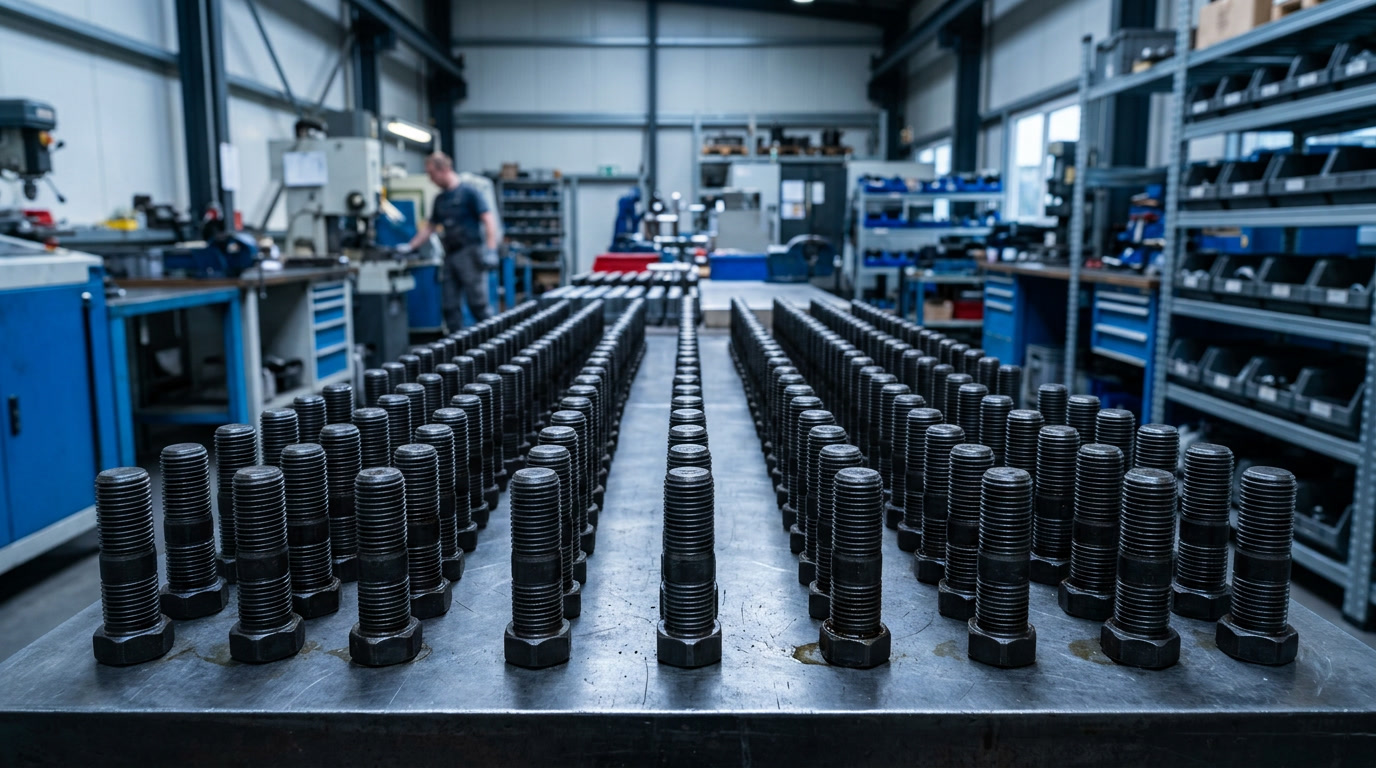
If you’ve ever ordered stud bolts for a pipeline flange and wondered why the material call-out reads “ASTM A193 B7” rather than just “alloy steel,” you’re not alone. The designation carries precise legal and engineering weight: it tells the inspector exactly what heat treatment was applied, what tensile strength to expect, and which nuts pair with the studs. Get it wrong — or accept a counterfeit — and a pressure vessel joint can fail catastrophically. This guide cuts through the alphabet soup so engineers, procurement teams, and QA professionals can specify, source, and verify ASTM A193 fasteners with confidence.
What Is ASTM A193?
ASTM A193 (full title: Standard Specification for Alloy-Steel and Stainless Steel Bolting for High Temperature or High Pressure Service and Other Special Purpose Applications) is published and maintained by ASTM International, the global standards body that governs material testing and product specifications across engineering disciplines. The specification was first approved in 1936 and has been revised numerous times since — the current active edition is A193/A193M-26.
ASTM A193 covers the material requirements, heat treatment, mechanical properties, dimensional tolerances, marking, and testing for bolts, screws, studs, and stud bolts intended for:
- Pressure vessels (ASME Section VIII applications)
- Flanges and pipe fittings in high-temperature systems
- Valves in petroleum, chemical, and power-generation service
- Structural anchor bolts in specialty construction
- Any “other special purpose” application where elevated temperature, elevated pressure, or aggressive environments demand verified mechanical properties
The designation system uses letter-number codes. The letter indicates the alloy family (B = alloy or stainless, L = low-alloy for low-temperature use), and the number identifies the specific grade. The “M” suffix on the specification (A193M) denotes metric units; the underlying chemistry and properties are identical.
Scope and Purpose
The core purpose of ASTM A193 is traceability. When a flange joint on a 600°F steam header fails, engineers need to know exactly what material they were working with. A193 requires heat numbers, certified mill test reports (CMTRs), and physical markings on each bolt — creating an unbroken documentation chain from the steel mill to the installed joint.
This is different from simply ordering “4140 steel bolts.” You could order 4140 and get material that was never heat-treated, or heat-treated to the wrong hardness. ASTM A193 eliminates that ambiguity by mandating specific quench-and-temper cycles, tensile testing on each heat, and mandatory hardness limits.
History and Development
ASTM International developed A193 in the 1930s alongside the growth of the U.S. petroleum refining and power-generation industries. Early editions focused on a handful of alloy steel grades for steam service. Over the decades, stainless steel grades (B8 family) were added as chemical processing demanded corrosion-resistant bolting, and specialty grades like B16 emerged to serve higher-temperature applications.
| Specification Era | Key Additions |
|---|---|
| 1936–1960 | B7, B8 grades established |
| 1961–1990 | B8M, B16 added; metric version (M) issued |
| 1991–2010 | B7M (sour-service), B8 Class 2 tensile requirements refined |
| 2011–present | Periodic revision every 2–3 years; ASTM A193-2026 is current |
ASTM A193 Grades: Alloy Steel
ASTM A193 organizes fastener materials into clearly defined grades. The most widely used grades split into two families: alloy steels (non-stainless) and stainless steels. Let us work through the alloy steel grades first.
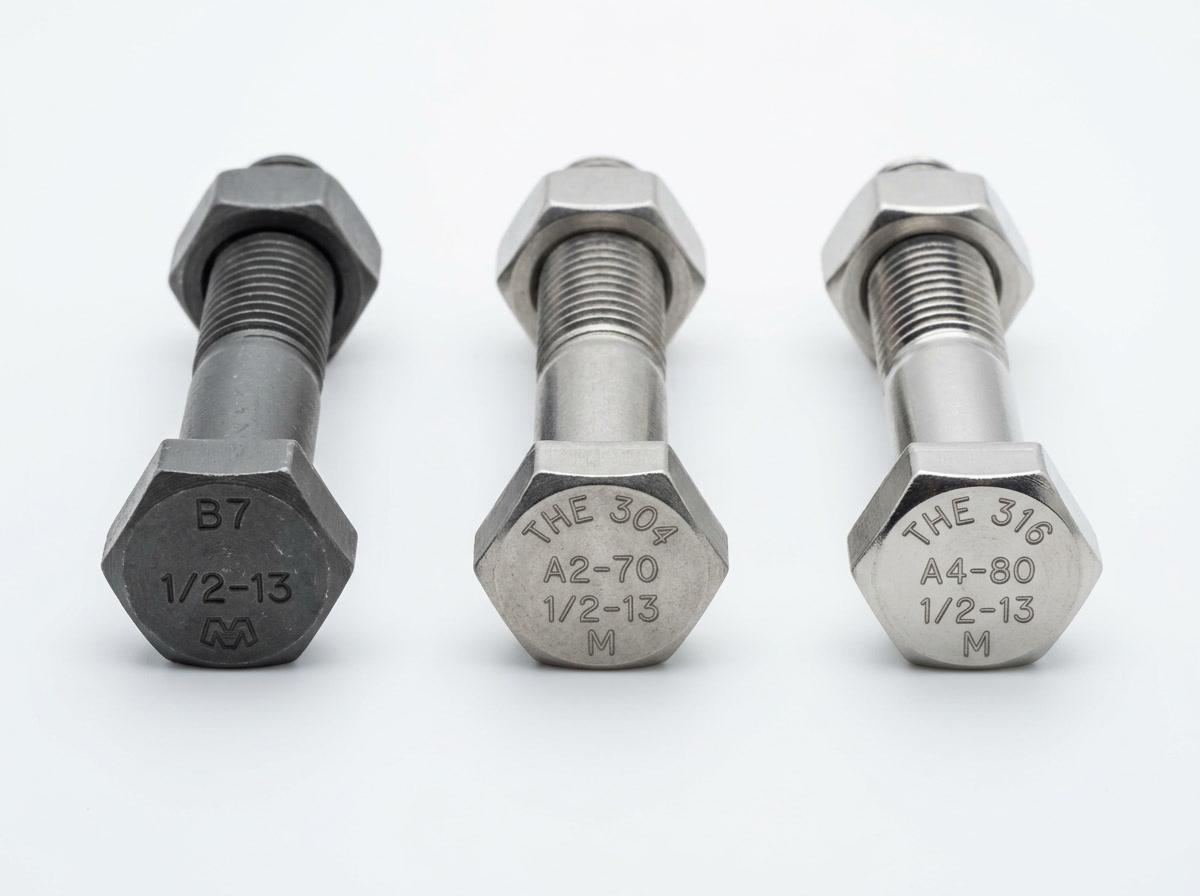
Grade B7 — The Industry Workhorse
ASTM A193 Grade B7 is the dominant fastener grade in oil and gas, power generation, and general industrial construction. If you work anywhere near a flanged piping system, you have touched B7 studs.
Material: chromium-molybdenum (Cr-Mo) alloy steel, specifically AISI 4140 or 4142, quenched and tempered. The Cr-Mo chemistry gives B7 an excellent combination of high strength, toughness, and creep resistance at moderately elevated temperatures.
Mechanical property requirements for B7 (up to 4-inch diameter):
– Minimum tensile strength: 125 ksi (860 MPa)
– Minimum yield strength (0.2% offset): 105 ksi (725 MPa)
– Minimum elongation: 16%
– Minimum reduction of area: 50%
– Maximum hardness: 35 HRC (321 HB)
Temperature limit: ASTM A193 Grade B7 is rated to approximately 450°F (232°C) in continuous service before creep becomes a concern. Above that threshold, Grade B16 or stainless grades are preferred.
The standard also specifies size-based property steps. Bolts larger than 4 inches have reduced minimum tensile and yield requirements because larger bar diameters cool more slowly during quenching, resulting in a coarser microstructure. Procurement teams often miss this — specifying “B7” without noting the diameter can mean a significantly lower-strength material on large-diameter anchor bolts.
Grade B7M — Modified for Sour Service
ASTM A193 Grade B7M is a hydrogen-sulfide-resistant variant of B7, created to meet NACE MR0175 / ISO 15156 requirements. The chemistry is the same 4140/4142 base, but B7M is tempered to a lower maximum hardness of 22 HRC (237 HB).
Why does hardness matter in sour service? High-hardness steel is susceptible to sulfide stress cracking (SSC) in wet H₂S environments. By keeping hardness below 22 HRC, B7M resists the hydrogen embrittlement mechanism that makes B7 dangerous in sour gas wells and downstream processing.
In practice, B7M is approximately 15–20% lower in tensile strength than B7 for the same diameter. The tradeoff is acceptable in sour service because joint loads are sized accordingly — but never substitute B7M in a non-sour system where B7 strength was part of the design calculation.
Grade B16 — High-Temperature Chrome-Moly-Vanadium
ASTM A193 Grade B16 uses a chromium-molybdenum-vanadium (Cr-Mo-V) alloy steel. The vanadium addition creates fine carbides that resist grain growth at elevated temperature, making B16 suitable for continuous service up to 1000°F (538°C).
Heat treatment: austenitize at 1700–1750°F (927–955°C), oil quench, then temper. Hardness: 253–319 HB (25–34 HRC).
B16 is common in steam turbine casings, high-pressure boiler connections, and petrochemical reactors where B7’s temperature limit is insufficient. It is significantly more expensive than B7 — in practice, we’ve seen B16 studs run 3–4× the cost of equivalent B7 on large-diameter applications — so specifying it where B7 suffices wastes money without adding reliability.
Stainless Steel Grades Under ASTM A193
Grade B8 — Austenitic 304 Stainless Steel
ASTM A193 Grade B8 covers bolting made from AISI 304 austenitic stainless steel. The “B8” designation alone does not mean high strength — it comes in two classes:
- Class 1 (solution-annealed): Carbide solution-treated (annealed) for maximum corrosion resistance. Lower strength but excellent ductility and weldability. Minimum tensile: 75 ksi (515 MPa) for smaller diameters.
- Class 2 (strain-hardened): Cold-worked after solution treatment to increase strength. Minimum tensile: 125 ksi (860 MPa) for ≤¾-inch diameter, stepping down with size. Used where both corrosion resistance and structural strength are needed.
Is ASTM A193 Grade B8 stainless steel? Yes — Grade B8 is 304 stainless steel. It is not magnetic after solution annealing (though it may become slightly magnetic if cold-worked).
Grade B8M — 316 Stainless for Corrosive Environments
ASTM A193 Grade B8M uses AISI 316 stainless steel, which adds molybdenum (2–3%) to the 304 base chemistry. The molybdenum dramatically improves resistance to chloride pitting and crevice corrosion — making B8M the preferred grade for coastal environments, seawater service, chemical plants handling halides, and food-processing equipment.
Like B8, B8M comes in Class 1 (solution-annealed) and Class 2 (strain-hardened). Class 2 B8M is common on subsea wellheads and heat exchangers where you need both 316’s corrosion resistance and structural strength.
Class 1 vs. Class 2: The Distinction That Matters
Ordering “B8 bolts” without specifying the class is a common procurement error. Class 1 and Class 2 have the same material chemistry but can differ by 50+ ksi in tensile strength. A joint designed for Class 2 tensile loads will be significantly under-strength if Class 1 arrives instead. Always specify both grade and class: “ASTM A193 Grade B8M Class 2.”
Mechanical Properties Comparison
The table below summarizes the key mechanical property requirements for the most common ASTM A193 grades (values for the smallest diameter range, where requirements are highest):
| Grade | Material | Min. Tensile (ksi) | Min. Yield (ksi) | Max. Hardness | Temp. Limit |
|---|---|---|---|---|---|
| B7 | 4140/4142 Cr-Mo steel | 125 | 105 | 35 HRC | ~450°F |
| B7M | 4140/4142 Cr-Mo (low hardness) | 100 | 80 | 22 HRC | ~450°F |
| B16 | Cr-Mo-V alloy steel | 125 | 105 | 34 HRC | ~1000°F |
| B8 Cl.1 | 304 stainless | 75 | 30 | — | ~800°F |
| B8 Cl.2 | 304 SS (strain-hardened) | 125 | 100 | 35 HRC | ~800°F |
| B8M Cl.1 | 316 stainless | 75 | 30 | — | ~800°F |
| B8M Cl.2 | 316 SS (strain-hardened) | 125 | 100 | 35 HRC | ~800°F |
Source: ASTM A193/A193M standard; properties shown for diameter ≤ ¾ inch or equivalent smallest-range step.
How to Select the Right ASTM A193 Grade
Grade selection for ASTM A193 bolting depends on three intersecting factors: temperature, environment, and required strength. Get all three right and you have a reliable joint for the service life. Optimize for only one and you risk either over-spending or under-engineering.

Temperature-Based Selection
Start here. Temperature determines which alloy families are even eligible.
- Below 250°F (121°C), non-corrosive: Grade B7 is almost always the correct choice. It is widely available, cost-effective, and has documented performance in thousands of installations.
- 250°F–450°F (121°C–232°C): B7 remains viable but verify creep allowances in the joint design, especially for long-term sustained loading.
- 450°F–1000°F (232°C–538°C): Grade B16 is the primary alloy steel option. Alternatively, stainless grades B8/B8M can serve in this range if corrosion resistance is also required.
- Above 1000°F (538°C): ASTM A193 loses coverage; consult ASTM A453 (precipitation-hardening alloys) or Ni-based superalloys.
Environment and Corrosion Considerations
Temperature alone doesn’t determine grade. Consider the chemical environment:
- Sour service (H₂S-containing): B7M mandatory per NACE MR0175. Do not use standard B7, regardless of pressure or temperature.
- Chloride-rich (marine, seawater, some chemical processes): Grade B8M (316 SS). Grade B8 (304 SS) pits in chloride environments faster than most engineers expect — even in nominally “light” service.
- Oxidizing acids (nitric acid, chromic acid): B8 (304 SS) is acceptable; B8M not always superior here because molybdenum can oxidize.
- Reducing acids (hydrochloric, sulfuric): Neither B8 nor B8M is fully resistant at elevated concentrations. Consult a corrosion engineer.
- Outdoor atmospheric exposure (non-marine): B7 with zinc-phosphate coating or hot-dip galvanizing is cost-effective. B8M is more expensive without adding meaningful benefit in a dry, non-chloride atmosphere.
Pressure Rating and Load Requirements
The bolt’s role in the joint determines the minimum strength needed. For ASTM A193 Grade B7 studs paired with A194 Grade 2H heavy hex nuts — the most common bolted-flange combination in industrial piping — the joint capacity is governed by the lower of:
- The bolt tensile capacity (area × tensile strength)
- The gasket crush limit
- The flange ligament strength
In practice, joint designers follow ASME PCC-1 Guidelines for Pressure Boundary Bolted Flange Joint Assembly, which requires target bolt stress levels during assembly. For most ASME B16.5 Class 150–1500 flanges, B7 tensile strength is sufficient. For Class 2500 and special alloy flanges, verify the calculation — don’t assume B7 covers every scenario just because it is the “standard” grade.
ASTM A193 vs. ASME SA193: What’s the Difference?
This question comes up constantly in procurement and inspection. The short answer: SA193 is essentially A193 adopted into the ASME Boiler and Pressure Vessel Code (BPVC).
ASTM International writes the A193 specification and updates it on its own revision cycle. ASME then adopts the A193 content into Section II of the BPVC as SA-193, sometimes with additional requirements or commentary. The underlying chemistry, heat treatment, and mechanical property requirements are the same — the difference is the code framework they operate within.
Code Adoption and Legal Requirements
When a pressure vessel or piping system is stamped to an ASME code (ASME Section VIII, B31.3, etc.), the procurement document must call out SA-193, not A193. Using A193-marked material on an ASME-stamped vessel is technically non-compliant, even if the physical material is identical, because the code stamps refer specifically to ASME specifications.
Many mills dual-certify their material: the CMTR shows both A193 and SA-193 compliance. This is acceptable — dual-certified material satisfies both ASTM and ASME procurement requirements. According to technical guidance on ASME fastener specifications, SA-193/B7 studs are among the most specified dual-certified fasteners in ASME pressure vessel construction.
When to Specify SA193 Over A193
- Any ASME code vessel or piping system: Specify SA-193 (or dual-cert A193/SA-193).
- Non-code mechanical equipment, structural applications: A193 alone is sufficient.
- Export projects to non-US markets: Verify local code requirements; some jurisdictions require ASTM designations, others accept ASME.
The mark on the bolt head matters for third-party inspection. An inspector checking an ASME-stamped pressure vessel will look for SA-193 on the CMTR and may reject A193-only marked material even if technically identical.
Pairing ASTM A193 with ASTM A194 Nuts
ASTM A193 covers the bolts and studs. ASTM A194 covers the matching nuts. Using the wrong nut grade is one of the most common and least-discussed failure modes in bolted flange assemblies.
The standard pairing rules:
| A193 Bolt Grade | Recommended A194 Nut Grade | Notes |
|---|---|---|
| B7 | 2H (heavy hex) | Most common industrial pairing |
| B7M | 2HM | Must match M grade for sour service compliance |
| B16 | 4 or 7M | Higher nut hardness for high-temperature creep resistance |
| B8 Cl.1 | 8 | Same 304 SS family |
| B8 Cl.2 | 8 | Same 304 SS family |
| B8M Cl.1 | 8M | 316 SS nut for full corrosion-resistance continuity |
| B8M Cl.2 | 8M | 316 SS nut |
The key rule: never use a carbon steel nut on an A193 stainless bolt. The galvanic couple accelerates corrosion at the nut-stud interface, and the differing thermal expansion rates at elevated temperature can cause the nut to seize or loosen unpredictably.
Also avoid mixing class grades on the nut: a Class 1 (solution-annealed) A194 Grade 8 nut will gall against a Class 2 (strain-hardened) A193 B8 stud if the nut is softer. Galling during assembly is permanent — it can destroy the thread engagement and require saw-cutting to remove the stuck nut.
As Portland Bolt’s technical specification resource notes, verifying nut-bolt compatibility before ordering is essential, particularly on large-diameter high-pressure applications where disassembly is difficult or impossible.
Testing, Marking, and Inspection Requirements
ASTM A193 does not stop at material chemistry. The specification mandates specific testing, traceability, and physical marking requirements that should appear on every compliant shipment.
Heat Treatment Requirements
Each grade specifies precise heat treatment windows:
- B7: Austenitize at 1650°F min., then quench in oil or polymer; temper at 1100°F minimum. The minimum temper temperature is critical — lower tempering produces higher hardness but also higher brittleness and susceptibility to hydrogen stress cracking.
- B7M: Same base treatment as B7, but temper temperature adjusted upward to reduce final hardness to 22 HRC max.
- B16: Austenitize at 1700–1750°F, oil quench, temper at 1150°F min.
- B8/B8M Class 1: Carbide solution treatment (anneal) at 1900°F min., water quench. No subsequent cold working.
Failure to meet the minimum temper temperature is one of the most common causes of non-conforming ASTM A193 material. If a CMTR shows a temper temperature below the specification minimum, reject the lot — the mechanical property test results on that CMTR are not reliable predictors of in-service behavior.
Hardness and Tensile Testing
ASTM A193 requires:
– Tensile testing: One test per heat per size per heat treatment lot. The test must be conducted on material from the same heat and heat treatment as the production bolts.
– Hardness testing: Each lot of bolts. For B7, the 35 HRC maximum is an absolute limit — individual bolts testing above 35 HRC in a lot are subject to rejection of the entire lot in most interpretations.
– Supplementary testing (S-series): The specification offers optional supplementary requirements (S1 through S5+) for charpy impact testing, elevated-temperature tensile testing, and magnetic particle inspection. Specify these when the application demands them.
Identification Marking
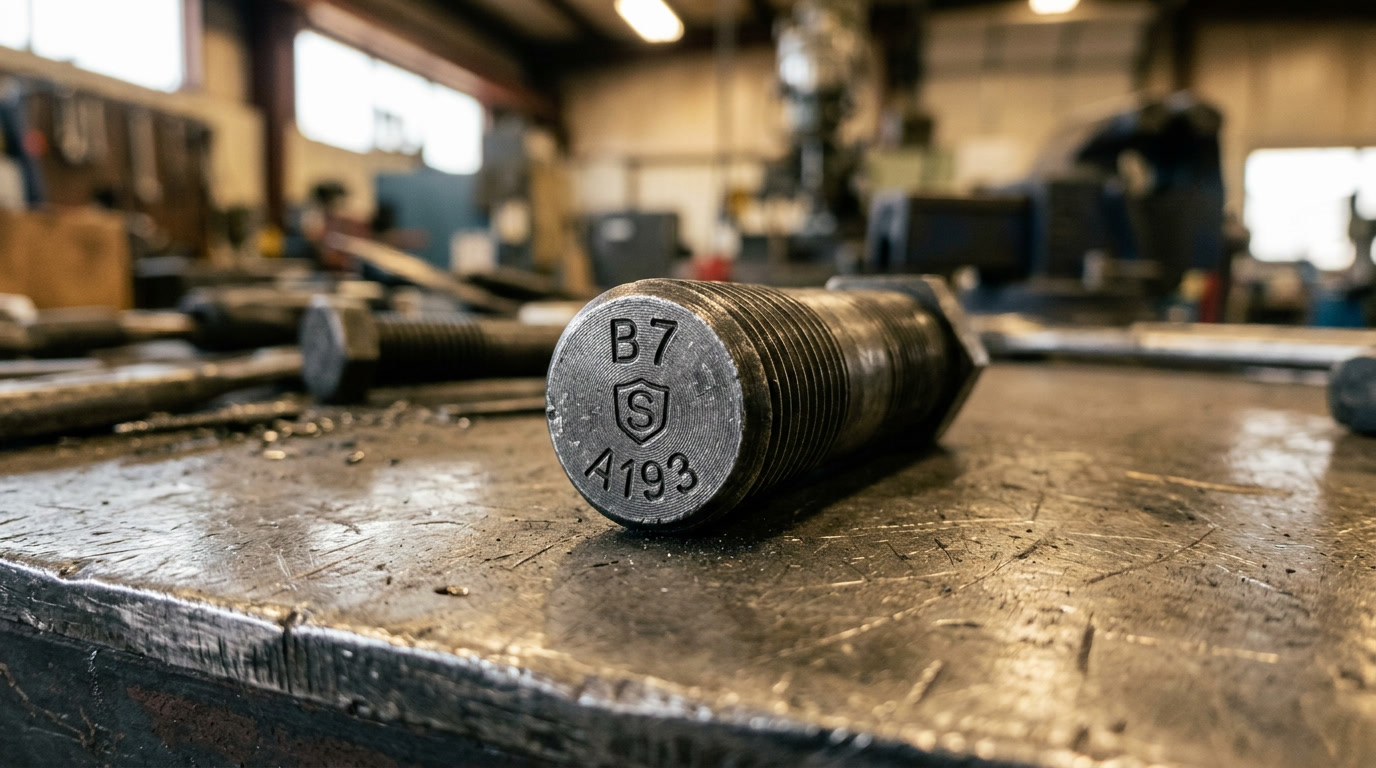
Every ASTM A193 bolt must be marked with:
– Grade symbol (e.g., “B7”)
– Manufacturer’s identification symbol
– Heat number or lot number
Unmarked or illegibly marked bolts are non-conforming regardless of any CMTR presented. Physical marking is the only field-verifiable proof of compliance. On large stud bolts, markings typically appear on the end face; on hex bolts, on the head.
Common Procurement Mistakes and Red Flags
Counterfeit and Non-Compliant Fasteners
The industrial fastener market has a documented counterfeiting problem. The ASME or equivalent standards bodies have long flagged that Grade B7 — being the most specified and highest-volume ASTM A193 grade — is also the most frequently counterfeited. Common fraud patterns include:
- Carbon steel bolts stamped “B7” without any alloy content
- B7 bolts that were not heat-treated (surface hardness passes a superficial check; core properties fail)
- Material where the CMTR is fabricated or copied from a different heat
Mitigation: require third-party inspection on import lots, specify Portable Rockwell hardness testing (field-testable), and cross-reference the CMTR heat number against the physical marking on the bolts. Any discrepancy is a rejection trigger.
Grade Substitution Risks
Never accept the following substitutions without an engineering review and written client approval:
- B7 in place of B7M in sour service → sulfide stress cracking risk
- B8 Class 1 in place of B8 Class 2 where strength was designed for Class 2 → joint under-loaded
- B16 in place of B7 at lower temperatures → waste of money but technically safe; however, ensure the nut grade matches
- Carbon steel in place of any A193 grade → catastrophically under-designed; reject immediately
The spec does not allow grade substitution without engineering approval. Any supplier who proposes a substitution without documentation should trigger an audit of the entire order.
Future Trends and Updates (2026+)
ASTM Revision Cycles
ASTM A193 is reviewed and revised approximately every 2–3 years. The most recent major update cycle (2023–2026) refined heat treatment documentation requirements and clarified Class 1 vs. Class 2 testing requirements for stainless grades. As additive manufacturing (AM) begins appearing in specialty fastener production, future revisions may address AM-produced studs — though traditional wrought and machined production remains dominant for code-critical applications.
Sustainability and Material Innovation
Industrial fastener manufacturing is not immune to sustainability pressure. Two trends are emerging:
- Electric arc furnace (EAF) steel: More ASTM A193 B7 material is being produced from EAF-melted scrap rather than basic oxygen furnace (BOF) primary steel. CMTR traceability requirements already accommodate this; the mechanical properties are equivalent. According to data from leading steel producers, EAF-produced alloy steel can reduce CO₂ intensity by 40–70% compared to primary BOF routes — significant for large infrastructure projects with Scope 3 emission targets.
- Duplex stainless steel grades: Grades like 2205 duplex offer higher strength than standard B8M with comparable or superior corrosion resistance. ASTM is evaluating whether to expand A193 coverage to duplex grades, which would provide a specification framework for a material already widely used in offshore and subsea bolting. As Lightning Bolt & Supply’s fastener reference guide notes, duplex fasteners often require individual engineering review today because no standard grade designation exists.
FAQ
Q: Is ASTM A193 Grade B7 stainless steel?
No. Grade B7 is alloy steel — specifically chromium-molybdenum steel (AISI 4140 or 4142). It is not stainless and will corrode without surface protection in wet or corrosive environments. For stainless bolting, specify ASTM A193 Grade B8 (304 SS) or Grade B8M (316 SS).
Q: What is the difference between ASTM A193 and ASME SA193?
SA-193 is the ASME Boiler and Pressure Vessel Code adoption of ASTM A193. The material requirements are essentially identical; the difference is the code context. For ASME-stamped vessels or piping systems, the procurement document must reference SA-193 (or dual-certified A193/SA-193). For non-code mechanical applications, A193 alone suffices.
Q: Is ASTM A193 Grade B8 stainless steel?
Yes. Grade B8 is AISI 304 austenitic stainless steel. Grade B8M is AISI 316 stainless steel. Both come in Class 1 (solution-annealed, lower strength) and Class 2 (strain-hardened, higher strength) variants. Always specify the class when ordering.
Q: What nuts pair with ASTM A193 B7 studs?
The standard pairing is ASTM A194 Grade 2H heavy hex nuts. For sour service B7M studs, use ASTM A194 Grade 2HM nuts. Mismatching nut and bolt grades — for example, using carbon steel nuts on stainless B8 studs — causes galvanic corrosion and is never acceptable.
Q: What is the maximum temperature for ASTM A193 Grade B7?
Grade B7 is generally rated to approximately 450°F (232°C) in continuous service. Above this temperature, creep becomes a factor that must be evaluated in joint design. For applications up to 1000°F (538°C), Grade B16 is the preferred alloy steel option within the ASTM A193 specification.
Q: How do I verify ASTM A193 compliance in the field?
Three checks: (1) Physical marking — each bolt should show the grade symbol (e.g., “B7”) and a manufacturer identifier. (2) Certified Mill Test Report (CMTR) — heat number on the CMTR must match the physical marking on the bolts. (3) Hardness testing — a portable Rockwell hardness tester can verify the B7 maximum of 35 HRC. If any of these three fail to align, reject the lot pending full inspection.
Q: Can I substitute ASTM A193 B7 for B7M in H₂S service?
No. Standard B7 is not rated for sour (H₂S-containing) service because its hardness typically exceeds 22 HRC, making it susceptible to sulfide stress cracking. NACE MR0175 / ISO 15156 requires maximum 22 HRC hardness for low-alloy steel bolting in sour environments — which is what B7M delivers. This substitution is unsafe regardless of pressure or temperature.
Q: What does the ASTM A193M designation mean?
The “M” suffix indicates the metric version of the specification (SI units). The material chemistry, heat treatment requirements, and mechanical properties are identical to the non-M version — the difference is unit expression (MPa instead of ksi, °C instead of °F). Most modern CMTRs include both unit systems regardless of which specification is invoked.
Conclusion
ASTM A193 is the backbone of industrial bolting for high-pressure and high-temperature service. Understanding the grade system — B7 for general alloy service, B7M for sour environments, B16 for extreme heat, and the B8/B8M stainless family for corrosion resistance — is the difference between a reliable, long-life joint and a maintenance headache or safety incident.
The practical takeaways: always pair A193 bolts with the correct A194 nut grade, demand CMTRs with heat numbers that match physical bolt markings, and never accept grade substitutions without written engineering approval. For ASME-code work, specify SA-193 or dual-certified material. For sour service, B7M is non-negotiable.
If you need high-quality ASTM A193-compliant fasteners — B7 stud bolts, hex bolts, or threaded rod — sourced to full CMTR and marking requirements, explore the production screws and industrial fastener inventory at productionscrews.com for reliable supply on standard and custom dimensions.
Related Products
Solutions & Cluster
Related Articles
- Fasteners, Screws & Bolts: The Complete Selection Guide
- Bolt Screw Guide: Types, Differences, Sizes, and Industrial Applications
- Nut Caging: Complete Guide to Cage Nuts, Types & Installation
- Fasteners Brass: Complete Guide to Brass Fasteners, Grades, Uses, and Buying in 2026
- The Complete Guide to Captive Bolts: Types, Applications, and Choosing the Right Fastener
- Top China M2-M12 Stud Screw Manufacturing Guide: Quality & Process Insights
- Plastic Washers: The Complete Guide to Materials, Types, and Choosing the Right One
- Screw Definition: What It Is, How It Works, and Why It Matters More Than You Think