 English
 German
 Spanish
 Portuguese
 French
 Japanese
 Arabic
 Korean
 Vietnamese
 Russian
Direct answer: A jam nut is a thin nut, about half the height of a regular nut, that is tightened against another nut to hold it in place. ISO 898-2 says the thin nut goes on first, against the assembled parts, and the regular nut goes on top of it. A thin nut is also not built to carry the bolt load alone. A class 04 M10 thin nut is proof tested at 22,000 N, which is only 65% of the 33,700 N proof load of an 8.8 bolt.
This guide is for design engineers, maintenance planners and buyers who have to specify, order or install jam nuts. It covers the standard sizes, the nut order that the standards and the test evidence support, what a thin nut can and cannot carry, and what to send a supplier so the first quote is the right part.
Use jam nuts when you need to lock the position of a nut on a threaded rod or bolt, when there is not enough room for two regular nuts, or when a joint sees light vibration and a two-nut lock is acceptable. Look elsewhere when the joint is safety-critical, when it sees heavy transverse vibration, or when the person tightening it cannot follow a two-step torque procedure. A prevailing-torque or nylon-insert nut is then a safer choice (see our guides to locking nuts and nylon lock nuts).
What a jam nut is, and what the name really means
“Jam nut” describes two things. One is a product: a thin hex nut sold under ISO 4035 (the standard behind DIN 439 B) or as a “hex jam nut” under ASME B18.2.2. The other is a job: any nut, even a regular one, that is jammed against a second nut to lock the pair. Wikipedia notes the same split, and it matters when you buy. If your drawing says “jam nut” without a standard, your supplier has to guess which part you mean.
ISO 898-2:2012 defines thin nuts as “style 0”, with a minimum height of at least 0.45 D but less than 0.8 D. Regular nuts (style 1) are at least 0.8 D. The first digit of a thin-nut property class is zero on purpose. In the standard’s words, it shows that the nut’s loadability is reduced and that thread stripping can occur when it is overloaded.
Jam nuts do three jobs in practice:
- Lock a nut against loosening. Two nuts jammed together resist self-loosening if they are tightened in the right order.
- Lock a position. A jam nut fixes a setting on an adjustable rod, linkage or leveling stud without clamping anything.
- Fit where there is no room. A thin nut gives a threaded connection in a tight stack-up where a regular nut will not fit.
Jam nut sizes: ISO 4035 and ASME B18.2.2
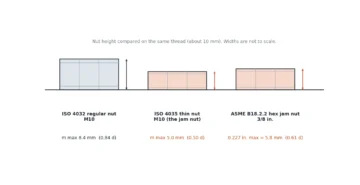
Metric thin nuts to ISO 4035 are about half a diameter tall. A regular ISO 4032 nut is 0.84 to 0.93 of the diameter. For M10 that is 5.0 mm against 8.4 mm.
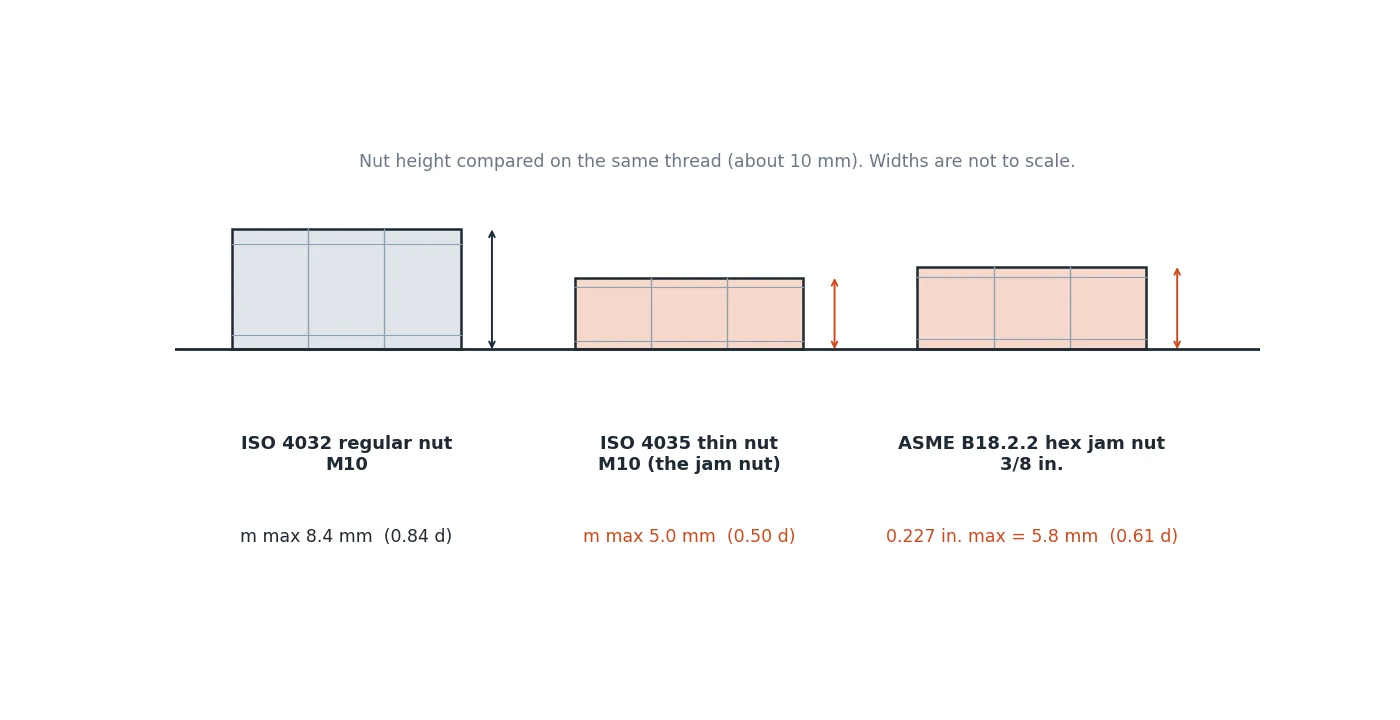
| Thread | ISO 4035 thin nut, m max (mm) | ISO 4032 regular nut, m max (mm) | Jam nut + regular nut (mm) | Two regular nuts (mm) | Height saved (mm) |
|---|---|---|---|---|---|
| M6 | 3.2 | 5.2 | 8.4 | 10.4 | 2.0 |
| M8 | 4.0 | 6.8 | 10.8 | 13.6 | 2.8 |
| M10 | 5.0 | 8.4 | 13.4 | 16.8 | 3.4 |
| M12 | 6.0 | 10.8 | 16.8 | 21.6 | 4.8 |
| M16 | 8.0 | 14.8 | 22.8 | 29.6 | 6.8 |
| M20 | 10.0 | 18.0 | 28.0 | 36.0 | 8.0 |
| M24 | 12.0 | 21.5 | 33.5 | 43.0 | 9.5 |
Heights from the ISO 4035 table and the ISO 4032 table on the same site. The last three columns are our own sums of the maximum heights.
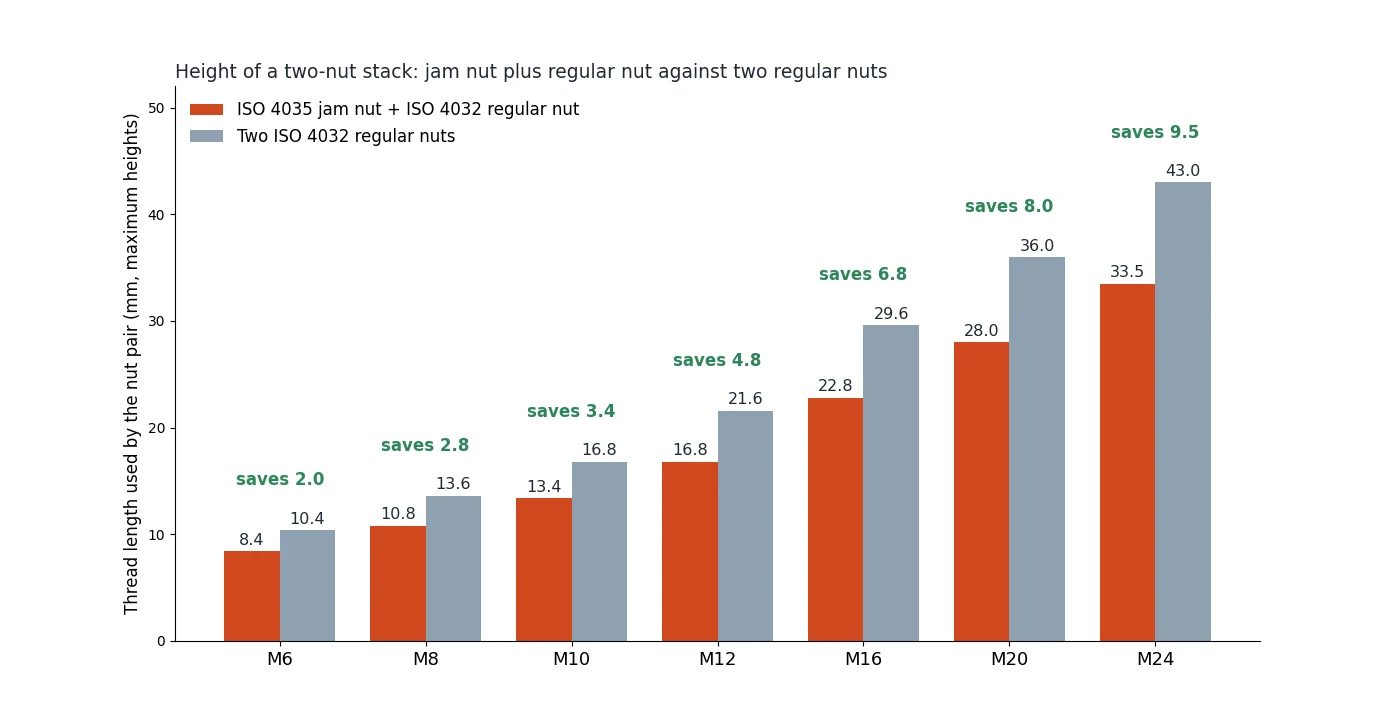
The saved height is also thread length you do not have to order. On an M10 stud, a jam nut plus a regular nut needs 3.4 mm less thread than two regular nuts.
Inch jam nuts are slightly thicker than metric thin nuts, about 0.6 to 0.65 of the nominal diameter.
| Nominal size | Regular hex nut thickness, max / min (in.) | Hex jam nut thickness, max / min (in.) |
|---|---|---|
| 1/4 | 0.226 / 0.212 | 0.163 / 0.150 |
| 3/8 | 0.337 / 0.320 | 0.227 / 0.210 |
| 1/2 | 0.448 / 0.427 | 0.323 / 0.302 |
| 5/8 | 0.559 / 0.535 | 0.387 / 0.363 |
| 3/4 | 0.665 / 0.617 | 0.446 / 0.398 |
Source: ASME B18.2.2 values as tabulated by Engineers Edge.
A 3/8 inch jam nut is 0.227 in. (5.8 mm) thick, and an M10 ISO thin nut is 5.0 mm. They are close, but not interchangeable. The threads differ, and the standards do not use the same height rules.
Which nut goes against the joint?
You will see both orders on old machinery, and many how-to guides never say which of the two nuts is the thin one. ISO 898-2 does.
ISO 898-2, clause 5 of the 2012 edition, states: “Thin nuts used as jam nuts should be assembled together with a regular nut or a high nut. In assemblies with jam nut, the thin nut is first tightened against the assembled parts and then the regular or high nut is tightened against the thin nut.”
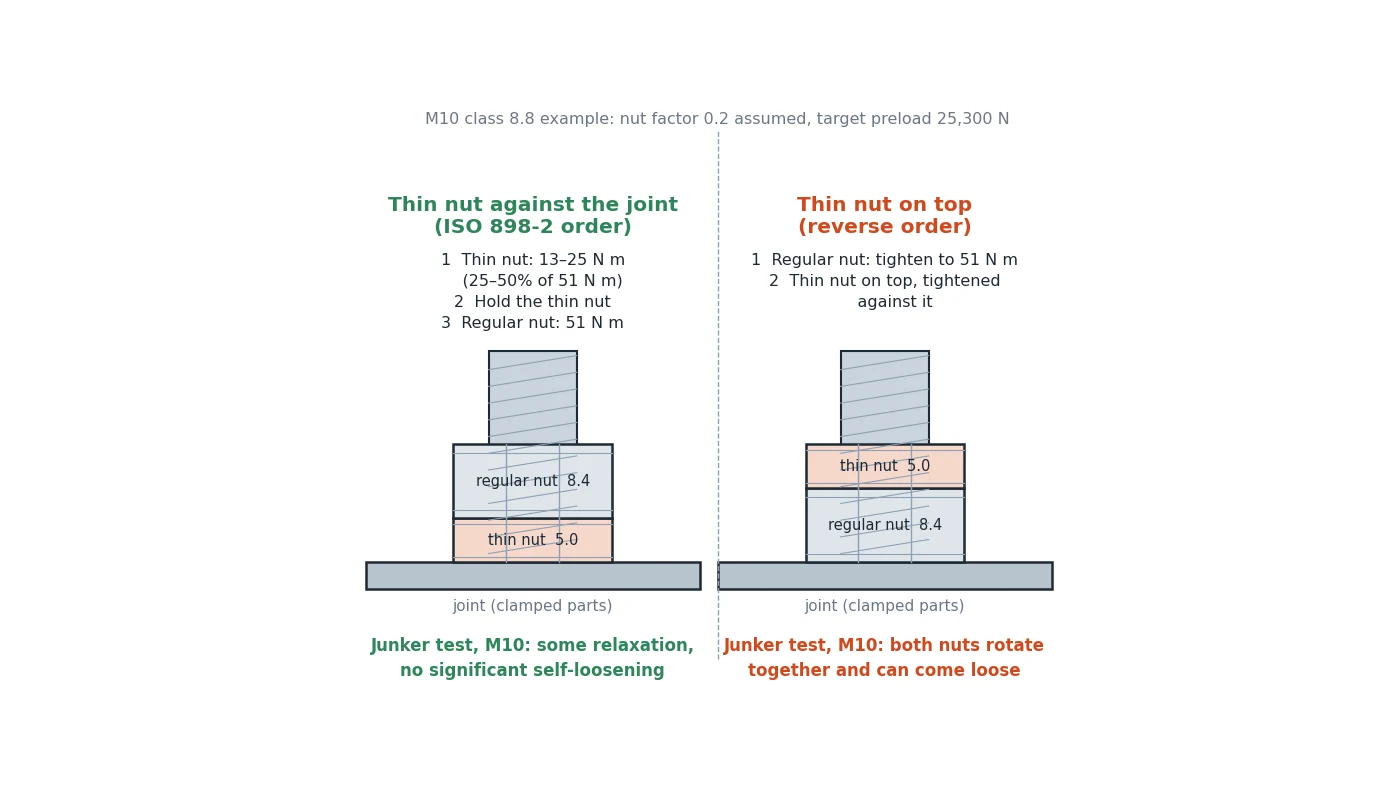
The test evidence agrees. Bolt Science ran a Junker transverse vibration test on M10 nuts and bolts in both orders. With the thin nut on top, both nuts turned together and came completely loose, only slightly better than a single plain nut. With the thin nut against the joint, there was some relaxation but no significant self-loosening.
The reason is the way the threads load. When the regular nut is tightened onto the thin nut, the load comes off the thin nut’s pressure flanks until the bolt thread bears on its other flank. The bolt thread then touches opposite flanks of the two nuts, so the threads cannot move against each other. That jamming is what resists loosening.
The tightening procedure that follows from this:
- Tighten the thin nut against the joint to 25 to 50% of the full torque. Wikipedia gives a quarter to a half, and Dr Bill Eccles of Bolt Science describes about 30%.
- Hold the thin nut still with a second wrench.
- Tighten the regular nut onto the thin nut to the full torque.
Worked example, M10 class 8.8. The proof load of an M10 8.8 bolt is 33,700 N (ISO 898-1:2013, Table 5). Take a target preload of 75% of proof, a common design choice rather than a rule, which is 25,300 N. With a nut factor of 0.2 (an assumption; lubricant and plating change it), torque is 0.2 x 0.010 m x 25,300 N, or about 51 N m. The thin nut then goes on at roughly 13 to 25 N m, and the regular nut on top at 51 N m.
There is one catch. In Fastener + Fixing, Dr Eccles writes that tightening the regular nut gives a joint preload equal to about 70% of what the same torque would give with a single nut. In our M10 example that is about 17,700 N, which is 7,600 N short of the target. Raising the torque to make up the difference is not a fix, because by the same formula the 72 N m needed would imply about 36,000 N, above the bolt’s proof load. If the joint needs its full preload, pick another way to lock it. Eccles himself says he usually recommends more modern locking methods, because the result depends too much on the person tightening.
How much load can a thin nut carry?
Less than the bolt it sits on. ISO 898-2:2012 Table 4 gives proof loads for thin nuts of class 04 and 05, and for regular nuts. Compared with the bolt proof loads in ISO 898-1:2013 Table 5, the gap is large and consistent across sizes. These are 2012 and 2013 edition values, so check the current editions before you write a purchase specification.
| Thread | 8.8 bolt proof load (N) | Thin nut class 04 (N) | Thin nut class 05 (N) | Regular nut class 8 (N) | Class 04 as % of bolt | Class 05 as % of bolt |
|---|---|---|---|---|---|---|
| M6 | 11,600 | 7,640 | 10,000 | 17,200 | 66% | 86% |
| M8 | 21,200 | 13,900 | 18,300 | 31,800 | 66% | 86% |
| M10 | 33,700 | 22,000 | 29,000 | 50,500 | 65% | 86% |
| M12 | 48,900 | 32,000 | 42,200 | 74,200 | 65% | 86% |
| M16 | 91,000 | 59,700 | 78,500 | 138,200 | 66% | 86% |
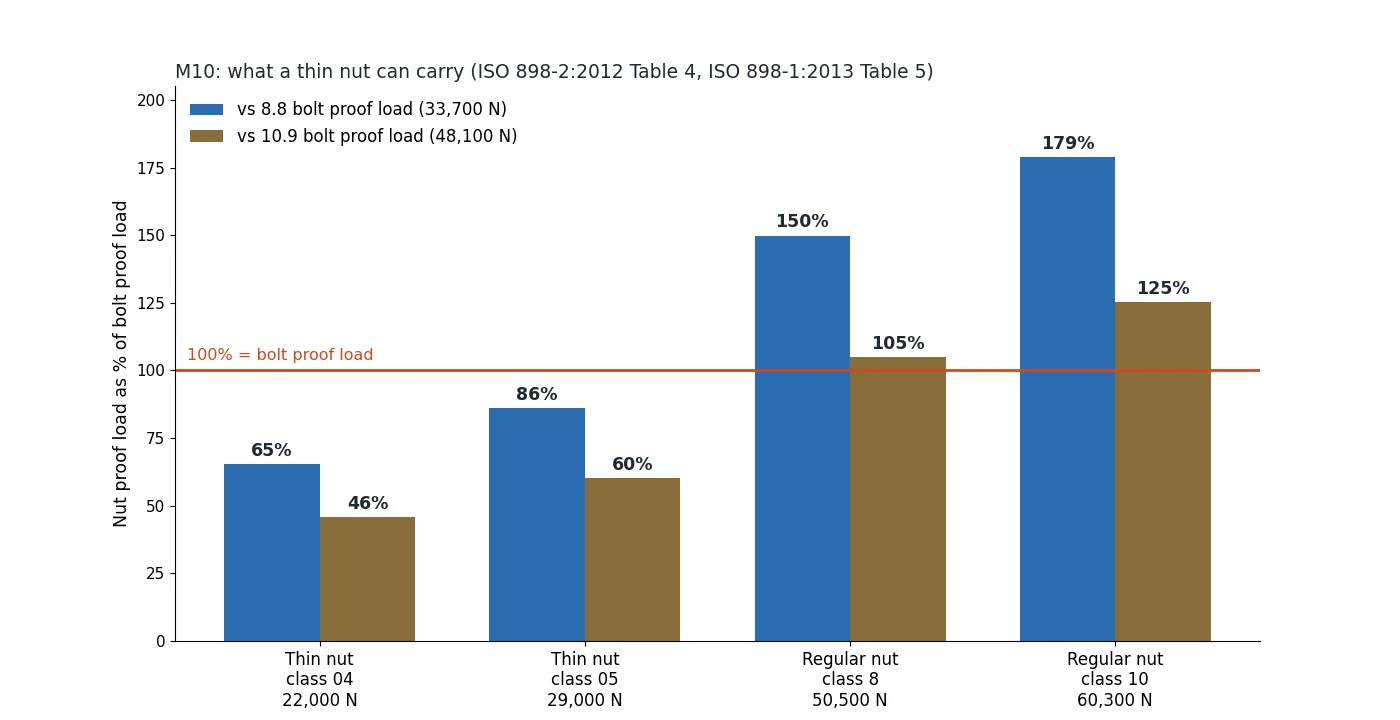
Against a 10.9 bolt the shortfall is bigger: class 04 reaches 46% and class 05 reaches 60% of the bolt’s proof load. Two things follow:
- A thin nut cannot be the only load-carrying nut on an 8.8 or stronger bolt. In the M10 example, a 25,300 N preload is 115% of the class 04 proof load. The thread would be at risk of stripping. Class 05 would be at 87%, with little margin.
- In a correct two-nut stack the thin nut carries little load. Bolt Science notes that the lower nut does not need full height because its threads do not carry the load. This fits the ISO 898-2 rule that a thin jam nut works only together with a regular or high nut.
The standard adds another warning. Hot-dip galvanized nuts, which have oversize-tapped threads (6AZ, 6AX), have lower stripping strength than 6H nuts. That leaves a thin galvanized nut with even less margin.
When a jam nut is the wrong lock
| Situation | What goes wrong | Better choice |
|---|---|---|
| Thin nut used as the only nut | It can strip before the bolt reaches proof load | Regular or high nut of a matching class |
| Thin nut tightened on top of the regular nut | Both nuts can turn together and loosen in a vibration test | Thin nut against the joint, regular nut on top |
| Two thin nuts stacked | The first can partly strip the bolt thread, causing preload loss | Two regular nuts |
| Long bolt with a large stretch | Extension can exceed the thread clearance in a thin nut and strip it | Two regular nuts, or another lock |
| Heavy transverse vibration or safety-critical joint | Result depends on tightening skill; NASA’s Fastener Design Manual is reported to call jam-nut assemblies unpredictable | Prevailing-torque or nylon-insert nut, or a locking method approved for the design |
| Tight tolerance on preload | The two-nut method may lower preload by about 30% (one author’s estimate) | Single nut with measured tightening |
The two-nut method is not useless. Bolt Science found that, applied correctly, it can beat many lock nuts in a Junker test. It is just labor-intensive and sensitive to who does the work. Our 8.8 bolt guide covers the bolt side of the same preload question.
What to send with a jam nut RFQ
Jam nuts look simple, which is why RFQs for them go wrong. Send these details:
- Standard: ISO 4035 (DIN 439 B), ASME B18.2.2 hex jam nut, or a drawing. Do not write “jam nut” alone.
- Thread: size, pitch, thread class (6H for metric) and hand.
- Property class or grade: class 04 or 05 for steel thin nuts, A2 or A4 for stainless, or the inch grade.
- Mating bolt: property class and grade. This decides whether a thin nut is allowed at all.
- Finish: zinc, black oxide or hot-dip galvanizing. For galvanized nuts, say whether the tapped thread is oversize.
- Use: locking a position, stacking with a regular nut, or tight clearance. This tells us whether the thin nut is the right part.
- Quantity, marking and packing.
If you need jam nuts to a standard or drawing, send those details through our contact page. We confirm whether we can supply them before any price is given. Our hex nut page shows the regular range, and the custom fastener solutions page covers made-to-drawing parts.
Frequently asked questions
What is a jam nut?
A jam nut is a thin nut, usually about half the height of a regular nut, that is tightened against another nut to lock it. The term can also mean any nut used this way.
Which nut goes on first, the thin one or the thick one?
ISO 898-2 says the thin nut goes on first, tightened against the assembled parts. The regular nut is then tightened against the thin nut. Test results show that this order resists loosening far better than the reverse.
Can I use two regular nuts instead of a jam nut?
Yes. Bolt Science says two full-height nuts work if the same tightening procedure is followed. They also avoid the thread-stripping risk of a thin nut, but they need more thread length.
Are jam nuts reliable under vibration?
Only when tightened correctly, and not for every joint. The method works in tests when the thin nut is against the joint, but it depends on the person tightening and lowers preload. For safety-critical joints, use a prevailing-torque or nylon-insert nut instead.
How tight should a jam nut be?
Tighten the thin nut to 25 to 50% of the full torque, hold it, then tighten the regular nut to the full torque. The full torque comes from your joint design, not from the jam nut.
Next step: send the joint, not just “jam nut”
Tell us the bolt class, the thread, the standard and what the second nut has to do. That is enough for us to say whether a thin nut, two regular nuts or another locking nut is the right part.