 English
 German
 Spanish
 Portuguese
 French
 Japanese
 Arabic
 Korean
 Vietnamese
 Russian
Direct answer: A shoulder bolt (also sold as a shoulder screw or stripper bolt) has a ground, unthreaded shoulder between the head and a smaller thread. The shoulder does the pivot, guide or spacer job, and the thread only holds it in place. Order it by shoulder diameter first, shoulder length second and thread third. Then check three things on your drawing: the shoulder tolerance against the bore, the shoulder length against the stack, and the thread neck, which is weaker than the thread itself.
This guide is for design engineers, maintenance planners and buyers who have to turn a pivot, guide or standoff drawing into a purchase order. It covers how shoulder bolts are sized, where the size names disagree, how to work out the fit and the length, and what to send a supplier so the first quote is the right part.
Use a shoulder bolt when a part has to rotate, slide or sit at a fixed distance on the fastener, and you want to remove it again without special tools. Look elsewhere when the joint must clamp two parts with a high preload, when two plates need a fixed locating pin (see taper pins), or when the volume is so low that a made-to-drawing part costs more than a standard bolt plus a bushing.
What a shoulder bolt does that a standard bolt cannot
A standard bolt has one working diameter. A shoulder bolt has two. The larger one, the shoulder, is ground to a tight tolerance and becomes an axle, guide pin or spacer. The smaller one, the thread, screws into a tapped hole and draws the shoulder up against the mating face. The shoulder length, not the tightening torque, sets the gap between the head and that face, so a lever or bearing can turn on the shoulder without being clamped.
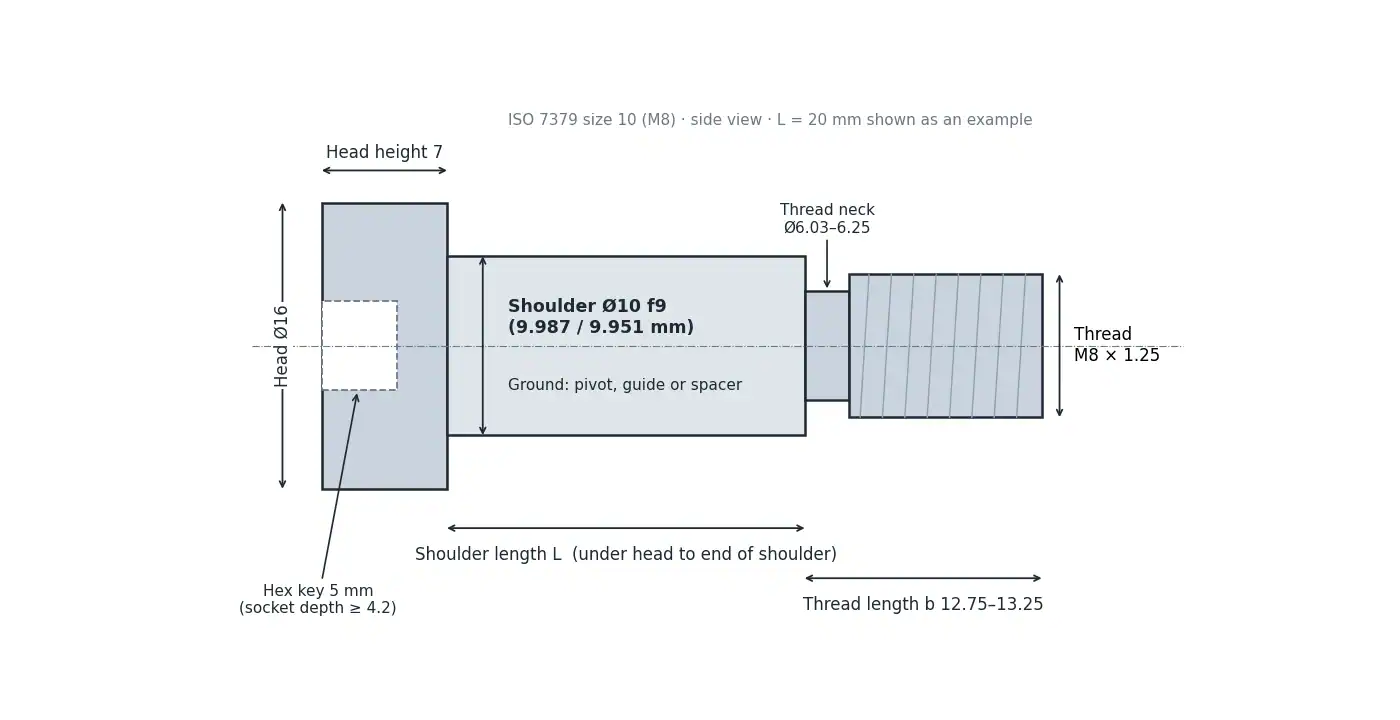
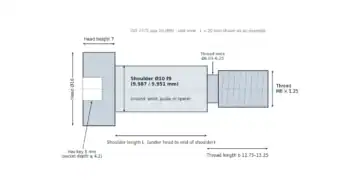
On an ISO 7379 hexagon socket shoulder screw of size 10, the shoulder is 10 mm with f9 limits of 9.987 to 9.951 mm, the thread is M8 x 1.25 and up to 13.25 mm long, the head is about 16 mm across and 7 mm high, and the hex key is 5 mm (Fuller Fasteners ISO 7379 table). ISO 7379 itself covers metric sizes with nominal shoulder diameters from 6.5 mm to 25 mm (ISO).
Three jobs come up again and again in the sources we read:
- Pivot: levers, latches, linkages and idler rollers turn on the shoulder, often through a bushing or bearing.
- Guide: a plate slides along the shoulder. Stamping dies use this layout, which is where the name “stripper bolt” comes from.
- Standoff: the shoulder length sets a repeatable gap between two plates, with no separate spacer to lose.
How shoulder bolts are sized, and why “M8” can mean two different parts
Shoulder bolts are named by the shoulder, not the thread. A “10 x 30” ISO shoulder bolt has a 10 mm shoulder that is 30 mm long, and the thread (M8 x 1.25) is implied by the shoulder size. Overall length is not part of the name. It also includes the head height and the thread length. Inch parts follow the same logic: “1/2 x 1” is a 1/2 in. shoulder, 1 in. of shoulder length and a 3/8-16 thread (AFT Fasteners, ASME B18.3 tables).
That is why a request for an “M8 shoulder bolt” is incomplete. It could mean an 8 mm shoulder with an M6 thread, or a 10 mm shoulder with an M8 thread. Confirm which feature the number describes before you quote or order.
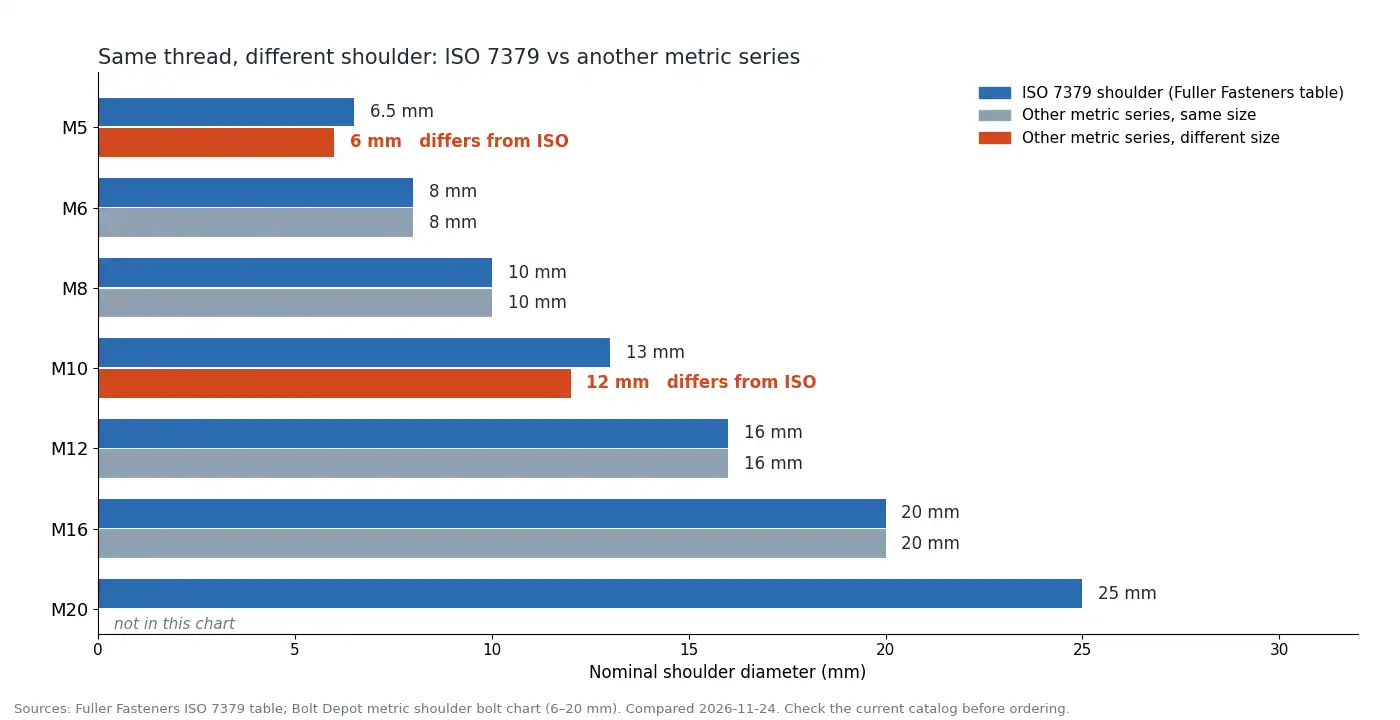
The second trap is that metric catalogs do not share one size series. ISO 7379 uses 6.5, 13 and 25 mm shoulders on M5, M10 and M20 threads. Some distributors sell 6 and 12 mm shoulders on the same threads, and one chart we checked lists no 25 mm size. A Brighton-Best data sheet states that its 4, 5, 6, 12 and 24 mm sizes follow the manufacturer’s own design because they are not in ISO 7379 (Brighton-Best data sheet). The Elesa standard-parts catalog makes the same point: its M5, M10 and M20 sizes differ from the official ISO sheet.
| Thread | ISO 7379 shoulder | Other metric series (one US distributor) | Interchangeable? |
|---|---|---|---|
| M5 x 0.8 | 6.5 mm | 6 mm | No |
| M6 x 1 | 8 mm | 8 mm | Same shoulder size; check tolerance and head |
| M8 x 1.25 | 10 mm | 10 mm | Same shoulder size; check tolerance and head |
| M10 x 1.5 | 13 mm | 12 mm | No |
| M12 x 1.75 | 16 mm | 16 mm | Same shoulder size; check tolerance and head |
| M16 x 2 | 20 mm | 20 mm | Same shoulder size; check tolerance and head |
| M20 x 2.5 | 25 mm | not listed | Not applicable |
Shoulder sizes from the Fuller Fasteners ISO 7379 table and the Bolt Depot metric shoulder bolt chart, compared on 2026-11-24. Check the current catalog before you rely on a size.
For inch screws, the shoulder diameter and thread pair up as 1/4 in. with #10-24, 5/16 in. with 1/4-20, 3/8 in. with 5/16-18, 1/2 in. with 3/8-16, 5/8 in. with 1/2-13 and 3/4 in. with 5/8-11. Inch and metric shoulders do not interchange either: a 1/2 in. shoulder is 12.7 mm, which is neither a 12 mm nor a 13 mm shoulder. In mixed-unit assemblies, check the shoulder against the actual bore.
Shoulder bolt or something else?
The shoulder bolt is not always the cheapest way to build a pivot. Use this table before you commit to a custom part.
| Option | Good when | Weak when |
|---|---|---|
| Shoulder bolt | A part turns or slides on the fastener and must come apart for service | The joint needs high clamp load, or the shoulder is never loaded as a bearing |
| Socket head cap screw plus spacer or bushing | The joint clamps and the stack height can be set with a separate part | More parts to stock, and stack tolerances add up |
| Dowel or taper pin plus a retaining screw | Two plates must stay in one position | The pin does not clamp, and a second fastener is needed |
| Clevis pin with a clip | Tool-free pivots that are opened often | The pin cannot clamp or preload, and it needs a clip groove or cross hole |
| Turned stud or axle made to drawing | The shoulder, head or length does not exist in a standard series | Setup cost at low volume |
Cost follows the process. Standard shoulder screws are mostly cold headed, which pays off in quantities of tens of thousands, and non-standard sizes can be too expensive at that process (Machine Design). The same article says custom shoulder screws can be made on screw machines in small quantities, and that precision-grade screws hold tighter shoulder-diameter and length tolerances than commercial grade. If your volume is a few hundred pieces a year, ask for both quotes.
Check the fit before you order: a worked example
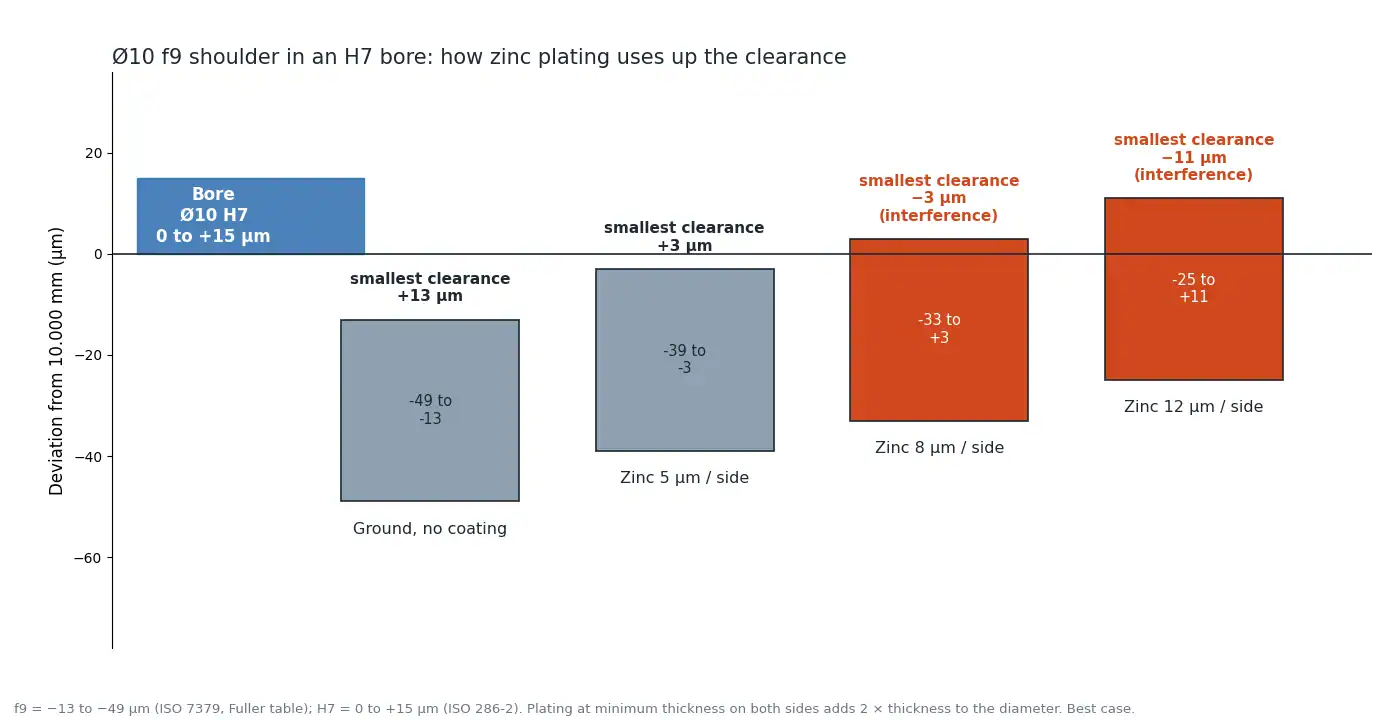
Take a 10 mm shoulder running in a 10 mm bore. An ISO 7379 shoulder has f9 limits, so the shoulder measures 9.951 to 9.987 mm. A bore reamed to H7 measures 10.000 to 10.015 mm. The H7 limits for sizes over 6 mm up to 10 mm (0 to +15 µm) come from ISO 286-2.
- Smallest clearance: 10.000 − 9.987 = 0.013 mm
- Largest clearance: 10.015 − 9.951 = 0.064 mm
That is a small window, and a coating can close it. ASTM B633 electroplated zinc is specified by service condition, with minimum thicknesses of 5, 8, 12 and 25 µm for SC1 to SC4. Thickness builds on both sides of the shoulder, so the diameter grows by twice the coating thickness.
| Finish on the shoulder | Diameter growth | Shoulder max (mm) | Smallest clearance in an H7 bore |
|---|---|---|---|
| Ground, no coating | 0 | 9.987 | 0.013 mm |
| Zinc, 5 µm minimum per side | 0.010 mm | 9.997 | 0.003 mm |
| Zinc, 8 µm minimum per side | 0.016 mm | 10.003 | −0.003 mm (can bind) |
| Zinc, 12 µm minimum per side | 0.024 mm | 10.011 | −0.011 mm (will bind) |
Calculation assumes the coating is at its minimum thickness. Real coatings run thicker, and thickness is usually uneven on a part, so treat these figures as the best case.
The fix is on the drawing, not at the bench. Say whether the shoulder diameter applies after finish, ask for the shoulder to be left uncoated or ground after plating, or choose a finish that adds almost nothing. One distributor data sheet lists steel shoulder screws with the shoulder as ground and the other surfaces thermally blackened (Brighton-Best data sheet). Inch parts show the same pattern: a 1/4 in. ASME B18.3 shoulder runs 0.2480 to 0.2460 in., always under nominal (AFT Fasteners table). If you need a tighter or looser fit than f9 gives, ask the supplier which classes they can ground to. Fuller’s table lists h8 as an alternative for steel, and Misumi’s shoulder screw guide mentions g6, h7 and e9 classes.
Work out the shoulder length from the stack
Shoulder length runs from the underside of the head to the end of the shoulder. The thread is not part of it (Brighton-Best data sheet). Add up everything that sits on the shoulder, then add the axial play you want.
Example: a lever 12.0 mm thick, one 1.0 mm thrust washer under the head, and a target axial play of 0.2 to 0.5 mm.
- Required shoulder length: 12.0 + 1.0 + (0.2 to 0.5) = 13.2 to 13.5 mm
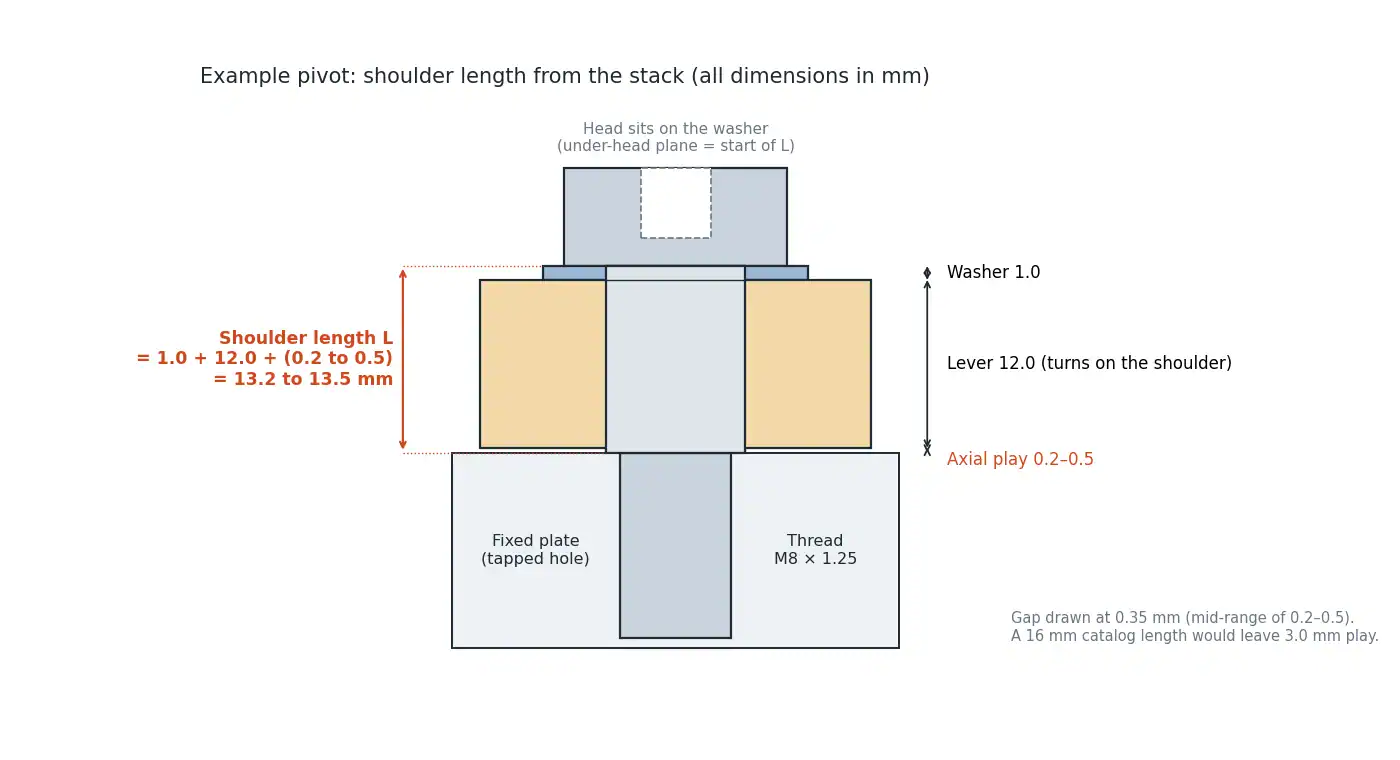
Catalog lengths come in steps. The Elesa catalog lists the 10 mm shoulder size starting at 16 mm, then 20, 25 and 30 mm. Taking the 16 mm screw leaves 16 − 13.0 = 3.0 mm of play, so you would need a 2.5 to 2.8 mm spacer to get back inside the target. That spacer is one more part and one more tolerance. A shoulder made to 13.3 mm removes both, if the volume supports a made-to-drawing part.
The thread neck is the weak point
It is easy to assume the thread limits the strength. On a shoulder bolt, the smallest section is usually the undercut between the shoulder and the thread. The table compares the minimum thread-neck cross-section from the ISO 7379 dimensions with the standard tensile stress area of the thread.
| Shoulder | Thread | Thread stress area (mm²) | Neck area, minimum diameter (mm²) | Neck vs thread | Shoulder area vs neck |
|---|---|---|---|---|---|
| 6.5 | M5 | 14.2 | 10.6 | −25% | 3.1x |
| 8 | M6 | 20.1 | 15.2 | −24% | 3.3x |
| 10 | M8 | 36.6 | 28.6 | −22% | 2.8x |
| 13 | M10 | 58.0 | 46.4 | −20% | 2.9x |
| 16 | M12 | 84.3 | 68.7 | −19% | 2.9x |
| 20 | M16 | 157 | 131.9 | −16% | 2.4x |
| 25 | M20 | 245 | 208.7 | −15% | 2.4x |
Neck diameters are the minimum values in the Fuller Fasteners ISO 7379 table. Stress areas are the standard ISO coarse-thread values. This compares cross-sections only. It is not a load rating.
Two consequences follow. First, do not take a tightening torque from a class 12.9 socket head cap screw table. The Elesa catalog makes the same point: the maximum torque on these screws is limited by the small bearing shoulders and the recesses at the diameter transitions, not by the steel property class. Use the seating torque published by the manufacturer of your screw. Second, ask what the supplier tests. One data sheet says shoulder screws are not tensile tested because of their design, that hardness and decarburization are the required checks, and that 12.9 shoulder screws are marked 012.9 because they are classified as reduced-loadability fasteners (Brighton-Best data sheet). For the strength classes themselves, see our guide to high strength bolts.
Material and finish: choose for wear first
- Alloy steel, class 12.9: the common choice for tooling and machinery. The same data sheet gives 39 to 44 HRC for class 12.9. Black oxide adds almost no thickness, which suits a ground shoulder.
- Stainless steel (A2 or A4): better for washdown and corrosion. It is usually softer than hardened alloy steel, so check wear on the shoulder in a high-cycle pivot at regular intervals. One distributor data sheet says stainless shoulder screws fall outside ISO 7379, so confirm the supplier’s own dimensions and tolerances (Brighton-Best data sheet).
- Zinc or zinc flake coatings: useful for corrosion, but see the fit table above. Say whether the coating applies to the shoulder.
What to send with a shoulder bolt request
A size alone leaves the supplier guessing. A short pivot drawing usually answers the questions that cause re-quotes.
- Shoulder diameter and tolerance class, and whether it applies after finish
- Shoulder length and tolerance, measured from under the head
- Thread size, pitch and length (and left-hand thread if needed)
- Head style and drive, plus any counterbore depth that limits head height
- Standard or drawing reference (ISO 7379, ASME B18.3, or your own)
- Material, property class and hardness limits
- Finish, and which surfaces it must or must not cover
- Annual quantity and delivery pattern
- What the shoulder runs in: bore size and tolerance, bushing or bearing type
- The failure you are replacing, if this is a repeat order
A complete line looks like this: Hexagon socket shoulder screw, ISO 7379 size 10 x 14 mm shoulder, M8 x 1.25 thread, class 12.9 steel, shoulder f9 and uncoated, remaining surfaces black oxide, 5,000 pcs per year, mating bore 10 H7.
Common failure patterns and what they usually point to
This table follows from the mechanics above. It is a checklist, not field failure statistics.
| What you see | Likely cause | First thing to check |
|---|---|---|
| Pivot binds after a finish change | Coating thickness used up the clearance | Shoulder diameter after finish |
| Head breaks off at the shoulder-to-thread step | Torque taken from a standard screw table | Manufacturer seating torque |
| Lever has too much end play | Catalog length steps, or washer stack too thin | Shoulder length against the stack |
| Wear groove on the shoulder | Soft material in a high-cycle pivot, or no lubrication | Hardness, bushing material and clearance |
| New screw does not fit the old bore | Wrong size series (6 vs 6.5 mm, 12 vs 13 mm) | Shoulder diameter, not the thread name |
| Screw backs out | Vibration on the thread, with no thread lock | Thread locking method specified by the design |
Frequently asked questions
What is a shoulder bolt used for?
It is used where a part must rotate, slide or sit at a fixed distance on a fastener. Typical uses are pivots for levers and linkages, axles for bearings and rollers, guide pins for sliding plates, and standoffs.
Are shoulder bolts, shoulder screws and stripper bolts the same thing?
Yes, for most practical purposes. “Stripper bolt” is the name used in die and stamping work. Catalogs often call the socket head version a socket shoulder screw.
How are shoulder bolts specified?
By shoulder diameter, then shoulder length, with the thread size usually implied by the shoulder diameter. A 10 x 30 ISO shoulder bolt has a 10 mm shoulder 30 mm long and an M8 thread.
Why does an 8 mm shoulder bolt not have an M8 thread?
The thread is always smaller than the shoulder so that the shoulder forms a step. In the ISO 7379 series, an 8 mm shoulder pairs with M6, and M8 pairs with a 10 mm shoulder.
Can a shoulder bolt replace a dowel pin?
Not directly. A shoulder bolt can locate a part that turns or slides on it, but it does not give the press-fit location of a dowel. If two plates must stay in one position, use dowels or taper pins and a separate fastener.
Next step: send the pivot, not just a size
If you need shoulder bolts made to a drawing, send the drawing or a sketch of the pivot: shoulder diameter and tolerance, shoulder length, thread, material, finish, mating bore and yearly quantity. Use the quote form on our contact page and mention “shoulder bolt” in the message. Shoulder bolts are not a listed catalog line on this site. The custom fastener solutions page covers made-to-drawing screws, bolts and special fasteners from M2 to M30, so we will confirm feasibility from your drawing before any price is given.
For related parts and sizing background, see our pages on hexagon socket screws and metric thread.