 English
  German
  Spanish
  Portuguese
  French
  Japanese
  Arabic
  Korean
  Vietnamese
  Russian
 Bolt nut stainless steel assemblies combine corrosion-resistant bolts, matching nuts, and washers for wet, outdoor, marine, food-grade, chemical, and industrial joints where rust control matters as much as clamp reliability.
Bolt nut stainless steel assemblies are used when a joint needs corrosion resistance, clean appearance, and reliable clamp load in wet, outdoor, chemical, food-grade, marine, or general industrial environments. The phrase may sound simple, but the right stainless steel bolt and nut combination depends on grade, thread fit, strength class, washer selection, surface condition, galling risk, and the environment where the joint will work.
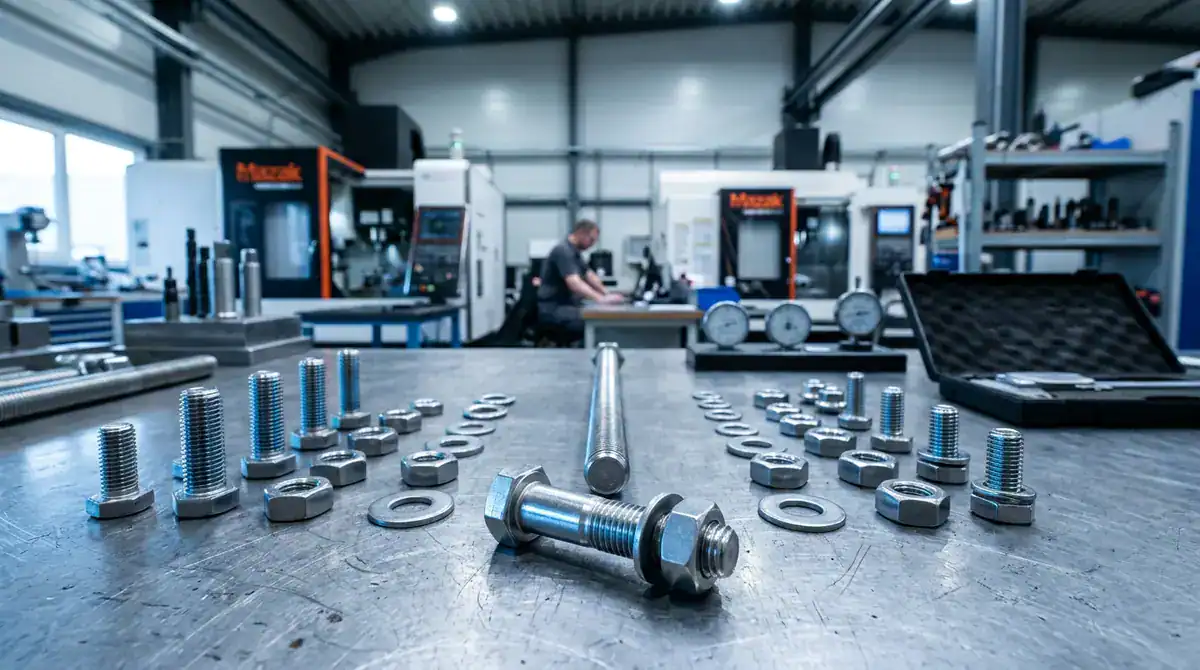
For purchasing teams, engineers, and maintenance buyers, the most important question is not only “Should we use stainless steel?” The better question is: which stainless steel grade, which nut style, and which installation practice will prevent rust, seizure, loosening, or premature failure? This guide explains how to select stainless steel bolts and nuts for production, repair, and OEM supply.
What is a stainless steel bolt and nut assembly?
A stainless steel bolt and nut assembly is a mechanical fastening set where a threaded bolt passes through one or more components and is tightened with a matching internally threaded nut. The bolt creates clamp force, while the nut provides the mating thread that holds the assembly together.
Compared with carbon steel fasteners, stainless steel fasteners contain chromium, which forms a passive oxide layer on the surface. This passive layer helps resist red rust and staining. In many applications, stainless steel is chosen not because it is always stronger than alloy steel, but because it performs better against moisture, washdown, mild chemicals, and cosmetic corrosion.
If you need a broader overview of different fastener families, see our guide to screw nut bolt selection. If your project is focused specifically on bolts, you can also compare options in our stainless steel bolt guide.
Specification standards buyers should cite
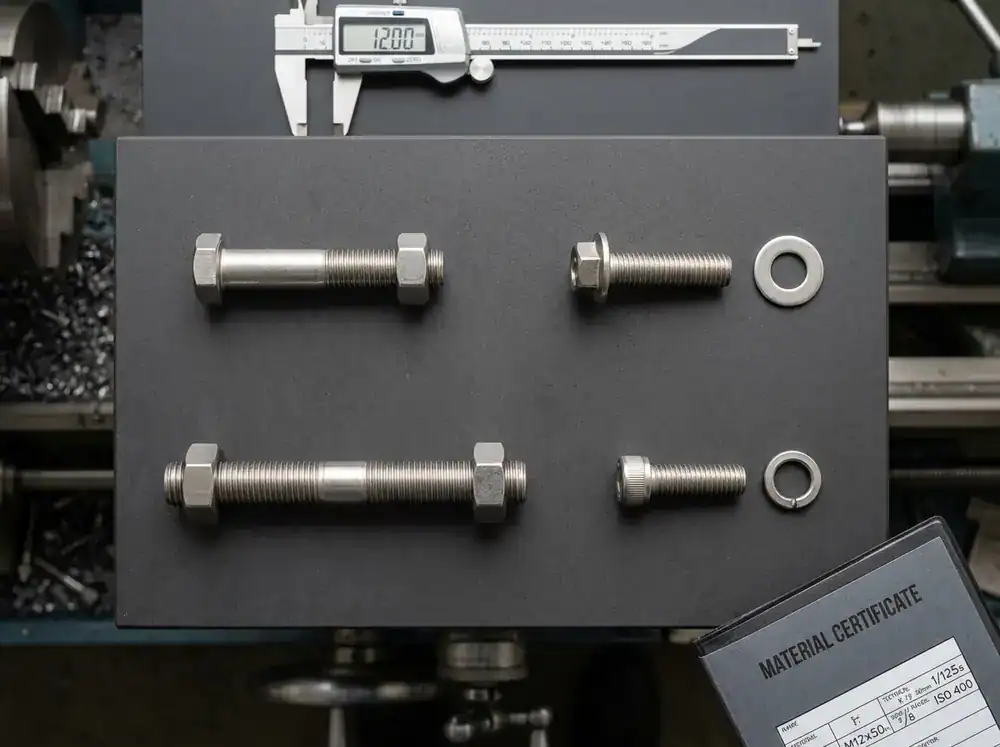
Use standards to define material, threads, dimensions, and inspection expectations before asking for price. The fastest way to create confusion in a stainless steel bolt nut order is to write only “stainless bolt and nut” on the RFQ. That phrase does not tell the factory whether the buyer needs metric or inch threads, A2 or A4 stainless, full thread or partial thread, coarse or fine pitch, normal hex nuts or heavy hex nuts, passivation, lubrication, or documentation.
For metric stainless bolts, screws, and studs, the key mechanical-property reference is ISO 3506-1. For stainless nuts, the matching reference is ISO 3506-2. These standards matter because a marking such as A2-70 or A4-80 is not decorative; it communicates stainless steel group and property class. In practical procurement language, A2 usually points to the 304 family, while A4 usually points to the 316 family. The number, such as 70 or 80, indicates the strength class used for the fastener.
| What to specify | Example | Why it matters |
|---|---|---|
| Product standard | DIN 933, ISO 4017, DIN 6921, DIN 934 | Controls head style, dimensions, and fit |
| Material group | A2 / 304 or A4 / 316 | Controls corrosion resistance and cost |
| Property class | A2-70, A4-70, A4-80 | Controls tensile strength expectations |
| Thread | M10 x 1.5, M12 x 1.75, 3/8-16 UNC | Prevents mismatched bolt and nut sets |
| Finish or treatment | Plain, passivated, waxed, anti-seize, polished | Affects corrosion appearance and installation behavior |
| Documentation | Material certificate, inspection report, salt spray request | Supports quality control and incoming inspection |
In practice, a clean RFQ might say: “M10 x 40 DIN 933 hex bolt, A4-70 stainless steel, paired with DIN 934 A4 nut and A4 flat washer, passivated, carton-packed, with material certificate and dimensional inspection report.” That one sentence gives the supplier enough information to quote consistently. It also protects the buyer from receiving a mixed lot of visually similar but technically different stainless steel hardware.
For high-temperature, pressure-vessel, flange, valve, and special-purpose service, buyers may also encounter ASTM bolting specifications. ASTM A193/A193M, for example, covers alloy-steel and stainless-steel bolting for high-temperature, high-pressure, and special-purpose applications. That does not mean every stainless bolt nut order needs ASTM A193. It means the buyer should match the standard to the application instead of mixing ISO, DIN, ASTM, and drawing requirements casually.
Common stainless steel grades for bolts and nuts
The two most common stainless grades for industrial bolt and nut sets are 304 and 316. Both are austenitic stainless steels, but they are not identical in corrosion performance.
| Grade | Typical Fastener Marking | Best Use | Key Advantage |
|---|---|---|---|
| 304 stainless steel | A2 | Indoor equipment, general outdoor use, machinery covers, brackets, light structural assemblies | Good corrosion resistance and cost efficiency |
| 316 stainless steel | A4 | Marine, coastal, chemical exposure, washdown areas, food equipment, outdoor infrastructure | Better resistance to chlorides and pitting corrosion |
| 410 stainless steel | Often martensitic marking | Self-tapping screws and applications needing higher hardness | Higher hardness, but lower corrosion resistance than 304 or 316 |
| Duplex stainless steel | Project-specific | High-corrosion and higher-strength industrial environments | Higher strength plus strong chloride resistance |
For most buyers, 304 stainless steel is the standard choice for general corrosion resistance. For coastal, marine, salt spray, pool, chemical, or long-term outdoor applications, 316 stainless steel is usually the safer choice. The cost is higher, but the service life can be much better in chloride-rich environments.
Corrosion environment map for 304 and 316
Choose 304 for clean general exposure and 316 when chlorides, salt, washdown chemicals, or coastal air are part of the service environment. Stainless steel resists corrosion because chromium creates a passive surface film, but the film can be damaged by chlorides, crevices, deposits, and poor cleaning. That is why a bolt nut stainless steel assembly can look perfect in a dry factory yet stain quickly beside the ocean or in a food plant using aggressive cleaners.
The British Stainless Steel Association explains that known pitting hazards often require molybdenum-bearing stainless steel, and 316 is the common molybdenum-bearing upgrade from 304 in many industrial applications. Their notes on stainless steel corrosion mechanisms are useful for buyers because they connect grade choice to real environments rather than catalog shorthand.
| Environment | Risk level | Practical choice | Buyer note |
|---|---|---|---|
| Dry indoor machinery | Low | 304 / A2 | Usually enough if appearance and rust resistance are the main goals |
| Outdoor rain exposure | Medium | 304 or 316 | Use 316 if pollution, de-icing salt, or long service life matters |
| Coastal air or salt spray | High | 316 / A4 | 304 may tea-stain or pit faster than expected |
| Food washdown | Medium to high | 304 or 316 | Cleaning chemical concentration decides the safer grade |
| Swimming pools or chlorinated service | High | 316 or project-specific alloy | Crevice corrosion and stress corrosion need engineering review |
| Marine immersion | Very high | 316, duplex, or specialized alloy | Standard 304 should not be treated as a marine-grade default |
A useful field detail: corrosion often starts where inspectors do not look first. The exposed bolt head may still look acceptable, while the washer edge, nut bearing face, or crevice under a bracket is already collecting chloride residue. For outdoor OEM hardware, we prefer to evaluate the whole joint, not just the bolt grade. Drainage, washer contact, trapped moisture, surface finish, and cleaning access can change the real life of the fastener.
Another practical data point comes from BSSA guidance on crevice corrosion: reported threshold examples are much less forgiving for 304 than for 316 in chloride-containing conditions. The exact safe limit depends on temperature, pH, oxygen, deposits, and crevice geometry, but the direction is clear: 316 gives buyers a wider margin when chloride exposure cannot be controlled.
How to match stainless steel bolts and nuts
A bolt and nut should match in diameter, thread pitch, thread standard, material grade, and intended strength level. A metric M8 bolt, for example, must be paired with an M8 nut of the same thread pitch. An M8 x 1.25 coarse thread nut will not correctly match an M8 x 1.0 fine thread bolt.
When matching stainless bolt nut sets, check these details before ordering:
- Thread standard: Metric, UNC, UNF, or special drawing-based thread.
- Diameter and pitch: Example: M6 x 1.0, M8 x 1.25, M10 x 1.5, or 1/4-20 UNC.
- Length: Bolt length should allow full nut engagement without excessive exposed thread.
- Grade: Use compatible stainless grades, such as A2 bolt with A2 nut, or A4 bolt with A4 nut.
- Nut style: Hex nut, flange nut, lock nut, cap nut, coupling nut, or custom nut.
- Washer: Use flat washers or spring washers when the bearing surface needs load distribution or anti-loosening support.
For standard production, many buyers specify a complete set: stainless steel bolt, matching nut, and washer. This helps reduce assembly errors and ensures the fasteners arrive with compatible dimensions and finish.
304 vs 316 stainless steel bolts and nuts
The difference between 304 and 316 stainless steel often matters most after the fastener has been installed for months or years. In a clean indoor environment, 304 stainless steel is usually sufficient. In coastal or chloride exposure, 316 stainless steel is much more reliable because molybdenum improves resistance to pitting corrosion.
| Application | Recommended Grade | Reason |
|---|---|---|
| Indoor machinery | 304 / A2 | Good corrosion resistance at lower cost |
| Outdoor guardrails and brackets | 304 or 316 | Choose 316 if exposed to salt, rain, or pollution |
| Marine hardware | 316 / A4 | Better chloride and saltwater resistance |
| Food and beverage equipment | 304 or 316 | Depends on cleaning chemicals and hygiene requirements |
| Chemical processing | 316 or project-specific alloy | Better resistance to many corrosive agents |
If the application is safety-critical, corrosive, high-temperature, or exposed to unusual chemicals, confirm the material with engineering before mass procurement. Stainless steel is corrosion resistant, but it is not corrosion proof in every environment.
Step-by-step buying workflow
Start from the joint, then specify the stainless fastener set, then verify production and documents. A buyer who starts from price alone often ends up comparing non-equivalent offers. One supplier quotes 304, another quotes 316, a third quotes a thinner washer, and a fourth leaves out inspection. The unit price looks different because the technical package is different.
Step 1: Define the joint duty
Write down whether the joint is structural, cosmetic, removable, vibrating, sealed, hygienic, or exposed to weather. A stainless decorative cover screw has a different risk profile from a stainless bolt nut set holding a machine guard, solar bracket, rail component, or chemical pump frame. If the joint carries load, ask engineering for required clamp force and torque range before changing material or grade.
Step 2: Pick grade by environment
Use A2/304 for normal indoor and clean outdoor environments. Move to A4/316 when salt, chlorides, food washdown, coastal exposure, or chemical cleaning appears in the requirement. For unusual acids, high temperature, or long life in harsh service, do not guess from a catalog page. Use a project-specific alloy review.
Step 3: Lock thread and geometry
Confirm diameter, pitch, length, thread length, head type, nut height, and washer size. For a bolt nut stainless steel set, nut engagement is as important as bolt length. Too little engagement can strip threads; too much exposed thread may interfere with covers, operators, or moving parts. For metric fasteners, a quick check is to verify that the nut threads freely by hand before any torque tool is used.
Step 4: Decide whether anti-galling treatment is needed
Stainless-on-stainless installation can seize. Fastenal’s engineering article on thread galling describes why pressure and friction can break down oxide films and cause threads to cold-weld. The British Stainless Steel Association also notes in its galling guidance that soft, ductile austenitic stainless steels are prone to seizure under high stress and poor lubrication. For production assembly, specify lubricant, waxed nuts, controlled speed, or a tested installation process.
Step 5: Verify samples before bulk production
Before releasing a large order, test a sample set with the actual joint material, torque tool, washer, and installation speed. We have seen stainless assemblies pass dimensional inspection but still fail during assembly because operators used high-speed impact drivers on dry stainless threads. A 15-minute sample trial can prevent a full batch from becoming expensive rework.
Procurement tip: If the application needs stainless steel for corrosion resistance and repeat assembly, ask the supplier to quote the bolt, nut, washer, and anti-galling recommendation as a set. Buying each component separately can save a few cents and create a much larger problem during installation.
Strength and mechanical properties
Stainless steel bolts and nuts are often marked according to property classes such as A2-70, A4-70, A2-80, or A4-80. The first part indicates the stainless grade group, while the number indicates tensile strength class.
- A2-70: Common 304 stainless fastener class for general industrial use.
- A4-70: Common 316 stainless class for higher corrosion resistance.
- A2-80 or A4-80: Higher strength stainless fasteners, often selected where stronger clamp force is needed.
Do not assume stainless steel automatically equals high strength. A class 12.9 alloy steel bolt can be much stronger than common stainless steel grades. Stainless steel is selected for corrosion resistance, hygiene, and appearance, while alloy steel is often selected for maximum tensile strength. If the joint is load-bearing or safety-critical, confirm tensile strength, proof load, and torque requirements.
Preventing galling during installation
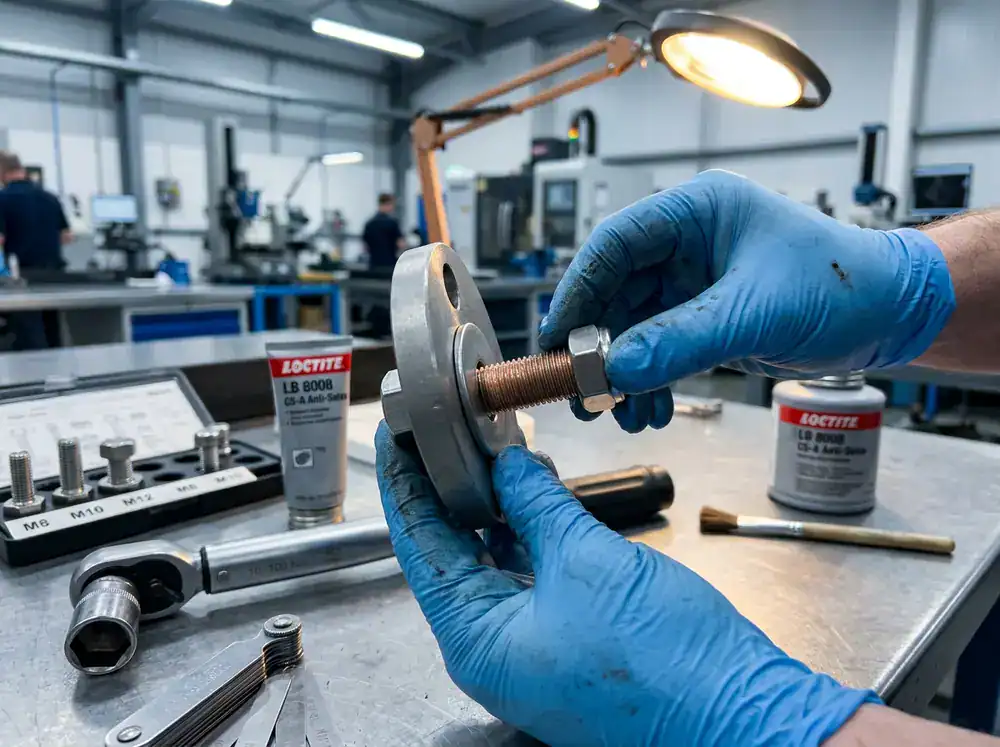
Galling is one of the most common problems with stainless steel bolt and nut assemblies. It happens when stainless threads seize during tightening. The fastener may lock before the correct clamp load is reached, and in severe cases the bolt and nut cannot be removed without cutting.
To reduce galling risk:
- Use clean, smooth threads with consistent tolerance.
- Apply suitable anti-seize lubricant when the application allows it.
- Avoid excessive installation speed with power tools.
- Do not overtighten beyond recommended torque.
- Use compatible but carefully selected bolt and nut materials.
- For repeated assembly, consider nut designs and coatings that reduce friction.
Galling is especially important in stainless-on-stainless contact. For high-volume assembly, run installation trials before approving a bulk order.
Should you use washers with stainless steel bolts and nuts?
Washers are often recommended when the joint surface is soft, slotted, painted, uneven, or at risk of local deformation. A flat washer spreads the load under the bolt head or nut. A spring washer or locking washer may be used for vibration resistance, though the best anti-loosening method depends on the application.
For stainless assemblies, the washer grade should generally match the bolt and nut grade. Using a carbon steel washer with a stainless bolt can create corrosion staining and reduce the benefit of stainless material.
Where stainless bolt and nut sets are used
Stainless steel bolt nut assemblies are widely used in:
- Food processing and packaging equipment
- Outdoor enclosures and electrical cabinets
- Marine and coastal structures
- Automotive accessories and brackets
- Rail, telecom, and infrastructure hardware
- Solar mounting systems and rooftop structures
- Medical equipment frames and cleanroom fixtures
- Construction hardware exposed to rain or humidity
For example, a stainless steel hex bolt with a matching hex nut may be used in an outdoor bracket. A stainless flange bolt and flange nut can provide a larger bearing surface for sheet metal or equipment frames. A stainless lock nut may be chosen when vibration is present.
Quick RFQ examples for bolt nut stainless steel orders
Use RFQ examples to make bolt nut stainless steel requirements clear before the supplier quotes. These examples show how the same keyword can represent very different technical packages. The words are similar, but the grade, washer, finish, documentation, and packing change the real cost.
- Indoor machinery: M8 x 30 bolt nut stainless steel set, A2-70 hex bolt, A2 hex nut, A2 flat washer, plain finish, bulk carton.
- Outdoor bracket: M10 x 40 bolt nut stainless steel set, A4-70 grade, flat washer and spring washer, passivated finish, labeled bags.
- Food equipment: M6 bolt nut stainless steel assembly, 316/A4 material, smooth finish, clean packaging, material certificate required.
- Solar mounting: M12 bolt nut stainless steel kit, A4-70 or A4-80, washer set included, corrosion-resistant packing for outdoor installation.
- Marine hardware: 316 bolt nut stainless steel set with matching washer, anti-galling recommendation, lot traceability, and export carton labels.
- OEM drawing part: custom bolt nut stainless steel assembly made to drawing, thread gauge inspection, dimensional report, and sample approval before bulk production.
- Maintenance stock: mixed-size bolt nut stainless steel assortment packed by diameter and pitch, with clear labels to prevent thread mismatch.
- High-vibration equipment: bolt nut stainless steel set with lock nut or approved locking method, tested on the real joint before mass order.
These examples also help compare suppliers fairly. If one quote includes washers, passivation, anti-galling guidance, and reports while another only lists loose bolts and nuts, the cheaper price may not be the better bolt nut stainless steel offer.
Procurement checklist for stainless steel bolt and nut orders
Before placing an RFQ, prepare the technical details clearly. This reduces back-and-forth communication and helps the supplier quote accurately.
- Fastener type: hex bolt, flange bolt, carriage bolt, stud bolt, threaded rod, hex nut, flange nut, lock nut.
- Material: 304/A2, 316/A4, 410, duplex, or custom grade.
- Size: diameter, pitch, length, and thread length.
- Standard: DIN, ISO, ANSI, ASTM, or drawing-based custom specification.
- Finish: plain stainless, passivated, polished, waxed, coated, or lubricated.
- Quantity: trial order quantity and annual volume.
- Documentation: material certificate, dimensional inspection, salt spray report, PPAP, or third-party inspection.
- Packaging: bulk cartons, small bags, labels, barcodes, or customer-specific export packaging.
DingLong Hardware manufactures DIN and ISO standard fasteners and custom drawing-based hardware for industrial buyers. For related product options, see DIN 6921 hex flange bolts, DIN 938 double end stud bolts, and DIN 939 double end stud bolts.
Inspection and documentation for bulk orders
For industrial sourcing, the paperwork should prove material, dimensions, surface condition, and packaging control. Stainless steel fasteners are often purchased for environments where failure is visible and expensive: outdoor installations, clean equipment, export machinery, marine hardware, or production-line frames. That means the supplier should be able to support more than a product photo.
At minimum, ask for a material certificate when the grade matters. For drawing-based OEM parts, ask for dimensional inspection against the drawing, including thread gauge results. For appearance-sensitive hardware, confirm whether passivation, polishing, or protective packaging is required. Stainless steel can still arrive scratched, contaminated with carbon steel dust, or mixed with another grade if the production and packing controls are weak.
| Document or check | What it confirms | When to request it |
|---|---|---|
| Material certificate | Steel grade and chemical composition | Any A2/A4/316-critical order |
| Dimensional report | Diameter, pitch, length, head size, nut height | OEM and drawing-based parts |
| Thread gauge check | Functional thread fit | Any bolt-and-nut paired order |
| Surface inspection | Scratches, stains, burrs, contamination | Visible or hygienic assemblies |
| Salt spray or corrosion report | Finish or treatment comparison | When a customer specification requires it |
| Packaging photos | Labeling, separation, carton quality | Export, kitting, and assembly-line supply |
One overlooked point is lot separation. If an order includes M6, M8, M10, and M12 stainless bolt nut sets, each size should be packed and labeled clearly. When a maintenance team receives unlabeled mixed bags, the risk of wrong-pitch assembly rises immediately. For production buyers, barcoded bags, carton labels, or kitted bolt-nut-washer packs can reduce errors on the line.
DingLong Hardware can support DIN and ISO standard parts, custom drawing-based fasteners, bulk cartons, small-bag packing, and inspection documentation for industrial buyers. The best result comes when the RFQ includes the whole fastener system: bolt, nut, washer, grade, standard, quantity, finish, documents, and packaging.
Incoming inspection tip for mixed shipments
Check one assembled set from every labeled size before releasing the goods to production. This small habit catches many avoidable problems: a nut with the wrong pitch, a washer from a different material batch, a bolt length that changed during packing, or a surface finish that looks acceptable in a bag but stains after handling. For stainless hardware, we also recommend keeping carbon steel tools, grinding dust, and unprotected steel parts away from open stainless fastener cartons. Surface contamination can create rust-colored marks that look like material failure even when the stainless grade is correct.
Common mistakes to avoid
- Choosing 304 for saltwater exposure: 304 can stain or pit in chloride-rich environments. Use 316 for marine and coastal conditions.
- Mixing incompatible threads: Metric and imperial threads are not interchangeable.
- Ignoring galling: Stainless threads can seize without lubrication or proper installation practice.
- Using the wrong nut grade: A weak or mismatched nut can limit joint performance.
- Forgetting washers: Thin sheet, soft material, or slotted holes often need washers for load distribution.
- Assuming stainless means highest strength: Stainless resists corrosion, but alloy steel may be stronger for high-load joints.
Future trends for stainless fastener sourcing in 2026
Buyers are moving from simple part purchasing toward documented, corrosion-aware, assembly-ready fastener kits. The pressure is coming from export machinery, infrastructure, renewable energy, food equipment, and maintenance teams that want fewer site failures. A stainless bolt nut order is no longer only a line item; it is part of the reliability package.
More buyers will specify complete kits
Instead of ordering bolts in one lot, nuts in another, and washers later, procurement teams increasingly ask for matched sets. This reduces thread mismatch, grade mismatch, and warehouse picking errors. It also makes the supplier responsible for checking fit before shipment.
Documentation will matter more
Material certificates, inspection records, and clear packing labels are becoming normal for B2B fastener supply. Buyers serving railway, telecom, solar, machinery, and food-processing customers often need traceability even when the fastener itself is a standard part.
Anti-galling instructions will become part of the quote
For stainless assemblies, the installation method is part of product performance. Expect more buyers to ask whether the nut should be waxed, whether anti-seize should be used, whether power tools are allowed, and what torque range was tested. This is especially important for larger diameters and repeated assembly.
316 demand will keep rising in outdoor equipment
As more equipment is installed near coastal cities, logistics yards, solar farms, and outdoor utility sites, the cost difference between 304 and 316 will be weighed against replacement labor. In many cases, paying more for 316 is cheaper than returning to replace stained or seized hardware.
FAQ about bolt nut stainless steel assemblies
Is 304 or 316 stainless steel better for bolts and nuts?
316 stainless steel is better for marine, coastal, chloride, and chemical exposure. 304 stainless steel is usually suitable for indoor, general outdoor, and cost-sensitive industrial applications.
Can stainless steel bolts be used with carbon steel nuts?
It is possible in some non-critical applications, but it is usually not preferred when corrosion resistance is the goal. A carbon steel nut can rust and stain the assembly. For corrosion-resistant joints, use matching stainless steel nuts and washers.
Why do stainless steel nuts seize on bolts?
Seizing is usually caused by galling. Stainless steel threads can cold-weld under friction, pressure, and heat during tightening. Lubrication, slower installation speed, clean threads, and correct torque help reduce this risk.
Are stainless steel bolts stronger than zinc plated bolts?
Not always. Zinc plated alloy steel bolts can have higher tensile strength than common stainless steel bolts. Stainless steel is chosen mainly for corrosion resistance, hygiene, and appearance.
How do I request a quote for stainless steel bolt and nut sets?
Send the fastener standard or drawing, size, grade, quantity, finish, packaging requirements, and any inspection documents needed. You can contact DingLong Hardware through the contact page for OEM and bulk stainless fastener supply.
When should you not use stainless steel bolts?
Do not use stainless steel blindly for high-load, high-temperature, or severe chemical service. Stainless steel is excellent for corrosion resistance, but common A2-70 or A4-70 fasteners may not match the strength of high-grade alloy steel. In hot, acidic, highly chlorinated, or safety-critical joints, engineering should confirm the material and property class before purchase.
Does a stainless steel nut and bolt rust?
It can stain, pit, or corrode if the environment overwhelms the passive layer. Stainless steel resists red rust better than plain carbon steel, but chlorides, crevices, contamination, poor drainage, and aggressive cleaning chemicals can still damage it. Choose 316 or a specialized alloy when the environment is harsh.
Can you put a stainless steel nut on a brass bolt?
It may fit mechanically, but galvanic compatibility and strength must be checked. Stainless steel and brass are different metals, so corrosion behavior depends on moisture, electrical contact, exposed area ratio, and the surrounding material. Brass is also softer than stainless steel, which can limit thread strength.
For a repeatable bolt nut stainless steel sourcing process, keep one approved specification sheet for each recurring size and update it only after sample testing. This makes each bolt nut stainless steel reorder easier to inspect, quote, and assemble without changing the joint by accident.
Conclusion
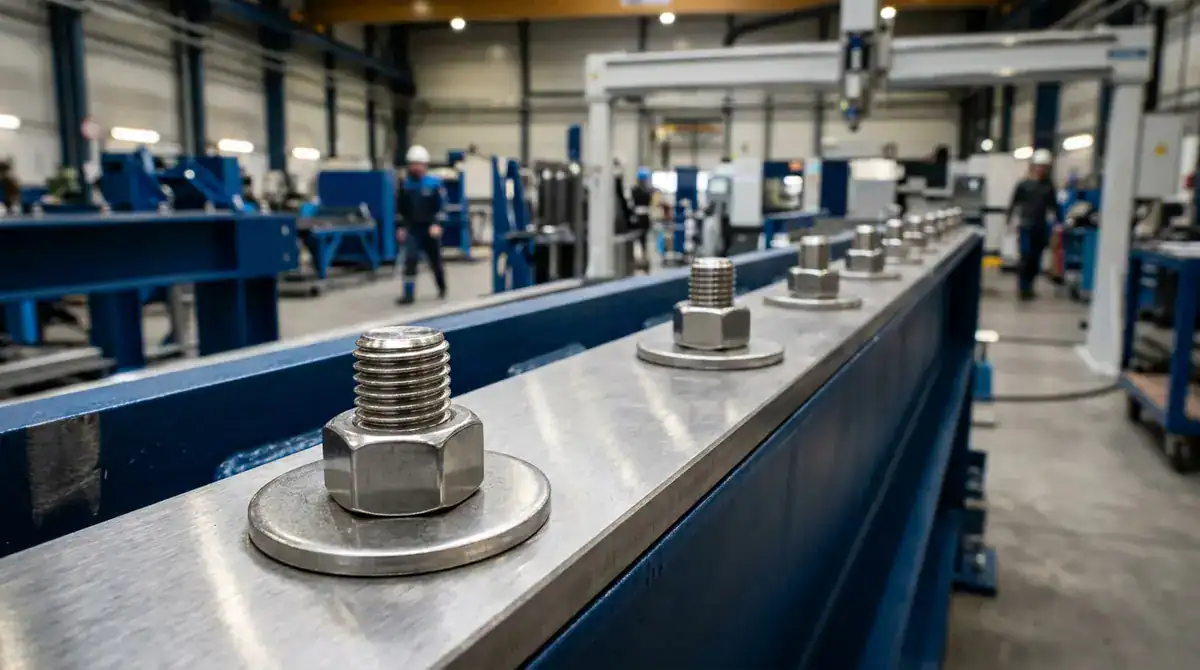
A reliable bolt nut stainless steel assembly starts with the right grade, correct thread match, suitable nut style, and installation method that prevents galling. Choose 304 stainless steel for general corrosion resistance and 316 stainless steel for salt, moisture, marine, or chemical exposure. For OEM production, always specify the standard, size, grade, tolerance, finish, washer requirements, and inspection documents before ordering.
For bulk stainless steel bolts, nuts, washers, threaded rods, and custom fasteners, DingLong Hardware can support DIN/ISO standard parts and drawing-based production for industrial buyers.
Send the standard, drawing, grade, quantity, finish, documentation needs, and packaging requirements through the contact page. A clear technical request helps us quote the correct bolt nut stainless steel assembly instead of guessing from a short description.
Related Products
Solutions & Cluster
Related Articles
- Nylon Lock Nuts: The Complete Guide to Types, Sizes, Specs & Applications (2026)
- M2 Screw Size: Complete Dimensions, Types & Selection Guide (2026)
- M2 Screw Dimensions: Complete Size Chart, Head Types & Specs
- U-Bolt Fasteners: The Complete Guide to Types, Sizes & Applications
- Top Silicon Bronze Bolts for Durable and Reliable Fastening Solutions
- Threaded Bar: Complete Guide to Types, Grades, and Applications (2026)
- Sex Screw (Sex Bolt): Complete Guide to Types, Uses & Installation
- Nut Caging: Complete Guide to Cage Nuts, Types & Installation