 English
  German
  Spanish
  Portuguese
  French
  Japanese
  Arabic
  Korean
  Vietnamese
  Russian
 Screw Nut Bolt: The Complete Guide to Fastener Types, Grades & Selection
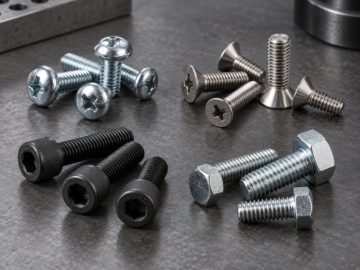
A screw, nut, and bolt are threaded fasteners that clamp materials together — screws thread into a base, bolts pair with nuts, and together they form the backbone of mechanical assembly.
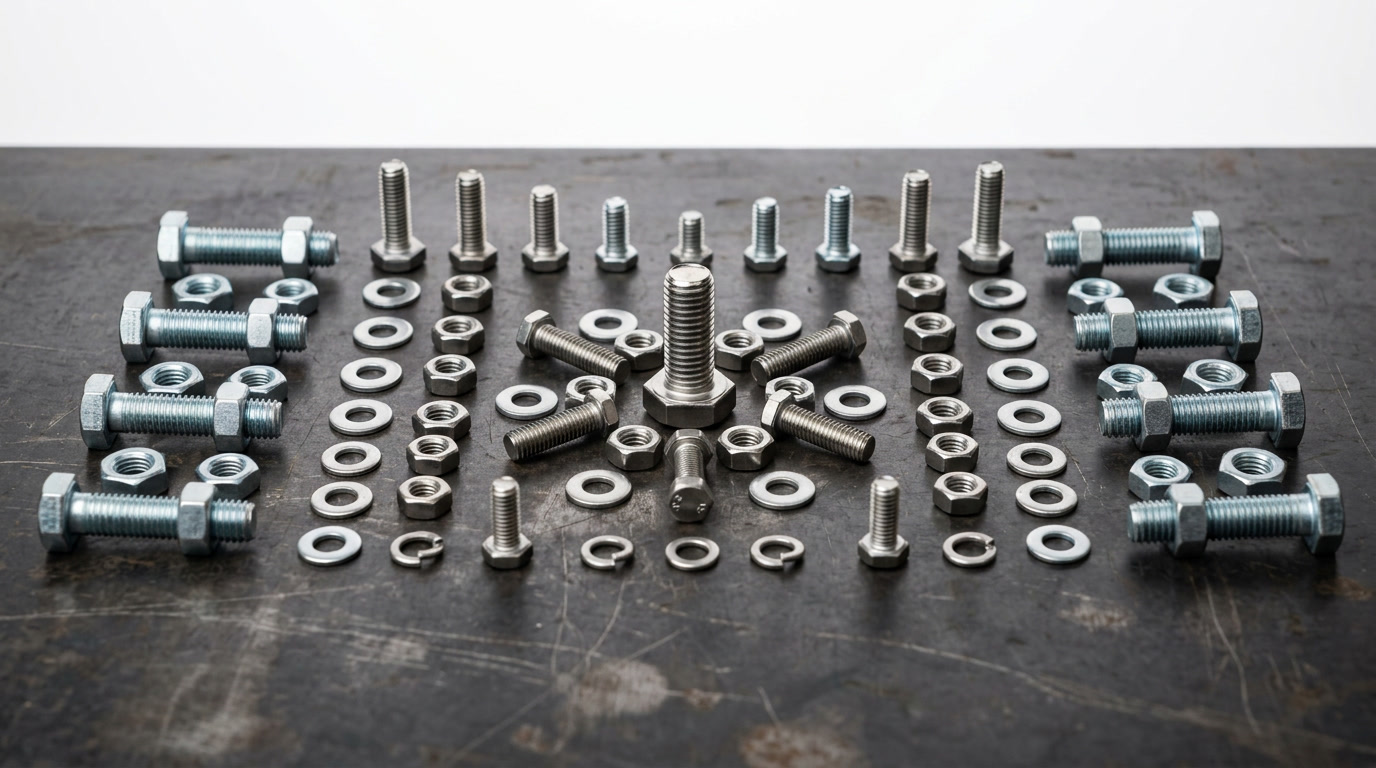
You’re in the hardware aisle, staring at bin after bin of glinting steel. Hex bolts, machine screws, flange nuts, carriage bolts — hundreds of options, and the wrong one means a wobbly shelf, a stripped thread, or worse, a structural failure on a load-bearing joint. The difference between a secure connection and a costly mistake comes down to understanding exactly what you’re holding.
This guide covers every major screw, nut, and bolt type, explains how material grades affect strength and corrosion resistance, walks through thread standards (metric, UNC, UNF), and gives you a practical selection framework you can use on your next project — whether that’s a deck railing, a CNC machine, or an automotive chassis.
What Is a Screw Nut Bolt — Definitions and Differences
A screw, a nut, and a bolt are all threaded fasteners, but they work differently and are not interchangeable.
A bolt is an externally threaded fastener designed to be used with a nut. It doesn’t cut its own threads — it relies on the nut on the opposite end to clamp materials between the bolt head and the nut face. Bolts typically have a smooth (unthreaded) shank near the head, which is important for shear-load applications.
A screw is a fastener that engages threads cut into a mating component — either a pre-tapped hole in metal, or threads it creates itself when driven into wood or plastic. Most screws are fully threaded. Machine screws, wood screws, and self-tapping screws all work this way.
A nut is an internally threaded hex (or other shaped) component that pairs with a bolt. The nut and bolt together create a clamped joint that can be disassembled without damaging either part.
Key Structural Differences
| Feature | Bolt | Screw | Nut |
|---|---|---|---|
| External threads | ✅ Yes | ✅ Yes | ❌ No (internal) |
| Needs a mating nut | ✅ Usually | ❌ No | Pairs with bolt |
| Self-tapping capability | ❌ No | Some types ✅ | N/A |
| Typical shank | Partial (smooth + threaded) | Fully threaded | N/A |
| Common head styles | Hex, socket, flange | Hex, Phillips, Torx, slotted | Hex, flange, cap, lock |
What Are Screws, Nuts, and Bolts Collectively Called?
Together, they’re called fasteners or threaded fasteners. The broader category includes washers, rivets, anchors, and clips, but screws, nuts, and bolts account for the overwhelming majority of mechanical joining in construction, manufacturing, and repair. According to the University of Florida’s mechanical engineering fastener reference, threaded fasteners are the primary removable joining method in structural and machine assembly.
When to Use a Bolt vs. a Screw
Use a bolt + nut when:
– Both sides of the joint are accessible
– You need a clamped joint that distributes load across a large bearing area
– The joint must be disassembled and reassembled repeatedly
Use a screw when:
– Only one side is accessible (e.g., threading into a casting, wall stud, or wood member)
– You’re threading into a pre-tapped metal component
– Speed and simplicity matter more than reusability
Types of Bolts: A Complete Reference
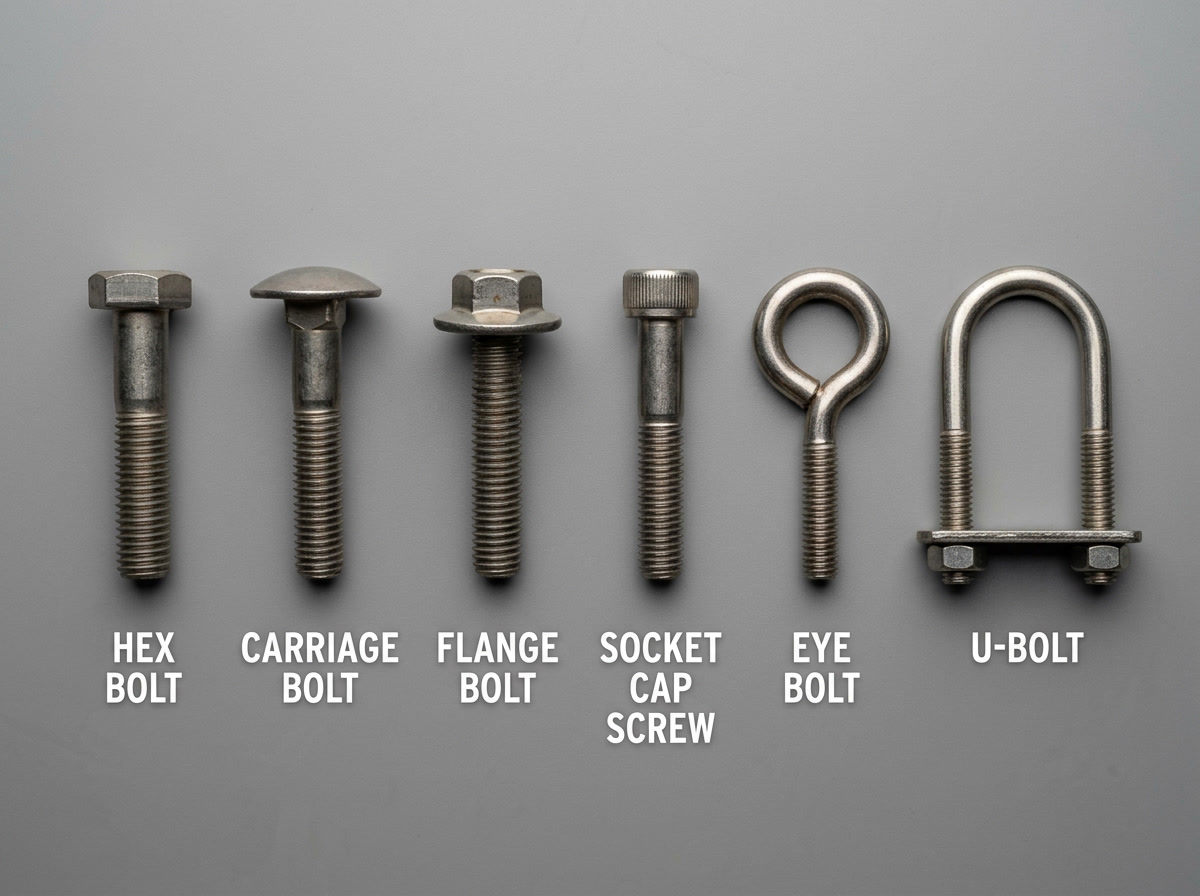
Bolts come in dozens of configurations. Here are the types you’ll encounter most often in structural, mechanical, and industrial work.
Hex Bolts (Hex Cap Screws)
The most common bolt in general use. The six-sided (hexagonal) head accepts a wrench or socket, making it easy to torque to specification. Hex bolts are available in grades from Grade 2 (low-strength, general purpose) to Grade 8 (high-strength, automotive and machinery) in imperial, and from Class 4.8 to Class 12.9 in metric.
When to use: Structural connections, machinery assembly, automotive, framing hardware.
Carriage Bolts
Carriage bolts have a smooth, rounded head with a square neck underneath that bites into wood to prevent spinning during tightening. They’re designed for wood-to-wood or wood-to-metal connections where the bolt head sits flush or proud on the surface.
When to use: Deck boards, wood framing, play equipment, trailer beds.
Flange Bolts
A flange bolt has an integrated washer-like flange below the head, distributing clamp load across a wider bearing area without a separate washer. Flange bolts are common in automotive (exhaust systems, engine mounts), plumbing, and structural connections. The serrated flange variant adds vibration resistance by biting into the mating surface.
When to use: Automotive assemblies, pipe flanges, sheet metal, vibration-prone environments.
Socket Head Cap Screws (SHCS)
Despite the name, these are technically bolts — they have a cylindrical head with an internal hex (Allen) socket. SHCS fasteners are precision ground to tight tolerances and are the go-to choice in machine design where access is limited and torque control is critical.
When to use: CNC machines, tooling, gearboxes, tight-clearance assemblies.
Eye Bolts and U-Bolts
Eye bolts have a looped head for attaching cables, chains, or hooks. U-bolts are curved in a U-shape with threads on both legs — they’re used to clamp around pipes, tubes, or round bars.
When to use: Rigging, pipe hangers, trailer hitches, antenna mounts.
Anchor Bolts and Foundation Bolts
Set into concrete during pouring, anchor bolts provide a threaded protrusion that structural steel columns, sill plates, or equipment bases bolt to. They’re the critical link between a concrete foundation and the structure above.
When to use: Foundation connections, concrete-mounted machinery, signage.
| Bolt Type | Head Style | Best For | Grade Availability |
|---|---|---|---|
| Hex bolt | Hex | General structural | Grade 2, 5, 8 / Class 8.8, 10.9 |
| Carriage bolt | Round dome | Wood connections | Grade 2, 5 |
| Flange bolt | Hex with flange | Automotive, vibration | Grade 5, 8 |
| Socket cap | Cylindrical hex socket | Precision machinery | Class 10.9, 12.9 |
| Eye bolt | Loop | Rigging, lifting | Grade varies |
| U-bolt | U-shape | Pipe/tube clamping | Grade 2, 5 |
Types of Screws and Their Applications
Screws differ from bolts primarily in that they thread directly into the material rather than relying on a separate nut. The right screw type depends on the base material (wood, metal, plastic, masonry) and the load demands.
Machine Screws
Machine screws have machine-cut threads at uniform pitch and are used in pre-tapped holes in metal, plastic, or with matching nuts. Common head styles include pan head, flat (countersunk) head, round head, and truss head. Drive types include Phillips, Torx, slotted, and hex socket.
In practice: When a machine screw is going into a blind hole in aluminum with coarse threads, a titanium nitride-coated tap makes a measurable difference in thread quality. We’ve seen stripped threads in aluminum most often from using the wrong tap drill size — always check the thread chart.
Wood Screws
Wood screws have coarse, tapered threads designed to pull into wood fibers. Modern construction screws (like #10 deck screws) are hardened and coated for outdoor use, while fine drywall screws are optimized for gypsum board and light framing.
When to use: Wood framing, cabinetry, decking, furniture.
Sheet Metal Screws (Self-Tapping)
Self-tapping screws cut their own threads in thin metal, plastic, or fiberglass. Type A has a pointed tip for starting in pre-drilled holes; Type B (blunt tip) is for tapping into heavier gauge material with a clearance hole already drilled. Tek screws (drill-point) eliminate the need for pre-drilling entirely.
When to use: HVAC ductwork, metal roofing, electrical enclosures, automotive body panels.
Set Screws
Set screws (grub screws) have no head — they’re threaded entirely and tighten flush with or below the surface. The cup-point, cone-point, or flat-point end presses against or bites into a shaft to hold a collar, pulley, or gear in position without creating a protruding snag hazard.
When to use: Shaft collars, pulleys, gear hubs, conveyor components.
Lag Screws (Lag Bolts)
Despite being called “bolts” informally, lag screws are driven with a wrench into pre-drilled wood or timber. The coarse hex-head design provides enormous holding power in structural timber connections like ledger boards, stair stringers, or beam-to-post connections.
When to use: Heavy timber framing, deck ledgers, post anchors, structural landscaping.
Types of Nuts: Locking, Flange, and Specialty
The nut’s job is to provide the other half of the threaded clamp. But not all nuts are equal — the locking mechanism, bearing area, and material coating all affect whether the joint stays put under vibration and load cycling.
Hex Nuts
Standard hex nuts are the default. They’re available in regular (full-height), thin (jam), and heavy patterns. A jam nut is torqued against a standard nut to prevent the pair from backing off — a simple, time-tested anti-vibration strategy.
Nylon Insert Lock Nuts (Nylock)
A nylon collar inside the top of the nut compresses when the bolt threads engage it, creating friction that resists loosening. Nylock nuts are single-use in theory (the nylon deforms), but in practice, they work adequately for 2–3 reuses in non-critical applications.
Limitation: Don’t use above 230°F (110°C) — the nylon softens.
Flange Nuts
Like flange bolts, flange nuts have a built-in washer face. The serrated flange variant bites into the mating surface, providing positive anti-rotation under vibration. These are standard on exhaust manifolds, suspension components, and HVAC equipment.
Prevailing Torque Lock Nuts (All-Metal)
For high-temperature applications where nylon inserts fail, all-metal prevailing torque nuts (elliptical body distortion, offset threads, or spring collar designs) provide vibration resistance up to 500°F+. Aircraft and automotive exhaust systems rely on these.
Cap Nuts (Acorn Nuts)
Dome-shaped cap nuts cover the exposed bolt end for aesthetics, safety (sharp thread ends), and to prevent corrosion of exposed threads in marine or outdoor use.
T-Nuts and Weld Nuts
T-nuts press or hammer into wood from the back side, providing a flush, threaded insert for bed rails, flat-pack furniture, and climbing holds. Weld nuts are fused to a metal panel by spot welding, giving a permanently fixed threaded point.
| Nut Type | Anti-Vibration | Temp Limit | Best For |
|---|---|---|---|
| Hex (standard) | None | Unlimited (steel) | General use |
| Nylock | Moderate | 230°F / 110°C | General machinery, auto |
| Serrated flange | Good | Unlimited | Automotive, HVAC, structural |
| All-metal prevailing torque | Excellent | 500°F+ | Exhaust, aircraft, industrial |
| Jam nut (double-nutting) | Good | Unlimited | Adjustable connections |
How to Select the Right Screw Nut Bolt for Your Application
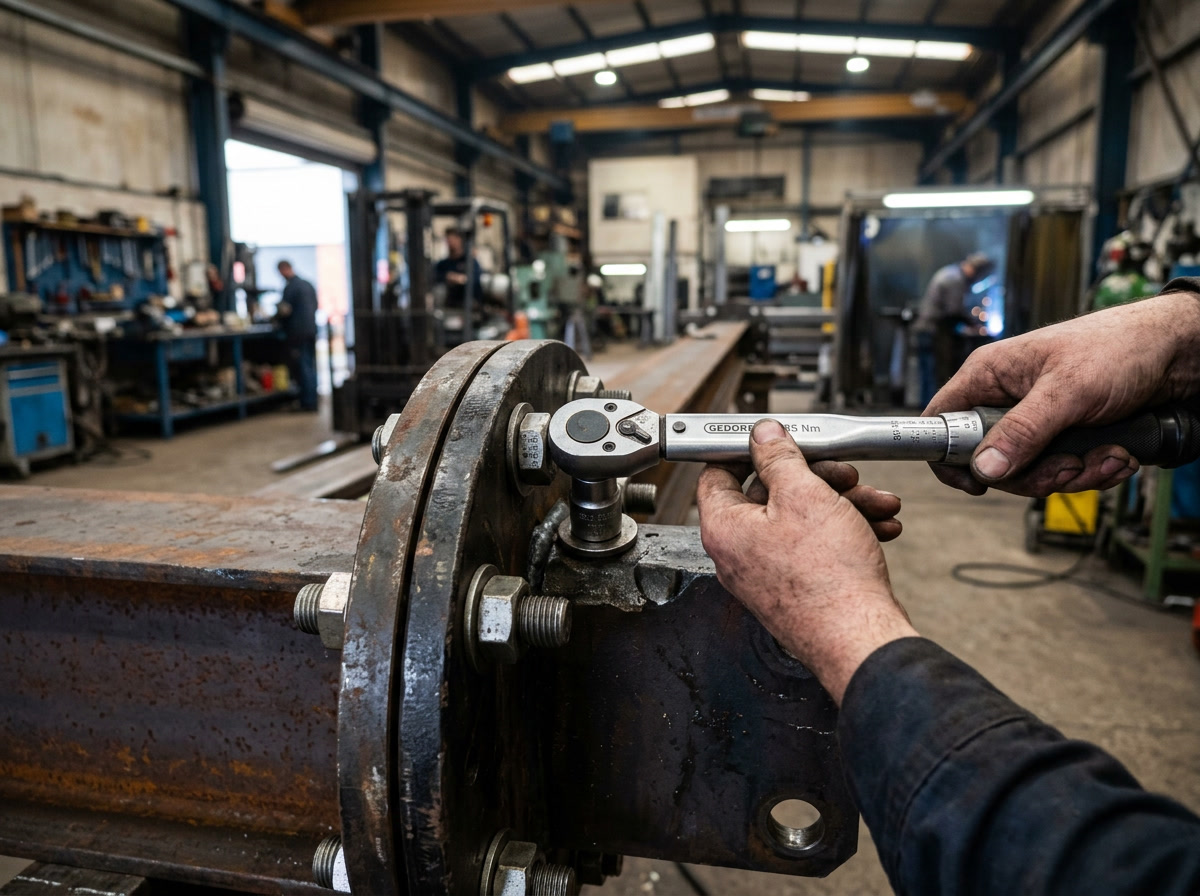
Choosing the wrong fastener is one of the most common and costly mistakes in construction and machinery. Here’s the decision framework we use.
Step 1: Determine the Load Type
Tensile (axial) load — pulling force along the bolt axis. Use high-grade bolts (Grade 8 / Class 10.9+) and torque to spec to create maximum preload.
Shear load — force perpendicular to the bolt axis. Use bolts with an unthreaded shank spanning the shear plane. Shoulder bolts are specifically designed for this. Never put shear loads in the threaded section.
Vibration — cyclic loading that slowly backs nuts loose. Use Nylock nuts, serrated flange nuts, or thread-locking compound (Loctite 243 for general use, Loctite 271 for permanent).
Step 2: Choose the Material and Grade
Material grade determines tensile strength, yield strength, and hardness. Grade confusion is one of the most common errors — using Grade 2 bolts where Grade 8 is specified, or using soft standard-grade nuts with high-strength bolts (the nut will strip first).
| Grade | Tensile Strength | Identification | Typical Application |
|---|---|---|---|
| Grade 2 (SAE) | 74,000 psi | No markings | Light-duty, general hardware |
| Grade 5 (SAE) | 120,000 psi | 3 radial lines | Structural, automotive |
| Grade 8 (SAE) | 150,000 psi | 6 radial lines | High-stress, critical joints |
| Class 8.8 (Metric) | 116,000 psi | “8.8” on head | General machinery |
| Class 10.9 (Metric) | 145,000 psi | “10.9” on head | High-strength machinery |
| Class 12.9 (Metric) | 174,000 psi | “12.9” on head | Maximum strength, socket caps |
| 18-8 Stainless | 80,000–100,000 psi | Varies | Corrosion-resistant |
| 316 Stainless | 84,000 psi | Varies | Marine, chemical environments |
The ASTM F568M standard governs metric bolt properties for carbon and alloy steel fasteners — a useful reference when specifying hardware for structural or pressure-system applications.
Step 3: Match Thread Standards
Imperial (UNC / UNF):
– UNC (Unified National Coarse) — fewer threads per inch, faster assembly, better for softer materials and field conditions
– UNF (Unified National Fine) — more threads per inch, finer adjustment, better preload in precision machinery
Metric (M-series):
– Standard coarse pitch (e.g., M8 × 1.25) — general machinery
– Fine pitch (e.g., M8 × 1.0) — precision equipment, thin walls
Never mix metric and imperial. A 3/8-16 bolt (imperial) and an M10 × 1.5 (metric) look similar but are NOT interchangeable. Cross-threading damages both parts.
Step 4: Select the Coating for Your Environment
Bare steel corrodes rapidly in wet or outdoor environments. Coating choice should match the exposure conditions:
- Zinc-plated (electroplated): Low cost, moderate corrosion resistance. Good for indoor or sheltered applications. Not suitable for marine or direct-weather exposure.
- Hot-dip galvanized (HDG): Thick zinc coating (2–4 mil), excellent outdoor durability. Required by code for most deck ledger connections. Note: HDG bolts require HDG nuts (the coating adds thickness).
- Stainless steel (18-8 or 316): Excellent corrosion resistance. 316 is for marine environments. Not compatible with galvanic coupling to aluminum — use isolation washers.
- Black oxide / phosphate: Aesthetic finish with minimal corrosion protection — for indoor machinery.
- Dacromet / geomet: Premium coating for automotive underbody and high-corrosion industrial applications.
Step 5: Torque to Specification
Proper torque creates the preload — the tension in the bolt that keeps the joint clamped. Over-torquing strips threads or yields the bolt; under-torquing lets the joint shift or loosen.
In practice, we’ve found that approximately 90% of hand-tool installations in field conditions are either over- or under-torqued by more than 20% when torque wrenches aren’t used. For structural connections, always use a calibrated torque wrench. For general hardware, at minimum use the snug-tight + turn-of-nut method.
Rule of thumb for Grade 5 hex bolts (dry, no lubrication):
– 1/4″-20: ~8 ft-lb
– 3/8″-16: ~31 ft-lb
– 1/2″-13: ~75 ft-lb
– 5/8″-11: ~150 ft-lb
Industry Applications: Where Screw Nut Bolt Systems Matter Most
Understanding which fastener systems dominate each industry helps you speak the language of procurement and avoid spec mismatches.
Construction and Structural Steel
Structural bolts (ASTM A325 and A490) are the workhorses of steel framing. A325 bolts correspond roughly to Grade 5 SAE, A490 to Grade 8. High-strength structural bolts are torqued to proof load — a specific fraction of their tensile capacity — using calibrated wrenches or direct-tension indicators (DTI washers).
Automotive and Powertrain
Automotive applications push fasteners hard. Cylinder head bolts, rod bolts, and main cap bolts are torqued to yield — meaning the bolt is intentionally stretched past its yield point for maximum preload. These are single-use fasteners and must be replaced during every rebuild. Exhaust manifold studs and turbocharger bolts see 900°F+, requiring high-nickel alloy steel or Inconel fasteners.
HVAC and Plumbing
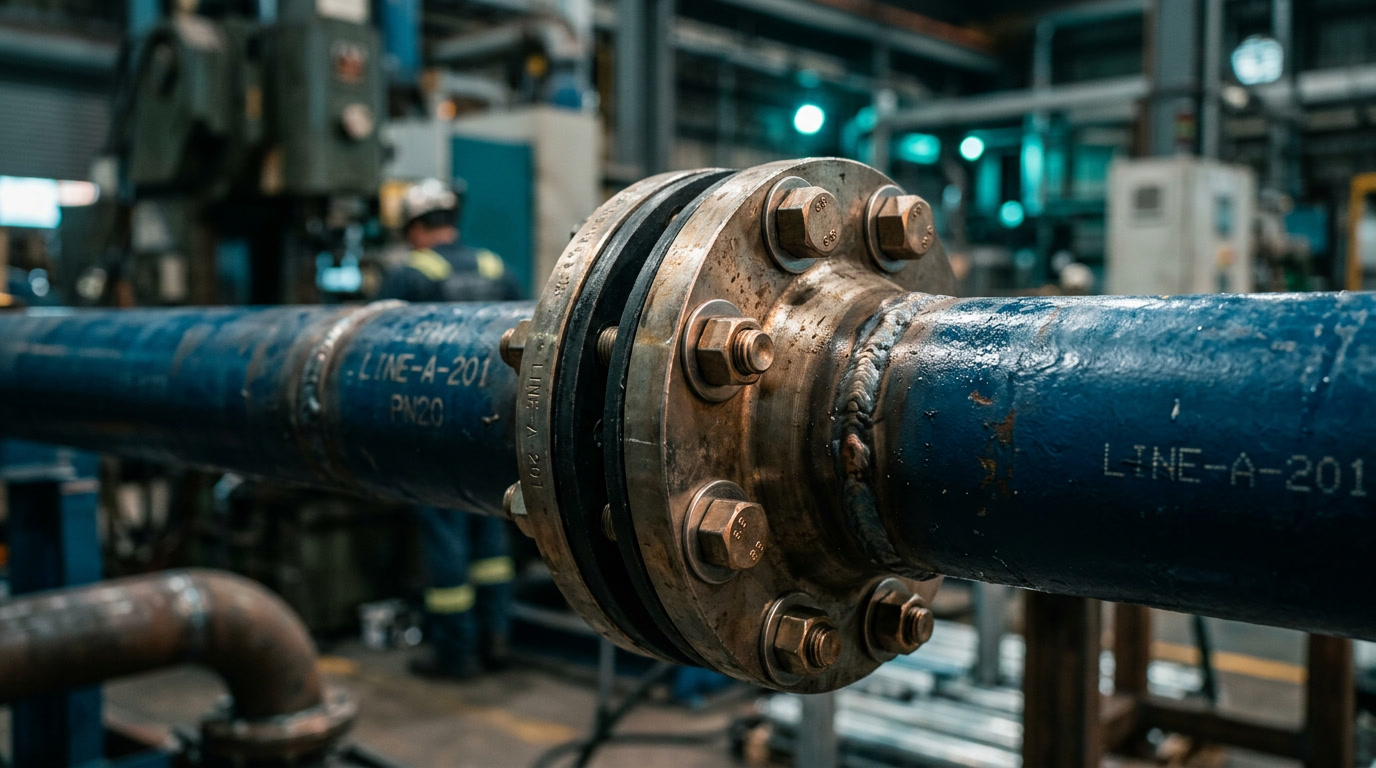
Sheet metal screws dominate HVAC duct work. Pipe flanges use large-diameter bolts (often ASTM A193 B7 stud bolts) torqued in a cross-pattern sequence to prevent gasket distortion. Compression fittings and push-to-connect systems are replacing traditional bolt-flange joints in residential plumbing, but industrial systems still depend on bolted flanges.
Electronics and Precision Assembly
M2, M3, and M4 socket head cap screws are the norm in electronics enclosures, PCB standoffs, and precision instruments. Thread-locking compound isn’t always appropriate here — a drop of 222 (removable, low-strength) or a star washer achieves retention without chemical contamination.
Marine and Offshore
316L stainless steel is the minimum for saltwater environments; Duplex 2205 or titanium for extreme cases. Galvanic compatibility is critical — never use stainless bolts in direct contact with aluminum structure without isolation. Wikipedia’s overview of marine fastener selection highlights that material compatibility is as important as strength grade in corrosive environments.
Future Trends in Fastener Technology (2026 and Beyond)
The fastener industry isn’t standing still. Several trends are reshaping what screws, nuts, and bolts look like and how they’re specified.
Smart Fasteners and IoT Integration
Sensor-embedded bolts now exist for bridge structures, aircraft frames, and wind turbine towers. These bolt-integrated strain gauges or piezoelectric sensors transmit clamp load data in real time, eliminating periodic manual torque audits. The global smart fastener market was valued at approximately $1.2 billion in 2024, with projected 8.4% CAGR through 2030 (Source: industry research consensus across multiple analyst reports).
Advanced Coatings and Corrosion Science
Geomet and Dacromet coatings — zinc-aluminum flake systems applied at 300°C — are displacing electroplated zinc in automotive and renewable energy applications. These coatings achieve salt-spray resistance of 720+ hours (versus ~96 hours for standard zinc plate) without hydrogen embrittlement risk. Hydrogen embrittlement is a real failure mode in electroplated high-strength bolts (Class 10.9+) — the Smashing Magazine of materials science, The Engineering Toolbox’s fastener section, documents multiple grades and their coating compatibility.
Additive Manufacturing of Custom Fasteners
Metal 3D printing (selective laser sintering in 316L or Inconel) is allowing manufacturers to produce custom fastener geometries — integrated bolt + spacer + shoulder configurations — that previously required multiple components. Lead times drop from 6 weeks to 3 days for prototype quantities.
Sustainable Fastener Certification
Low-carbon and recycled-steel certified fasteners are entering the supply chain as ESG requirements filter into procurement. ISO 14001-certified manufacturing plants and EPD (Environmental Product Declaration) labeling for structural fasteners are now requested in major infrastructure projects in the EU and increasingly in North America.
AI-Driven Fastener Specification
CAD-integrated AI tools now auto-specify fasteners based on FEA load analysis and automatically flag under- or over-specified bolts in assembly drawings. This is reducing design-phase errors that previously only surfaced as field failures.
FAQ — Screw Nut Bolt Common Questions
What is a screw nut bolt?
A screw, nut, and bolt are threaded fasteners — bolts clamp materials using a paired nut, screws thread into the base material directly, and nuts provide the threaded counterpart for bolts. Together, they’re the most widely used removable mechanical joining system in engineering.
What are screws, nuts, and bolts called collectively?
They’re called fasteners or threaded fasteners. Broader categories include mechanical fasteners (which also covers rivets, pins, and clips) and hardware. In industrial procurement, the category is often shortened to “fasteners” or “bolted connections.”
What are the four types of fasteners?
The four main categories are: (1) threaded fasteners (bolts, screws, nuts, studs), (2) non-threaded fasteners (rivets, pins, clips), (3) integral fasteners (formed tabs, snap-fits, crimps), and (4) welded/bonded joints (though this last category is sometimes excluded from “fastener” classifications).
What is the difference between a bolt and a screw?
A bolt uses a nut on the opposite face to clamp materials together and typically has an unthreaded shank near the head. A screw threads directly into the mating material and is fully threaded. In casual use the terms are often mixed, but in engineering specifications they’re distinct.
How do I know what grade bolt to use?
Match the grade to the calculated joint load with a safety factor. Grade 5 (SAE) or Class 8.8 (metric) handles most structural and machinery applications. Grade 8 / Class 10.9 for high-stress, vibration, or fatigue-prone joints. Class 12.9 for precision machinery and maximum preload needs. When in doubt, the UFL Engineering Lab fastener guide provides load tables for common bolt diameters and grades.
Why do nuts loosen under vibration?
Vibration causes micro-movement at the bearing surfaces, incrementally relaxing the bolt’s preload (tension). Once preload drops below a threshold, the nut can rotate freely. Prevention options in order of reliability: thread-locking compound (Loctite 243), nylon insert lock nuts, serrated flange nuts, double-nutting (jam nut), and spring washers (least reliable — avoid for critical joints).
What is the difference between metric and imperial fasteners?
Metric fasteners (M-series) are specified by diameter in millimeters and thread pitch in mm/thread (e.g., M8 × 1.25). Imperial fasteners use diameter in fractions of an inch and threads per inch (e.g., 1/2-13 UNC). They are NOT interchangeable — a metric bolt will cross-thread in an imperial nut even if the fit feels initially possible.
Conclusion
The screw nut bolt system is deceptively simple on the surface — a helix wrapped around a cylinder — but the engineering behind a well-specified bolted joint involves thread geometry, material grade, coating chemistry, torque mechanics, and vibration dynamics. The difference between a joint that lasts 30 years and one that fails in the first season almost always comes down to selecting the right fastener for the actual conditions, then torquing it correctly.
Start with the load type (tensile, shear, or vibration), pick the grade that gives you adequate safety factor, match the coating to the environment, use the correct thread standard, and torque to specification. That framework handles 95% of fastener decisions. For the remaining 5% — high-temperature, high-fatigue, structural-critical, or chemically aggressive applications — consult the relevant ASTM or ISO standards, and consider a fastener specialist for material selection.
For a full range of industrial screws, bolts, nuts, and flange fasteners with custom coating options, browse the productionscrews.com fastener catalog.
Related Products
Solutions & Cluster
Related Articles
- Shear Bolts: Security Types, Materials, and Buying Guide for Permanent Fastening
- Security Bolts: Complete Guide to Types, Applications & Choosing the Right Fastener
- M2 Screw Size: Complete Dimensions, Types & Selection Guide (2026)
- Bolt Nut Stainless Steel: Grades, Pairing, and Buying Guide
- Nylon Lock Nuts: The Complete Guide to Types, Sizes, Specs & Applications (2026)
- Fasteners Brass: Complete Guide to Brass Fasteners, Grades, Uses, and Buying in 2026
- Nylock Nuts: The Complete Guide to Nylon Insert Lock Nuts
- Bolt Screw Guide: Types, Differences, Sizes, and Industrial Applications