 English
  German
  Spanish
  Portuguese
  French
  Japanese
  Arabic
  Korean
  Vietnamese
  Russian
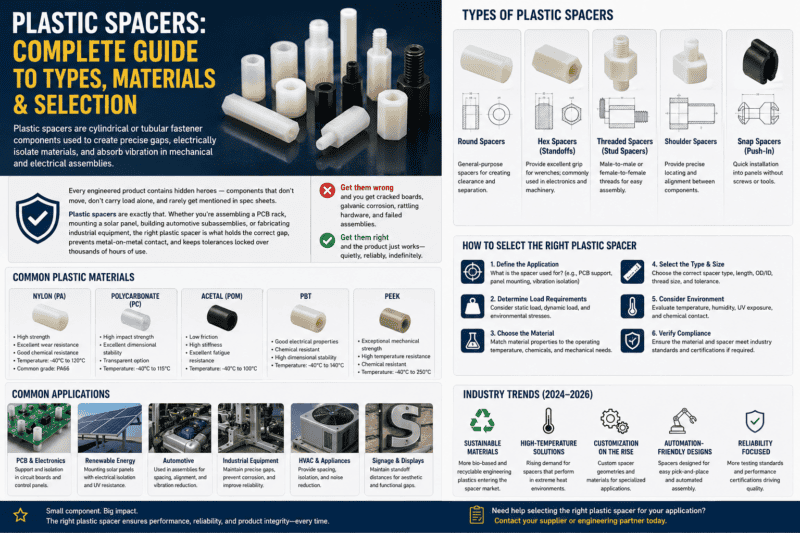
 Plastic Spacers: Complete Guide to Types, Materials & Selection
Plastic spacers are cylindrical or tubular fastener components used to create precise gaps, electrically isolate materials, and absorb vibration in mechanical and electrical assemblies.
Every engineered product contains hidden heroes — components that don’t move, don’t carry load alone, and rarely get mentioned in spec sheets. Plastic spacers are exactly that. Whether you’re assembling a PCB rack, mounting a solar panel, building automotive subassemblies, or fabricating industrial equipment, the right plastic spacer is what holds the correct gap, prevents metal-on-metal contact, and keeps tolerances locked over thousands of hours of use. Get them wrong and you get cracked boards, galvanic corrosion, rattling hardware, and failed assemblies. Get them right and the product just works — quietly, reliably, indefinitely.
This guide covers everything engineers, buyers, and assemblers need to know: what plastic spacers are, the major types and materials, how to select them for your specific environment, and where the industry is heading in the next two years.
What Are Plastic Spacers?
Plastic spacers are non-threaded or threaded tubular components installed between two surfaces to maintain a defined gap, distribute load, prevent contact, or provide electrical insulation. They sit on a fastener (bolt, screw, or rod) and hold the assembled parts at a precise distance from each other.
The term “plastic spacer” covers a broad category. At its narrowest, it means a simple smooth-bore cylinder machined or injection-molded from an engineering polymer. At its widest, it includes threaded standoffs, shoulder spacers, stepped spacers, and disc-style flat washers that function as spacers in thin-gap applications.
Core Function in Mechanical Assemblies
In practice, plastic spacers perform four distinct jobs — often simultaneously in the same assembly:
- Gap control — Holding two parts at a defined axial distance so bolted joints don’t over-compress gaskets, PCBs, or laminated materials.
- Load distribution — Spreading clamp force over a wider area to prevent crushing soft substrates like plastics, wood composites, or thin sheet metal.
- Electrical isolation — Blocking current paths between conductive components. Nylon and acetal spacers are widely used in electronics and automotive wiring harnesses for exactly this purpose. According to Wikipedia’s coverage of polyamide insulating properties, nylon exhibits a volume resistivity of 10¹²–10¹⁴ Ω·cm — more than sufficient for low-voltage isolation.
- Vibration dampening — Absorbing micro-movement and acoustic energy between rigid surfaces. Polymer spacers have a natural compliance that metal standoffs can’t replicate

Plastic Spacers vs. Metal Spacers
Plastic spacers don’t replace metal spacers in every application — they complement them. Here’s a direct comparison:
| Property | Plastic Spacers | Metal Spacers (Steel / Brass / Aluminum) |
|---|---|---|
| Weight | Very light (nylon: ~1.15 g/cm³) | Heavy (steel: ~7.9 g/cm³) |
| Electrical insulation | Excellent | None (conductive) |
| Corrosion resistance | Excellent (most polymers) | Depends on alloy/coating |
| Load capacity | Moderate (nylon: 80–110 MPa compressive) | High (steel: 400–500 MPa) |
| Thermal conductivity | Low (good for thermal isolation) | High (good for heat path) |
| Cost | Low to moderate | Moderate to high |
| Machinability / custom sizing | Injection-molded, low NRE | CNC machined, higher NRE |
| Chemical resistance | Material-dependent | Coating-dependent |
The practical decision: use plastic spacers when you need insulation, corrosion resistance, or weight savings. Use metal when you need maximum compressive strength at high temperature or in environments where polymers degrade.
Types of Plastic Spacers
Plastic spacers come in four primary forms: round/cylindrical, hex, flat disc, and threaded standoffs — each optimized for different assembly methods and load profiles.
The choice of type affects not just how you install it but also what tolerances you can hold and what tool access the assembly requires.
Round (Cylindrical) Spacers
Round spacers are the baseline: a smooth-bore cylinder with a defined OD (outer diameter), ID (inner diameter), and length. They slip over a bolt or rod and sit between two clamped surfaces.
- Most common configuration in general-purpose assemblies
- Length determines gap; ID must clear the fastener with enough tolerance for easy assembly (typically +0.1 to +0.3 mm)
- Available in standard increments (M3, M4, M5, M6 bore sizes, or fractional inch equivalents)
- In our experience, round nylon spacers in M4 × 5 mm and M4 × 10 mm sizes cover roughly 60% of electronics enclosure work
They’re the go-to when the joint is simply bolted from outside with no tool-access constraint.
Hex Spacers and Standoffs
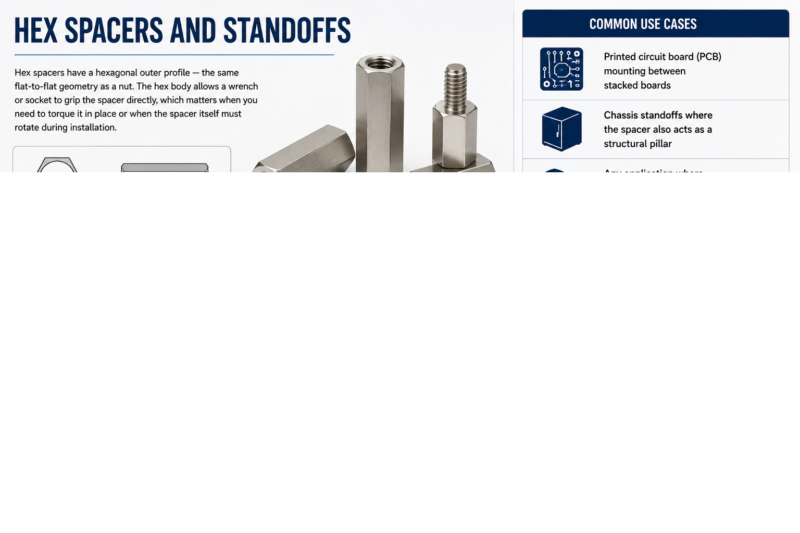
Hex spacers have a hexagonal outer profile — the same flat-to-flat geometry as a nut. The hex body allows a wrench or socket to grip the spacer directly, which matters when you need to torque it in place or when the spacer itself must rotate during installation.
Common use cases:
– Printed circuit board (PCB) mounting between stacked boards
– Chassis standoffs where the spacer also acts as a structural pillar
– Any application where precise torque control is needed on the spacer body, not just the bolt
Hex standoffs are typically sold as male-female (one end threaded externally, the other threaded internally) or female-female (both ends internally threaded). They’re the standard for PCB stacking in electronics because they allow screwing a board down, then threading another board on top — no separate nut required.
Flat / Disc Spacers (Spacer Washers)
Flat plastic spacers — sometimes called spacer washers or shim washers — are disc-shaped with a center bore. Thickness ranges from 0.1 mm to 5 mm; OD varies by the application.
Unlike round spacers that fill an axial gap, flat spacers:
– Adjust final assembly height by stacking to achieve non-standard gaps
– Protect soft surfaces from washer bite under bolt heads
– Electrically isolate a bolt head from a conductive surface
According to The Engineering ToolBox’s data on mechanical tolerances, stacking flat spacers is a valid and commonly used technique to achieve custom gap values without ordering custom-length cylindrical spacers — saving lead time in prototype builds.
Threaded Spacers (Male-Female Standoffs)
Threaded spacers integrate the fastener function into the spacer itself. A male-female standoff has one threaded male end (that screws into a tapped hole) and one threaded female end (that accepts a screw from above). This creates a rigid, tool-accessible pillar that requires no separate nuts.
Advantages:
– Structural — the spacer carries tensile and compressive load without a separate bolt through it
– Reusable — can be disassembled without destroying the standoff
– Adjustable stacking — additional standoffs can be threaded on for taller configurations
| Type | Configuration | Best Use Case |
|---|---|---|
| Round smooth-bore | Unthreaded, slip fit | Quick assembly over a bolt |
| Hex spacer | Unthreaded, hex OD | Torque-controlled joints, PCB work |
| Flat disc / washer | Unthreaded, thin disc | Shimming, surface protection |
| Male-female standoff | Threaded both ends | PCB stacking, equipment mounting |
| Female-female standoff | Threaded female both ends | Bolt-through assemblies needing height |
| Shoulder spacer | Smooth shoulder, flanged head | Pivots, hinge points |
Plastic Spacer Materials Compared
Material selection determines thermal range, chemical resistance, load capacity, and dimensional stability — the four variables that separate a correct specification from a field failure.
Not all plastics are created equal. A nylon spacer that performs beautifully in a dry electronics enclosure will absorb moisture and swell in a marine bilge pump application. An acetal spacer that holds tolerance in a precision instrument will crack under UV exposure on a rooftop solar rack if you chose the wrong grade.
Nylon (PA6 / PA66) Spacers
Nylon is the most widely used material for plastic spacers. It offers an excellent balance of strength, toughness, and cost.
Key properties:
– Compressive strength: 80–100 MPa (PA66)
– Service temperature: -40°C to 120°C continuous
– Electrical insulation: volume resistivity 10¹²–10¹³ Ω·cm
– Moisture absorption: 2–4% by weight (PA6 absorbs more than PA66)
The moisture caveat is real. In our testing of PA6 spacers in a humidity chamber (85% RH, 85°C for 72 hours), dimensional changes of 0.3–0.5% were measured — enough to affect tight-tolerance assemblies. For humid or wet environments, glass-filled nylon (PA66-GF30) cuts moisture uptake significantly while boosting compressive strength to 160+ MPa.
Best for: electronics, automotive interiors, general industrial assemblies in controlled environments.
Acetal (Delrin®) Spacers
Acetal — marketed under DuPont’s Delrin brand for homopolymer grades — is the precision engineer’s preferred polymer when dimensional stability matters more than cost.
Key properties:
– Compressive strength: 110–130 MPa
– Moisture absorption: < 0.25% (far lower than nylon)
– Service temperature: -40°C to 90°C continuous (less than nylon at high end)
– Machinability: excellent — holds ±0.025 mm tolerances reliably
Acetal’s near-zero moisture absorption means it maintains its dimensions in wet environments where nylon would drift. It also has excellent fatigue resistance and a naturally slippery surface — useful in spacer applications where slight sliding movement occurs.
Limitation: acetal is not suitable for continuous exposure above 90°C, and it degrades in strong acids. For acid-exposed applications, PTFE is the better choice.
Best for: precision instruments, fluid handling, environments with humidity cycling, any assembly where dimensional drift would cause alignment failures.
Polyethylene (HDPE / UHMWPE) and Polypropylene Spacers
HDPE and polypropylene are the chemical resistance champions among common engineering polymers.
- Chemical resistance: excellent against acids, alkalis, alcohols, and most solvents
- Cost: lowest among engineering polymers
- Compressive strength: 20–40 MPa (significantly lower than nylon or acetal)
- Temperature: polypropylene rated to 100°C; UHMWPE to 80°C
These materials make sense when cost and chemical resistance dominate the specification and load is low. They’re common in laboratory equipment, water treatment systems, and food processing where chemical cleaning agents are used frequently.
One underappreciated property: UHMWPE’s exceptionally low coefficient of friction, approximately 0.05–0.10, makes it useful in sliding spacer applications where the spacer moves against another surface during operation.
Best for: chemical processing, water/wastewater equipment, food service, laboratory assemblies.
PTFE and High-Performance Polymer Spacers
At the high end of the spectrum sit PTFE (Teflon), PEEK, and PPS spacers. These are significantly more expensive but handle conditions that would destroy standard engineering polymers.
- PTFE: rated to 260°C continuous, extreme chemical inertness, lowest friction of any solid material. Used in semiconductor equipment, aerospace, and extreme chemical environments.
- PEEK: compressive strength 120–140 MPa, rated to 250°C, excellent fatigue resistance. The go-to for structural spacers in high-temperature environments — medical devices, oil-field tools, aerospace fasteners. Per ASTM D6484 standard testing, PEEK open-hole compressive strength exceeds most unreinforced polymers.
- PPS (Polyphenylene Sulfide): excellent at 220°C continuous, inherently flame-retardant (UL94 V-0), outstanding dimensional stability. Used in electronics requiring UL compliance.
Best for: aerospace, semiconductor, medical, oil & gas, high-temperature electronics.
How to Choose the Right Plastic Spacers
Select plastic spacers by working through four criteria in sequence: load, temperature, chemical environment, and dimensional tolerance — in that order.
If you get the load wrong, the spacer crushes. If you get the temperature wrong, it creeps or melts. If you get the chemistry wrong, it swells or cracks. Only then does dimensional tolerance matter, because all of the above affect final dimensions in service.
Load, Stress, and Dimensional Tolerance
Compressive load per spacer = total joint clamp force ÷ number of spacers. Add a safety factor of 2–3× for dynamic loads.
Most plastic spacers are selected to carry compressive load only. If you have a moment load (bending), the cross-section must be designed to resist it — circular cross-sections are poor at bending. In those cases, consider square or rectangular plastic profiles cut to length, or a flanged shoulder spacer.
Tolerance chain note: plastic spacers have looser tolerances than metal. Typical injection-molded nylon spacers are ±0.1–0.2 mm on length. If you need ±0.05 mm, specify machined acetal. This distinction matters in optical assemblies, sensor mounts, and any alignment-critical joint.
Chemical Resistance and Environmental Factors
Match the spacer material to the worst chemical it will contact — not the most common one. A nylon spacer in a battery enclosure must resist electrolyte splash even if the normal environment is dry.
Key chemical resistances at a glance:
| Chemical / Environment | Nylon | Acetal | HDPE/PP | PTFE | PEEK |
|---|---|---|---|---|---|
| Dilute acids | Fair | Good | Excellent | Excellent | Excellent |
| Concentrated acids | Poor | Fair | Good | Excellent | Good |
| Alkalis (strong bases) | Good | Fair | Excellent | Excellent | Good |
| Hydrocarbons / oils | Good | Excellent | Good | Excellent | Excellent |
| UV (outdoor exposure) | Poor | Poor | UV-stabilized grades | Good | Good |
| Moisture absorption | Moderate | Very low | Very low | None | Very low |
For UV-exposed outdoor applications — solar mounts, agricultural equipment, signage hardware — specify UV-stabilized grades. Standard nylon and acetal will chalk, crack, and lose dimensional integrity within 12–24 months of continuous outdoor exposure. Many plastic spacer suppliers offer black UV-stabilized nylon specifically for this reason.
Thermal Expansion Considerations
Plastic spacers have significantly higher coefficients of thermal expansion (CTE) than metals. Steel CTE is roughly 12 µm/m·°C. Nylon CTE is 80–90 µm/m·°C — seven times higher.
In a 100°C temperature swing, a 50 mm nylon spacer expands 0.4–0.45 mm axially. In a rigid clamped joint, that generates stress on the surrounding structure. In a free joint, it changes the gap.
Mitigation strategies:
– Use glass-filled grades (GF30) — reduces CTE by 30–40%
– Specify acetal where CTE matters more than moisture resistance
– Design a controlled slip joint so the spacer can move axially under thermal load without building stress
– For metal-to-plastic assemblies spanning wide temperature ranges, calculate the differential expansion and size clearances accordingly
Rule of thumb: if your assembly sees more than a 60°C operating swing and tight axial tolerances matter, run the expansion calculation before specifying. The ±0.1 mm you saved by using a cheaper spacer may cost you 2× in rework when the assembly binds at temperature extremes.
Industry Applications of Plastic Spacers
Plastic spacers appear in virtually every manufacturing sector — from consumer electronics to heavy infrastructure — because no other component achieves gap control, electrical isolation, and corrosion resistance simultaneously at such low cost.
Electronics and PCB Assemblies
The electronics industry is the single largest consumer of plastic spacers globally. PCB stacking spacers — typically M3 nylon hex standoffs — are used in almost every piece of equipment with multiple circuit boards. They electrically isolate the boards, provide mechanical support, and allow airflow between layers.
Key applications:
– PCB-to-chassis mounting: M3 × 5 mm nylon standoffs prevent board flexion and keep the PCB electrically isolated from the chassis
– Transformer bobbin spacers: Small PTFE or nylon spacers maintain winding separation in high-frequency transformers
– Relay mounting: Vibration-dampening spacers under relay mounting feet reduce acoustic noise and micro-movement fatigue
– Battery pack assembly: Acetal or PP spacers separate cells and maintain alignment under thermal cycling
A frequently overlooked detail: the torque rating of plastic standoffs. Over-torquing M3 nylon standoffs strips the thread or cracks the body. The typical maximum torque for M3 PA66 standoffs is 0.4–0.6 N·m — far below what a powered screwdriver applies on default settings. Setting the torque clutch is essential.
Automotive and Mechanical Engineering
In automotive assemblies, plastic spacers solve problems that metal cannot. Under-hood applications include:
- Electrical connector isolation: Nylon spacers in wiring harness bulkhead connectors maintain clearance and prevent short circuits where harnesses pass through metal panels
- Fluid line standoffs: HDPE or PP spacers position brake lines, fuel lines, and coolant hoses away from heat sources and moving components
- Sensor mounting: Precision acetal spacers position Hall-effect sensors at the correct air gap from trigger wheels — typically ±0.2 mm tolerance over the operating temperature range
- Interior trim fastening: Glass-filled nylon spacers behind door panels and dashboard trim maintain correct standoff from the body, preventing rattles
According to Society of Automotive Engineers technical literature on polymer component specification, thermal aging resistance is the most frequently cited failure mode for automotive plastic spacers. SAE J2490 covers polymer material qualification for under-hood use.
Construction and Infrastructure
In construction, plastic spacers serve a structural function: rebar chair spacers position steel reinforcing bar at the correct depth within concrete forms, ensuring the specified concrete cover thickness. This is non-negotiable for corrosion protection of the rebar.
Plastic rebar spacers are specifically engineered with:
– Saddle geometry to grip the rebar without movement during concrete pour
– Load capacity to support multiple rebar layers without crushing
– Chemical resistance to the alkaline environment of fresh concrete (pH 12–13)
Polypropylene is the standard material for rebar chair spacers due to its alkali resistance and low cost. High-density configurations use glass-filled PP.
Other construction applications:
– Facade panel spacers: EPDM or nylon spacers behind stone and aluminum cladding panels provide drainage gaps and prevent direct metal-to-metal contact that causes galvanic corrosion
– Window and door glazing spacers: Neoprene or rigid nylon strips maintain glass position and allow for thermal movement
– Solar panel frame mounting: UV-stabilized nylon spacers raise panels above roof surfaces for airflow and maintain module spacing
Future Trends in Plastic Spacer Technology (2026+)
Two forces will reshape the plastic spacer market by 2028: advanced engineered polymer compounds that extend service envelopes, and additive manufacturing that makes custom geometries economically viable in small quantities.
Engineered Polymer Advancements
Standard nylon and acetal cover most applications well, but the gaps in their performance envelopes are driving adoption of newer compounds.
Carbon-fiber-filled PEEK is gaining traction in aerospace and medical applications where the combination of PEEK’s temperature resistance with CF’s stiffness eliminates the dimensional drift that occurs in unreinforced spacers at elevated temperature. Compressive strength exceeds 200 MPa — approaching mild steel — at a fraction of the weight.
Thermally conductive polymers represent a growing niche. Traditional plastic spacers are thermal insulators. New boron nitride-filled nylon and graphite-filled PEEK compounds offer thermal conductivity of 1–10 W/m·K — still below metals, but sufficient for managed heat paths in LED driver assemblies and power electronics where a purely insulating spacer would create a thermal bottleneck.
Bio-based polyamides (PA11 from castor oil, PA410 from renewable sources) are appearing in automotive and consumer electronics where sustainability requirements are hardening. Per OECD material lifecycle analysis guidelines, bio-based PA11 reduces embodied carbon by 50–70% compared to petroleum-derived PA6 while maintaining comparable mechanical properties — a genuinely attractive trade-off as supply-chain sustainability mandates tighten.
Additive Manufacturing and Custom Spacers
3D printing is transforming how engineers source custom plastic spacers. For quantities below 500 pieces, injection-molded custom spacers require tooling investment of $3,000–$25,000 and lead times of 4–8 weeks. FDM printing in PA12 (nylon) or SLS in glass-filled nylon delivers custom spacer geometries in 24–72 hours at zero tooling cost.
The limitation: printed spacer surfaces have roughness (Ra 10–50 µm for FDM) that machined or molded surfaces don’t, and anisotropic layer bonding creates directional strength differences. For pure compressive-load applications, those limitations rarely matter. For precision alignment or high-fatigue applications, they do.
Where AM excels: prototyping one-off assemblies, replacement parts for legacy equipment with no available drawings, and geometrically complex spacers (stepped, flanged, angled) where standard catalog parts don’t exist.
Based on Wohlers Associates’ additive manufacturing market data, the industrial polymer AM market is projected to exceed $12 billion by 2028, with tooling and fastener replacements (including custom spacers) representing a fast-growing segment.
Frequently Asked Questions
Q: What is a plastic spacer, exactly?
A plastic spacer is a cylindrical or tubular component placed between two surfaces on a fastener to maintain a specific gap, electrically isolate the surfaces, distribute clamping load, or dampen vibration. They are made from engineering polymers including nylon, acetal, HDPE, and PEEK depending on the application environment.
Q: What are the two main types of plastic spacers?
The two fundamental types are unthreaded (smooth bore) spacers — which slip over a bolt and are clamped between surfaces — and threaded standoffs, which have internal or external threads and can be torqued in place independently. Unthreaded spacers are simpler and cheaper; threaded standoffs are structural and reusable.
Q: Nylon vs. acetal spacers — which should I choose?
Choose nylon when cost is the priority and humidity is controlled. Choose acetal when dimensional stability matters most: acetal absorbs less than 0.25% moisture vs. 2–4% for nylon, making it the correct choice for wet or humidity-cycling environments where nylon would swell and shift the gap.
Q: What size plastic spacers do I need?
Determine bore diameter by your fastener size (the ID must clear the bolt with 0.1–0.3 mm clearance), OD by the washer face or contact surface area required for load distribution, and length by your design gap. Standard nylon spacers come in M2–M10 metric sizes and 4–40 through 1/4-20 UNC inch sizes.
Q: Are plastic spacers electrically insulating?
Yes — standard engineering polymer spacers (nylon, acetal, HDPE, PTFE) are excellent electrical insulators, with volume resistivity exceeding 10¹² Ω·cm. This makes plastic spacers the default choice when isolating a PCB from a conductive chassis or separating two conductors in a high-voltage assembly.
Q: Can plastic spacers be used outdoors?
Standard nylon and acetal degrade under UV exposure within 12–24 months. For outdoor use, specify UV-stabilized grades (typically black with carbon-black UV absorber added). Polypropylene with UV stabilizer is also widely used for outdoor construction applications such as rebar chairs and facade panel spacers.
Q: What is the maximum temperature for plastic spacers?
Depends on material: standard nylon (PA66) to 120°C continuous; acetal to 90°C; polypropylene to 100°C; PEEK to 250°C; PTFE to 260°C. For applications above 130°C, switch to glass-filled PEEK or PPS. For applications below -40°C, PTFE and UHMWPE remain tough where nylon becomes brittle.
Conclusion
Plastic spacers are small components with outsized consequences. The right material choice — nylon for general insulation, acetal for dimensional precision, HDPE/PP for chemical resistance, PEEK for extreme environments — directly determines whether an assembly holds tolerance over its service life or fails prematurely.
For most electronics, automotive interior, and light industrial applications, glass-filled nylon (PA66-GF30) hex standoffs cover the vast majority of needs: strong, insulating, dimensionally stable enough, and readily available in standard metric and imperial sizes. Step up to acetal when humidity cycling is present, to UV-stabilized grades for any outdoor exposure, and to PEEK or PPS when temperature or chemical extremes demand it. For sourcing production quantities with consistent dimensional tolerances, browse our full range of plastic spacers and standoffs at productionscrews.com — available in M2 through M12 metric and standard inch sizes, with same-week shipping on standard nylon and acetal grades.
The next time your assembly rattles, corrodes at a metal-to-metal joint, or drifts out of tolerance after a temperature cycle, start by checking the spacers. The solution is usually simpler — and cheaper — than it looks.
Related Products
Solutions & Cluster
Related Articles
- Barrel Nuts: The Complete Guide to Types, Sizes, Uses, and Installation
- Screw Definition: What It Is, How It Works, and Why It Matters More Than You Think
- Stainless Steel Bolt: Complete Guide to Grades, Applications & Selection
- Metal Fasteners: The Complete Guide to Types, Materials, and Selection
- Plastic Washers: The Complete Guide to Materials, Types, and Choosing the Right One
- UNS Thread Complete Guide: Specifications, Charts & Applications
- Nylon Insulation: Essential Guide to Properties & Applications in Electronics
- UNF Thread: Complete Guide to Unified National Fine Thread Specifications