 English
  German
  Spanish
  Portuguese
  French
  Japanese
  Arabic
  Korean
  Vietnamese
  Russian
 Thread forming screws displace rather than cut material to create mating threads, producing zero chips and a tighter, vibration-resistant fit without locking hardware.
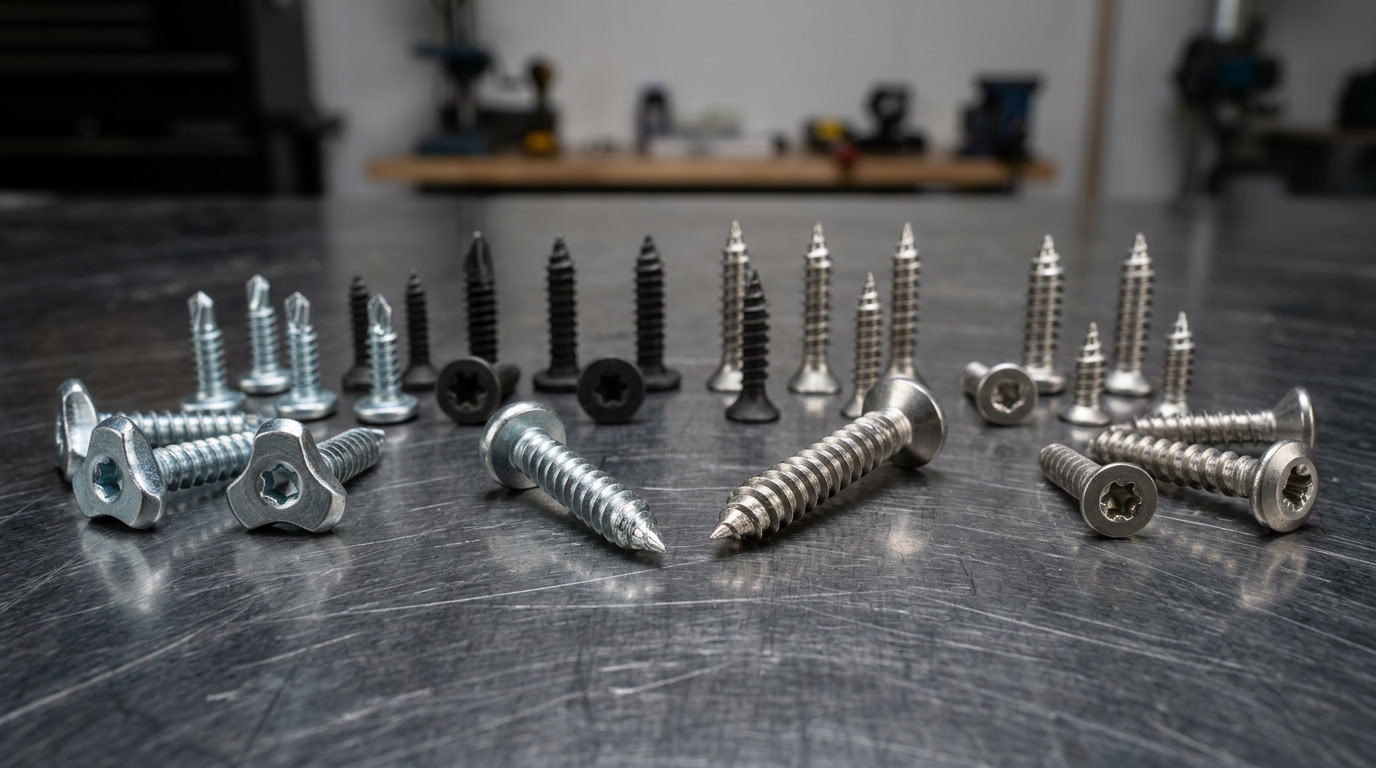
Walk into any automotive assembly plant, electronics factory, or HVAC shop and you’ll find thread forming screws driving production. They spin into untapped pilot holes, forge their own mating threads on the fly, and lock in place through the natural spring-back of displaced material. No pre-tapping. No chips to clear. No loose nuts rolling off the line.
Most engineers reach for these screws reflexively. Fewer understand why they work so well — or when the wrong type will crack a plastic housing or strip a thin sheet-metal flange on the very first installation. This guide covers both: the mechanics behind thread forming screws, every major type and its material match, and a practical selection framework you can use immediately.
What Are Thread Forming Screws?
Thread forming screws are self-threading fasteners that displace the surrounding material as they are driven in, rather than removing it. The result is a zero-clearance fit where the male screw threads and female mating threads interlock with no gaps — a characteristic that translates directly into vibration resistance and higher pull-out strength compared to standard machine screws in pre-tapped holes.
The fundamental operating principle distinguishes them from every other threaded fastener category. Standard machine screws rely on a separately tapped hole. Thread-cutting screws use cutting edges and chip cavities to carve threads, much like a hand tap. Thread forming screws do neither. According to Machine Design’s engineering analysis of thread forming mechanics, displaced material “flows around the screw’s threads,” creating internal compressive stresses that make it significantly harder for the fastener to back out under dynamic load.
That compressive grip is why thread forming screws are specified in automotive seat-belt mechanisms, medical device housings, and high-vibration HVAC assemblies — applications where a loose fastener is a safety issue, not merely a nuisance.
How Thread Forming Differs from Thread Cutting
Thread-cutting screws have flutes milled into their thread form, identical in function to a hand tap. They physically remove material and produce chips. This makes them well-suited for harder substrates — dense cast aluminum, reinforced composites, cast iron — where the driving torque required to form threads would shear the screw or fracture the base material. The trade-offs: chips must be managed, internal stresses are relieved rather than added, and the joint fit is only as tight as the tolerance of the cut thread.
Thread forming screws operate on the opposite principle. No cutting edges, no chip cavities, no debris. The screw geometry cold-works the substrate, and the material springs back against the thread flanks. In ductile substrates, that spring-back can increase strip-out torque by 20–40% compared to a cut thread of the same diameter.
The downside is that forming requires more insertion torque than cutting. In rigid materials — hard steel, dense thermoset composites, brittle castings — that extra torque will either snap the screw or fracture the base. Matching the screw type to the material’s ductility is non-negotiable.
The Mechanics of Material Displacement
When a thread forming screw enters a pilot hole, the lead thread makes first contact with the hole wall. As the screw advances, each successive thread pushes material radially outward and slightly downward, compacting it against the root of the newly formed thread groove. This cold-working process surface-hardens the hole wall — the same mechanism that makes cold-drawn steel stronger than hot-rolled.
For thermoplastics, there is a secondary benefit. The plastic’s inherent cold-flow characteristics cause it to relax back into the spaces between the screw threads over time, tightening the joint further rather than relaxing it. This self-healing behavior is one reason thread forming screws consistently outperform threaded inserts in low-to-medium vibration plastic assemblies — and can eliminate inserts entirely in most consumer electronics housings.
| Characteristic | Thread Forming | Thread Cutting | Thread Rolling (Metal) |
|---|---|---|---|
| Material action | Displaces (cold works) | Removes (cuts chips) | Displaces under high pressure |
| Chip production | None | Yes — must be managed | None |
| Insertion torque | Higher | Lower | Highest |
| Vibration resistance | Excellent | Good | Excellent |
| Best substrate | Ductile plastics, soft metals | Hard metals, brittle composites | Solid ductile metal |
| Locking hardware needed? | Rarely | Sometimes | Rarely |
| Reusability | Limited (thread deforms) | Good | Good |
| Min. tensile strength | 100,000 psi | 100,000 psi | 120,000 psi+ |
Types of Thread Forming Screws
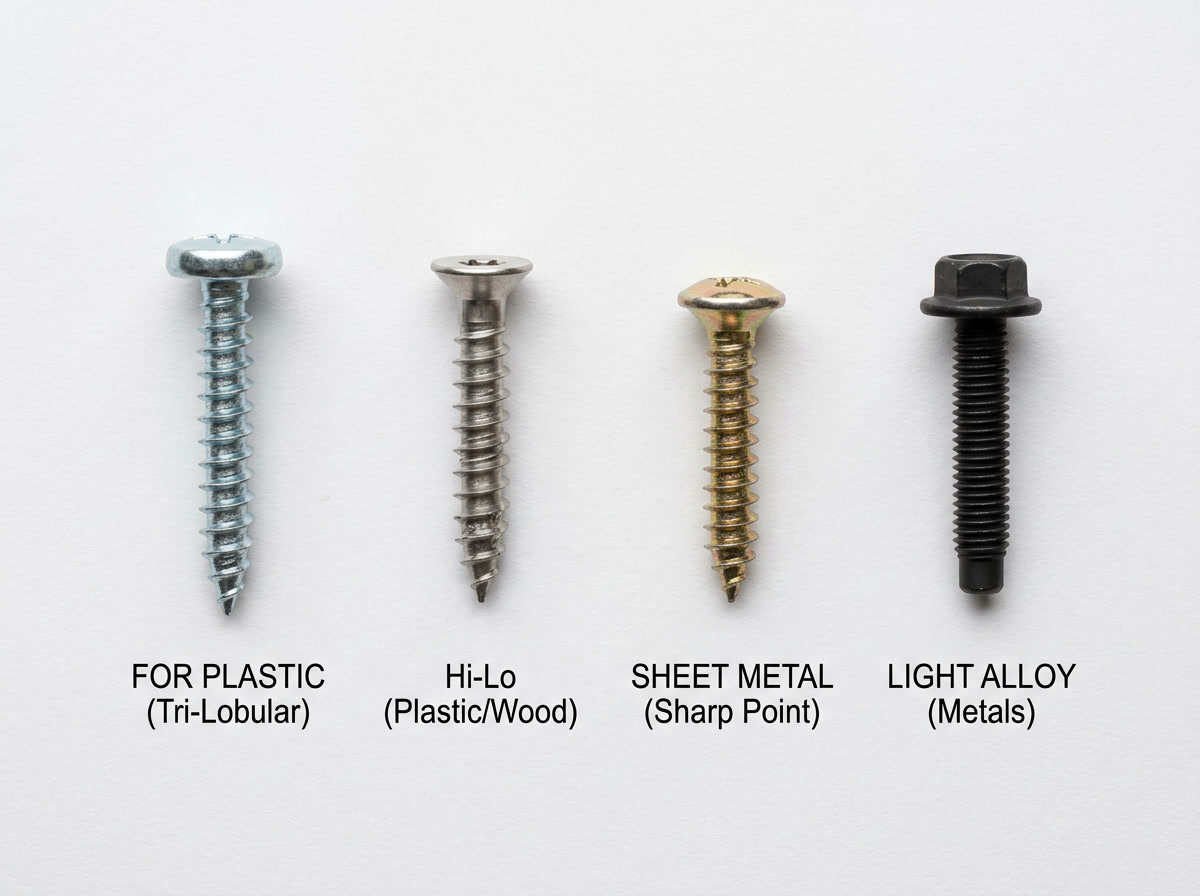
Thread forming screws are a family, not a single product. Each variant is engineered for a specific substrate hardness, modulus, and thickness range. Using the plastic type in a steel bracket, or the sheet-metal type in a polycarbonate housing, produces either a stripped joint or a cracked part.
Tri-Lobular (TAPTITE-Style) Screws
Tri-lobular screws are the most technically distinctive variant. Their cross-section is an approximate triangle with rounded lobes rather than a circle, concentrating forming pressure at three points around the hole. This progressive engagement reduces peak forming torque by 20–30% versus a round-shank forming screw of equal diameter while maintaining the same thread engagement depth and pull-out performance.
As ITW Shakeproof’s technical guide to thread forming screw types explains, the tri-lobular design “allows the screw to more progressively form threads through deformation with more capacity for spring-back.” In practice, this means you can drive larger-diameter tri-lobular screws into thermoplastic bosses without the torque spike that would crack the boss wall on a round-shank design.
Hi-Lo Thread Forming Screws for Plastics
The Hi-Lo thread design uses an alternating high-and-low thread pattern on the same shank. The tall thread creates the primary engagement path; the shorter thread between it provides secondary grip and reduces radial stress on the plastic boss. Together they lower driving torque and cracking risk compared to a standard pitch thread at the same diameter.
Hi-Lo screws are the default choice for thermoset and thermoplastic assemblies where boss wall thickness limits use of tri-lobular designs and where controlled insertion torque is critical. A direct assembly into plastic — no insert required — typically eliminates three to five components and one assembly step per joint.
Thread Forming Screws for Sheet Metal
Sheet-metal variants have sharp points, aggressive thread pitch, and hardened case steel. Designed for substrates from 24-gauge sheet steel down to thin aluminum panels (typically 0.5–3mm), the sharp point pierces a pre-drilled pilot hole cleanly without a chamfer, and the wide thread pitch engages multiple layers in stacked sheet assemblies.
These thread forming screws do not belong in structural load paths on thick metal sections. For HVAC ductwork, electrical enclosures, automotive body panels, and appliance cabinets they are the correct and cost-effective choice. For load-bearing joints in metal over 3mm, switch to thread rolling screws or standard machine screws in tapped holes.
Thread Forming Screws for Light Alloys (Aluminum and Magnesium)
Light alloy variants have a modified thread geometry — typically a larger included angle and more gradual helix — that increases pull-out force in materials with low shear strength. As Field Fastener’s engineering blog on thread forming vs. thread cutting notes, performance in aluminum and magnesium “depends significantly on thread engagement length and hole size.” Under-sizing the pilot hole in aluminum risks cracking the casting; over-sizing it reduces pull-out strength below specification.
| Screw Type | Best Material | Typical Use Case | Avoid In |
|---|---|---|---|
| Tri-Lobular (PT/TAPTITE) | Thermoplastics (ABS, PC, nylon, POM) | Consumer electronics, automotive trim | Hard thermosets, metals |
| Hi-Lo Thread | Soft thermoplastics, thin-wall bosses | Small enclosures, thin-wall assemblies | Sheet metal, alloys |
| Sheet Metal Type | 0.5–3mm steel/aluminum sheet | HVAC, enclosures, body panels | Thick sections (>3mm) |
| Light Alloy Type | Die-cast aluminum, magnesium | EV battery packs, aerospace brackets | Cast iron, hard steel |
| Thread Rolling (TAPTITE metal) | Ductile steel up to 2x screw diameter | Heavy industrial, structural steel | Brittle substrates |
Industry Applications of Thread Forming Screws
Understanding where thread forming screws are deployed in practice answers the “why bother” question more effectively than any torque calculation.
Automotive Manufacturing
Automotive is the single largest application sector for thread forming screws. A modern passenger vehicle contains 3,000–5,000 threaded fasteners, and a significant share of interior trim, electronic module mounting, and under-hood plastic housing assemblies use thread forming screws rather than machine screws with separate nuts.
The primary driver is cycle time. Thread forming screws eliminate the nut-feeding step on assembly lines running at 60–120 vehicles per hour. Beyond that, the vibration-resistant joint reduces warranty claims for rattles and loose trim — a chronic problem in early-2000s vehicles before thread forming became standard practice in plastic trim assemblies.
Safety-critical applications include seat-belt pretensioner housings, airbag module mounting brackets, and ABS sensor mounts. The compressive pre-stress in a thread-formed joint provides assurance that a standard machine screw in a loose-tolerance tapped hole cannot match.
Electronics and Enclosures
Consumer electronics moved aggressively to thread forming screws in the 1990s as polycarbonate and ABS housing designs replaced metal enclosures. A single #4-40 thread forming screw into ABS eliminates a brass threaded insert that costs four to eight times as much to procure and 10–15 seconds to install.
Medical device housings — insulin pump casings, diagnostic equipment, portable monitors — represent the demanding end of this segment. The screw must maintain joint integrity through repeated sterilization cycles (autoclaving at 134°C or chemical disinfection), vibration from transport, and thermoplastic creep over a 5–10 year service life. Thread forming screws lose approximately 15% of forming torque on second installation — medical device service manuals typically specify screw replacement at each service event.
HVAC and Sheet Metal Fabrication
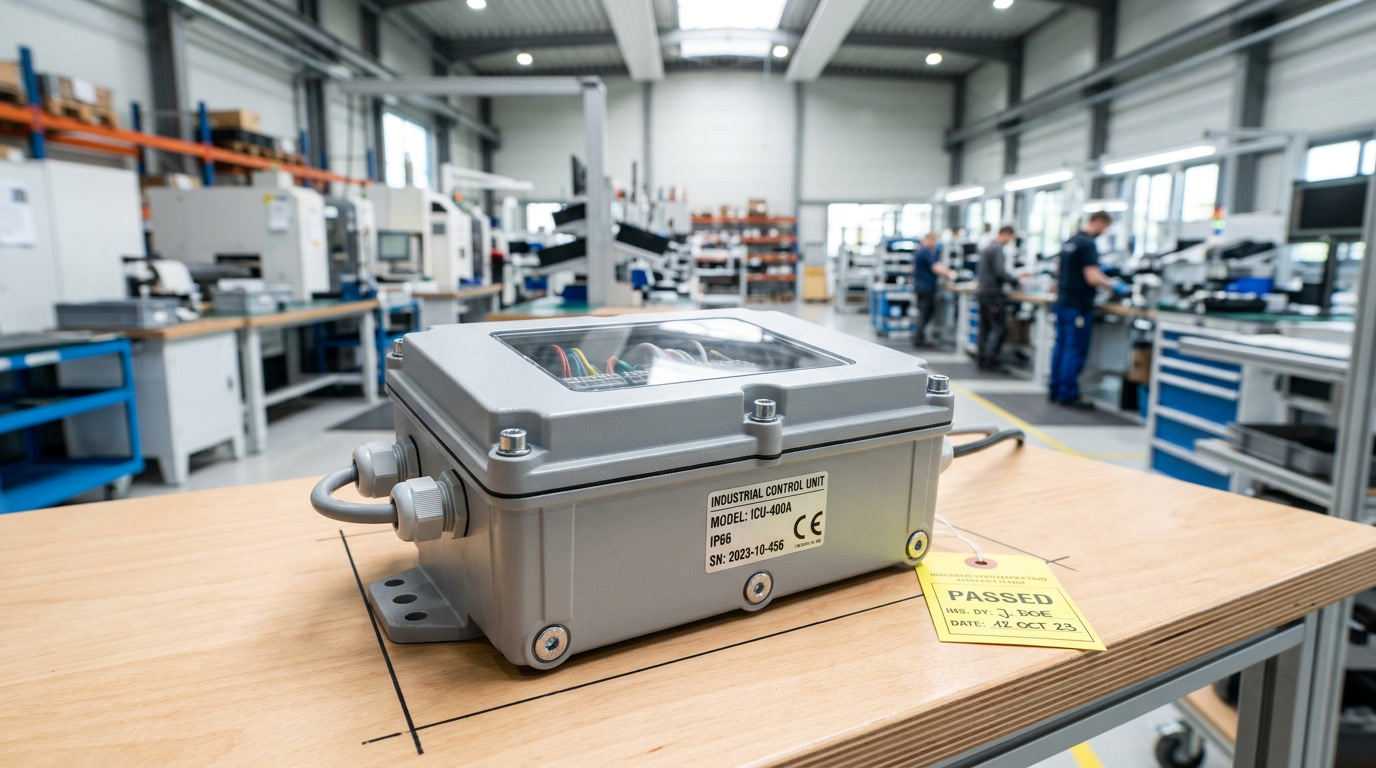
HVAC ductwork is a textbook application for sheet-metal thread forming screws. Duct panels are thin (typically 24–26 gauge galvanized steel), joints must resist static tension from pressurization and cyclic fatigue from airflow vibration, and the installation environment makes nut management impractical.
Sheet metal thread forming screws for HVAC are typically pan-head or hex-washer-head in #8 or #10, zinc-plated for corrosion resistance in humid environments. Installation tools are corded screwdrivers with clutches set to the 15–20 in-lb range appropriate for 24-gauge material.
Medical Devices and Safety Equipment
Safety devices — smoke detectors, carbon monoxide alarms, emergency lighting — rely on thread forming screws in plastic housings for a subtle design reason: tamper-evidence. A thread-formed joint in a plastic housing strips out if over-torqued during unauthorized disassembly, providing visible evidence that the device has been opened. In consumer safety applications, that is a feature, not a bug.
How to Choose the Right Thread Forming Screw
The most common failure mode in thread forming screw applications is not fastener quality — it is selection error. Screw type, pilot hole size, and material must all be correct simultaneously.
Matching Screw Type to Material
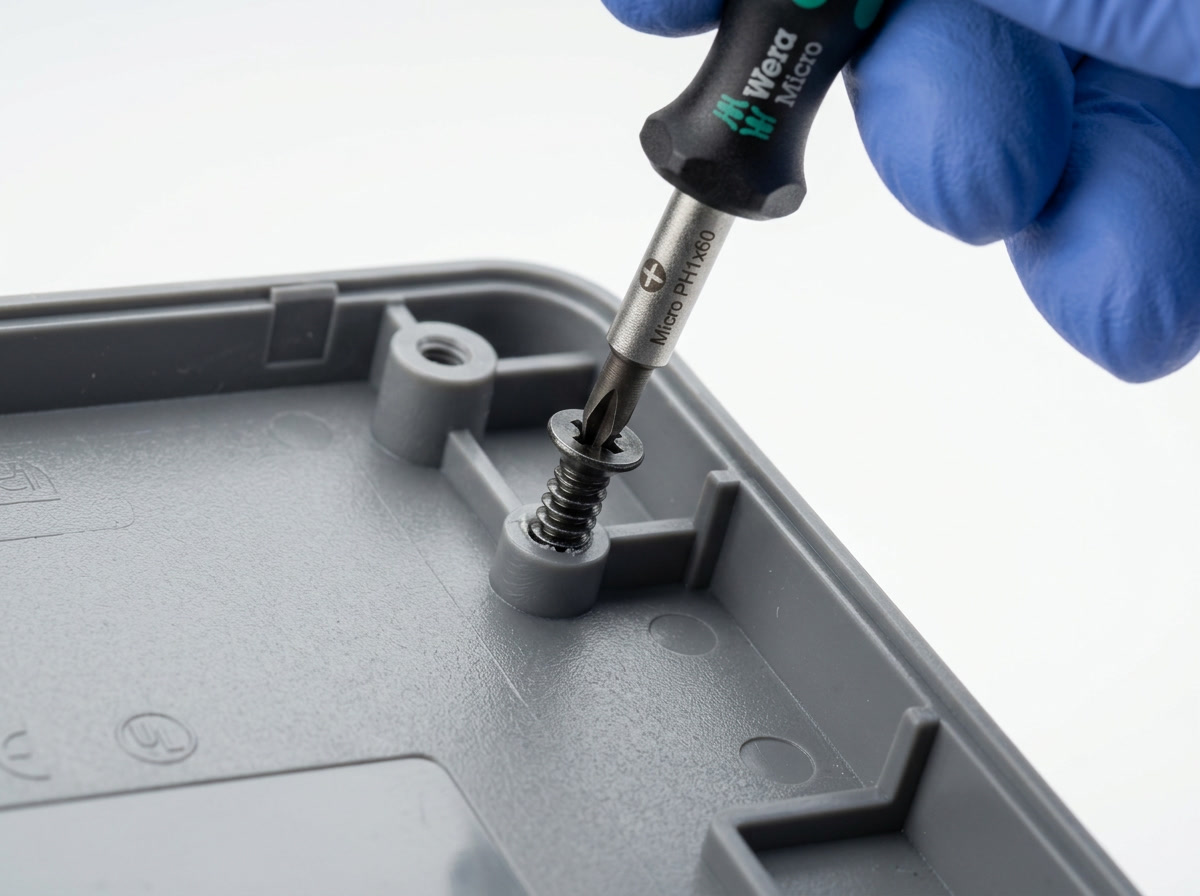
- High-ductility thermoplastics (ABS, polycarbonate, nylon 6/66, POM): Use tri-lobular or Hi-Lo thread forming screws. Avoid thread-cutting designs — chip cavities create stress concentrations in plastic boss walls.
- Thin sheet steel and aluminum (0.5–3mm): Use sheet-metal type thread forming screws optimized for limited thread engagement depth.
- Die-cast aluminum and magnesium: Use light alloy thread rolling designs. Pilot hole tolerance is ±0.05mm versus ±0.1mm for plastic.
- Ductile mild steel up to 2x screw diameter in thickness: Use TAPTITE-style thread rolling screws with hardened lead threads.
- Hard steel, cast iron, brittle thermosets: Do not use thread forming screws. Switch to thread-cutting types or machine screws in pre-tapped holes.
As TAPTITE’s technical documentation on thread rolling versus thread forming clarifies, the boundary between these screw families is primarily one of mechanism scale and material hardness range — not a categorical product difference.
Pilot Hole Sizing: The Critical Variable
Pilot hole size is the single most consequential variable in thread forming screw performance. A hole too small increases insertion torque past the screw’s torsional strength limit, snapping it before full engagement. A hole too large reduces thread engagement depth, lowering pull-out strength below specification.
For thermoplastic applications, the pilot hole diameter is typically 85–95% of the screw’s major thread diameter. Every reputable thread forming screw manufacturer publishes pilot hole tables by resin type — those tables should be followed, not improvised from a rule of thumb.
| Material | Pilot Hole as % of Major Diameter | Notes |
|---|---|---|
| ABS (unfilled) | 88–92% | Wider tolerance range tolerable |
| Polycarbonate | 90–94% | Monitor for stress whitening during install |
| Nylon 6/6 (unfilled) | 87–91% | Hygroscopic — validate at operating moisture |
| Glass-filled nylon (30%) | 91–95% | Higher modulus, less spring-back |
| POM (Delrin) | 88–92% | Very consistent spring-back behavior |
| Die-cast aluminum | 93–97% | Low ductility — hold ±0.05mm tolerance |
| 24-gauge sheet steel | 90–95% | Punched vs. drilled hole affects outcome |
| Magnesium alloy | 94–98% | Brittle — use upper end of range |
Common Mistakes That Strip or Crack
Mistake 1 — Using thread cutting screws in thin-wall plastic bosses. The chip cavity creates a notch that propagates under vibration. Swapping to Hi-Lo or tri-lobular thread forming eliminates this failure mode entirely.
Mistake 2 — Reusing thread forming screws in plastic. Pull-out strength drops 10–20% on second installation. Replace, do not reuse, in safety-critical applications.
Mistake 3 — Over-torquing in plastic. Thread forming screws hit a stripping torque threshold that is only 2–4x the seating torque. As ITW Shakeproof’s comparison of thread forming vs. everyday screws notes, the strip-to-drive torque ratio is a critical parameter that manufacturers rarely communicate prominently on spec sheets.
Mistake 4 — Ignoring material batch variation. A pilot hole validated on prime-grade ABS may produce boss cracks in a production batch containing 20% regrind if the assembly program was not re-validated.
Mistake 5 — Insufficient boss wall thickness. The industry standard minimum boss wall for thread forming screws is 2x the screw’s pitch diameter on each side of the hole — a design-phase requirement that cannot be fixed by changing screw selection after tooling is cut.
Future Trends in Thread Forming Screws (2026 and Beyond)
Advanced Polymer Applications and Sustainability
Lightweighting mandates across automotive and consumer electronics are driving a shift from glass-filled nylon and ABS to high-performance engineering polymers: PEEK, PPS, LCP, and bio-based PLA compounds. These materials have moduli two to three times higher than conventional ABS, requiring redesigned thread geometry to maintain the spring-back characteristics that make thread forming screws function.
Circular economy requirements are also increasing regrind and recycled-content percentages in production resins, reducing modulus consistency and increasing pilot hole validation burden. Forward-thinking fastener engineers are building material-variability margins into pilot hole callouts rather than specifying single-point diameters.
EV and Lightweight Alloy Expansion
Electric vehicles are the dominant growth driver for aluminum and magnesium thread forming screws. According to ThomasNet’s industry overview of screw thread systems and applications, the shift toward aluminum-intensive vehicle architectures is projected to continue through the end of this decade as automakers target structural weight reductions of 15–25% per vehicle.
Battery enclosures, inverter housings, motor end-covers, and chassis brackets in EVs all use die-cast aluminum with high fastener density — 50–100 thread forming screw joints per major component. Tightening torque and preload consistency requirements exceed those in traditional automotive manufacturing, driving investment in servo-controlled assembly tools that monitor the torque-angle curve in real time and detect deviation from the expected thread forming signature before a bad joint leaves the line.
Magnesium alloy usage in EV interiors and structural brackets is also growing due to superior specific stiffness versus aluminum. Magnesium’s lower ductility requires careful thread forming screw design — larger pilot holes, tighter tolerances, and progressive lead-thread geometry to avoid cracking on the first installation cycle.
Frequently Asked Questions About Thread Forming Screws
Are thread forming screws and thread rolling screws the same thing?
Not exactly. Thread rolling screws use cold-forming pressure to create threads in metal — primarily ductile steel. Thread forming screws is the broader category including plastic-optimized designs (tri-lobular, Hi-Lo) as well as sheet metal and light alloy types. All thread rolling screws are thread forming screws, but not all thread forming screws are thread rolling screws.
How do you use thread forming screws correctly?
Drill a pilot hole to the manufacturer’s specified diameter for your specific material, align the screw straight to avoid cross-threading, and drive to the published seating torque using a torque-limited driver. For plastic, the strip-to-seat ratio is 2–4:1, leaving almost no margin for over-torque.
Can thread forming screws be removed and reinstalled?
Yes, but with degraded performance. In plastic, the second installation delivers approximately 80–85% of the original pull-out strength. In metals, reusability is better because the formed thread is more dimensionally stable. For safety-critical applications, always replace the screw rather than reinstall the original.
What pilot hole size should I use for thread forming screws in ABS?
For unfilled ABS, target 88–92% of the screw’s major thread diameter. For a #6-20 thread forming screw (0.138″ major diameter), that is approximately 0.121–0.127″. Always verify with a sample installation before production — resin lot variation can shift the optimum by 0.005–0.008″.
Do thread forming screws need locking washers or thread-locking compound?
No, in most applications. The zero-clearance fit between formed threads eliminates the gaps that allow machine screws to back out under vibration. Adding thread-locking compound to a plastic boss can increase removal torque past the strip threshold and cause housing damage during service.
What is the minimum boss wall thickness for thread forming screws in plastic?
The standard recommendation is a minimum wall thickness of 2x the screw’s pitch diameter on each side of the boss hole. For a #6 screw (pitch diameter ~0.115″), that means at least 0.23″ of wall on each side. Thinner walls will crack on installation regardless of pilot hole size.
When should I use thread cutting screws instead of thread forming screws?
Use thread cutting screws when the substrate is brittle (thermoset composites, hard cast aluminum, cast iron), when insertion torque for forming exceeds the screw’s torsional strength, or when the design requires easy disassembly and full thread reusability. Thread cutting screws produce chips that must be controlled in clean assembly environments.
Conclusion
Thread forming screws are among the most efficient fasteners available for ductile substrates. By displacing material rather than removing it, they create zero-clearance joints with built-in vibration resistance — no locking hardware, no chips, no secondary tapping operation. That combination of process simplicity and mechanical performance is why they dominate plastic housing assemblies across automotive, consumer electronics, HVAC, and medical devices, and why their share in light alloy applications is growing as EV production scales up.
The practical takeaway is straightforward: select the right variant for your substrate, size the pilot hole to the manufacturer’s published recommendation for your specific material, and protect the joint with torque-limited installation. Get those three parameters right and thread forming screws will outperform threaded inserts, machine screws, and thread-cutting alternatives on cost, assembly time, and joint reliability simultaneously. Browse our full selection of thread forming screws and specialty production fasteners at productionscrews.com, or contact our engineering team for application-specific selection guidance.
Related Products
Solutions & Cluster
Related Articles
- Castellated Nut: Complete Guide to Types, Uses & Installation
- Screw Bolt Complete Guide: Types, Differences, Sizes & How to Choose (2026)
- Bolt Screw Guide: Types, Differences, Sizes, and Industrial Applications
- Screw Definition: What It Is, How It Works, and Why It Matters More Than You Think
- UNS Thread Complete Guide: Specifications, Charts & Applications
- Essential Guide to Choosing the Right Bolts for Your Projects
- The Complete Guide to Captive Bolts: Types, Applications, and Choosing the Right Fastener
- 8.8 Bolt: Complete Guide to Class 8.8 Bolts, Strength, and Applications