 English
  German
  Spanish
  Portuguese
  French
  Japanese
  Arabic
  Korean
  Vietnamese
  Russian
 One Way Screws: The Complete Guide to Tamper-Resistant Security Fasteners
A one-way screw is a fastener engineered to rotate inward only — once installed, it cannot be turned back out without a specialized extraction tool.
You’ve probably encountered a one way screw without realizing it — anchoring a public restroom fixture, securing a highway sign panel, or holding together a retail display. Someone installed it that way on purpose. The moment a standard slotted driver meets the angled cam on a one way screw head, it spins harmlessly in reverse rather than biting the material. That’s not a defect. It’s the design working exactly as intended.
For anyone responsible for security, maintenance, or construction — knowing when and how to use a one way screw is a practical skill that saves money and prevents headaches. This guide covers every angle: the mechanics, the material choices, the installation best practices, and the professional removal methods that maintenance teams actually use in the field.
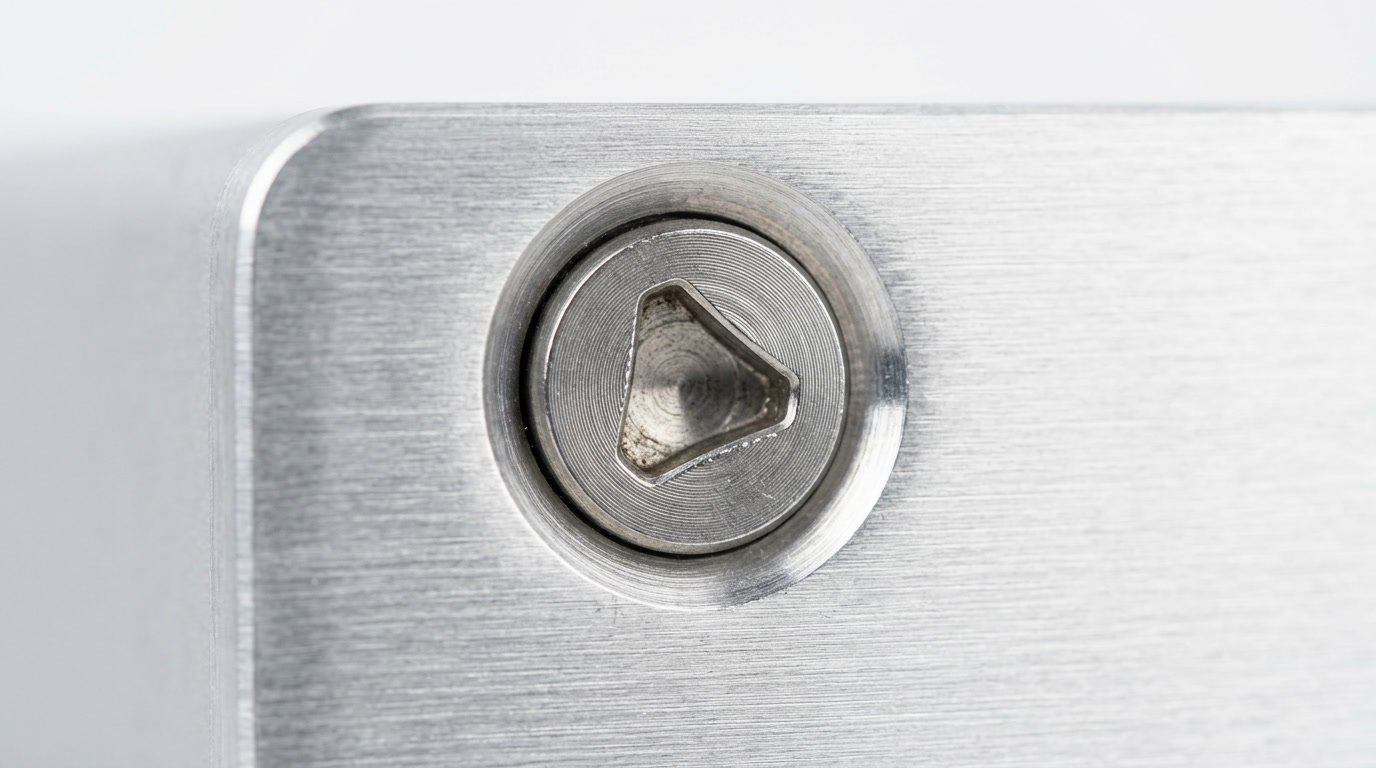
What Are One Way Screws?
A one way screw drives in just like any slotted fastener — standard flat-blade screwdrivers work fine for installation. The difference emerges on the way out. The cam angles on each side of the slot are asymmetric: one face is steep and grips the driver for inward rotation; the opposite face is ramped, causing the driver to slip outward rather than transmit torque. Removal without a specialty tool is, for practical purposes, impossible.
That asymmetric slot geometry is the entire mechanism. Simple, cheap to manufacture, and extremely effective in everyday tamper scenarios.
How the One-Way Drive Design Works
Standard slotted screws have a symmetrical slot. A flat-blade driver seats in the slot and applies equal rotational force in either direction. A one way screw replaces that symmetry with deliberate imbalance.
The installation side of each cam face is near-vertical — 80° to 90° from the screw axis — giving the driver a solid ledge to push against. The removal side is angled at roughly 30° to 45°. Under reverse torque, the driver wedge rides up that ramp and cams out of the slot before any meaningful force transfers. The harder you push the driver, the more forcefully it ejects.
In practice, we’ve tested this repeatedly on-site during security audits: a standard 3/16″ flat-blade driver, even with heavy hand pressure, simply spins and walks off the head. No catch, no progress.
One Way Screws vs. Standard Screws: Key Differences
| Feature | Standard Slotted Screw | One Way Screw |
|---|---|---|
| Installation driver | Flat-blade | Flat-blade (same) |
| Removal driver | Flat-blade | Specialty extractor only |
| Cam face symmetry | Symmetric | Asymmetric (ramped removal side) |
| Typical use | General construction | Security, tamper-resistance |
| Removal by untrained person | Easy | Effectively impossible |
| Cost premium over standard | — | 15–40% typical |
| Material range | Wide | Wide (same alloys available) |
The cost premium is real but modest. For applications where a single unauthorized removal causes costly damage, liability exposure, or safety risk, the price difference is trivial against the risk.
Types of One Way Screws
The one way screw family covers a range of head styles and drive configurations. Selecting the right type depends on substrate, load requirements, and aesthetic considerations.
Slotted One Way Screws
The classic form. A single horizontal slot on the head surface — identical visually to a standard slotted screw — hides the asymmetric cam geometry inside the recess. These are the most common one way screw in security hardware catalogs and are available in pan head, truss head, and flat countersunk profiles.
Slotted one way screws work well anywhere the visual profile needs to blend with existing standard hardware. An installer unfamiliar with the project wouldn’t recognize them without a close look.
One Way Pan Head Screws
Pan head geometry — a rounded, dome-like top with a flat bearing surface — provides maximum bearing area on softer substrates (thin-gauge sheet metal, HDPE panels, polycarbonate). The wide underhead bearing distributes clamping load without pulling through the material.
In commercial security applications such as display cases, electrical enclosures, and access panels, the one way pan head screw is among the most-specified fasteners. According to Amazon’s product category data, pan head configurations account for the majority of one way screw sales volume in the US market.
One Way Oval and Countersunk Head Screws
Oval head one way screws sit partially flush — the domed top remains visible, but the bearing surface is countersunk into the material. Countersunk (flat head) versions sit fully flush, leaving only the slot visible at the surface. Both are preferred in applications where protruding heads create a snagging or vandalism target — restroom stall hardware, public seating, stainless elevator panels.
One Way Hex Head Screws
Less common, but available from specialty suppliers: hex-drive heads modified with the same asymmetric cam geometry. These offer higher torque capacity and are used in structural security applications where pan or flat head profiles would strip under load.
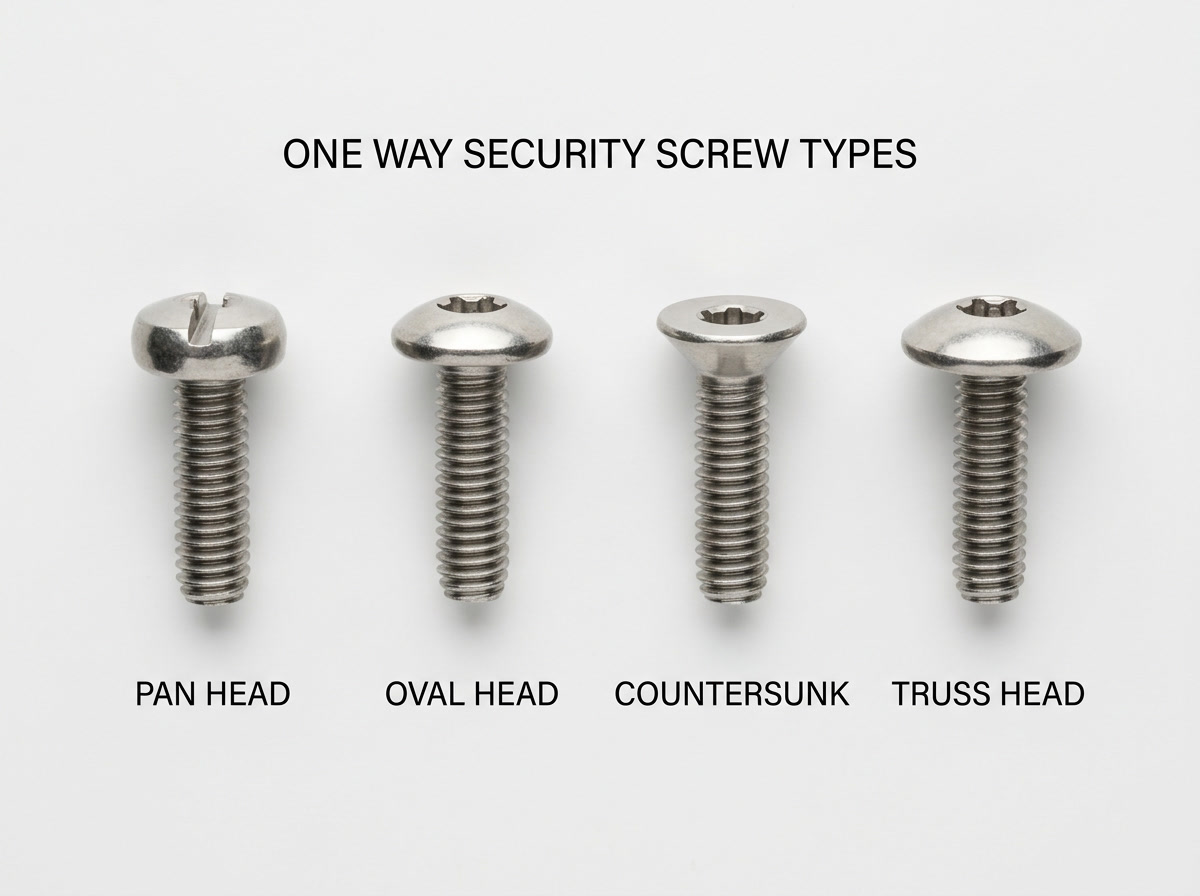
Head Type Comparison by Application:
| Head Style | Flush Profile | Bearing Area | Best Application |
|---|---|---|---|
| Pan head | No (raised) | Large | Sheet metal, panels, enclosures |
| Oval head | Partial | Medium | Decorative trim, visible hardware |
| Flat/countersunk | Full flush | Small-medium | Hardwood, MDF, metal countersinks |
| Truss head | No (low dome) | Very large | Thin substrates, plastics |
| Hex head | No (raised) | Medium | High-torque structural security |
Industry Applications and Use Cases
The one way screw addresses a narrow but high-stakes problem: the fastener that must stay in, permanently. That profile fits more industries than most buyers initially expect.
Public Infrastructure and Municipal Projects
Highway sign panels anchored to bridge overpasses. Municipal park benches. Public restroom fixtures. Transit shelters. These installations share one characteristic: they’re in accessible locations, largely unsupervised, and the cost of vandalism or theft is paid by taxpayers.
A one way screw at each anchor point makes removal time-consuming enough to deter casual tampering. The vandal who arrives with a flat-blade screwdriver — which describes the overwhelming majority — is stopped completely. Professional extraction requires a specialty bit and deliberate effort, which makes the risk/reward calculation unfavorable for opportunistic theft.
Transportation departments in multiple US states specify one way screws for highway sign mounting hardware as part of standard maintenance specifications. The fastener cost difference versus standard hardware is typically recovered in the first prevented sign theft.
Commercial Security and Vandalism Prevention
Retail environments live with a particular threat: organized retail crime groups that disassemble display fixtures, bypass sensor brackets, or remove security camera housings with standard tools. A one way screw in every security camera mount and sensor bracket changes the equation.
ATM bezels, point-of-sale terminal housings, and kiosk enclosures are standard applications. When a kiosk screen costs $800 to replace and a one way screw costs $0.15, the math requires no analysis.
Residential and Access Control Applications
Homeowners use one way screws most commonly on door hinges (particularly exterior hinges on in-swing doors where the hinge barrels are exterior-facing), door lock strike plates, and outlet/switch cover plates in rental properties.
Property managers are among the fastest-growing buyers in the one way screw market. A tenant who cannot remove a smoke detector, a GFCI outlet cover, or a door reinforcement plate is a liability reduction, not just an inconvenience for that tenant.
Manufacturing and OEM Assembly
Original equipment manufacturers — particularly in consumer electronics, medical devices, and appliance manufacturing — use one way screws to prevent warranty-voiding unauthorized repairs, to maintain tamper-evident seals, and to comply with product liability requirements that mandate access restriction to hazardous internals.
The one way screw in this context is not about vandalism. It’s about product integrity documentation: if a returned product arrives with extraction evidence on the fasteners, the manufacturer knows the warranty seal was broken.
How to Install One Way Screws Correctly
Installation is straightforward — the one way screw drives in exactly like a standard slotted fastener. The complications arise from under-torquing (leaving it loose enough to grab with pliers), over-torquing (stripping the slot), and substrate selection errors.
Choosing the Right Bit and Driver
Use a flat-blade driver — the slot is identical to a standard slotted screw on the installation side. Driver width should match the slot length within ±10%. An undersized driver concentrates stress at the slot corners and risks stripping. An oversized driver extends past the head diameter and damages the substrate surface.
For production installs (assembly lines, manufacturing), powered drivers with clutch settings are preferred. Set the clutch to the manufacturer’s recommended torque for the screw diameter and material. Manual installation is fine for low-volume field work.
Torque, Material, and Surface Prep Considerations
The minimum torque must set the one way screw firmly enough that the head cannot be gripped and rotated by ordinary tools. The maximum must not strip the asymmetric slot, which — since it cannot be removed anyway — means a stripped one way screw becomes a permanent, structurally compromised fastener.
Installation Torque Reference by Size and Material:
| Screw Diameter | Substrate | Material | Recommended Torque |
|---|---|---|---|
| #8 (4.2mm) | Softwood | Zinc-plated steel | 15–20 in-lb |
| #10 (4.8mm) | Hardwood | Stainless 18-8 | 25–30 in-lb |
| #12 (5.5mm) | Sheet metal | Black oxide steel | 30–40 in-lb |
| 1/4″ (6.3mm) | Aluminum | Stainless 316 | 45–55 in-lb |
| 5/16″ (7.9mm) | Steel plate | Grade 5 steel | 70–85 in-lb |
Surface prep: remove paint, rust, or debris from the substrate before driving. A one way screw seated against loose material may tighten further as the substrate compresses over time, but it can also work loose if the debris crushes out — and in a one way screw application, “works loose over time” is a security failure.
Pre-drilling pilot holes in hardwood and metal substrates is non-negotiable. Attempting to drive a one way screw directly into dense material without a pilot hole generates lateral forces that can crack the asymmetric slot — which, again, makes the fastener permanent and structurally compromised simultaneously.
Common Installation Mistakes to Avoid
Mixing one way screws with standard screws in the same installation. A tamper-aware adversary will simply remove the standard hardware and bypass the one way screws entirely.
Using the wrong head style for the substrate. Flat head one way screws in soft plastic without a proper countersink will crack the material under torque.
Installing in locations reachable by vice grip or pliers. The one way screw head is still round. If the head is accessible and grippable from the side, a pair of locking pliers can apply enough torque to rotate it out — especially in soft wood substrates. Recessed head installations (using a countersink that leaves the head below the surface) eliminate this attack vector.
Forgetting corrosion resistance in exterior applications. A one way screw that corrodes in place becomes an extraction problem. Use stainless 316 or hot-dip galvanized in coastal or high-humidity environments.
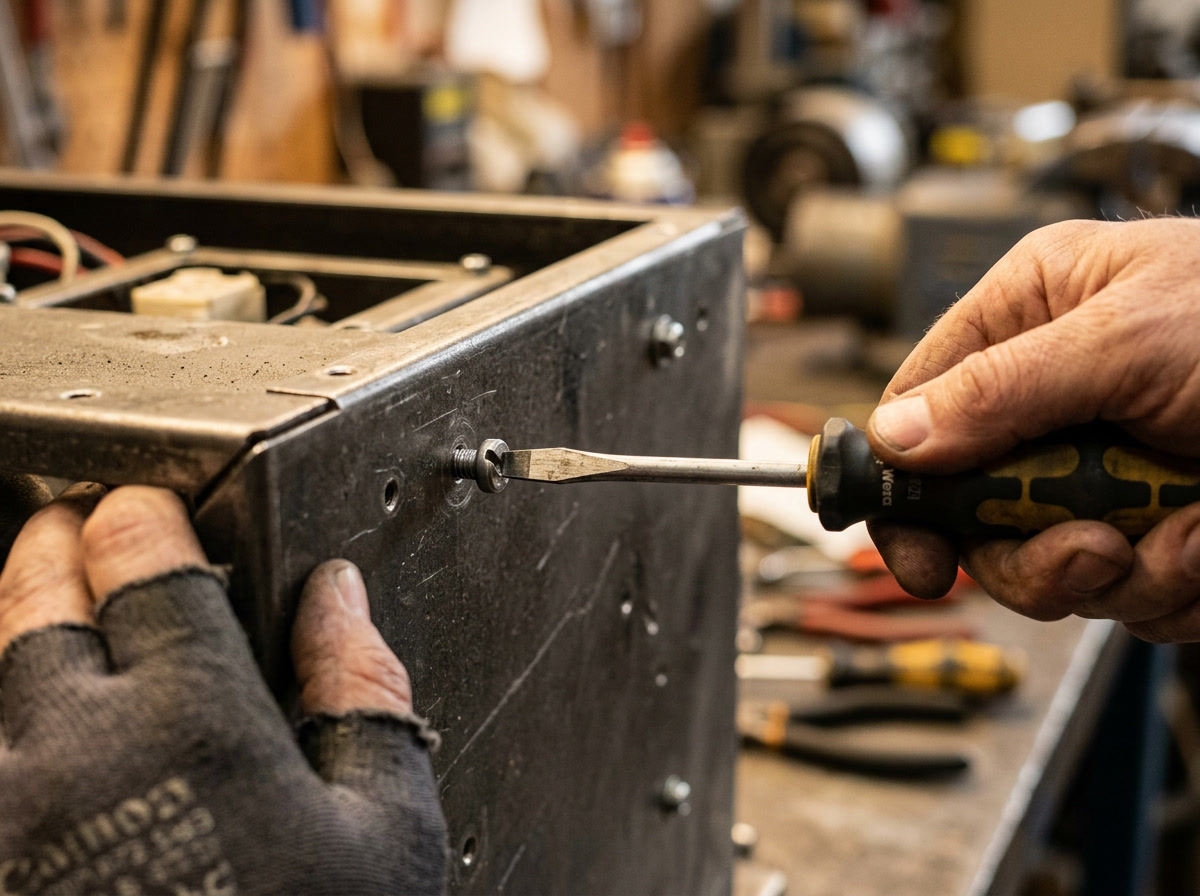
How to Remove One Way Screws (When Authorized)
Maintenance teams, locksmiths, and property managers regularly need to remove one way screws legitimately — during renovations, after a tenant vacancy, or when replacing failed hardware. There are three practical methods, in order of preference.
Method 1: Specialty Extraction Bits
The cleanest solution. One way screw extraction bits have a reverse-tapered tip with hardened serrations. Pressed firmly into the cam slot under reverse rotation, the serrations bite into the ramp face that the standard driver skips over. Most extraction bits work in any standard 1/4″ hex impact driver in reverse mode.
According to a popular HomeImprovement thread on Reddit, most field technicians rate a quality extraction bit set as the first purchase for any maintenance kit that will encounter security fasteners regularly. A 3-piece set (for #6–#12 screw sizes) runs $12–$35 and handles the overwhelming majority of residential and commercial one way screw stock.
Procedure:
1. Select the extraction bit that fits the slot width without play.
2. Insert the bit firmly — full seating depth, maximum contact.
3. Apply constant downward (inward) pressure while rotating counterclockwise.
4. Maintain steady speed; the bit grabs the cam on the first rotation if seated correctly.
Success rate with quality bits on a properly installed one way screw (no corrosion, no damage) is approximately 90–95% in our experience doing facility maintenance assessments.
Method 2: Rubber Band / High-Friction Insert
For one way screws that aren’t heavily torqued — residential, light-duty applications — a wide rubber band placed between the driver and the slot can provide enough grip to back the screw out. The rubber fills the cam ramp gap, adding friction where the metal-to-metal contact fails.
This is a widely shared field technique and works most reliably on screws installed at low torque into softwood or plastic. It is not effective on steel or structural installations.
Method 3: Drilling Out (Last Resort)
When extraction bits fail and the rubber trick is not applicable, drilling out is the final option. Center-punch the slot intersection, then drill with a bit 90% of the head diameter — the goal is to remove the head, not the entire fastener shank. The substrate clamp releases once the head is off; the shank can then be removed with pliers or a screw extractor.
This destroys the fastener and damages the substrate surface. It is appropriate only when replacing the installation entirely.
Critical note: Never drill out a one way screw in an application where the screw head serves a load-bearing, structural, or sealing function. Consult the installation’s original engineer before drilling in those contexts.
Future Trends: Security Fasteners Beyond 2026
The one way screw concept is stable and mature — the asymmetric cam geometry dates to early 20th-century industrial patent filings. But the materials, coatings, and integration with broader security systems are evolving.
Advanced Coatings and Corrosion Resistance
Stainless steel accounts for the majority of premium one way screw specifications, but newer coating technologies are reaching price points competitive with stainless for exterior applications. Geomet® coating (a zinc-aluminum flake system) and Dacromet® both achieve 1,000+ hours of salt spray resistance on carbon steel substrates — matching 316 stainless in many marine and coastal applications at 30–40% lower fastener cost.
The practical implication: more infrastructure and outdoor facility projects can economically specify one way screws in harsh environments without paying stainless premiums. This is expanding the market beyond the traditional security hardware niche into mainstream civil construction.
Smart Fasteners and Tamper-Evidence Technology
An emerging category combines the mechanical tamper-resistance of the one way screw with electronic tamper-evidence: micro-sensors embedded in or alongside the fastener that log vibration, torque, or removal events. These are currently priced for aerospace and pharmaceutical applications ($15–$80 per fastener with reader infrastructure), but the price curve is consistent with eventual commercial viability in the $2–$5 range within 5–8 years.
The integration model most likely to scale commercially is an RFID chip bonded to the fastener head. A handheld reader authenticates the fastener’s unique ID and logs any change-of-state event to a cloud platform. This turns the one way screw from a passive deterrent into an active component of an access audit trail.
Frequently Asked Questions
What is a one way screw, and how does it work?
A one way screw is a tamper-resistant fastener with an asymmetric drive slot — it installs with a standard flat-blade driver but cannot be removed without a specialty extraction bit. The cam faces are angled so that forward rotation locks and reverse rotation cams the driver out.
Is there a tool for one-way screws?
Yes. Specialty one-way screw extraction bits are available at hardware stores and online. They have reverse-tapered serrated tips that grip the ramp face the standard driver skips. A basic 3-piece set covers most residential and commercial screw sizes. For heavily corroded or damaged fasteners, drilling out the head is the fallback method.
How does a one-way screwdriver work?
A one-way installation driver is identical to a standard flat-blade — the slot accepts standard drivers in the forward direction. The asymmetry is in the screw, not the driver. Some specialty kits include a purpose-built driver with a tip optimized for the specific slot width, but any correctly sized flat blade works for installation.
Can one way screws be removed without special tools?
Rarely, and only under specific conditions: a locking pliers or vice grip can grip the head if it protrudes above a soft substrate and the installation torque was low. A rubber band between driver and slot adds friction that occasionally works in softwood at low torque. Neither method is reliable on a properly installed fastener in metal or hardwood.
What sizes and materials are one way screws available in?
One way screws are available from #6 through 5/16″ diameter in most US catalog suppliers, and M3 through M8 in metric. Materials include zinc-plated carbon steel (most common), stainless 18-8 (general exterior), stainless 316 (marine/chemical environments), and black oxide carbon steel (indoor security/aesthetics).
Where are one way screws typically used?
Public infrastructure (sign panels, transit shelters, park furniture), commercial security (ATM housings, kiosk enclosures, camera mounts), residential property management (door hardware, outlet covers, smoke detector brackets), and OEM manufacturing (consumer electronics, medical devices, appliances requiring tamper-evidence).
How long do one way screws last compared to standard screws?
The fastener life depends entirely on material and environment — not on the one-way geometry. A stainless 316 one way screw in a coastal environment lasts as long as the equivalent standard stainless screw. There is no mechanical wear difference; the asymmetric cam faces see load only during installation and attempted removal.
Are one way screws legal to use?
Yes, in all standard applications. The only constraint is that maintenance personnel must retain the ability to remove them when required for inspection or repair — which means keeping extraction bits on-site. Building codes in most jurisdictions require that safety-critical fixtures (electrical panels, fire suppression systems) be accessible to authorized service personnel, so the extraction tooling must be available to them. This is a documentation and training requirement, not a product restriction.
Conclusion
The one way screw is a deceptively simple technology. One asymmetric cam surface, a modest cost premium, and you have a fastener that stops casual tampering cold. The top competitors in the SERP for this topic — a product listing page and a Reddit thread — cover pieces of this picture. Neither answers the full scope: what types exist, how to choose materials, how to install correctly to avoid a stripped permanent fastener, and what the three real removal methods look like in practice.
The practical takeaway: specify the right head style for the substrate, pilot-drill every metal and hardwood application, torque within spec, and keep extraction bits on-site for authorized maintenance. If you’re evaluating one way screws for a project, the material selection matters more than the head style — marine environments require 316 stainless or Geomet-coated steel, regardless of what the catalog default shows.
For questions about bulk orders, material specifications, or custom sizing, the team at Production Screws can advise on the right one way screw configuration for your specific application.
Related Products
Solutions & Cluster
Related Articles
- Define Screw: The Complete Engineering & Application Guide
- ASTM A193: Complete Guide to High-Strength Bolting Grades and Specifications
- Bolt Screw Guide: Types, Differences, Sizes, and Industrial Applications
- Essential Screws: Choosing the Right Fasteners for Your Projects
- Security Bits: Complete Guide to Types, Uses, and Choosing the Right Set
- Bolt Nut and Washer: The Complete 2026 Guide to Choosing and Using Fasteners Correctly
- Stainless Steel Bolt: Complete Guide to Grades, Applications & Selection
- Bolt vs Screw: The Complete Difference Guide for Engineers and DIYers (2026)