 English
  German
  Spanish
  Portuguese
  French
  Japanese
  Arabic
  Korean
  Vietnamese
  Russian
 Brass washers are flat, circular hardware components made from copper-zinc alloy, used to distribute load, prevent corrosion, and create reliable seals in plumbing, electrical, and mechanical assemblies.
Walk into any hardware store, open any electrical panel, or peer under the hood of a vintage motorcycle — brass washers are everywhere once you know to look for them. They sit quietly between bolt heads and surfaces, between pipe fittings and valves, between lamp sockets and lamp bodies. And yet, most guides treat them as an afterthought, lumping them in with “general hardware” and moving on.
That is a mistake when your project depends on getting the right washer for the job. Choose stainless when brass was called for, and you risk galvanic corrosion eating through your connection in six months. Grab a flat washer when a sealing washer was needed, and you will be chasing a slow drip that shows up only under pressure. This guide covers everything you need: what brass washers are, the distinct types and when to use each, how to size them, and how they stack up against alternative materials.
What Are Brass Washers?
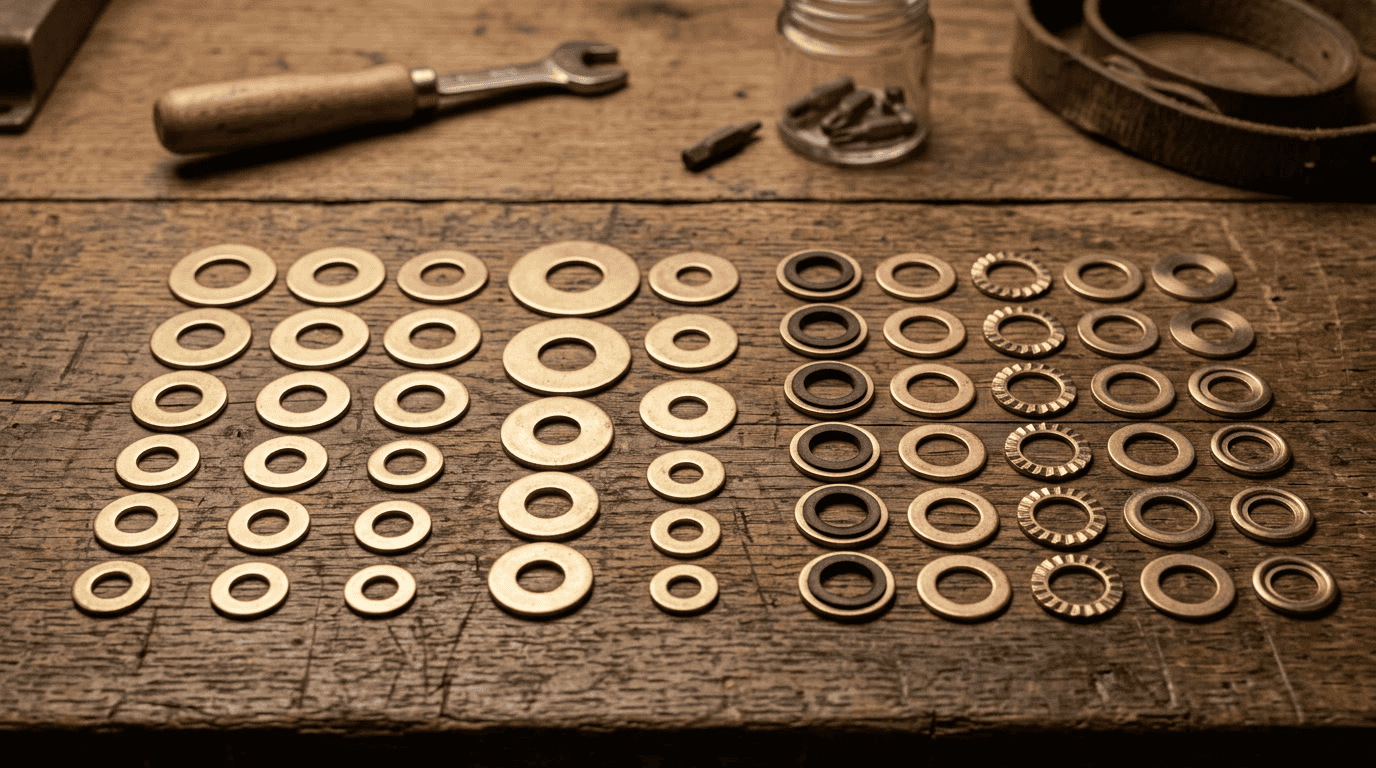
Brass washers are thin, flat discs with a central hole, stamped or machined from brass alloy and used as load-distributing, sealing, or spacing elements in mechanical and plumbing assemblies.
According to the Wikipedia article on washers, a washer is a thin plate with a hole that is normally used to distribute the load of a threaded fastener, such as a bolt or nut. Brass adds a specific property set to that basic function — a property set worth understanding.
The Alloy Behind the Function
Brass is an alloy of copper and zinc. The exact ratio varies by grade, but most hardware brass falls in the C260 (cartridge brass, 70% copper / 30% zinc) or C360 (free-machining brass, 61.5% copper / 35.5% zinc / 3% lead) range. The copper-zinc alloy properties documented in Wikipedia’s brass article explain why the 60-70% copper range delivers a balance of ductility, machinability, and corrosion resistance that neither pure copper nor pure zinc can match.
For brass washers specifically, that translates to four practical advantages:
- Corrosion resistance — brass forms a protective oxide layer (patina) that resists moisture, mild acids, and many industrial fluids. It will not rust the way steel does.
- Non-magnetic — critical in electrical and electronic assemblies where ferrous metal would interfere with fields or signals.
- Thermal and electrical conductivity — about 28% that of copper, which matters in grounding applications and heat-dissipating assemblies.
- Machinability — brass is among the easiest metals to machine, meaning tight tolerances are achievable at reasonable cost.
How a Washer Does Its Job
A washer under a bolt head does at least three distinct mechanical jobs simultaneously:
- Load distribution — spreads clamping force over a larger area, reducing the risk of the bolt pulling through soft materials (wood, aluminum, plastic, soft metal sheet).
- Surface protection — prevents the fastener from gouging or galling the mating surface as it rotates during tightening.
- Vibration resistance — certain washer types (spring, split lock) resist loosening under cyclic loads. Flat brass washers contribute a friction element here even without a locking profile.
In sealing applications, the washer takes on a fourth job: creating a deformable barrier that fills microscopic surface irregularities to prevent fluid or gas passage.
Types of Brass Washers
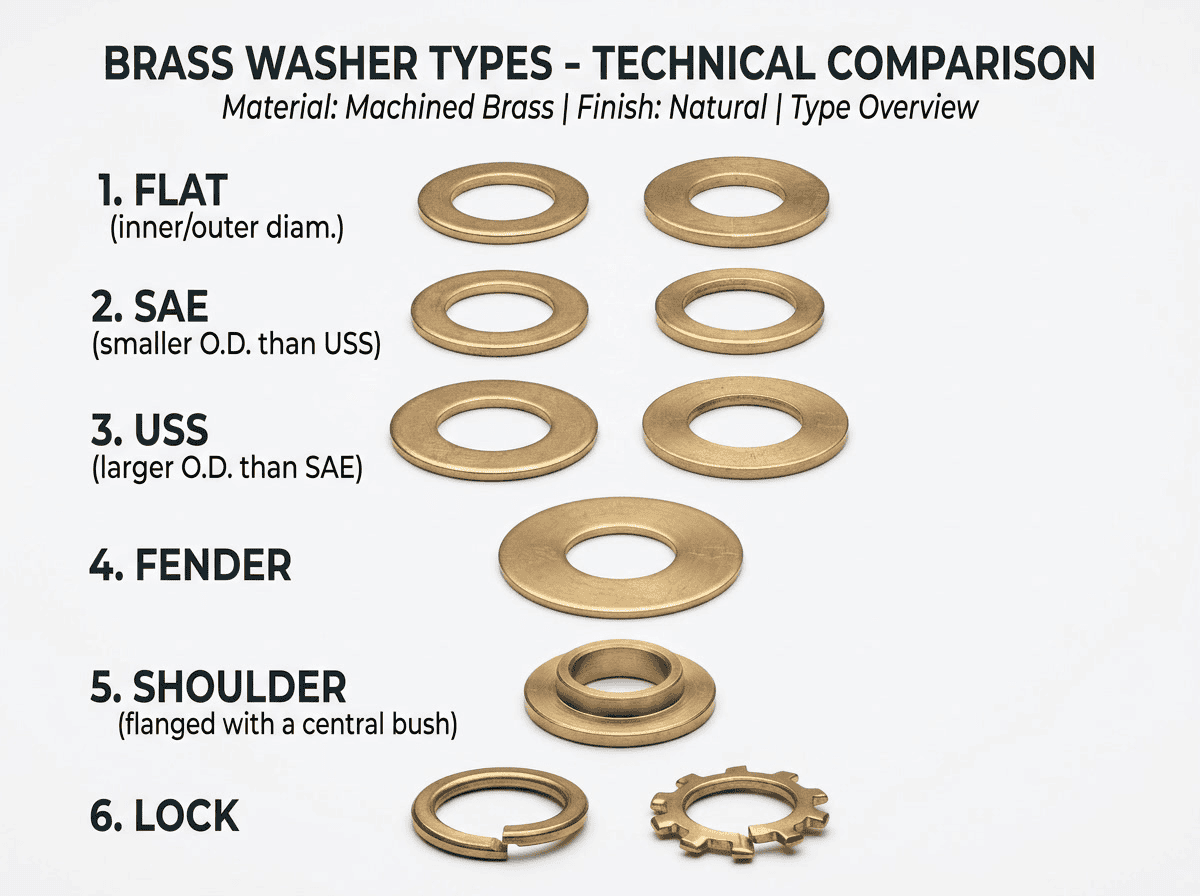
There are five main types of brass washers: flat, sealing (bonded), fender, shoulder, and lock — each optimized for a different load, sealing, or spacing requirement.
The top-3 Google results for “brass washers” are all product listing pages (Amazon, Grand Brass, McMaster-Carr). None of them explain why you would choose one type over another. That is the gap this guide fills.
Flat Brass Washers
The most common type. A flat disc with a center hole, no special profile. Available in two standard size series:
- SAE (Society of Automotive Engineers) — smaller outer diameter relative to the hole, designed for use with standard SAE bolts and screws. Common in automotive and general assembly work.
- USS (United States Standard) — larger outer diameter, providing more bearing surface. Preferred when the mating material is soft or when load distribution is the priority.
Sealing Washers (Bonded Washers)
A sealing washer pairs a metal outer ring with a rubber or neoprene inner sealing ring bonded to the metal. The metal ring handles the clamping load while the rubber deforms to fill surface gaps and stop fluid passage. Common in compression fittings on copper and plastic plumbing, hydraulic fittings, and outdoor fastener assemblies. The rubber element is usually EPDM (excellent resistance to water and weathering) or Nitrile/NBR (better for oils and fuels).
Fender Washers
Fender washers have a disproportionately large outer diameter relative to their hole size — originally designed for automotive sheet metal, where the metal is thin and bolt pull-through is a real failure mode. In non-automotive applications, brass fender washers appear in electrical conduit installations, decorative hardware (the large face is visible and the brass finish is intentional), and composite panel fastening.
Shoulder Washers
Also called insulating bushings or shoulder bushings, these have a cylindrical flange (the shoulder) that extends through the hole in the mating material. Brass shoulder washers are used primarily in PCB and electronics assembly, lamp and luminaire sockets, and instrument panel mounting.
Lock Washers (Split and Tooth)
Brass lock washers come in split (helical spring) and toothed (internal/external serrated) profiles. They resist rotation from vibration. Brass lock washers make sense when the assembly is non-ferrous (e.g., all-brass or bronze fitting) or the environment demands non-magnetic, corrosion-resistant hardware throughout.
| Type | Primary Function | Common Material | Best Application |
|---|---|---|---|
| Flat (SAE/USS) | Load distribution | C260 or C360 brass | General assembly, bolt seating |
| Sealing (Bonded) | Load distribution + fluid seal | Brass + EPDM/NBR | Plumbing fittings, hydraulics |
| Fender | Wide-area load distribution | C260 brass | Thin sheet metal, decorative |
| Shoulder | Electrical isolation + spacing | C360 brass | Electronics, lamp sockets |
| Lock (split/tooth) | Vibration resistance | C360 brass | All-brass assemblies, low-vibration |
Industry Applications of Brass Washers
Brass washers are used across plumbing, electrical, automotive restoration, marine hardware, and decorative lamp making — wherever corrosion resistance, non-magnetic properties, or aesthetics drive material selection.
Plumbing and Fluid Systems
This is where brass washers earn their keep most visibly. In compression fittings, a bonded sealing washer provides the primary seal between the fitting body and pipe. Standard flat brass washers appear at every faucet and angle-stop connection — seated inside the packing nut to protect the valve seat from direct metal contact. ASTM International publishes ASTM B16 and B21 specifications governing brass bar, rod, and shapes used in plumbing hardware. Specifying ASTM-compliant brass is the baseline for plumbing applications where codes apply.
Electrical and Electronic Assembly
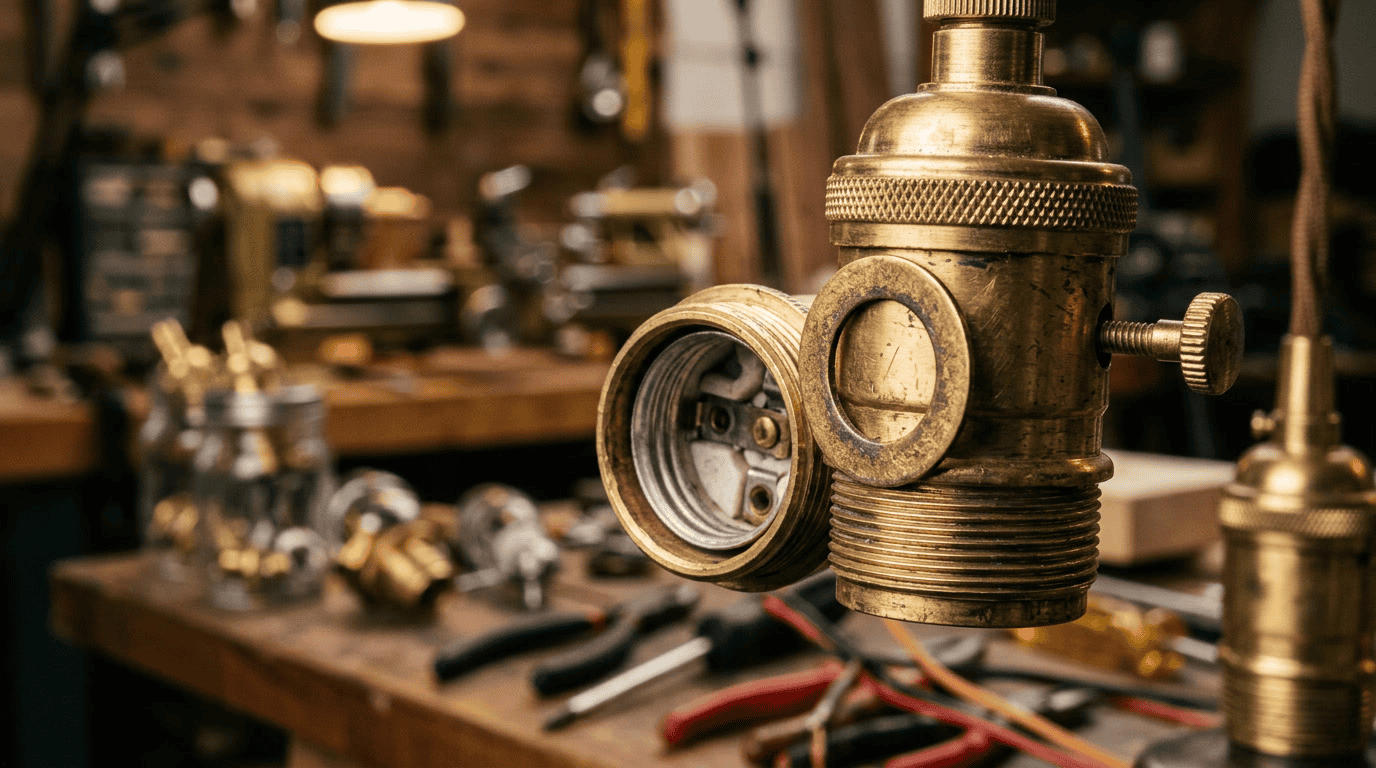
The non-magnetic and conductive properties of brass make it a go-to for electrical work. Grounding connections in panel boards often use brass or bronze washers under the lug bolt to ensure a clean, stable conduction path. Shoulder washers mount PCBs and components to chassis without risking short circuits. In lamp manufacturing, brass washers are both structural and decorative — visible in socket caps, shade fitters, and keyswitch hardware.
Marine and Outdoor Hardware
Salt spray is brutal to most metals. Brass does better than carbon steel by a wide margin. Above the waterline and in fresh-water boat hardware, brass washers are common and cost-effective. Outdoor electrical enclosures, weatherhead conduit fittings, and exterior decorative ironwork all use brass hardware because it weathers to a stable patina rather than pitting and losing structural integrity.
Automotive Restoration
In vintage and classic vehicle restoration, matching original materials matters both for authenticity and for galvanic compatibility. Pre-1970s automotive hardware was predominantly brass or cadmium-plated steel. Using modern stainless fasteners in contact with original brass components creates a dissimilar-metals pairing that accelerates corrosion under hood conditions (heat, condensation, road salt).
How to Choose the Right Brass Washer
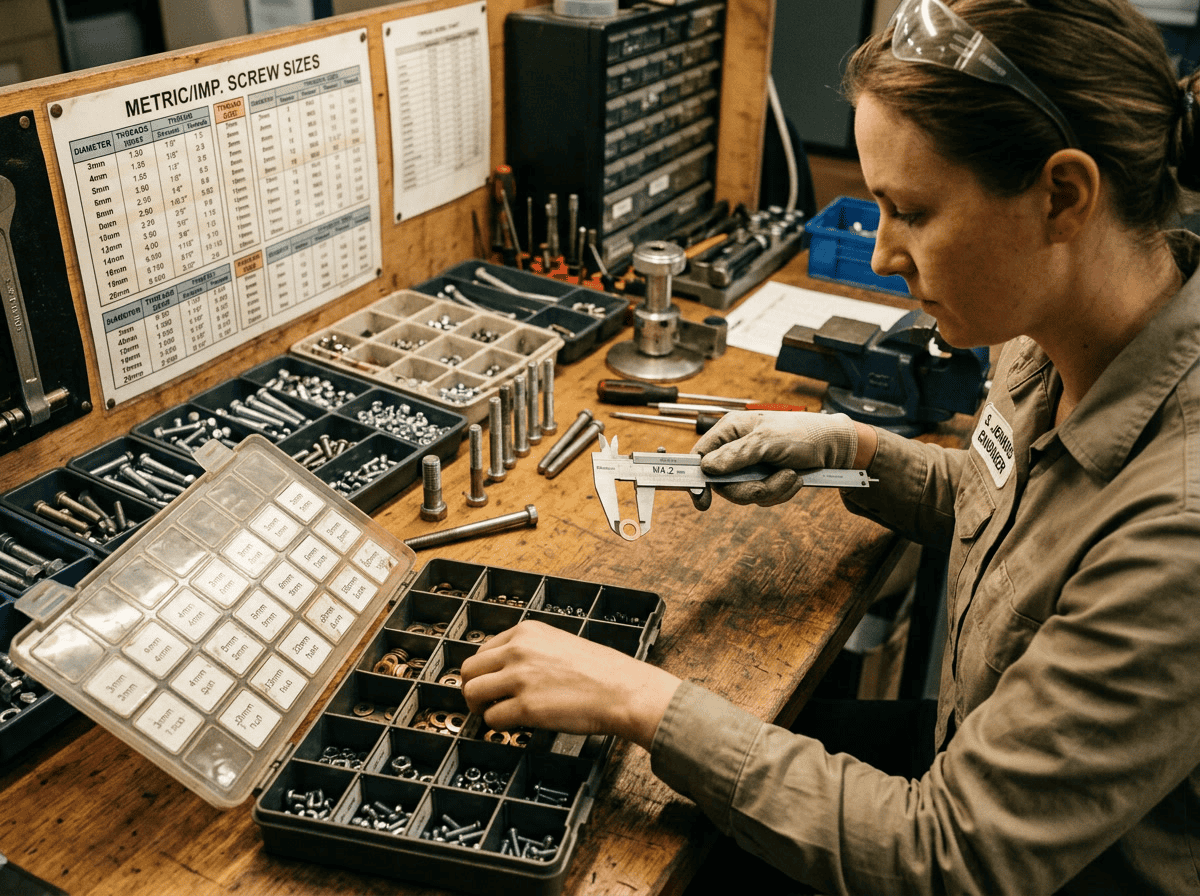
Choose a brass washer by matching four parameters: inside diameter (ID) to fastener shank, outside diameter (OD) to required bearing area, thickness to required spacing or compliance, and grade to the environment’s chemical exposure.
Step 1: Match Inside Diameter to Fastener
The ID should be slightly larger than the nominal bolt diameter. Standard clearance per ASME B18.22.1:
- Narrow fit: ID = nominal bolt size + 0.031 in. (tight, for close-tolerance positioning)
- Regular fit: ID = nominal bolt size + 0.063 in. (standard general use)
- Wide fit: ID = nominal bolt size + 0.094 in. (for oversized holes or field conditions)
Step 2: Set Outside Diameter by Load Requirement
Bigger OD = more bearing area = lower surface pressure on the mating material. Required area (sq in) = Clamping force (lbs) divided by Allowable surface pressure (psi). For common substrates: wood 400-600 psi, aluminum 1,000-1,500 psi, plastic 500-800 psi.
Step 3: Verify Thickness
Thickness affects rigidity and compliance. A thicker washer deforms less under load; a thinner, softer washer deforms slightly, which improves sealing contact. Sealing washers typically use thinner metal (0.040-0.050 in.) so the rubber element can compress uniformly.
Step 4: Match Grade to Environment
For most hardware applications, C260 cartridge brass is the standard. For precision machined parts, C360 free-machining brass gives tighter tolerances. Important caution: brass is susceptible to stress corrosion cracking (SCC) in ammonia-rich environments — in agricultural settings or ammonia-refrigeration systems, substitute silicon bronze or 316 stainless.
| Bolt Size | ID (in) | OD (in) | Thickness (in) | SAE Designation |
|---|---|---|---|---|
| #6 | 0.156 | 0.375 | 0.049 | No. 6 SAE |
| #8 | 0.188 | 0.438 | 0.049 | No. 8 SAE |
| #10 | 0.203 | 0.500 | 0.049 | No. 10 SAE |
| 1/4 in. | 0.281 | 0.625 | 0.065 | 1/4 SAE |
| 5/16 in. | 0.344 | 0.688 | 0.065 | 5/16 SAE |
| 3/8 in. | 0.406 | 0.812 | 0.065 | 3/8 SAE |
| 1/2 in. | 0.531 | 1.062 | 0.095 | 1/2 SAE |
| 5/8 in. | 0.656 | 1.312 | 0.095 | 5/8 SAE |
| 3/4 in. | 0.812 | 1.469 | 0.134 | 3/4 SAE |
Brass Washers vs. Other Washer Materials
Brass outperforms steel on corrosion resistance and non-magnetic properties but loses to stainless in tensile strength, to plastic in electrical isolation, and to copper in pure conductivity — the right choice depends on which properties your application actually requires.
Brass vs. Stainless Steel
Stainless steel (typically 304 or 316) surpasses brass in tensile strength (~30,000 psi yield for 304 SS vs. ~15,000 psi for C260 brass) and high-temperature resistance. Brass surpasses stainless in machinability (brass cuts approximately 5x faster), non-magnetic properties, and cost in small retail quantities (typically 20-40% less expensive). The real danger with mixed assemblies: galvanic corrosion. AMPP (formerly NACE International), the global corrosion authority, documents that stainless steel is more cathodic than brass — meaning brass corrodes preferentially when both metals contact an electrolyte. For long-term outdoor or marine assemblies, keep your metals consistent.
Brass vs. Zinc (Galvanized)
Galvanized steel washers are the cheapest option for general outdoor use. The zinc coating protects the steel beneath — until the coating is compromised by scratching, at which point rust accelerates. In plumbing applications, zinc can leach into potable water systems (a health concern). Brass has neither problem.
Brass vs. Copper
Pure copper offers higher electrical and thermal conductivity (~100% IACS vs. ~28% IACS for brass). Use copper washers in high-current bus bar connections where conductivity matters. For everything else, brass delivers similar corrosion resistance at lower cost with better machinability.
Brass vs. Nylon/Plastic
Plastic washers (nylon, PTFE, acetal) are fully electrically insulating. If you need true galvanic isolation between a fastener and a substrate, use nylon washers under and over the metal washer sandwich. The Engineering ToolBox corrosion reference provides a useful chemical compatibility table for selecting washer materials in process environments.
| Property | Brass (C260) | 304 Stainless | Galvanized Steel | Copper | Nylon |
|---|---|---|---|---|---|
| Corrosion resistance | Excellent | Excellent | Good (until scratched) | Excellent | Excellent |
| Tensile yield (psi) | ~15,000 | ~30,000 | ~36,000 | ~10,000 | ~7,000 |
| Electrical conductivity | Moderate (28% IACS) | Low (~2% IACS) | Low | High (100% IACS) | None (insulator) |
| Machinability | Excellent | Fair | Fair | Good | Excellent |
| Non-magnetic | Yes | Mostly yes | No | Yes | Yes |
| Potable water safe | Yes | Yes | Limited | Yes (check code) | Yes |
| Relative cost (1/4 in. flat) | $ | $$ | $ | $$$ | $ |
Installation Tips and Best Practices
Always seat brass washers flat before torquing, use a thin film of compatible anti-seize in corrosive environments, and never exceed the rated clamping load — brass deforms plastically above yield rather than springing back like steel.
Seating and Orientation
The chamfered side of a stamped washer — the side that faced the punch during manufacturing — should face the fastener head. This ensures the flat face contacts the substrate for maximum bearing area. With sealing washers, the rubber face contacts the substrate (not the bolt head). Reversing this puts the rubber in contact with the rotating fastener, causing it to tear or roll out from under the load as you torque.
Torque Values for Brass Hardware
In practice, brass hardware is consistently over-torqued in the field. Technicians accustomed to steel fasteners apply steel-appropriate torque to brass-seated connections, resulting in galled threads, cracked shoulder washers, or deformed washer faces. A rule of thumb: for C360 brass fasteners, use approximately 60% of the torque you would apply to the equivalent SAE grade 5 steel fastener.
Anti-Seize and Thread Lubricant
In applications where brass washers will be exposed to water, salt, or chemicals, a thin film of compatible anti-seize extends service life and makes future disassembly possible. Do not use copper-based anti-seize on brass hardware — the galvanic potential between the copper compound and the brass alloy is present in highly corrosive environments. Nickel-based or bismuth-based anti-seize is the safe choice.
Avoiding Stress Corrosion Cracking
Brass washers used in ammonia atmospheres (agricultural settings, certain refrigeration systems, environments with high concentrations of some cleaning agents) are susceptible to stress corrosion cracking (SCC). The condition creates intergranular cracks in stressed brass components without obvious surface corrosion first. In ammonia environments, silicon bronze or 316 stainless is the correct substitute.
Future Trends in Brass Hardware (2026+)
Two trends are reshaping brass washer sourcing: tighter environmental regulations on leaded brass (C360) and growing demand for precision metric hardware as US manufacturing adopts metric fastener systems.
Lead-Free and Low-Lead Brass Alloys
The US Reduction of Lead in Drinking Water Act (effective January 2014) and California Proposition 65 restrictions have pushed plumbing hardware manufacturers away from C360 (which contains ~3% lead) toward low-lead alternatives like C69300 (eco-brass) and C87850 (silicon brass). For brass washers used anywhere in a potable water system, specifying “lead-free” or “NSF/ANSI 61-compliant” is increasingly a code requirement. According to Statista market research, the global brass hardware market is projected to grow at approximately 3.8% CAGR through 2026-2030, driven partly by construction activity in South and Southeast Asia and partly by North American and EU plumbing code transitions requiring lead-free alloys.
Metric Conversion in US Manufacturing
US manufacturers — particularly automotive suppliers, medical device companies, and electronics assemblers — have been steadily converting from inch to metric fastener systems under pressure from global supply chains. This is increasing demand for metric brass washers (ISO 7089 dimensional series) from suppliers who historically stocked only SAE/USS inch sizes. If you are building a procurement program around brass washers in 2025-2026, adding M3 through M12 metric flat washers to your stocking list is a near-certainty for any shop touching international assemblies.
FAQ: Brass Washers
The most common questions about brass washers, answered directly.
Do they make brass washers?
Yes. Brass washers are a standard catalog item available from virtually every industrial fastener distributor in flat, sealing, fender, shoulder, and lock washer profiles, in inch (SAE/USS) and metric (ISO) sizes from No. 4 screw through 1 in. bolt. Specialty sizes are available from machine shops and turned-parts suppliers.
What metal washer will not rust?
Stainless steel (316), silicon bronze, and brass all resist rust effectively in most environments. Brass forms a patina (greenish oxidation) but does not rust — rust is iron oxide, specific to ferrous metals. For full marine immersion, 316 stainless is the standard. For general outdoor and plumbing use, brass is typically the most cost-effective rust-free choice.
What is the difference between copper and brass washers?
Copper washers are softer and more conductive (~100% IACS) than brass (~28% IACS). Copper is preferred for high-current electrical connections and hydraulic/pneumatic fittings where soft metal deforms to fill micro-gaps. Brass is preferred for general fastening because it machines better, is harder, and is less expensive. Both resist corrosion well.
Are brass washers good for outdoor use?
Yes, for most outdoor applications above grade. Brass forms a stable patina that protects the metal beneath and will not rust. For direct soil contact or marine environments with salt-spray exposure, 316 stainless or silicon bronze gives longer service life.
What is the difference between SAE and USS brass washers?
SAE washers have a smaller outer diameter relative to the hole size — designed for close-fit applications with standard bolt heads. USS washers have a larger outer diameter, providing more bearing surface. Use USS when spreading load over a larger area is the priority (soft substrates, oversized holes). Use SAE when the bolt head itself is the load distributor.
Can brass washers be used with stainless steel bolts?
Technically yes, but with caution. Brass and stainless steel have different electrochemical potentials, creating a galvanic couple when an electrolyte is present. Stainless is the more noble metal; brass will corrode preferentially. In dry indoor assemblies, this is not a practical concern. In plumbing, outdoor, or marine applications, keep fastener and washer in the same metal family.
What size brass washer do I need for a 3/8 in. bolt?
For a 3/8 in. bolt, a standard SAE flat brass washer has an ID of 0.406 in., OD of 0.812 in., and thickness of 0.065 in. For more bearing area, use the USS equivalent: 0.406 in. ID, 1.000 in. OD, 0.083 in. thick. The USS washer is the right choice if you are bolting through wood, plastic, or aluminum where bolt pull-through is a concern.
How do I stop brass washers from turning green?
The green patina (verdigris) is a natural copper oxide/carbonate that forms on brass in humid or outdoor conditions. It is protective, not damaging. To prevent it visually, apply a clear lacquer or wax coating to the brass surface. For hardware that needs to stay bright, use lacquered brass washers — the lacquer coating delays patina formation significantly in indoor environments.
Conclusion
Brass washers punch above their weight as a hardware category. They occupy the intersection of corrosion resistance, machinability, non-magnetic properties, and cost — a combination that no single alternative material fully replicates. Flat brass washers handle the broad middle of general assembly work. Sealing washers lock down fluid systems. Shoulder washers isolate electronics. Fender washers rescue thin sheet metal.
The key to getting the right brass washer is treating the selection as an engineering decision, not a grab-and-go moment. Match the ID to your fastener, size the OD to your load and substrate, specify the right alloy grade for your chemical environment, and verify torque against brass (not steel) specifications. Do that, and brass washers will outlast the assembly they are in. For production quantities of brass washers in SAE, USS, and metric sizes — including sealing, fender, and shoulder washer profiles — browse the full production hardware catalog to find the right specification for your project.
Related Products
Solutions & Cluster
Related Articles
- Tamper Proof Bolts: The Complete Guide to Types, Materials & Selection
- Nylon Screws: Complete Guide to Types, Sizes & Applications (2026)
- Essential Guide to UNC Fittings: Types, Uses, and Applications
- U Bolt: The Complete Guide to Types, Sizes, Materials, and Industrial Applications
- Bolt Nut Stainless Steel: Grades, Pairing, and Buying Guide
- Nut Nyloc: The Complete Guide to Nylon Insert Lock Nuts (2026)
- ASTM A193: Complete Guide to High-Strength Bolting Grades and Specifications
- The Complete Guide to Security Screws: Types, Applications & Why They Matter