 English
 German
 Spanish
 Portuguese
 French
 Japanese
 Arabic
 Korean
 Vietnamese
 Russian
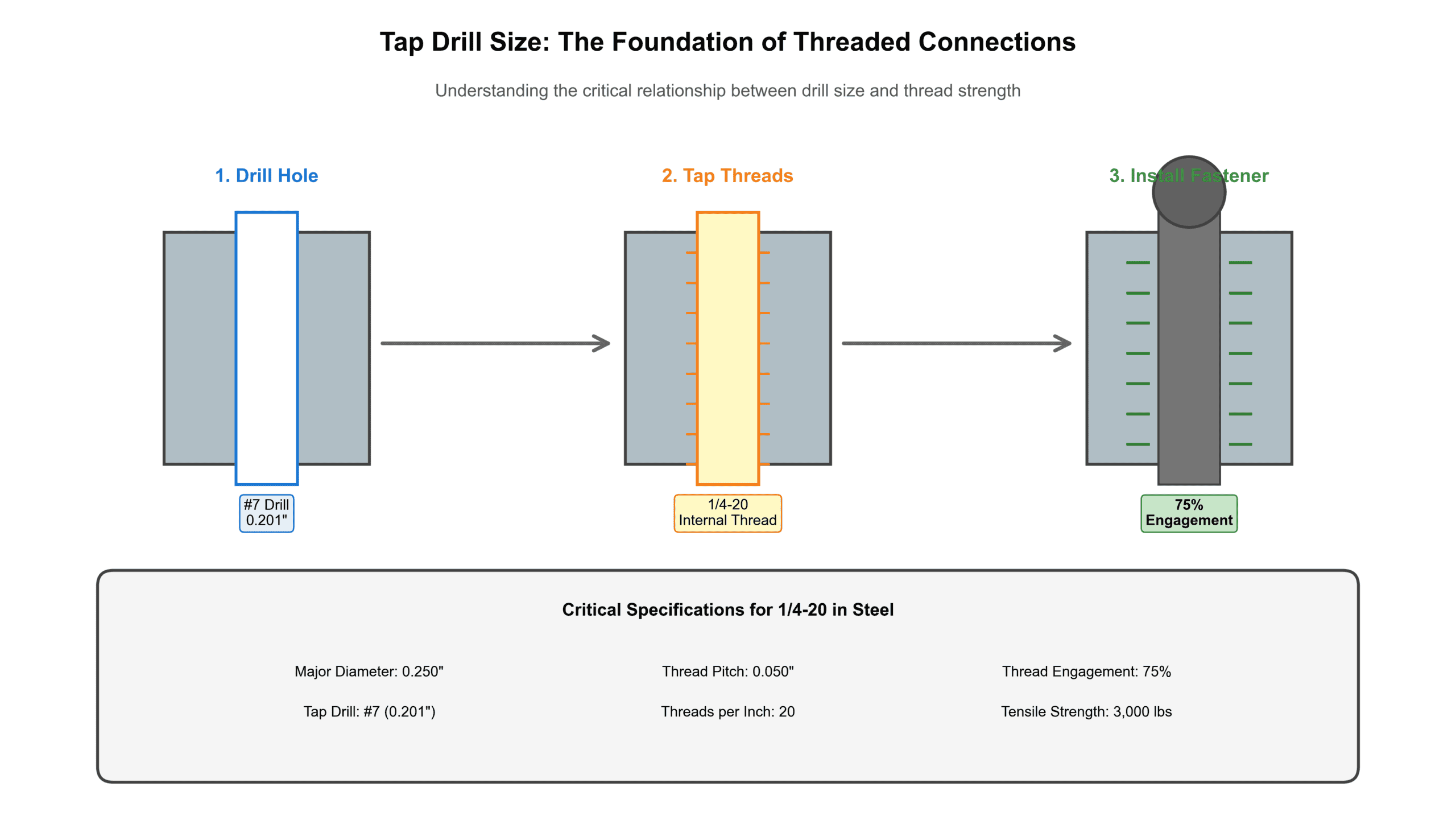
Direct answer: For a 1/4-20 thread, use a #7 drill bit (0.201″ diameter) to achieve the standard 75% thread engagement in steel. This provides optimal strength while allowing smooth tapping. The drill size changes based on material hardness—stainless steel may require #6 (0.204″), while cast iron works better with #8 (0.199″). Wrong drill sizes lead to stripped threads, broken taps, or weak connections that fail under load.
When specifying fasteners for production, send your supplier the thread designation, material grade, hole type (through or blind), required tolerances, and quantity. Our engineering team reviews tap drill dimensions and recommends thread engagement depths for your specific application.
What Is Tap Drill Size and Why It Matters
Tap drill size is the diameter of the hole drilled before cutting internal threads. It determines how much material remains for the tap to form threads into. The relationship follows this pattern:
- Major diameter: The thread’s outer edge (for 1/4-20, this is 0.250″)
- Minor diameter: The thread’s root (calculated from pitch)
- Tap drill size: Creates a hole between minor and major diameters
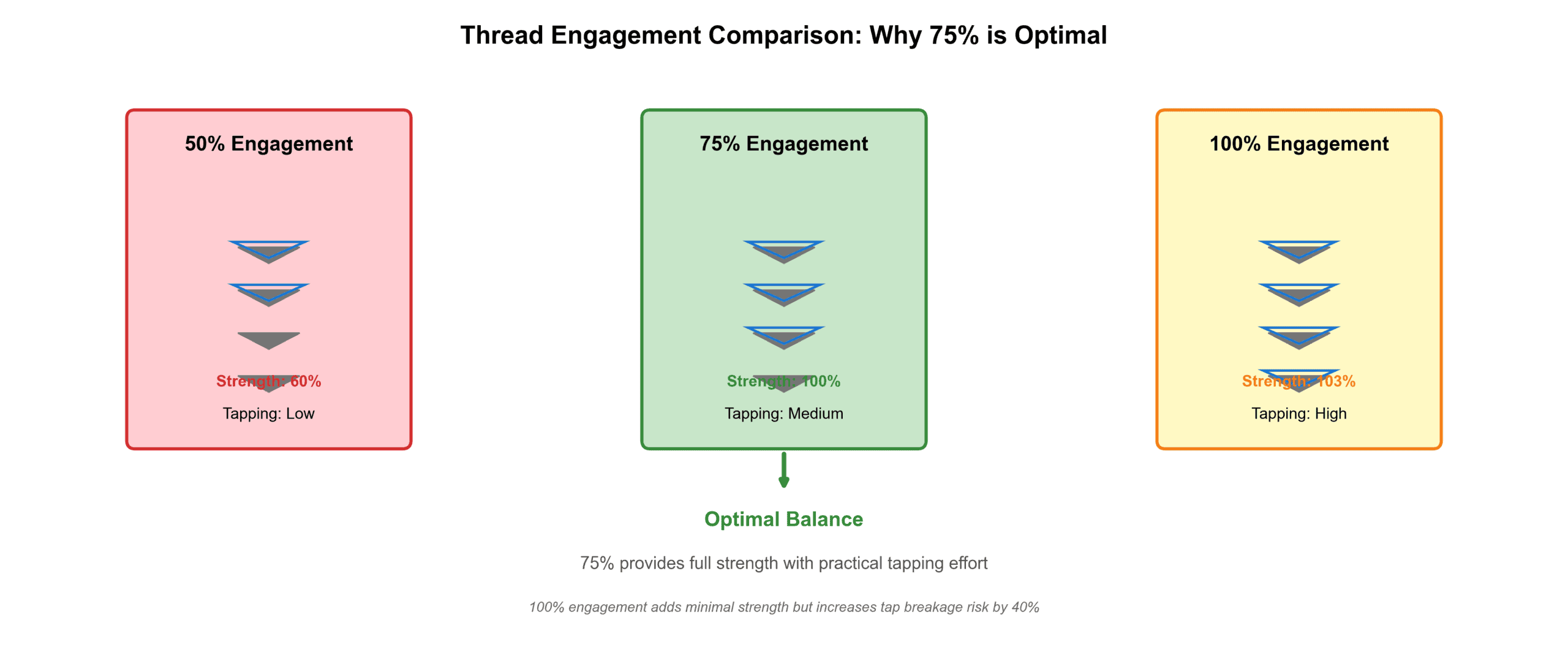
The industry standard targets 75% thread engagement—meaning the internal threads fill 75% of the theoretical maximum depth. This balance emerged from decades of mechanical testing:
- Below 60% engagement: Threads strip under normal torque loads
- 75% engagement: Full fastener strength with reasonable tapping effort
- Above 85% engagement: Minimal strength gain but drastically increased tap breakage
Real Failure Consequences
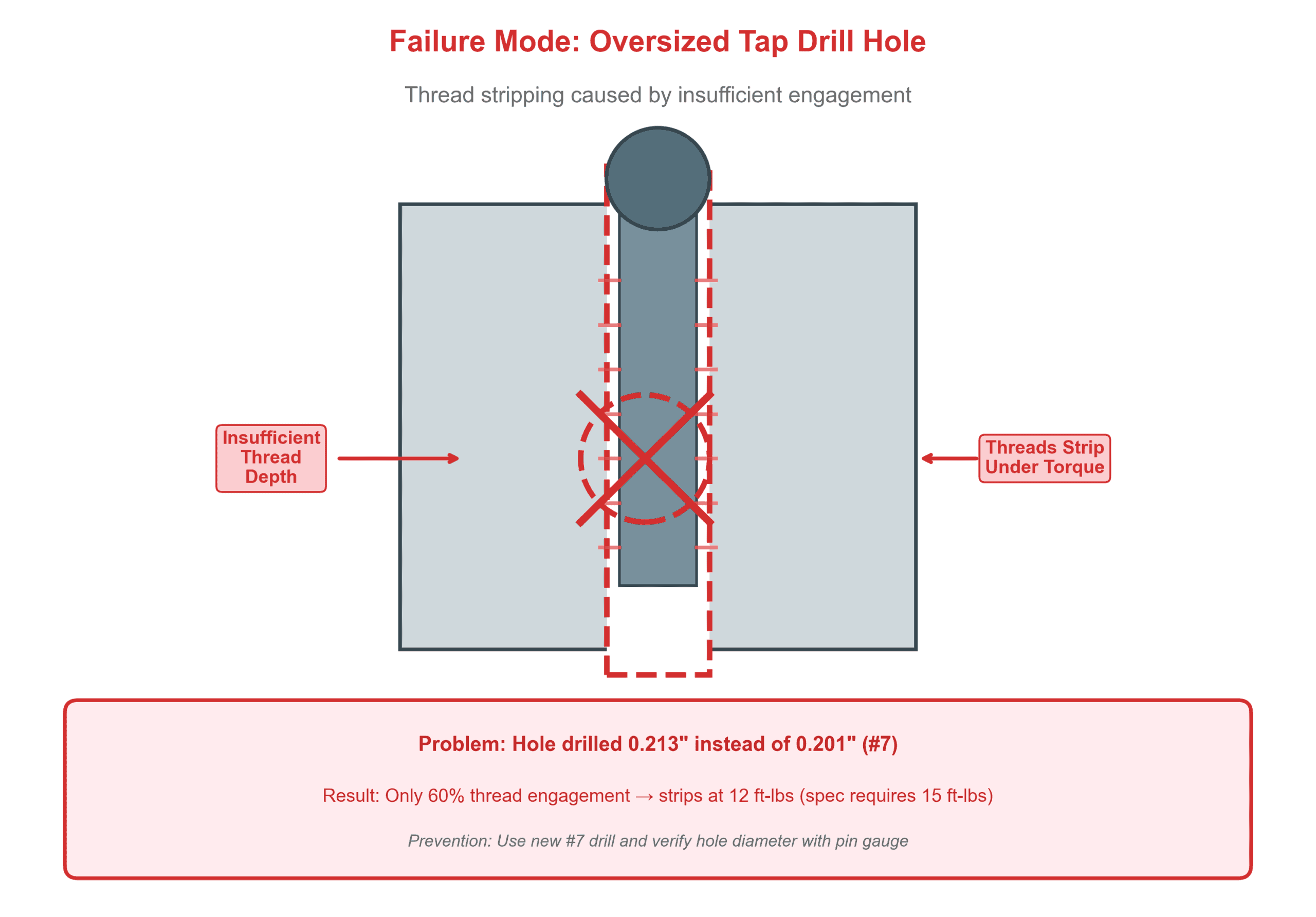
Case A: Aluminum housing, oversized hole
A machinery manufacturer drilled 0.213″ holes for 1/4-20 threads in 6061-T6 aluminum housings (specification called for 0.201″). The resulting 65% thread engagement caused progressive thread stripping when technicians torqued mounting bolts to 15 ft-lbs—well below the 20 ft-lbs the assembly required. The entire production batch of 480 units required helicoil thread inserts, adding $8.40 per unit in rework cost plus two weeks schedule delay.
Root cause: Shop floor used a 13/64″ drill (0.2031″) that had worn to 0.213″ after extended use. No verification gauge was employed.
Case B: Stainless steel bracket, undersized hole
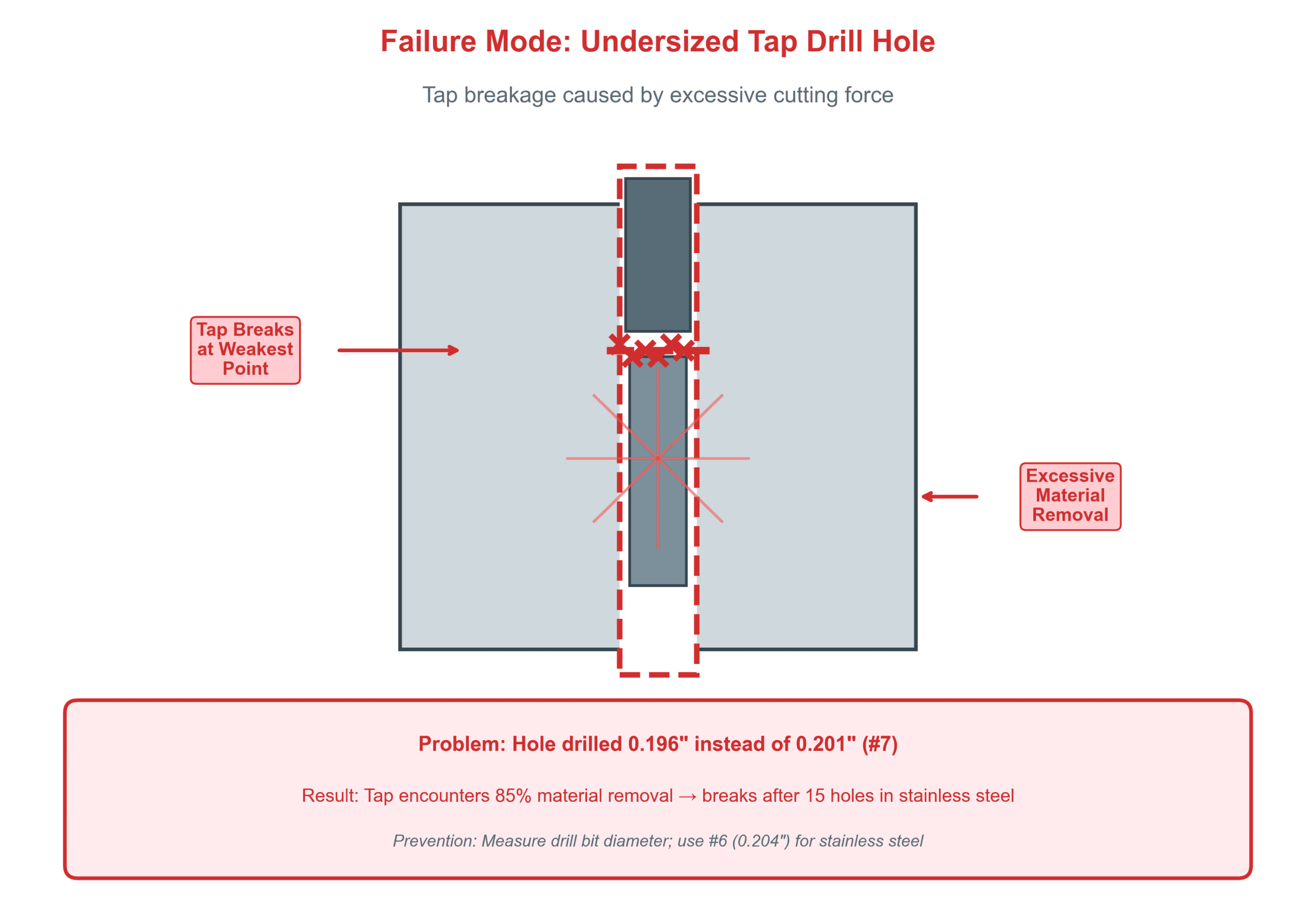
A contract manufacturer drilled 0.196″ holes for 1/4-20 threads in 304 stainless brackets. The tight pilot hole caused 12 tap breakages during the first 50 parts. Extracting broken taps required EDM work at $85 per hole, destroying 8 parts completely.
Root cause: The job specified mild steel tap drill size (0.201″) without accounting for stainless steel’s work-hardening characteristics. The correct size should have been 0.204″ (#6 drill).
How to Calculate Tap Drill Size
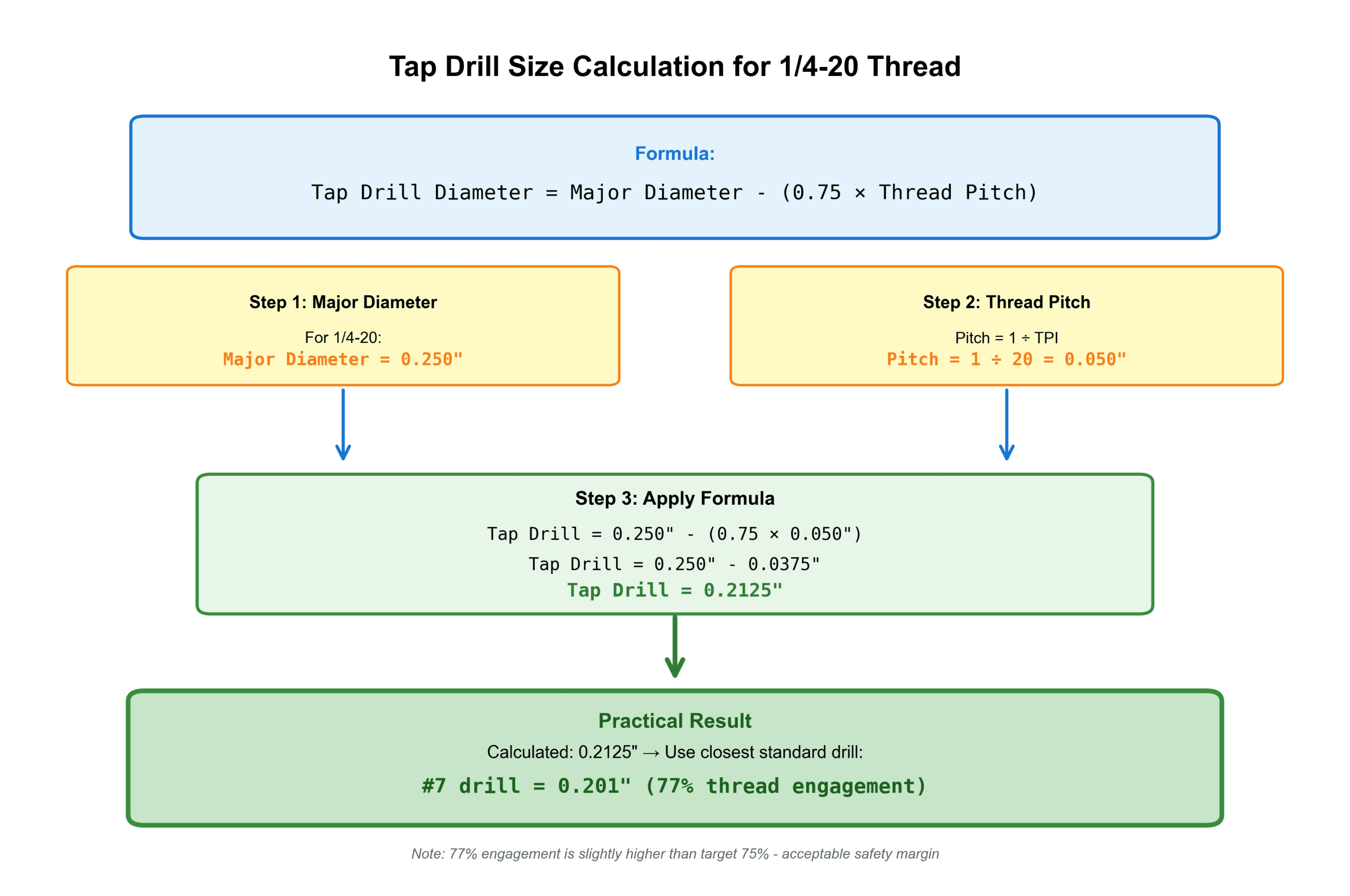
The fundamental formula for 75% thread engagement is:
Tap Drill Diameter = Major Diameter – (0.75 × Thread Pitch)
For unified threads, pitch equals 1 ÷ threads per inch. For 1/4-20:
- Major diameter = 0.250″
- Pitch = 1 ÷ 20 = 0.050″
- Tap drill = 0.250″ – (0.75 × 0.050″) = 0.250″ – 0.0375″ = 0.2125″
The closest standard drill is #7 at 0.201″, which actually provides approximately 77% engagement—slightly conservative for safety.
Why 75% Thread Engagement?
The percentage represents the ratio of actual thread height to theoretical maximum thread height. Engineering studies from the 1950s (documented in Machinery’s Handbook) established that:
- 50% engagement: Shear strength is only 60% of fastener strength
- 75% engagement: Shear strength matches or exceeds fastener tensile strength
- 100% engagement: Only 3-5% stronger than 75%, but tapping force increases 40%
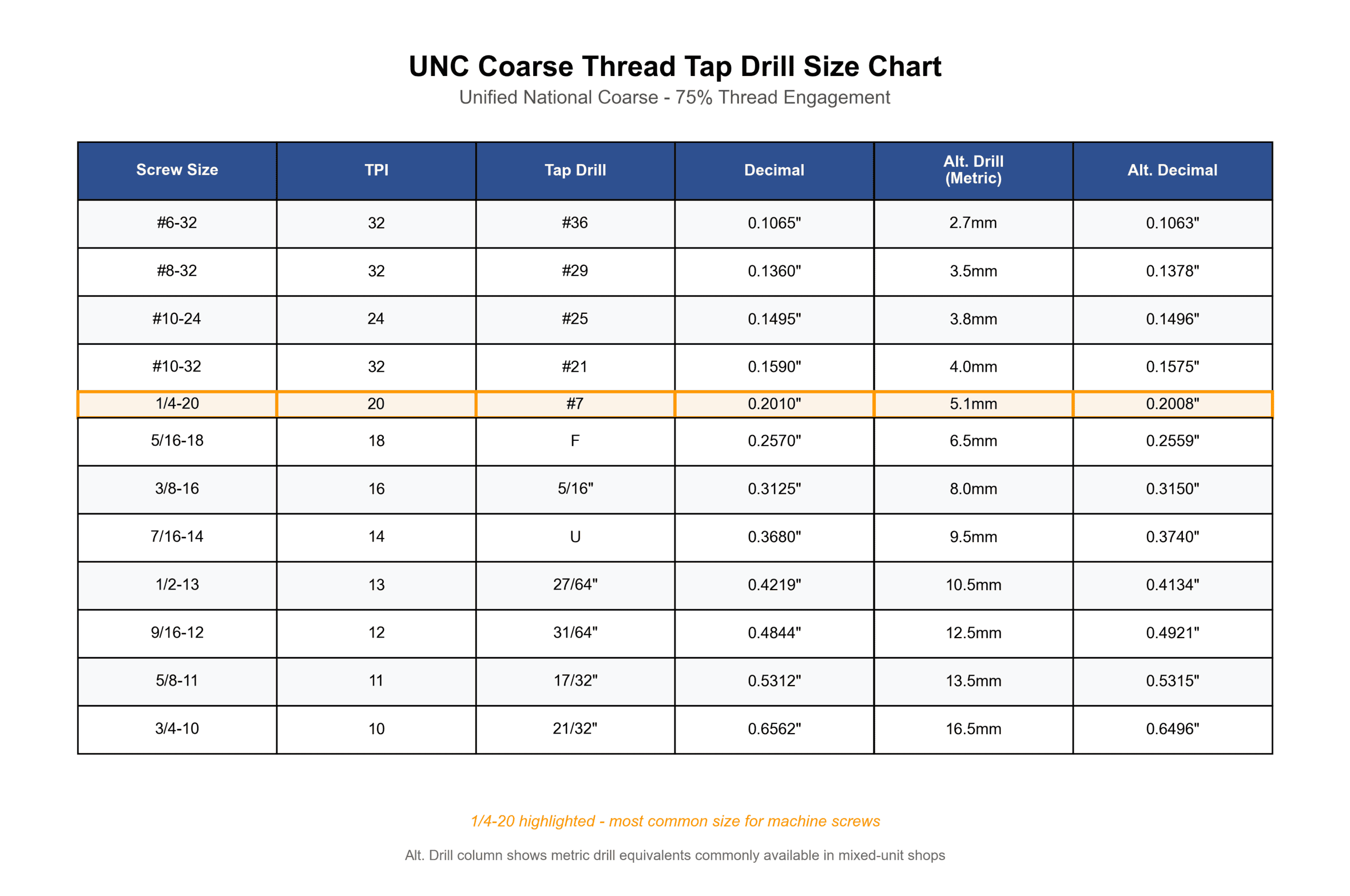
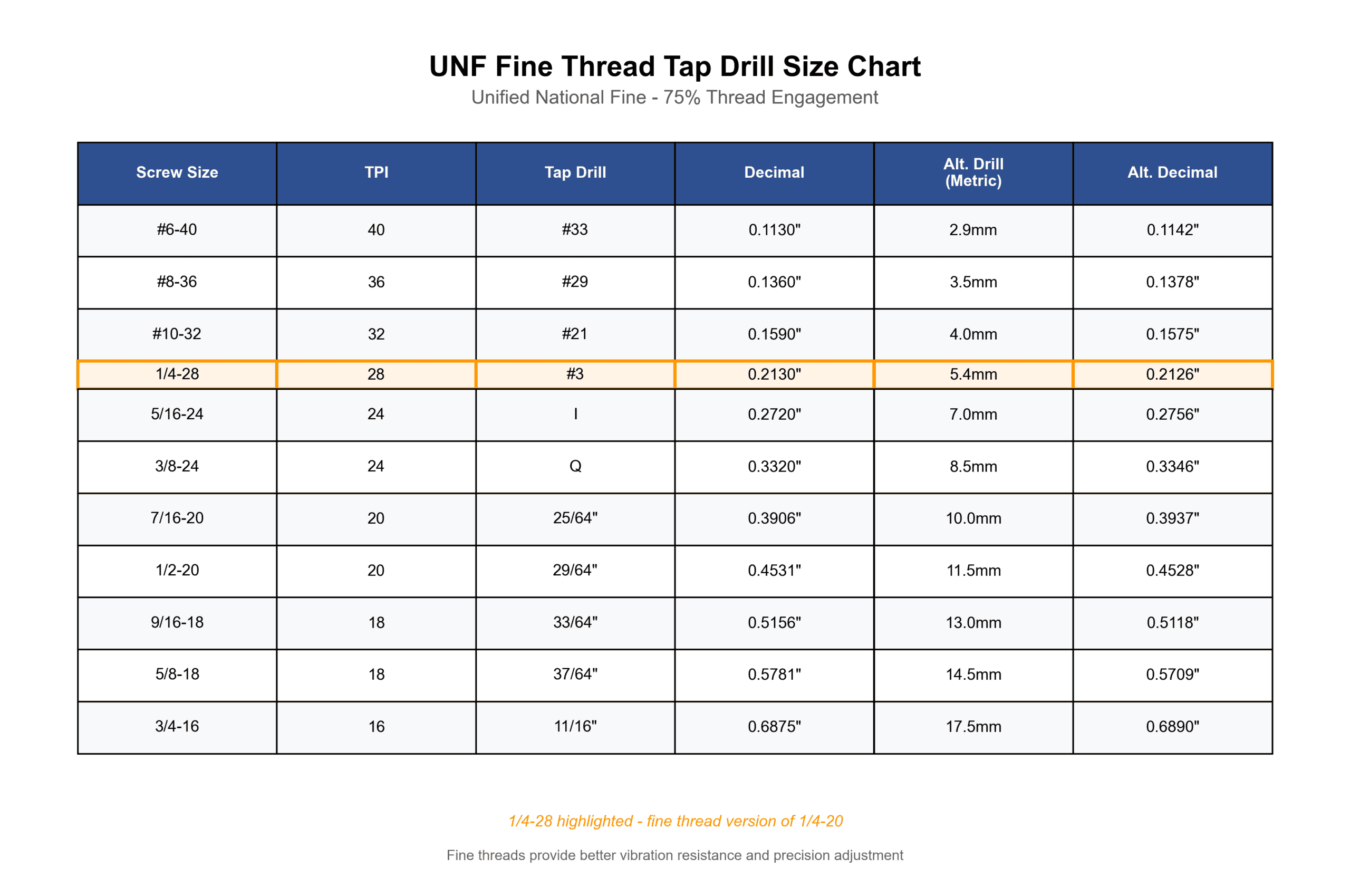
Complete Tap Drill Size Chart
Unified Coarse Thread (UNC)
Unified Fine Thread (UNF)
Material-Specific Tap Drill Recommendations
Different materials respond differently to tapping forces. This matrix shows recommended adjustments from the steel baseline:
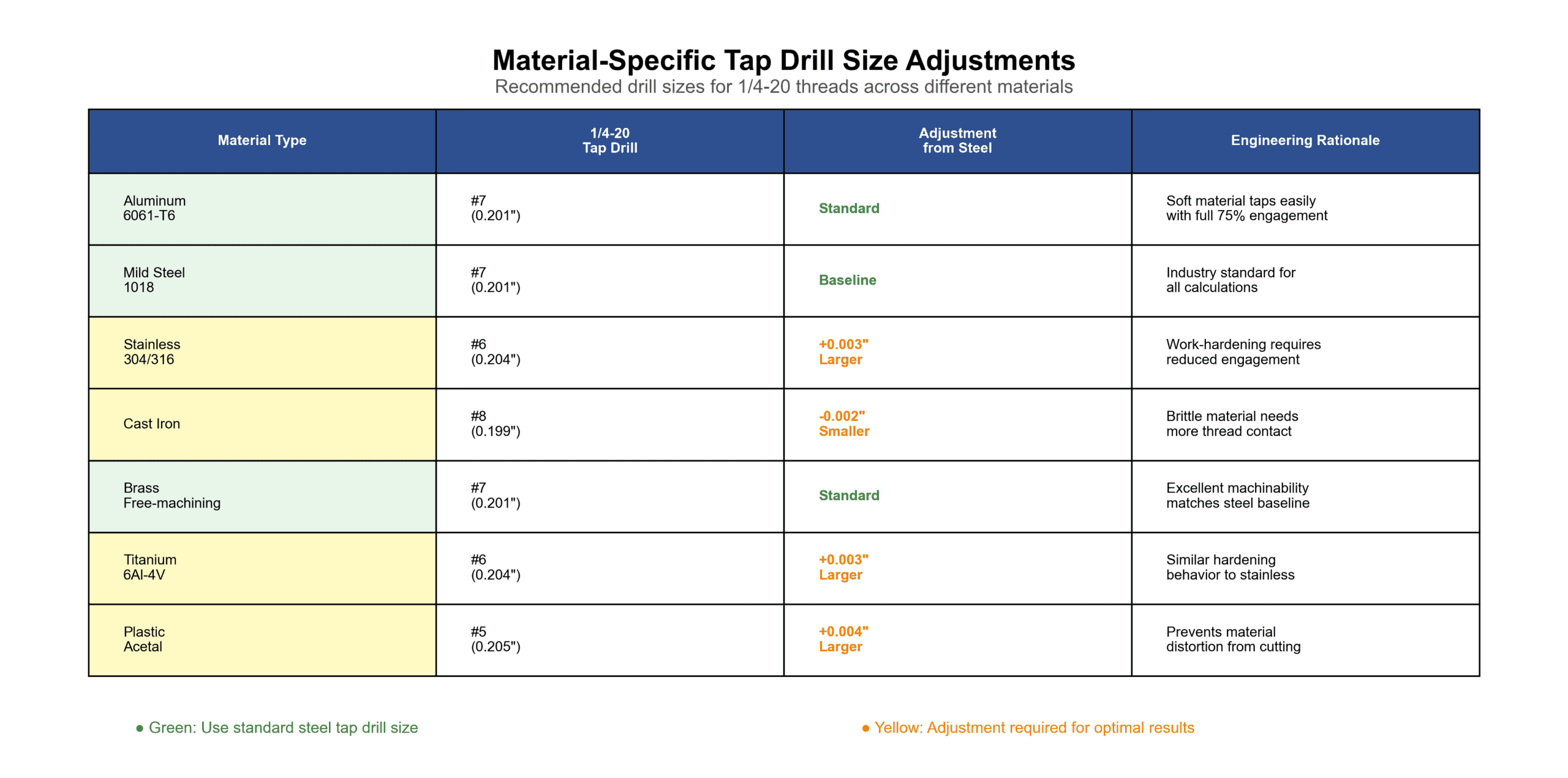
Stainless steel work-hardens rapidly during cutting. The tap’s leading threads compress and harden the material, making each successive thread harder to form. Opening the hole by 0.003″ reduces thread engagement from 77% to approximately 72%—still well above the 60% minimum, but significantly easier to tap. Production shops report 3-5× longer tap life with this adjustment.
Common Mistakes and How to Avoid Them
1. Using Worn Drill Bits
Problem: Drill bits wear on the outer cutting edges, reducing effective diameter. A #7 drill (nominal 0.201″) can measure 0.197″ after extended use, creating an undersized hole.
Solution: Measure drills with pin gauges every 500 holes in steel, 1000 holes in aluminum. Mark out drills that measure more than 0.003″ undersize. The cost of a drill is $4-8; the cost of a broken tap embedded in a part is $85-200.
Quality Control: How to Verify Tap Drill Size
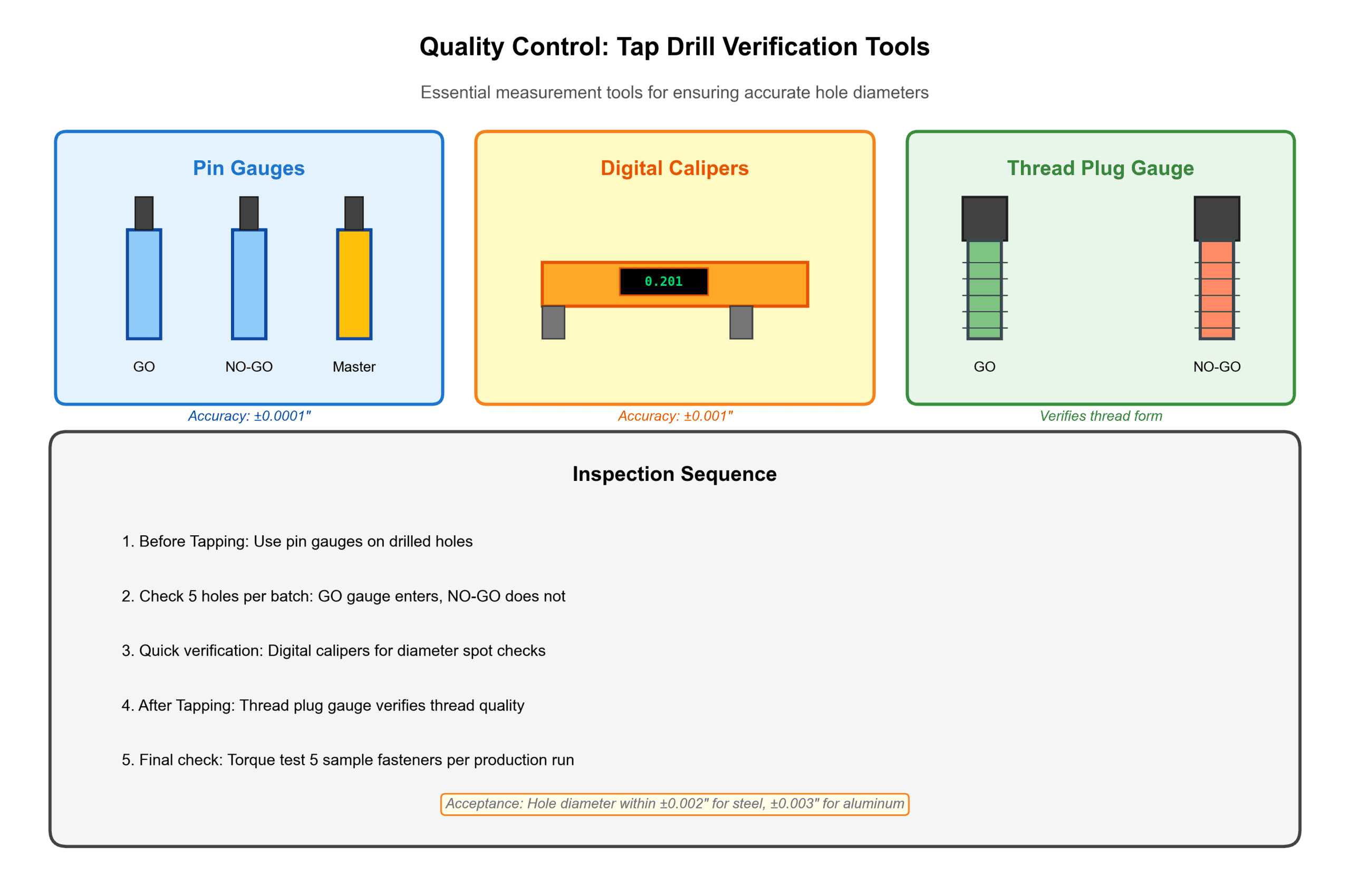
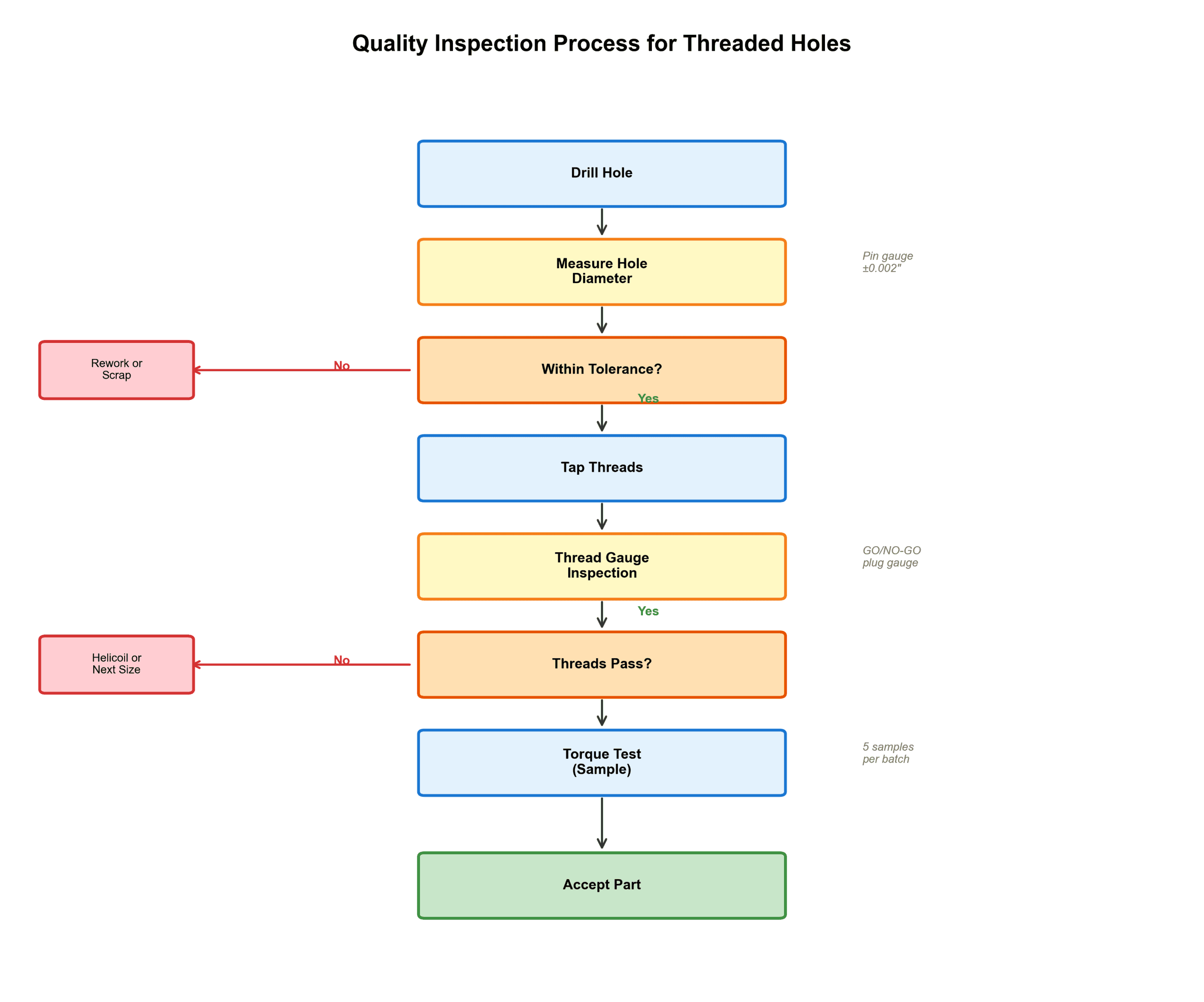
Production environments require verification beyond trusting the drill label. Implement these checkpoints:
Method 1: Pin Gauge Measurement (Most Accurate)
Use go/no-go pin gauges to check holes before tapping:
- Go gauge: Should enter the hole freely (tap drill nominal size)
- No-go gauge: Should not enter (typically 0.003″ oversize)
Specification Sheet: What to Include in Your RFQ
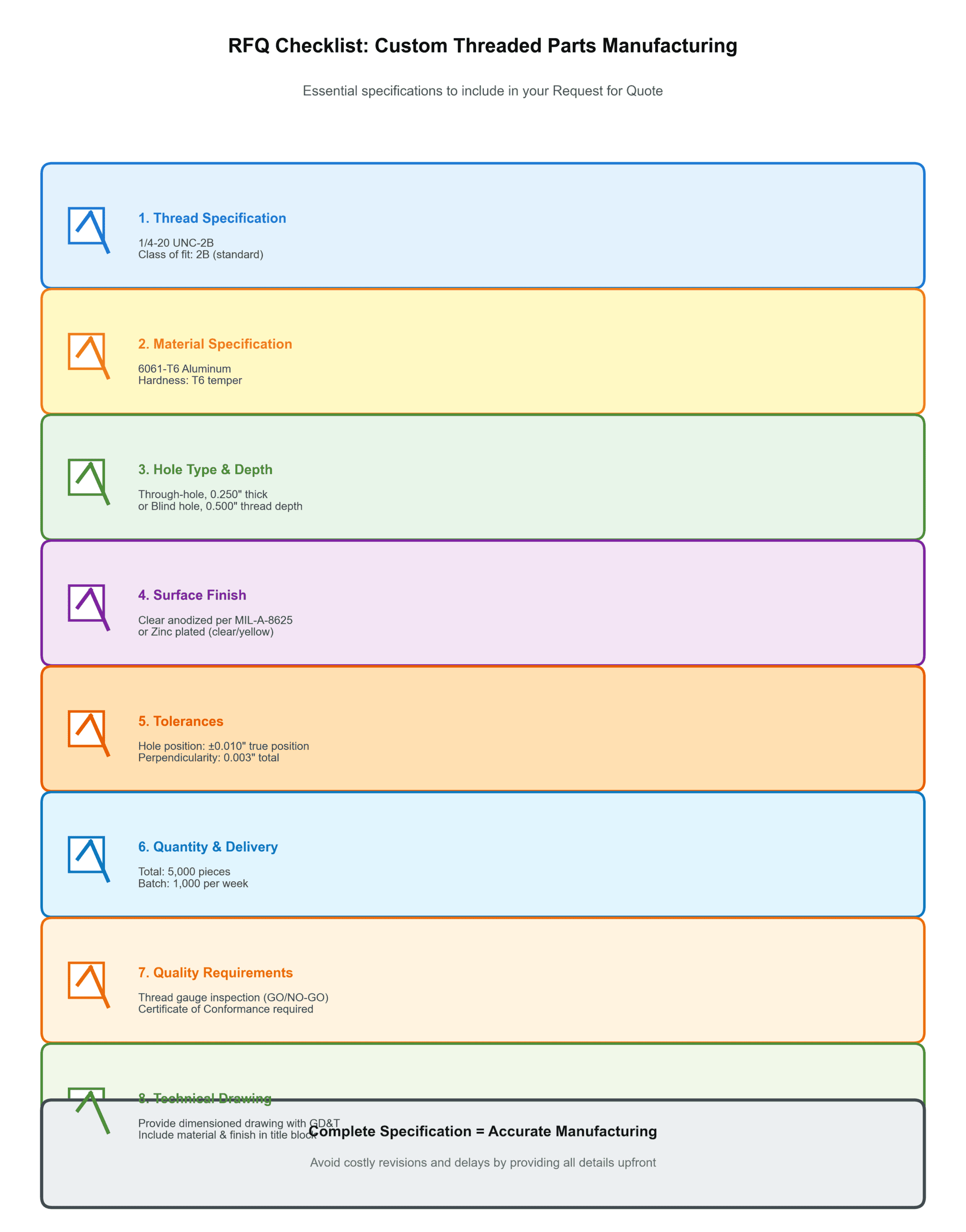
When requesting custom threaded parts or fasteners, provide these details to ensure correct manufacturing:
Essential Information
- Thread Specification: Full designation: “1/4-20 UNC” not just “1/4 thread”
- Material Specification: Alloy designation: “6061-T6 aluminum”, “304 stainless steel”
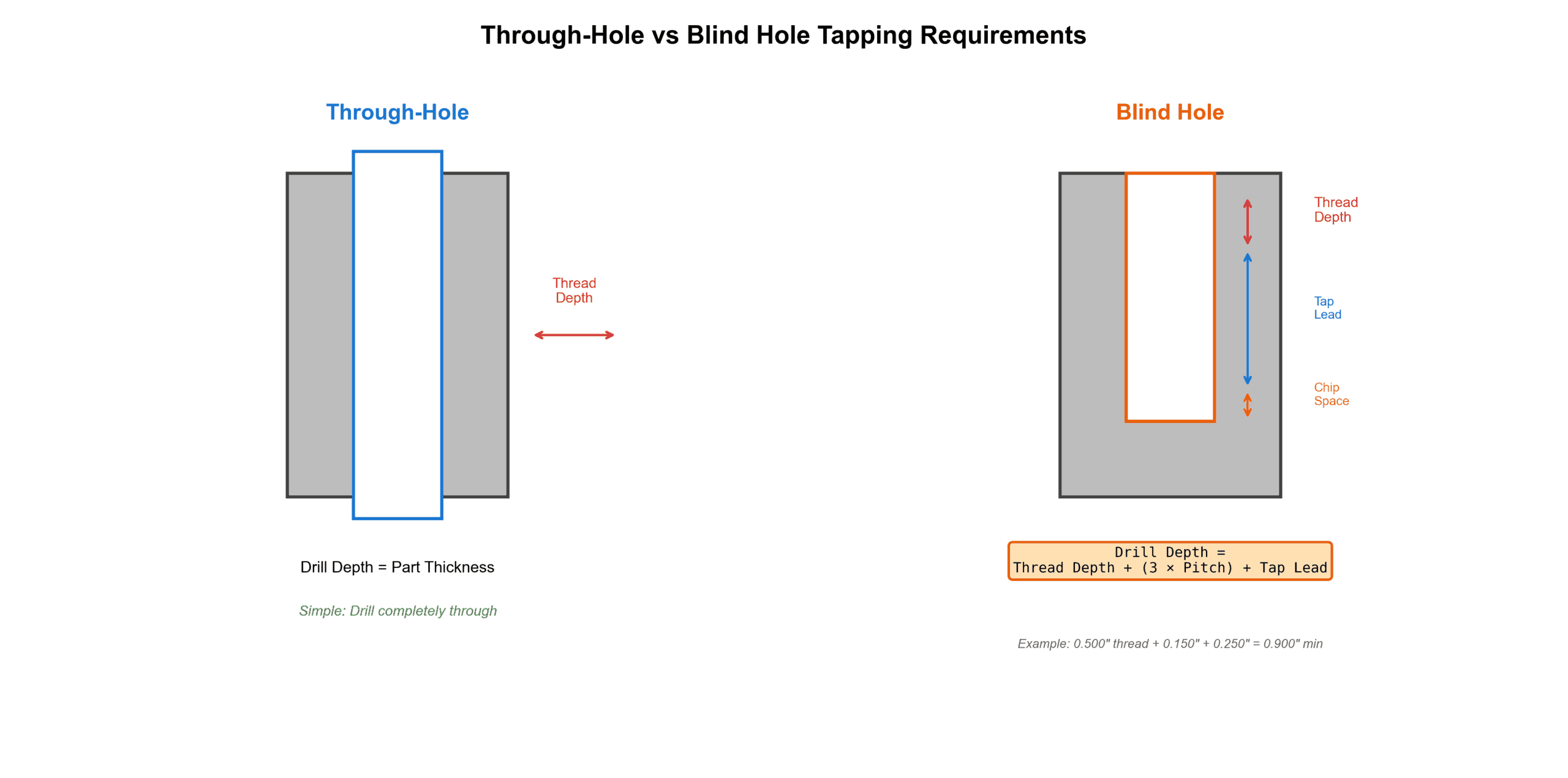
- Hole Type and Depth: Through-hole or blind hole with thread depth
- Surface Finish: Zinc plated, anodized, black oxide, etc.
- Tolerances: Hole position, diameter, perpendicularity
- Quantity and Delivery: Total quantity and per-delivery batch
- Quality Requirements: Thread gauge inspection, functional tests
- Technical Drawing: Dimensioned drawing with GD&T callouts
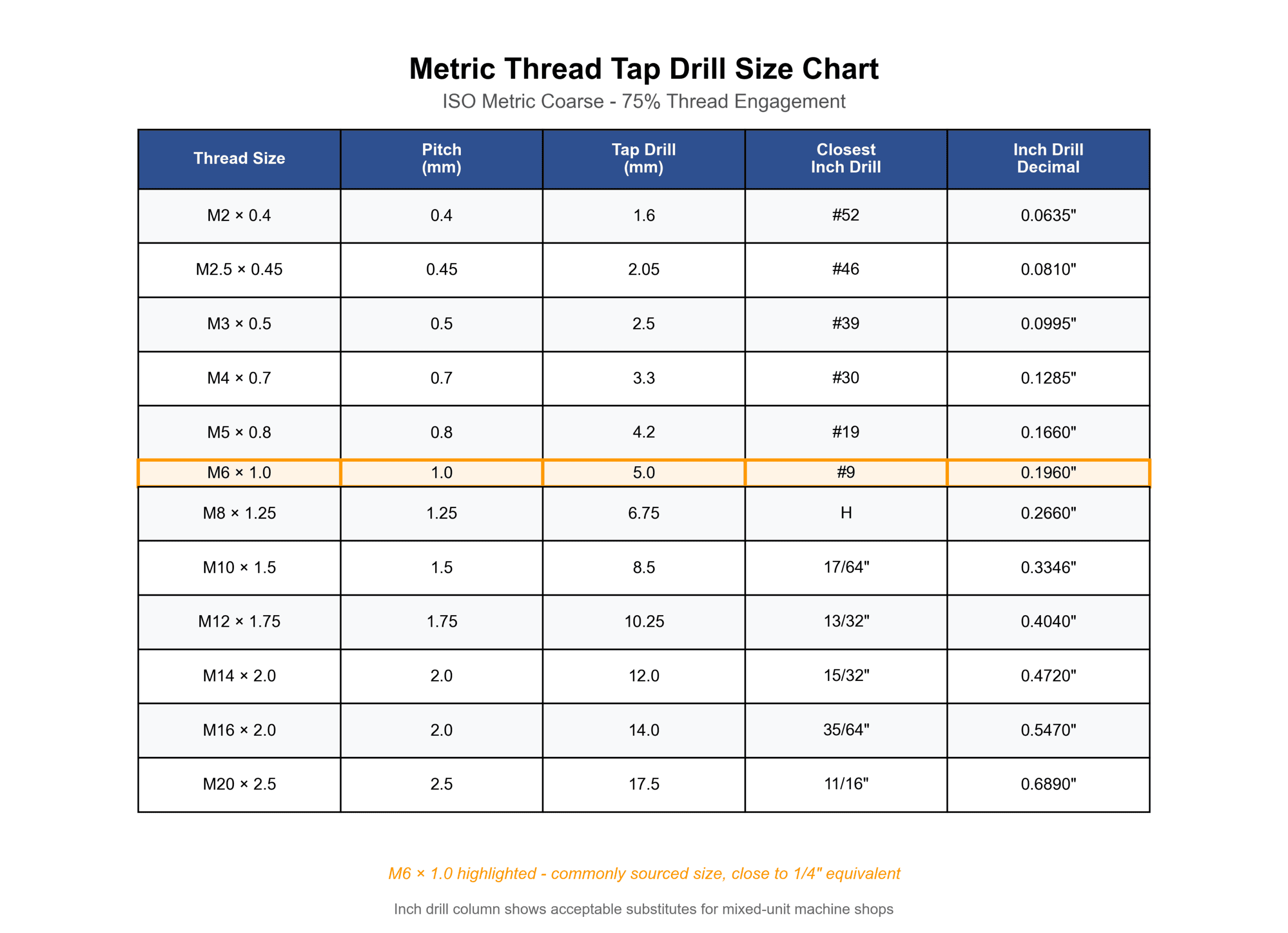
Tap Drill Size for Metric Threads
For global sourcing or metric-dimensioned products, use these tap drill sizes based on ISO standards:
Frequently Asked Questions
Q: Can I use a 13/64″ drill instead of #7 for 1/4-20 threads?
A: No. 13/64″ equals 0.2031″, which is 0.0021″ larger than the specified #7 (0.201″). This reduces thread engagement from 77% to approximately 72%. While this is above the 60% minimum, it weakens the connection by about 8%.
Q: What if I don’t have the exact tap drill size?
A: Use the next smaller size—never the next larger. For example, if you don’t have a #7 drill (0.201″), use a #8 drill (0.199″) rather than #6 (0.204″).
Summary
Selecting the correct tap drill size directly affects thread strength, assembly reliability, and production efficiency. For 1/4-20 threads in steel, a #7 drill (0.201″) creates the industry-standard 75% engagement—strong enough to exceed the fastener’s capacity while remaining practical to tap.
Need custom screws, fasteners, or precision-threaded components manufactured to your specifications? Send us your technical drawing, material requirements, and quantity. Our engineering team reviews tap drill dimensions and recommends optimal thread engagement depths for your specific application. We manufacture DIN/ISO-compliant fasteners in strength grades from 8.8 to 12.9, with IATF 16949 quality certification and OEM-volume capability.