 English
  German
  Spanish
  Portuguese
  French
  Japanese
  Arabic
  Korean
  Vietnamese
  Russian
 Fasteners brass usually means brass fasteners chosen for conductivity, appearance, machinability, and moderate corrosion resistance in electrical, decorative, and light industrial assemblies.
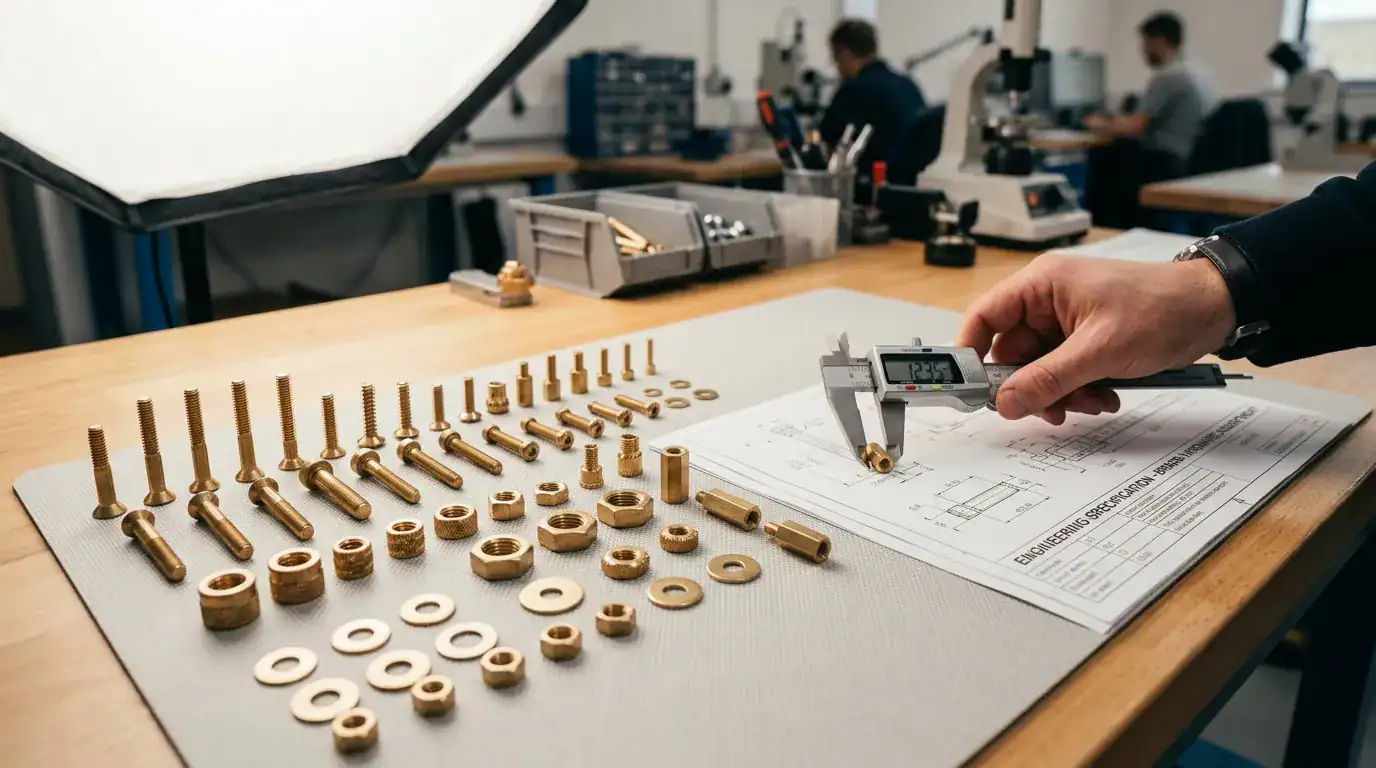
If you typed fasteners brass into Google, you probably did not mean paper brads from a craft store. You meant brass fasteners for real hardware work: screws, bolts, nuts, washers, inserts, terminals, and visible fittings where corrosion behavior, conductivity, finish, and machinability all matter.
That mismatch is exactly why the current search results are weak. The top results for fasteners brass are either pure product grids or pages that drift into paper fasteners, retail listings, or generic hardware copy. They do not explain how industrial buyers actually use brass, where brass beats stainless or plated steel, how alloy choice changes performance, or what should be written into a purchase order before production starts.
This guide closes those gaps. It explains what fasteners brass really means in industrial procurement, which brass fastener families are worth specifying, how material and finish decisions affect cost and failure risk, where brass belongs in production, and how to buy with fewer quoting mistakes. It also covers the angles competitors miss: conductivity-driven applications, material standards, galvanic pairing, decorative and architectural fit, and the difference between solid brass and brass-plated hardware.
What does fasteners brass actually mean?
Fasteners brass usually means brass fasteners made from copper-zinc alloys, not a single product type.
The phrase fasteners brass is awkward English, but it shows up in RFQs, import catalogs, search logs, and distributor filters. In practice, buyers use it as shorthand for a family of hardware made from brass or marketed under brass categories. That family often includes:
- Brass screws
- Brass machine screws
- Brass nuts
- Brass bolts and studs
- Brass washers
- Brass threaded inserts
- Brass standoffs and spacers
- Brass terminals and specialty conductive fittings
That is the first gap in the search results. Competitor pages talk about “brass products” or “brass hardware” without telling the reader that fasteners brass is not one SKU. It is a material-driven buying category.
According to the Copper Development Association’s overview of brasses, brasses are copper-zinc alloys known for good strength and corrosion resistance, with properties that shift as zinc content rises. That matters because fasteners brass is selected for a mix of workability and service behavior, not just for color.
We have found that buyers usually land on fasteners brass for one of four reasons:
- They need a non-ferrous fastener for electrical or magnetic considerations.
- They need a visible fastener with a warmer decorative finish than stainless steel.
- They need easy machining for inserts, terminals, or precision turned parts.
- They need moderate corrosion resistance in indoor or mildly humid service.
Short version: fasteners brass is a buying category shaped by application physics.
Why the keyword is confusing
The keyword fasteners brass is confusing because retail search results mix industrial brass hardware with office, craft, and decorative items.
The competitor set proves the problem. One result is a catalog page. Another is a generic retail assortment. Another goes off into paper fasteners. None of them explain how a plant engineer, sourcing manager, OEM designer, or architectural hardware buyer should evaluate fasteners brass.
That is why this article takes a more useful route:
- It sorts the product families first.
- It distinguishes solid brass from plated steel.
- It explains material tradeoffs before selling applications.
- It treats fasteners brass as an engineering and procurement decision, not a color preference.
Brass fasteners vs brass-plated fasteners
Solid brass fasteners and brass-plated steel fasteners should never be treated as interchangeable.
This is one of the costliest mistakes in fasteners brass procurement. A quote that says “brass finish” may mean appearance only. A quote that says “solid brass” means the underlying alloy itself is brass.
| Product style | Base material | Why buyers choose it | Main limit |
|---|---|---|---|
| Solid brass fasteners | Brass alloy throughout | Conductivity, machinability, non-ferrous behavior, authentic finish | Lower strength than many alloy-steel fasteners |
| Brass-plated steel fasteners | Steel core with brass coating | Low cost and brass appearance | Coating wear, corrosion once plating is damaged |
| Brass inserts and turned parts | Usually brass bar stock | Precision machining, thread quality, reliable electrical contact | Not ideal for high-load structural joints |
| Decorative brass hardware | Brass or plated steel depending spec | Visible hardware and furniture aesthetics | Must confirm substrate before buying |
If your requirement involves current flow, corrosion behavior after wear, or thread cutting in soft polymers, fasteners brass usually means solid brass. If the only requirement is the look, plated parts may be acceptable. That distinction should appear in the PO line, not as an afterthought in email.
Types of fasteners brass products and where each fits
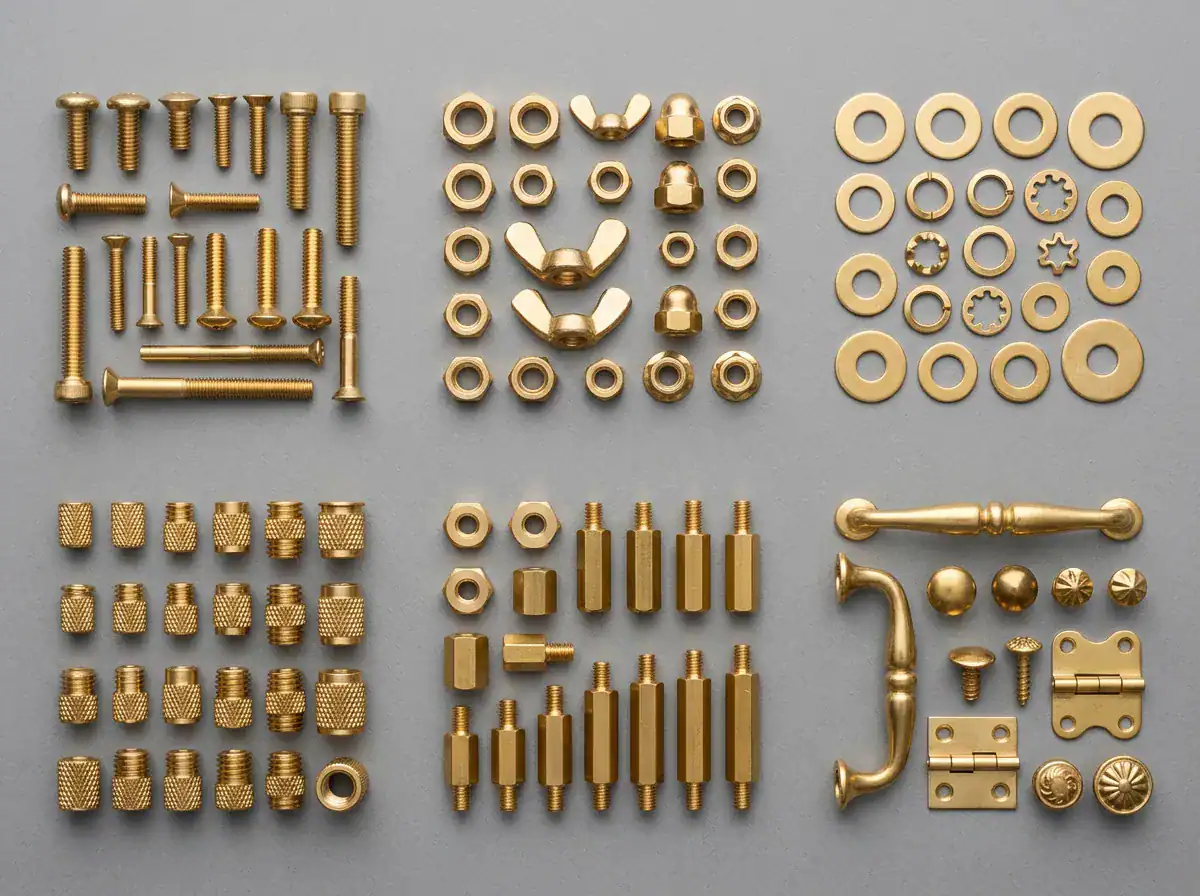
The main fasteners brass categories are screws, nuts, washers, inserts, studs, and decorative hardware, each with very different job roles.
The top results do not give a usable taxonomy, so start there. A good fasteners brass decision begins by asking what the joint is doing, not what the catalog thumbnail looks like.
Brass screws
Brass screws are the most common fasteners brass products for visible assembly, electrical hardware, and light-duty corrosion-sensitive work.
Typical subtypes include:
- Machine screws for terminals, covers, control panels, and small assemblies
- Wood screws for furniture, joinery, cabinets, and architectural trim
- Self-tapping or thread-forming designs for light sheet or molded components
- Decorative screws where appearance matters as much as retention
Brass screws are especially useful when the hardware stays visible or when the part mates with copper-rich electrical components. For a related material breakdown, our guide to do brass screws have more copper than zinc explains why brass composition affects workability and finish.
In practice we do not recommend brass screws for every job. They are a poor default for high-torque structural tightening, impact loading, or joints that will see abuse from rough drivers. Brass can deform more easily than hardened steel, and small brass drive recesses are easier to cam out if installation discipline is poor.
Brass nuts, washers, and spacers
Brass nuts, washers, and spacers are often chosen to complete non-ferrous assemblies or to control contact, spacing, and appearance.
This is where fasteners brass becomes more than a screw conversation. Nuts and washers matter when:
- You want a fully non-ferrous stack
- You need matching visible hardware
- You need softer bearing behavior against finished surfaces
- You need moderate corrosion resistance without switching the whole assembly to stainless
Our existing guide to brass washers is useful here, especially when the decision is really about bearing area, sealing support, or preventing surface marking rather than just “buying brass hardware.”
Brass threaded inserts and terminals
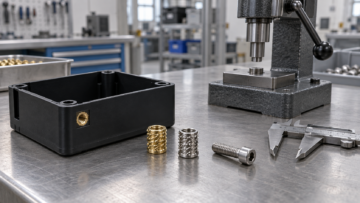
Brass threaded inserts are one of the most technically valuable fasteners brass products because they combine precise machining with reliable thread quality in plastics and softer materials.
This angle is missing from the current competitors. Many buyers searching fasteners brass are not really shopping for a bolt or a nut. They need:
- Heat-set threaded inserts for plastics
- Knurled inserts for molded components
- Captive electrical terminals
- Precision turned brass standoffs
Brass is favored here because it machines cleanly and holds tolerances well. According to Copper.org’s conductivity discussion for brass, copper-30% zinc brass is widely used in connectors and has conductivity around 28% IACS. That is a practical reason many electrical and connector-related fasteners brass components stay in brass instead of switching to generic plated steel.
Brass studs, bolts, and custom turned parts
Brass studs and bolts are more niche than brass screws, but they matter in terminals, instrument hardware, marine-adjacent assemblies, and custom architectural fittings.
When the search term fasteners brass is coming from a B2B sourcing workflow, it often includes custom turned parts with threads, such as:
- Brass terminal studs
- Brass machine bolts
- Brass thumb screws
- Brass knurled nuts
- Brass standoffs
- Brass sensor or instrument fittings with threaded retention features
That means the material decision may be tied to machining yield and surface finish as much as to the final assembly function.
Quick selection table
A fasteners brass shortlist should start with product family, not with diameter.
| Fasteners brass type | Best use case | Main advantage | Main caution |
|---|---|---|---|
| Brass machine screws | Electrical hardware, covers, visible equipment | Conductive, neat finish, non-ferrous | Not for high preload joints |
| Brass wood screws | Furniture, trim, decorative joinery | Attractive finish, easy matching | Can shear or strip if over-driven |
| Brass nuts and washers | Complete non-ferrous stacks, visible hardware | Finish consistency and softer bearing surface | Need correct strength expectations |
| Brass inserts | Plastics, molded parts, terminals | Precision machined threads, repeatable installation | Application-specific geometry required |
| Brass studs and turned fasteners | Instrument hardware, connectors, custom assemblies | Excellent machinability and finish | Often require custom production |
Brass grades, properties, and material tradeoffs
The right fasteners brass grade depends on zinc level, machining needs, corrosion exposure, conductivity requirements, and how much mechanical load the joint must carry.
This is the area most competitors barely touch. They sell the category without explaining the material logic. That makes the buyer more likely to order the wrong thing.
Common brass alloys used in fasteners brass
Fasteners brass commonly uses yellow brass, cartridge brass, free-cutting brass, naval brass, or silicon brass depending the application.
The exact grade depends on whether the part is cold formed, machined from bar stock, or exposed to a harsher environment. Common examples include:
- Cartridge brass / C260 for good ductility and formability
- Yellow brass / C270 or similar families for general-purpose brass hardware
- Free-cutting brass / C360 for machined inserts, nuts, and turned parts
- Naval brass / C464 where improved resistance to dezincification is needed
- Silicon brass for some corrosion-sensitive and architectural hardware
The Copper Development Association’s brass microstructure guide notes that brasses containing up to about 35% zinc are single-phase alpha alloys with good strength, ductility, and cold workability. For fasteners brass, that means alloy family selection is not cosmetic. It affects whether the part is better suited to forming, machining, decorative finishing, or field durability.
Conductivity and electrical use
Fasteners brass is often chosen in electrical products because it balances conductivity with strength and manufacturability better than many alternatives.
Pure copper conducts better, but it is often too soft for threaded hardware. Steel is stronger, but it conducts far worse and changes corrosion behavior when paired with copper-rich systems. Brass sits in the middle.
According to Copper.org’s electrical and thermal conductivity reference, brass around the common copper-zinc connector range can sit at roughly 28% IACS. That is a useful number. It explains why fasteners brass remains common in terminals, switchgear subcomponents, connector hardware, and low-voltage assemblies even when it is not the strongest metal on the shelf.
Corrosion limits and dezincification
Fasteners brass resists many indoor and mild atmospheric environments well, but high-zinc brass can be a bad choice in stagnant or marine-like service.
This nuance matters. Buyers often hear “brass resists corrosion” and stop there. The more useful statement is that corrosion performance depends on alloy, moisture pattern, contaminants, and contact pairing.
According to Copper.org’s seawater guidance for copper alloys, brass alloys with more than 15% zinc can be susceptible to dezincification in seawater-related exposure unless the alloy and inhibitor package are chosen correctly. That does not mean all fasteners brass is unsafe. It means outdoor coastal, plumbing-adjacent, or chloride-rich use needs a better conversation than “brass won’t rust.”
That is where stainless often wins. If the job is washdown, salt spray, exterior enclosure hardware, or long-life outdoor clamping, fasteners brass may be the wrong answer unless the brass grade and geometry are very deliberate.
Solid brass vs stainless steel vs zinc-plated steel
Fasteners brass should be compared against stainless and plated steel by use case, not by raw material price alone.
| Material option | Where it wins | Where it loses | Best fit |
|---|---|---|---|
| Fasteners brass | Conductivity, machinability, decorative finish, non-ferrous assemblies | Lower structural strength, not ideal for aggressive corrosion | Electrical hardware, visible hardware, inserts, terminals |
| Stainless steel | Broad corrosion resistance, strong general-purpose performance | Higher cost, galling risk, colder visual finish | Outdoor hardware, washdown, marine-adjacent use |
| Zinc-plated steel | Low cost and higher strength than brass in many sizes | Coating damage exposes steel, lower conductivity, magnetic | Hidden indoor hardware and cost-sensitive assemblies |
Most guides stop at generic pros and cons. Here is the more practical takeaway: choose fasteners brass when the joint gains something specific from brass. If the only goal is “not plain steel,” you may be buying the wrong material at the wrong price.
Where fasteners brass works best in real industrial and commercial use
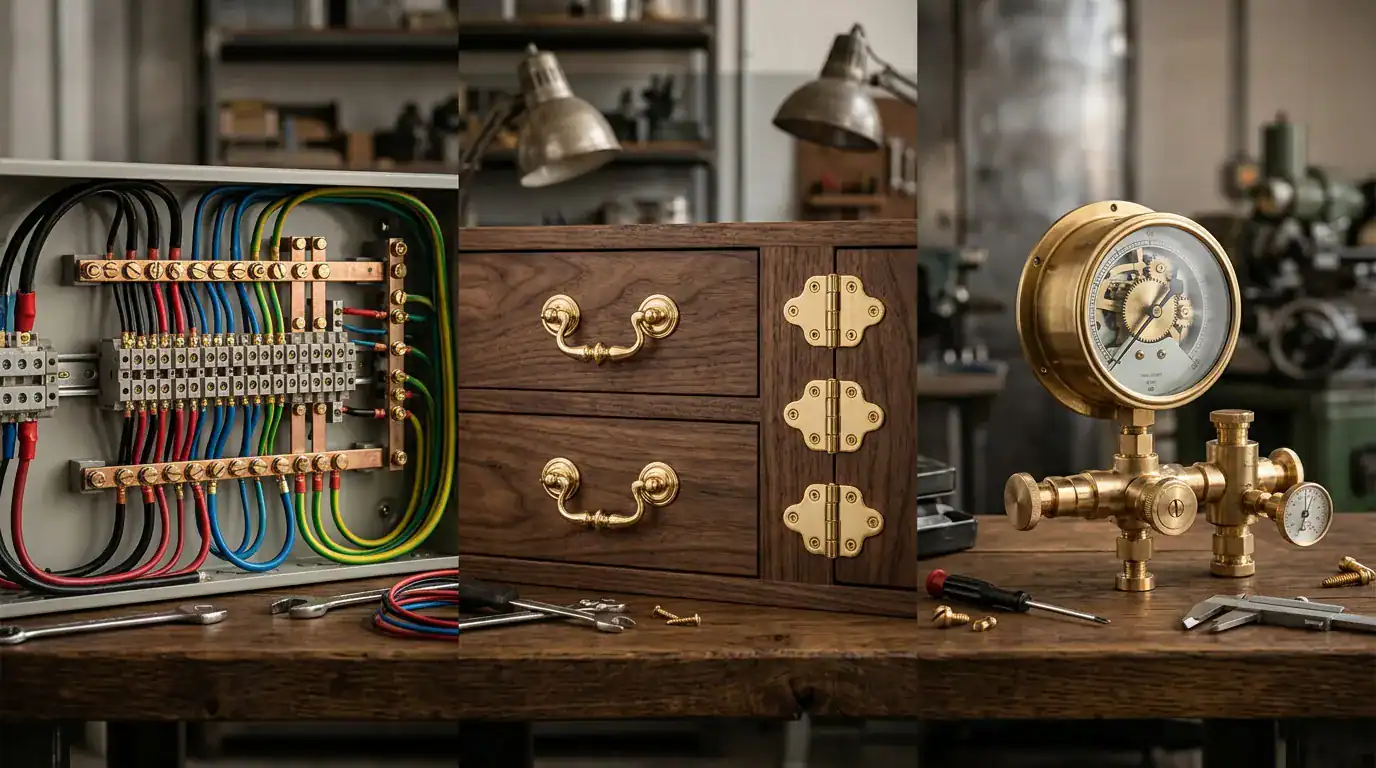
Fasteners brass works best in electrical, decorative, instrument, plumbing-adjacent, and light-duty corrosion-aware assemblies where brass solves a specific problem.
Brass is not the universal fastener material. That is exactly why it is valuable. It wins where its property mix is relevant.
Electrical and electronics assemblies
Fasteners brass is strong enough for many terminals and covers while staying non-ferrous and acceptably conductive.
Typical uses include:
- Terminal screws
- Busbar-adjacent hardware
- Connector hardware
- Panel assemblies
- Lighting fixtures
- Sensor and instrument fasteners
In practice we see fasteners brass chosen when current path, signal integrity, or corrosion compatibility matters more than maximum clamp load. The material is also easier to machine into small precise features than many stainless grades, which helps for low-volume custom hardware.
Decorative and architectural hardware
Fasteners brass is a natural fit for visible hardware because the finish reads as intentional rather than purely utilitarian.
This includes:
- Cabinet hardware screws
- Furniture connectors
- Signage hardware
- Decorative trim screws
- Retail fixture fasteners
- Restoration and heritage-style hardware
If appearance is the lead requirement, fasteners brass often competes not just with stainless steel, but with plated steel trying to imitate brass. We usually advise buyers to decide early whether the part needs real brass behavior or only a brass look. That one decision changes the entire sourcing strategy.
Plumbing-adjacent and instrument hardware
Fasteners brass is widely used around fittings, valves, gauges, and access covers when machinability and moderate corrosion behavior matter.
This does not mean every wet system should use brass fasteners. It means brass often works well in low-to-moderate exposure environments where precision threads, clean machining, and compatibility with brass bodies or fittings are useful.
The Wikipedia overview of brass fasteners is not a technical standard, but it captures the broad historical reality: brass hardware has stayed common because it combines appearance, corrosion behavior, and workable strength in a way that steel and copper do not.
Antimicrobial touchpoints and specialty public hardware
Fasteners brass can support antimicrobial design strategies in selected touchpoint and public-contact hardware.
This angle is almost never mentioned in competing content. According to Copper.org’s antimicrobial properties reference, over 400 copper alloy compositions have been registered with the U.S. EPA for public health claims relating to antimicrobial performance. That does not turn every fasteners brass part into a medical solution, but it does explain why brass and other copper alloys stay relevant in public hardware, handles, fixtures, and selected shared-contact environments.
The practical bottom line is narrower: if the assembly already benefits from brass for appearance or corrosion reasons, antimicrobial positioning can be a useful supporting advantage. It should not be the only purchasing argument.
How to choose fasteners brass for procurement and design
Fasteners brass should be chosen by function, alloy, substrate, finish expectation, and environment before price comparison begins.
This is where the article needs to outperform the competitors. Product grids help once you know what to buy. They do not help you decide whether fasteners brass is right in the first place.
Start with the failure mode, not the catalog
The best fasteners brass choice comes from defining what failure would look like in the actual assembly.
Ask these questions first:
- Will the part be visible?
- Does it need to conduct current or stay non-magnetic?
- Is the hardware going into wood, metal, plastic, or a mixed stack?
- Will installers use hand tools, power drivers, or torque tools?
- Is the environment dry indoor, humid indoor, outdoor, or chloride-heavy?
- Is solid brass required, or only a brass finish?
If the likely failure is stripped drive recess, plated corrosion, thread galling, or decorative mismatch, fasteners brass may solve the problem better than steel. If the likely failure is tensile overload or vibration-driven preload loss in a structural joint, brass may not be your material at all.
Procurement checklist for fasteners brass
A fasteners brass RFQ should define more than size and finish if you want comparable quotes.
| RFQ field | What to specify | Why it matters |
|---|---|---|
| Product family | Screw, nut, washer, insert, stud, standoff | Prevents apples-to-oranges quotes |
| Material | Solid brass alloy or brass-plated steel | Avoids false equivalence |
| Thread standard | Metric, UNC, UNF, wood thread, custom insert form | Controls fit and installation |
| Finish expectation | Bright brass, natural brass, passivated, antique brass, plated look | Prevents appearance disputes |
| Use environment | Indoor dry, humid indoor, exterior, electrical, marine-adjacent | Screens out wrong grades |
| Substrate | Wood, metal, plastic, terminal block, architectural fixture | Changes geometry and alloy choice |
| Performance note | Conductive, decorative, non-ferrous, custom machined, visible face | Helps supplier optimize the right part |
We have seen buyers save days of back-and-forth by writing “solid brass machine screw for visible electrical terminal use” instead of just “brass screw M4.” The second line invites guessing. The first line gives context.
Common mistakes when buying fasteners brass
Most fasteners brass buying mistakes come from treating brass as a finish label instead of a material decision.
The repeat offenders are predictable:
- Ordering brass-plated steel when solid brass was required
- Using brass wood screws with aggressive impact driving
- Choosing brass for outdoor chloride exposure without checking alloy
- Ignoring galvanic pairing with adjacent metals
- Assuming every brass fastener family has the same strength behavior
- Forgetting that inserts and turned parts may need a different brass grade than formed screws
Here is where it gets nuanced: fasteners brass often looks forgiving because the hardware is small, polished, and easy to handle. The risk is that small parts get underspecified precisely because they feel simple.
Galvanic pairing and mixed-material assemblies
Fasteners brass in mixed-metal assemblies should be checked for galvanic compatibility before the drawing is frozen.
This is another missing competitor angle. Buyers often think only about the brass part itself. They forget the stack:
- Brass against stainless
- Brass against aluminum
- Brass in copper-rich electrical systems
- Brass near wet steel structures
If the joint will stay dry, the risk may be small. If the joint lives in humidity, condensation, or outdoor contamination, galvanic effects can become real. That is why fasteners brass tends to do best where the material pairing is either already brass-friendly or the environment is controlled.
Installing and handling fasteners brass without damage
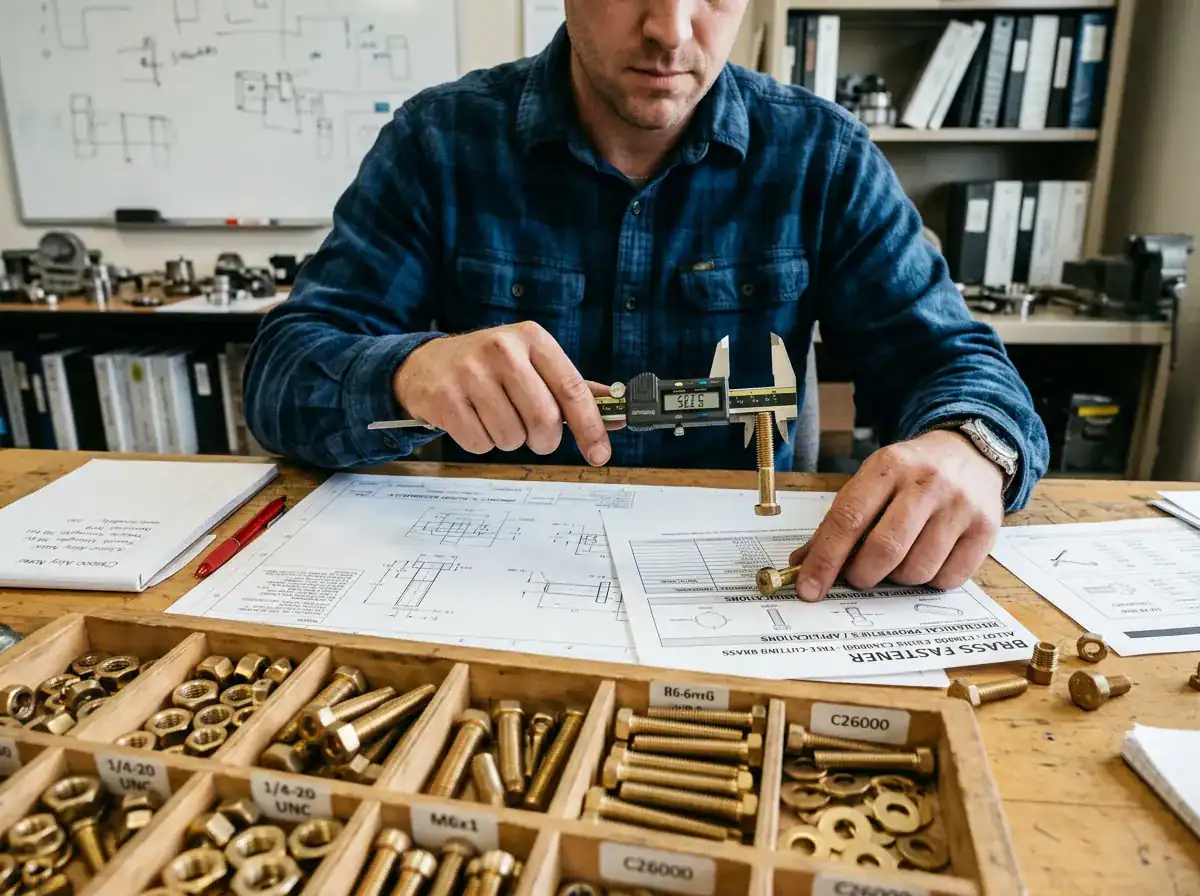
Fasteners brass should be installed with lower-force discipline, clean threads, and realistic torque expectations because brass is more easily damaged than hardened steel.
Searchers often want a buying guide. They also need installation guidance because poor handling creates returns that get blamed on the supplier.
Avoid over-driving and recess damage
Brass screws fail early when installers drive them like hardened steel fasteners.
That sounds basic. It is not basic on a production floor. With fasteners brass, small mistakes show up fast:
- Driver cams out
- Slot or cross recess deforms
- Threads seize in misaligned entry
- Shank twists in small wood screws
In practice we often recommend one of two methods for visible brass screw work:
- Drive a matching steel setup screw first to cut or confirm the path.
- Finish with the brass screw by hand or with controlled low torque.
That extra step is not overkill. It reduces scrap, preserves finish, and keeps fasteners brass from being judged unfairly against a job it was never meant to perform like hardened steel.
Keep threads clean and aligned
Fasteners brass performs best when the mating path is clean, straight, and burr-free.
This matters for inserts and machine screws especially. Brass is forgiving in machining, but the installed part still needs good thread engagement. Misalignment that a stronger steel fastener might bully through can permanently damage a brass thread.
For molded parts and inserts, we usually insist on confirming:
- Hole diameter
- Heat-set conditions if relevant
- Knurl style
- Pull-out direction
- Insertion depth
The spec sheets rarely mention this, but a brass insert problem is often a hole-prep problem.
Storage and finish handling
Fasteners brass should be stored and handled like finish hardware, not like anonymous bulk steel fasteners.
If the visible finish matters:
- Use clean packaging
- Prevent mixed-bin scratching
- Separate natural brass from plated look-alikes
- Keep oily fingerprints off polished hardware before final install
This matters more than many buyers expect. A large share of “bad brass hardware” complaints are really packaging, abrasion, or handling issues after production.
Future trends for fasteners brass in 2026 and beyond
In 2026, fasteners brass demand is growing most where design value, electrical function, and custom machining matter more than pure commodity pricing.
The current SERP barely touches trend direction. That is another opportunity gap.
More split between commodity and engineered fasteners brass
Fasteners brass is splitting into low-cost decorative commodity hardware and higher-value engineered custom parts.
We see two clear lanes:
- Commodity visible hardware for furniture, fixtures, and retail packaging
- Higher-spec brass inserts, terminals, spacers, and machined threaded parts for electrical and instrument use
That split is important because the word fasteners brass covers both lanes, but the supplier base is not the same. One is catalog-heavy. The other is drawing-heavy.
More demand for brass alternatives only where brass adds no real value
Brass is holding its ground when it solves conductivity, finish, or machinability problems, and losing ground where buyers only wanted a premium look.
That means:
- Plated steel will keep competing on appearance-only jobs
- Stainless will keep taking outdoor and aggressive-corrosion jobs
- Brass will stay strong in terminals, inserts, decorative visible hardware, and custom machined components
This is the clearest strategic takeaway for fasteners brass buyers in 2026: keep brass where brass earns its place. Replace it only when the property advantage is no longer relevant.
Better specifications will outperform larger catalogs
The fasteners brass suppliers that win in 2026 are the ones who can translate a vague brass request into a clean manufacturable specification.
That is why content still matters. Buyers searching fasteners brass are often at the confusion stage before they reach a clean RFQ. A useful article can bridge that gap faster than another product wall.
FAQ about fasteners brass
These questions cover the parts of fasteners brass selection that buyers, designers, and sourcing teams usually need answered quickly.
What does fasteners brass mean in product search?
Fasteners brass usually means brass fasteners grouped by material rather than one exact part. The phrase normally covers screws, nuts, bolts, washers, inserts, standoffs, and similar hardware made from brass or sold in brass categories. The practical bottom line: define the product family before you request a quote.
Is fasteners brass the same as solid brass hardware?
Not always, because some fasteners brass listings are solid brass and others are only brass-plated. That difference changes corrosion behavior, wear life, conductivity, and price. The practical bottom line: if the material matters, write solid brass in the RFQ and confirm the alloy.
Are fasteners brass good for outdoor use?
Fasteners brass can work outdoors in mild service, but chloride-rich or marine-adjacent environments need careful alloy and design review. Brass is not automatically the best outdoor hardware. The practical bottom line: choose brass outdoors only when you can justify the alloy and environment fit.
Why are fasteners brass popular in electrical hardware?
Fasteners brass stays popular in electrical hardware because brass balances conductivity, machinability, and practical thread strength. Pure copper is softer, and steel is far less conductive. The practical bottom line: brass is often the right compromise for terminals, inserts, and connector-related hardware.
Can fasteners brass replace stainless steel fasteners?
Fasteners brass can replace stainless only in selected assemblies, not as a universal substitute. Brass may win on finish, conductivity, or non-ferrous behavior, while stainless usually wins on broad corrosion resistance. The practical bottom line: compare by application, not by appearance.
What is the biggest buying mistake with fasteners brass?
The biggest buying mistake is confusing solid brass with brass-plated steel. That error changes durability, corrosion path, conductivity, and true value. The practical bottom line: separate brass material from brass finish every time.
When should fasteners brass be custom manufactured?
Fasteners brass should be custom made when standard catalog geometry cannot meet the thread, finish, or functional requirements. This is common for inserts, terminals, decorative visible hardware, and precision turned threaded parts. The practical bottom line: custom brass hardware pays off when tolerance, appearance, or electrical function cannot be compromised.
Conclusion
Fasteners brass is not a vague retail keyword once you translate it properly. It is a practical material category covering brass screws, nuts, washers, inserts, studs, and custom machined hardware chosen for conductivity, appearance, machinability, and controlled corrosion behavior.
The best way to buy fasteners brass is to stop treating brass as a color and start treating it as a specification decision. Define whether you need solid brass or plated steel, pick the right product family, check the service environment, and write the function into the RFQ. For related selection work, continue with our guides to metal fasteners, brass composition in screws, brass washers, and decorative screws.
Related Products
Solutions & Cluster
Related Articles
- Self Locking Nut: Types, Working Principles & Selection Guide
- What Is a Screw? The Complete Guide to Types, Uses & Selection for Production
- What Is a Screw and Nut — and Why Does the Pairing Matter
- Bolt Nut Stainless Steel: Grades, Pairing, and Buying Guide
- Plastic Spacers: Complete Guide to Types, Materials & Selection
- Top Silicon Bronze Bolts for Durable and Reliable Fastening Solutions
- Nut vs Bolt: Complete Comparison Guide and Industry Applications (2026 Edition)
- How Do You Use a Rivet Gun? Step-by-Step Guide for Clean, Strong Blind Rivets